


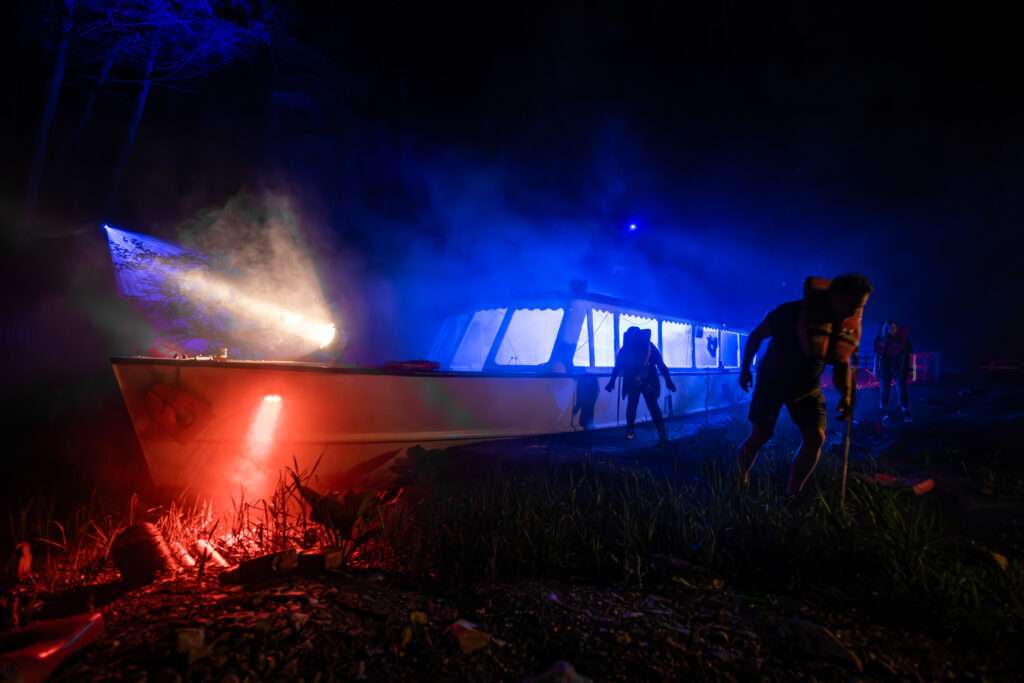
Moment Factory joined forces with Dells Boat Tours for a major multimedia transformation of the classic Wisconsin Dells fright attraction
interview by Martin Palicki
Though perhaps best known in the attractions world for its multitude of waterparks, the Wisconsin Dells offers vast natural appeal as well. Carved out of sandstone as glaciers melted thousands of years ago, the landscape is picturesque and serene.
Coldwater Canyon is one of these scenic destinations in the Dells that hosted tourists from the 1940s-1970s. Dells Boat Tours® featured the canyon for several decades as one of three exclusive shore landings on their Upper Dells tour, and later expanded their scenic tour offerings with Original Wisconsin Ducks® (amphibious vehicles), Jet Boat Adventures and a Sunset Dinner Cruise. In 2010, the Dells Boat Tours team decided to reopen Coldwater Canyon for a new haunted nighttime experience, and Ghost Boat was added to their portfolio.
The first iteration of the haunted attraction was themed to an 1800s settlement. In 2023, Dells Boat Tours felt it was time to reinvent the experience and upgrade the technology. At that time, Moment Factory was working with the nearby Wilderness Resort on developing Aquavia Lumina [See InPark issue #106]. The Ghost Boat crew reached out to Moment Factory, who were excited to take on the project.
Just in time for summer 2025, the revamped seasonal attraction reopened with an entirely new storyline, a vastly enhanced AV package, new media and scenic props that will surprise both new and returning guests.
The experience starts with approximately 75 guests boarding a boat for a short ride to Coldwater Canyon landing, recently reopened for tours after having been shuttered for decades. The boat captain invites the passengers on a night ride that might not go as planned, and an eerie atmosphere sets the stage for the story and hints at the sinister forces that lie ahead.
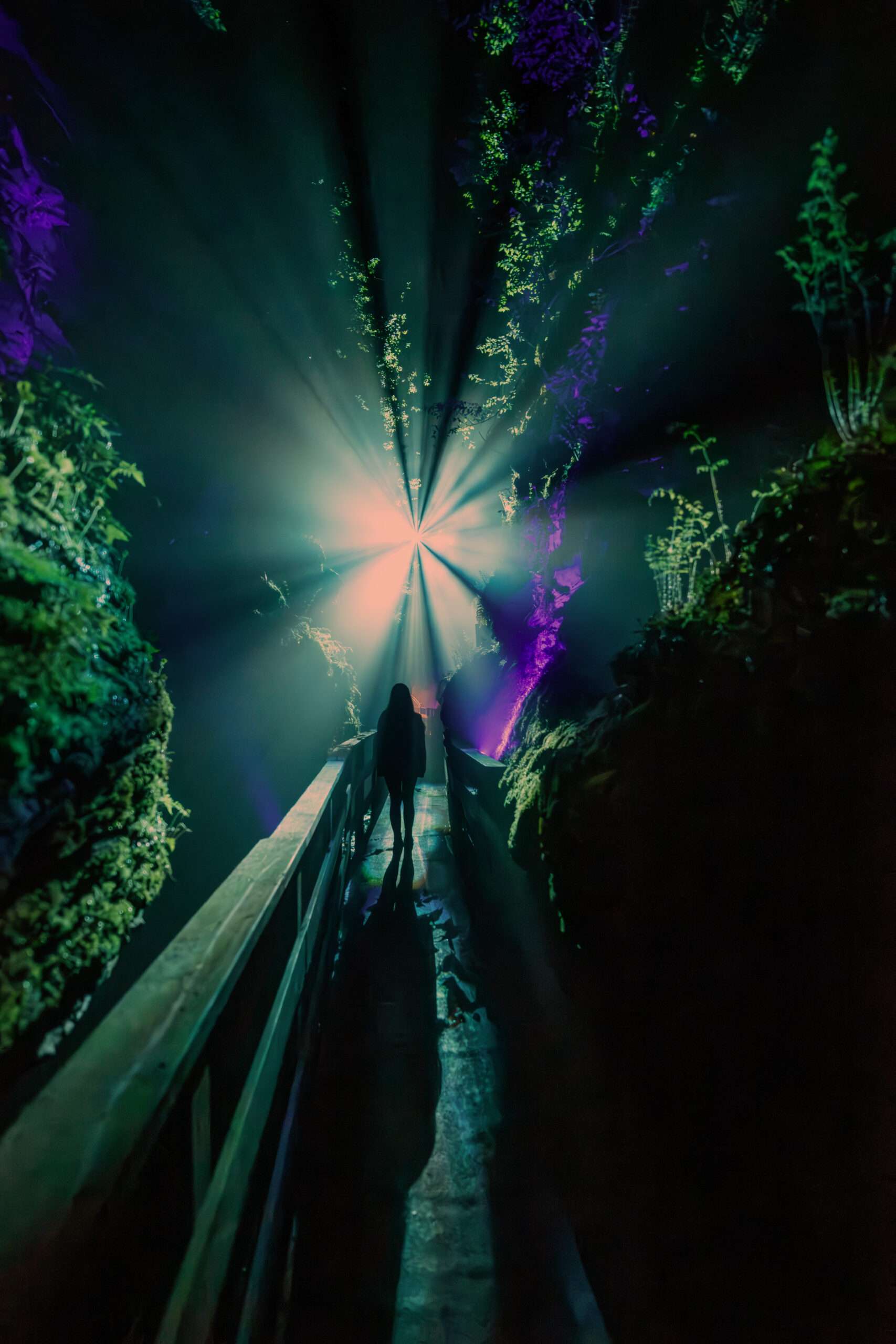
Once on land, guests find the canyon frozen in time, with signage, audio, and scenery reflecting a mid-century aesthetic. As they approach the canyon, they notice something mysterious has happened to another tour boat, and they proceed single file into the passage. Along the pathway, unsettling encounters and sinister surprises await, brought to life by live actors through a combination of physical and digital elements, featuring dynamic lighting, eerie video projections, timed “scare moments,” and immersive spatial audio.
At the end of the canyon the entire group is gathered while projections on the canyon walls help clarify what kind of sinister creature has been causing all the problems. Small groups are then sent back down through the canyon, which has been transformed through lighting, audio and talented scare actors. After (hopefully) escaping unscathed, guests board a boat for the return trip.
For more information on the attraction upgrade, InPark spoke with Moment Factory’s Virginie Valastro, Producer on the project, and Emil Bertalot, Communications Director for
Dells Boat Tours. Virginie Valastro joined Moment Factory over seven years ago, after accumulating more than 25 years of experience in the entertainment industry. She has explored many facets of storytelling across television, film, animation, multimedia, and web, working as a production manager, line producer, and producer. Emil Bertalot started his career in the Dells while a college student, driving one of the Original Wisconsin Ducks. He continued with the company in several roles and assisting in many projects, including developing the first iteration of Ghost Boat.
Virginie Valastro, Producer, Moment Factory
What was your scope of work?
Initially our scope was to work with the existing storyline and enhance specific zones within the experience As we talked more with their team, we brought more ideas to the table and they were excited. It evolved into a big brainstorm of ideas which led us to not only change the storyline but also incorporate multimedia throughout the path.
What was the experience like when you started the project?
The bones of the experience were solid, the scare actors were great and the flow of the experience worked. The challenge was more on the operational behind-the-scenes side. Workers would have to turn lights on and off manually and none of the systems were connected. We all thought there were plenty of opportunities to enhance the technology, choreograph lighting and audio scenes and utilize more multimedia.
How did your two teams work together?
Our teams were truly integrated throughout the ideation, development and production process. Emil has been a creative director there for over 30 years. He helped create the original attraction and he was a huge part of this update. From our perspective, this was perfect because there are many advantages to having people who know the site as well as the audience. We handled the creative and technical equipment while they took care of all the scenic and prop elements (though we did provide guidance and suggestions). It really was a two-way street where everyone was open to input.
What operational tech package did you provide them?
We didn’t want the technology to add a burden on their teams or require a technical director every night, so we developed a programming timeline on an off-the-shelf software system that simplifies the operational process. A guide at the end of each group can trigger everything through the simple operational system. Additionally, the system is flexible and the guides can easily adjust controls based on group size and the number of groups.

What were some of the challenges of the project?
One of the constraints we quickly noticed was the canyon is very tight in many spaces and that sometimes can create a brief bottleneck of guests on the journey into the canyon. As such, we needed to be mindful to not trigger scares too often so as not to spoil it for people behind. For the return journey out of the canyon, guests are pulsed in small groups so this is less of an issue, but we still rely heavily on media, lighting, sound and scare actors to create a different, much scarier experience going out versus going in.
This is your first foray into haunt. How did you prepare for this project?
Our in-house experts include major haunted attraction fans and their knowledge contributed greatly to the project. They brought deep expertise in haunt design and a great understanding of how important illusion and timing are. The whole team, including me, has plenty of experience with our nighttime attractions, so we were able to bring a lot of that know-how into this project too.
How did you approach this project differently from other projects?
For scare experiences, timing is critical. Most of our other projects run on loops, so it was important for us to understand how to trigger effects precisely. We developed a solution we called “scare actor kits.” We created 11 of these kits that the actors could trigger with a button or foot pedal at the right moment. The scare kits utilize bright lighting and loud sounds to accentuate the actor’s movements and provide the perfect fright.
Where do you think you will take this experience in haunt?
We would love to collaborate on more projects in this area. This is a true example of how multimedia is the perfect ally to horror, showing that any environment can be transformed into an emotionally captivating immersive experience, helping to reimagine the potential of night-based offerings and boost regional tourism in meaningful ways.
Emil Bertalot, Communications Director, Dells Boat Tours
Why did you feel the need to bring in another company to help with the project?
The original Ghost Boat was developed by an internal team that I was a part of, and based on its success, I’d say we did pretty well with that first iteration. But we’re not wired to rest on our laurels; we want to give our guests the best possible experience, and we’re always open to fresh ways of doing that, whether those ideas are generated internally or externally. Moment Factory was able to help us take things to that next level. We provided them with our goals and a broad vision, and they added layers of innovative technology, blended with exceptional creativity and storytelling. That’s a rare combination of skills to find, and their talents are on full display with the reimagined Ghost Boat. The whole project is a testament to great collaboration between two teams who were very passionate about creating a unique and amazing final product.
What was the process of working with Moment Factory?
It was very collaborative. Initially we thought Moment Factory would enhance the attraction, adding new tech to a few existing scenes. We gave them a tour of the site, shared how the attraction operates and let them know we were completely open to their ideas – and they had plenty! As we worked together more, the ideas kept flowing back and forth, and we realized the potential for something bigger, a complete reimagining. They pitched us the story of the abandoned canyon tour that was reopening, a missing boat and the idea that something very bad had happened there. As they made their presentation we were all nodding our heads, realizing “Yeah, this is it!”
How did the experience change from the previous version?
In the canyon there was only rudimentary lighting and sound effects, no music soundtrack. The journey through the canyon was dimly lit to aid the scares, but it was so dark you never appreciated the sheer scale of what you were walking through. There was no change in the experience walking up and back down through the passage, other than higher intensity by the scare actors on the way out. But the canyon isn’t just a setting; it’s essentially a character in the story, and we never took full advantage of that. Now, with strategic lighting zones, sound effects and a powerful music score, the canyon has distinct moods, a personality that shifts from unnerving to terrifying. We’re leaning into the imposing strength of the canyon itself.
At the top of the canyon where guests turned around there were a few buildings themed to the original scenario, an abandoned settlement from the 1800s. We re-skinned all of those and added new props to reflect the new “shore landing abruptly abandoned in 1950” storyline and aesthetic. The older version did a projection in that space too, but it was very rudimentary.
Essentially the natural elements of the setting and the flow of guests are all the same, but what we did with them to intensify the experience, and how we tied it all together with the story, is dramatically, drastically different. The lighting and audio effects alone are a significant upgrade to what was there before.
Did you consider adding animatronics or other scare systems?
We considered it, and it might happen in the future because – spoiler alert – Ghost Boat isn’t done! We look at this as a kind of living attraction that is going to continue to grow and evolve through the years. There is some Moment Factory tech that we deliberately held off on incorporating, with an eye towards adding it in the future. In terms of complementary props, like animatronics, we’re open to it but also cautious about it – anything we add would have to be incredibly weather resistant. So there are challenges to integrating that type of technology in the canyon.

How do you think the new Ghost Boat fits into the larger Wisconsin Dells attraction landscape?
It carves out a very unique niche. Wisconsin Dells became a visitor mecca because of the amazing natural scenery along this ten-mile stretch of the Wisconsin River, and there are attractions that cater to that – boat tours and duck tours. As the area grew in popularity, entrepreneurs applied their ingenuity to new attractions that explored a variety of themes. So there are two sides to Wisconsin Dells, the natural and the man-made. But throughout the Dells’ history, there have been visionaries that have figured out ways to bring both sides together, and I give Dan Gavinski (Ghost Boat’s owner) a lot of credit for being one of them. He has an appreciation and reverence for the history and the beauty here, and also the imagination to see how it can be paired and enhanced, made even bigger and better, with thoughtful and strategic application of technology. That’s what happened with Ghost Boat. A 300-million-year-old canyon, seamlessly blended with the latest tech to create something that’s both naturally spectacular and utterly terrifying. It’s a completely unique experience. And not just for Wisconsin Dells; an attraction like this doesn’t exist anywhere else in the world.
So from that perspective, what we did here with Moment Factory absolutely fits into this tradition and legacy of Wisconsin Dells. I think our team, the Moment Factory team, and the larger attractions community here all share the same ethos: If we are going to do something, we are going to do it the right way and do justice to the total experience. That has been our secret to success. •
For more information, visit dellsghostboat.com.