


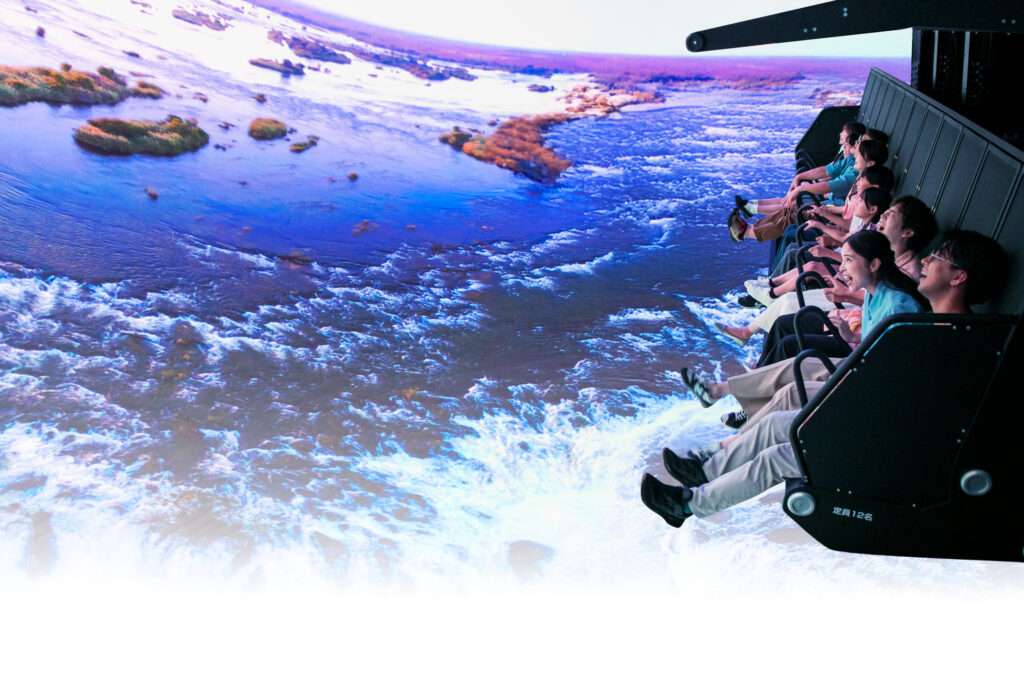
Air Cruise The Ride, Brogent’s 8K LED dome, redefines the flying theater experience
interview by Becci Knowles
A new chapter in immersive ride technology has opened at Huis Ten Bosch Theme Park in Nagasaki. On September 12, the park debuted Air Cruise The Ride, a state-of-the- art flying theater designed and delivered by Brogent. The attraction marks a major step forward for Japan’s themed entertainment market and showcases the company’s ongoing innovation in motion simulation and visual technology.

Headquartered in Kaohsiung, Taiwan, Brogent is recognized worldwide for developing cutting-edge simulation systems that blend creativity and engineering. The company’s expertise spans software and hardware R&D, manufacturing, and full turnkey attraction delivery—from concept to installation. Its team includes experienced designers, engineers, and filmmakers who share a goal of transforming imaginative ideas into physical experiences. Brogent’s work can be seen in high-profile destinations around the world, including its well- known FlyOver attractions in Canada and the United States. The company continues to push the boundaries of immersive media and ride design, adapting its proprietary simulation systems to a wide range of markets and creative concepts.
Air Cruise The Ride is located in Huis Ten Bosch’s Attraction Town area and features Japan’s first 8K LED dome screen, offering guests a seamless, high-definition journey through the skies. InPark contributor Becci Knowles spoke with Brogent’s Director of Sales & Marketing, Stefan Rothaug, about this technological milestone, the shift from projection to LED, and what it means for the future of immersive entertainment. Air Cruise The Ride is the first flying theater with an 8K LED dome screen in Japan.
Can you walk us through this installation?
Air Cruise The Ride is a true milestone as it marks the first time an 8K LED dome has been used as the main screen in a flying theater in Japan. Traditionally, these attractions have relied on projection systems, which have certain limitations in brightness, contrast, and image alignment. With the move to an 8K LED dome, we can now deliver visuals with exceptional clarity, vibrant colors, and deep contrast, creating a more lifelike and immersive experience than ever before.
For Brogent, this project is the culmination of years of R&D in LED integration. We developed patented solutions for video compression and dome structure design that enable seamless image delivery across a curved LED surface. This achievement is not only a technological breakthrough but also demonstrates that LED can serve as a viable and scalable solution for large-scale attractions.

For the industry, this installation sets a new benchmark. It shows how flying theater technology is continually evolving to deliver higher-quality visuals, lower maintenance, and greater long-term sustainability. It also opens the door to new creative possibilities, empowering parks to design more dynamic, visually stunning, and emotionally engaging experiences.
How did you work with the park to integrate Air Cruise The Ride into Huis Ten Bosch’s creative vision?
From the beginning, Huis Ten Bosch made it clear that their goal was not simply to install new technology, but to create an experience that seamlessly blended with the park’s unique identity: its European townscape, seasonal beauty, and reputation for spectacular entertainment. We worked hand in hand with their team to ensure that Air Cruise The Ride would feel like a natural extension of this vision. By combining our cutting-edge LED dome and flying theater technology with their focus on storytelling, we were able to deliver an attraction that enhances the park’s charm while introducing an entirely new dimension of thrill and immersion.
What are the main advantages of moving to LED for flying theaters?
Switching from projection to LED brings dramatic improvements in image quality and guest experience. LED provides higher brightness, superior contrast, and richer color saturation, making visuals vivid and lifelike. Guests will immediately notice sharper details and deeper blacks across the dome.
Because each pixel can be precisely controlled, content aligns perfectly with the dome’s curved geometry. This precision enhances motion and depth, synchronizing seamlessly with the ride’s movements to draw audiences into the story. The result is a realistic, dynamic, and unforgettable experience.
What were the biggest technical challenges your team faced, and how did you overcome them?
The biggest challenge was integrating LED dome control technology into the flying theater system. Unlike standard LED applications, this required perfect synchronization between hardware, software, and content to ensure a smooth, immersive experience.
We achieved this through close collaboration with our partners and by leveraging our patented video compression technology. Traditional fisheye lens systems require a great amount of bandwidth and resources, but our system intelligently delivers only necessary data, improving efficiency and reducing costs.

On the hardware side, our patented dome structure ensures seamless panel alignment without visible joins. These combined innovations – compression algorithms, structural design, and system integration – allowed us to overcome the limits of conventional LED domes. The Huis Ten Bosch project represents the first large-scale application of our integrated LED dome in a flying theater environment.
What do operators need to consider before adopting LED in a dome?
Operators should understand both the initial investment and the long-term advantages. While LED requires higher upfront costs, it offers durability, lower maintenance, and a longer lifespan than projector bulbs – reducing operational costs and downtime. LED also delivers consistently superior visuals that can enhance guest satisfaction, potentially driving repeat visitation. With precise pixel-level control, operators can also easily adapt visuals for different shows without major hardware changes.
Can you give more details about the sustainability and maintenance benefits?
Projectors require frequent lamp or laser replacements and recalibration, increasing cost, downtime, and waste. LEDs, by contrast, are more durable and energy- efficient, maintaining brightness and color over a longer lifespan. They also eliminate issues like edge blending or misalignment, reducing technical intervention. LEDs consume less energy, making them a cost-effective and environmentally responsible solution.
Do you see LED technology becoming the new standard for flying theaters worldwide, or is it best suited to certain projects?
Air Cruise The Ride showcases LED’s potential for unmatched visual quality and immersion. While not every project requires LED, it’s ideal for large-scale, high-impact attractions where brightness and clarity are critical.
We believe LED will increasingly become a preferred solution as costs decrease and technology advances. Its pixel-level control and seamless integration give designers unprecedented creative freedom. While projection will still have its place, LED is rapidly becoming the standard for projects focused on immersive storytelling.
What’s next for Brogent in immersive media and ride technology?
Looking ahead, we’re expanding LED applications into more media-based attractions, combining technology with original IPs such as Attack on Titan, Ghost Chaser, and Godzilla. This strategy aligns with the global rise of anime and the growing demand for IP-driven experiences, offering operators world- class, content-rich attractions.
We’re also introducing new ride formats for a variety of applications. The v-Ride Explorer PLUS features a 360° rotating platform and panoramic screen for high-intensity scenarios, while the o-Ride E is a compact flying theater designed for smaller venues, offering flexibility and fast installation. •