


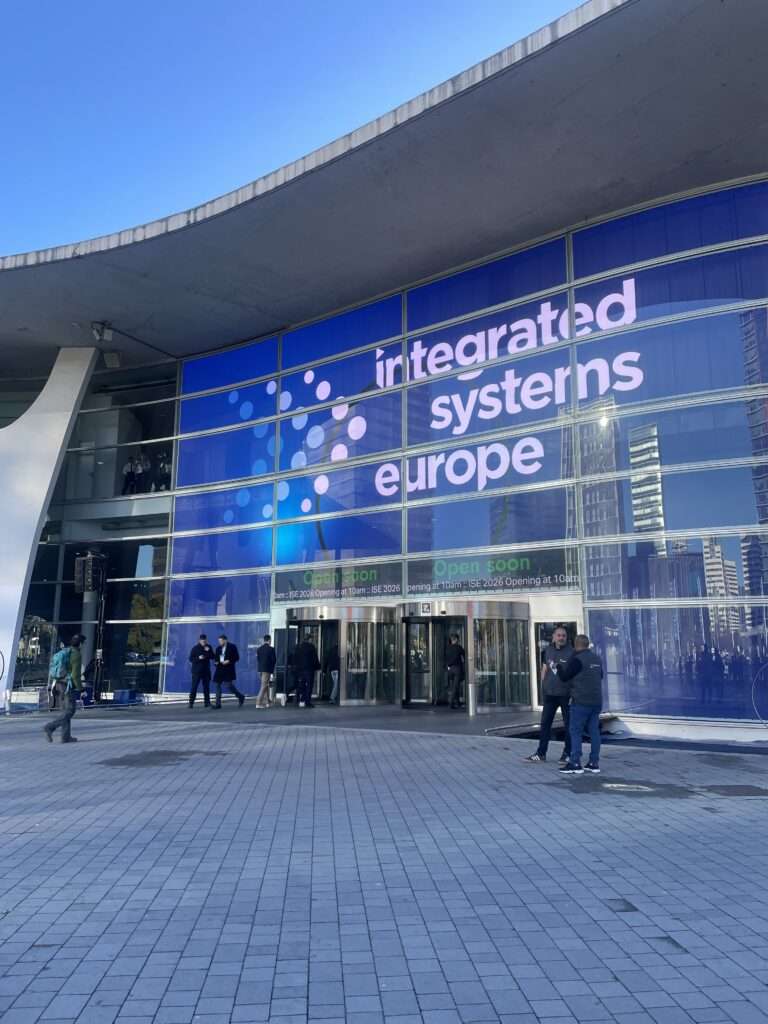
HIGHLIGHTS FROM THE SHOW FLOOR AT INTEGRATED SYSTEMS EUROPE’S 2026 SHOW IN BARCELONA, SPAIN
by Martin Palicki
ISE returns to Barcelona February 2-5, 2027. Visit iseurope.org
Integrated Systems Europe (ISE) 2026 closed its Barcelona run in February with record-breaking momentum, underscoring the growing convergence between pro AV, live events and themed entertainment. The show welcomed 92,170 unique visitors and 1,751 exhibitors across 101,000 square meters – the largest edition in its history. Beyond the numbers, the message was clear: the tools used to create immersive environments are becoming more intelligent, more connected and more accessible to a wider range of venues. Initiatives like the new Spark creative hub brought together technologists and storytellers from broadcast, gaming, design and live entertainment, while the launch of the ISE Foundation reinforced the show’s long-term commitment to industry growth and talent development. For themed entertainment professionals unable to make the event, here are some highlights from the show floor:
Barco
Barco’s new native-4K RGB QDX projector platform combines Rec. 2020 color with a modular design that allows key components to be swapped without removing the unit, a critical advantage for attractions running long daily operating hours.
A motorized rigging system enables precise physical alignment for stacked projection, while the DuraOptix optical engine is engineered to maintain image quality over high-hour use. For parks managing multiple attractions across large properties – or multiple properties across regions – Barco’s cloud-connected fleet management tools allow remote monitoring, diagnostics and performance optimization from a single location.
Christie
Christie’s booth demonstrated why projection remains indispensable despite the rapid rise of LED. Image mapping across a large, sculptured elephant highlighted the flexibility and cost-per-pixel advantages that continue to make projection the preferred solution for many large scenic applications.
The new Korus Series projectors bring 4K resolution into a price range traditionally associated with HD systems, using a compact form and shared lens compatibility to simplify integration. For museums, small to medium-sized attractions and preshows, and mid-scale immersive environments, that combination of performance and affordability opens new deployment possibilities.
Christie MicroTiles® LED and a technology preview of the new XP Series LED video wall solution were also showcased. XP series LED maintains visual integrity from very low to high brightness to deliver precise colors, ensuring content looks exactly as intended. Both solutions are powered by Christie VividLife™, the company’s advanced LED video processing platform.
Disguise
Disguise displayed the creative possibilities of a fully integrated media ecosystem. Its latest tools point toward a future where real-time content generation, LED, projection and interactive systems are part of a unified workflow. Ride creators understand that real-time content engines enable more interactivity within visitor experiences; an audience member’s choice can now translate into a new narrative path, allowing the person to be an active participant in the attraction’s story.
Disguise showcased several software features, including Ask AId3n, the company’s optional AI-powered workflow plugin for Designer, designed to reduce technical programming time and allow users to focus on creative output. The company also highlighted Mapping Matter, a browser-based projection mapping tool that enables users to previsualize and evaluate projector set-ups before arriving on site, helping reduce installation time.
The demonstrations also reflected broader trends in themed entertainment. Interactive dark rides, projection-mapped architecture and video continuity across entire sites are moving from flagship installations to standard practice. Disguise systems are already powering immersive tunnels, sports floors that track player movement and large-scale destination environments where retail, attractions and public spaces share a common visual language. For experience designers, the significance is notable: media systems are evolving from show control elements into the backbone of the guest journey. For more information, check out Disguise’s new magazine, launched at ISE.
Modulo Pi
Modulo Pi’s launch of Modulo Kinetic Version 7 addressed one of the most persistent challenges in immersive environments – recalibration and maintenance. Its expanded auto-calibration system can now align multi-projector arrays on complex 3D surfaces in minutes rather than overnight, delivering greater accuracy while reducing labor demands.
The platform’s redesigned interface allows operators to configure complex scenes across multiple displays and workstations, reflecting the reality that media servers must serve both creative teams and on-site technical staff. Integrated LiDAR support enables responsive environments in which projections react to guest movement, turning passive video mapping into interactive experiences.
Recent and upcoming installations in venues like Futuroscope demonstrate how these tools are being deployed for permanent attractions, children’s immersive environments and large-scale architectural mapping – all with an emphasis on repeatability and ease of operation.
Philips
Philips’ Wave platform illustrated how digital signage is evolving into a central operational tool. From ride queue messaging to retail promotions and wayfinding, a single system can manage thousands of screens across a property, automate content changes based on time of day or environmental conditions and monitor hardware status in real time.
For large parks and resorts, the implications extend beyond communications. Dynamic content can influence guest flow, drive in-park spending and personalize experiences, while energy-efficient displays and recyclable materials address sustainability goals.
Interactive retail demonstrations and AI-enabled touchpoints further emphasized the shift toward responsive environments, where screens are not simply informational but participatory. •