


by Gabrielle Russon
In themed entertainment, the most important technology is often the least visible.
Guests do not come to a theme park to admire show control systems or audio playback hardware. They come for Spider-Man leaping across rooftops, for parades that pulse with perfectly timed music, for immersive worlds that feel seamless and alive. Yet behind those moments (synchronized to the millisecond) stands a company that has quietly shaped the modern theme park experience for four decades: Alcorn McBride.
As the Orlando-based firm celebrates its 40th anniversary, its influence on the industry is undeniable. From the groundbreaking V16 show controller to the now-legendary Binloop digital audio and video player, Alcorn McBride has become synonymous with reliability, precision and purpose-built technology. But the company’s true legacy is not in circuit boards and firmware. It is in the people who built it, sustained it and continue to define its future.
EPCOT origins
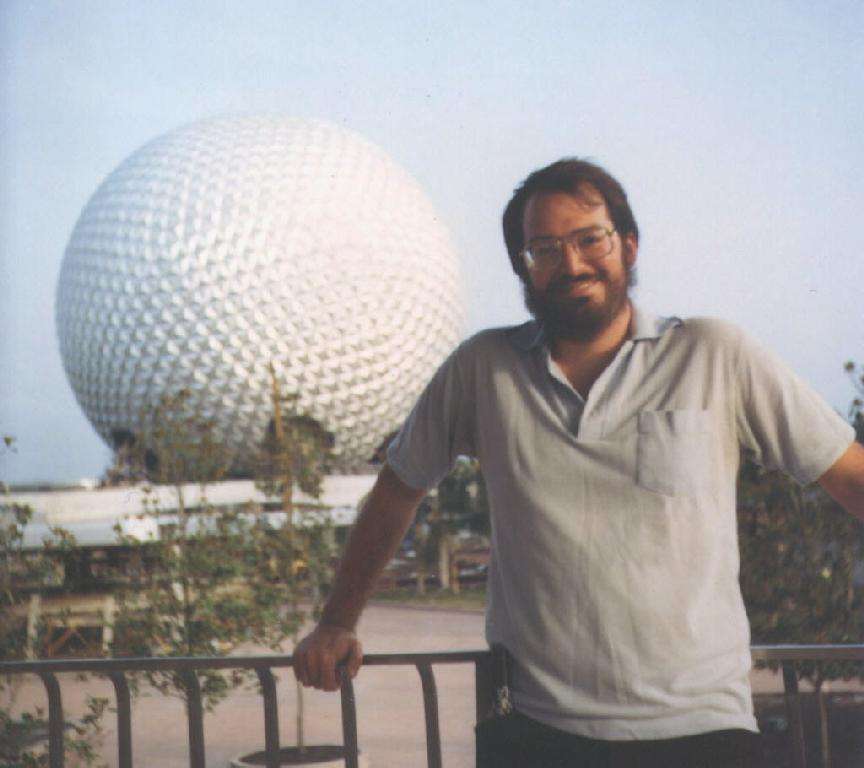
The story begins, fittingly, at EPCOT. In the spring of 1982, Steve Alcorn joined the massive effort to bring the ambitious new park to life. As Disney’s first systems engineer in the final months before opening, he was tasked with designing the complex control systems at The American Adventure show in World Showcase. To get it done on time the 10 people working on the attraction pulled 24-hour coverage, meaning Alcorn enjoyed 16-hour workdays, seven days a week. “We each had an eight-hour window to sleep, although many of us regularly slept in the building because it eliminated the 10-minute commute to our trailers,” he recalled.
In the chaos of construction, Alcorn had to compete for time and space to work with heavy equipment moving through, animators programming the show, and hydraulics getting worked on. All of it paused Alcorn’s own progress as the countdown to opening day loomed. “It was quite a nightmare of coordination,” he said.
What they were doing was big. Back then, nobody had computers on their desks. “Everybody was working on paper. There was a whole room full of draftsmen who were drawing out the drafts and any schematic,” Alcorn said. “It was all drawn in pencil by hand on big paper and then we went to blueprint machines, printing everything.”
In a moment that later helped spark the creation of Alcorn McBride, Alcorn realized no third-party companies existed to provide the systems Disney required. Imagineers were forced to design everything they needed, driving up the construction project’s cost.
“Our electronic engineering department had been developing new technologies to be able to do all of these things. But we couldn’t use PCs because they didn’t exist. So we were building our own computers from scratch in order to accomplish everything,” Alcorn said. “That meant designing circuit boards and writing operating systems and hand wiring things together.”
From home office to industry disruptor
By 1986, after leadership roles in the music technology sector, Alcorn launched his own company from home. “I had always had an entrepreneurial streak,” explained Alcorn. “I sold business cards and comic books in high school, had a college side hustle as a music producer, and even mailed out build-your-own computer kits.” He named the new company Alcorn McBride in honor of his wife, Linda McBride – herself a pioneering engineer and the first female engineer hired by Walt Disney Imagineering (WDI). McBride worked on ten pavilions for EPCOT’s opening and spent nearly four decades at WDI.
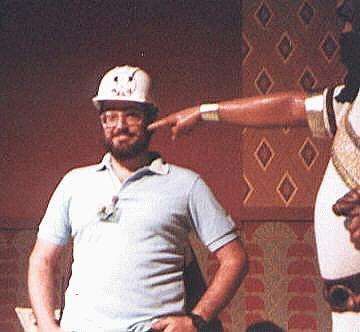
The company initially designed products for other manufacturers, including musical instruments and playback systems. But themed entertainment kept popping up. An early interactive exhibit for the Los Angeles Zoo required custom laserdisc control to allow Betty White to appear (wearing a gas mask) in the skunk exhibit to give a lesson on the animal.
But soon Disney called with a question: Did Alcorn McBride sell a product with the capability of controlling 16 interactive screens simultaneously for the new Wonders of Life Pavilion at EPCOT?
“Of course,” Alcorn answered, thinking quickly on his feet. “It’s called the V16.”
At the time, it did not yet exist. But that didn’t stop Alcorn. Delivered under tight deadlines, the V16 show controller quickly became the company’s breakout product when it launched in 1989. It provided high-quality, synchronous show control in a rugged, purpose-built package that could handle the complex needs of attractions running nearly nonstop.


Top to bottom: Alcorn McBride’s V16X, BinloopX, and RidePlayerX products.
The introduction of the V16 coincided with a broader shift in the industry. As parks grew beyond simple ride systems into multimedia dark rides, large-format theaters and synchronized spectaculars, the technical support systems also had to mature. Reliability was no longer optional. Downtime meant lost revenue and damaged guest trust. The V16 did more than solve a problem. It helped professionalize show control across the industry.
“We are responsible for huge attractions operating day in and day out,” said Scott Harkless, Chief Innovation Officer. “So everything needs to be very dependable. We have an amazing team of engineers that are creating custom-designed, easily maintained electronics specifically for these demanding environments.”
The Binloop becomes a legend
If the V16 established the company, the Binloop made it iconic. In the early 1990s, Disney needed precise synchronization between parade floats and distributed speakers along the route for the Main Street Electrical Parade at Disneyland. The technical challenge was formidable for its time, requiring complex communication between moving and fixed systems with perfect timing.
Alcorn’s solution became the first Binloop. Like its analog predecessor (the looping tape decks once ubiquitous in parks) the Binloop was engineered for continuous duty. Alcorn McBride systems are intentionally not PC-based. Doing so means they avoided hard drives, operating system crashes and forced updates. Instead, the company designs from the chip level up, controlling both hardware and software.
That philosophy has allowed the company to weather multiple waves of technological change. As consumer electronics cycles accelerated and obsolescence became commonplace, Alcorn McBride focused on longevity. Many systems installed decades ago remain operational today.
Over time, the Binloop digital audio and video player would become so widely adopted that it entered industry vernacular. “I would even say the Binloop is now the ‘Kleenex’ of our industry, in terms of overall familiarity,” said Loren Barrows, Chief Executive Officer. In 2022, the City of Orlando renamed the street leading to the company’s headquarters Binloop Drive – a rare civic tribute to a piece of show hardware and the company behind it.
Even today, forty years later, the company remains focused on the precision of synchronization that Binloop pioneered.
“If a character leaps onto the front of your vehicle in a 3D film projected around you, and there are speakers behind your headrest and speakers in the set, if those are off by even a tiny fraction of a second, the effect is ruined,” Alcorn said. “The ability to seamlessly and easily do that is really what makes Alcorn McBride successful from a product standpoint. What makes us successful from a company standpoint is the people that make that happen.”
Small team, global impact
For all its influence, Alcorn McBride has never been a sprawling corporation. The company has remained intentionally lean, typically employing around 20 people. It does not operate massive warehouses or chase scale for its own sake. Instead, it builds trust.

The biggest players in the global theme park industry rely on Alcorn McBride for custom electrical products that cannot be replicated elsewhere. As international markets have expanded, so too has the company’s reach, including the addition of a Channel Partner and Reseller focused on the European Union and United Kingdom markets [See InPark Issue #107, “Frank-ophile”].
Its reputation has been cemented as much by service as by technology. On one occasion, the company dispatched an employee around the world with just eight hours’ notice to troubleshoot a client issue. In a business where opening dates are fixed and reputations are hard won, that responsiveness matters.
While the products are widely known, the personalities behind them are truly legendary within the industry. Jim Carstensen, one of Alcorn’s earliest hires, became the engineering backbone of the company for more than three decades. He oversaw development of flagship products and embodied the firm’s engineering philosophy.
“People looked up to him literally – because he’s 6’5” – and figuratively because he was just so important,” said product manager Mike Polder, himself a 30-year veteran of the company.
Carstensen combined deep technical mastery with practical ingenuity. He also cultivated a culture of creativity and humor, famously hiding green army men around the office and staging elaborate pranks. The message was clear: excellence and enjoyment are not mutually exclusive.
Mechanical engineer Martin Chaney, who passed away last year, designed virtually every piece of hardware for more than 30 years. Known for declaring challenges “impossible” only to deliver elegant solutions days later, Chaney’s brilliance and craftsmanship remain embedded in every chassis and enclosure the company produces.
The Orlando headquarters reflects that spirit. A tiki bar anchors Friday afternoon gatherings beneath a simple motto: “Have fun, make money.” It is not a gimmick. It is a reminder that passion fuels performance.
A different kind of succession
When Steve Alcorn retired in 2024 at age 70, he made a decision that speaks volumes about the company he built. Rather than selling to a larger corporation or private equity firm, he transferred control of Alcorn McBride into a trust managed by a trustee selected by the company’s leadership team. The move shielded the company from external shareholder pressure and ensured continuity of culture and purpose.

“We are all here due to the unselfishness of Steve Alcorn,” Polder said. “He could have sold the company years ago and retired to an island, but that’s not what he wanted. He wanted this beautiful environment he created to continue.”
Today, Barrows oversees day-to-day operations. Hunter Olson leads engineering. Harkless drives innovation. Alex Wasson, Chief Financial Officer, positioned the company to purchase its MetroWest headquarters in 2018. A new generation of engineers is being mentored by veterans who understand not just the technology, but the philosophy behind it.
Alcorn still checks in, occasionally dropping a joke into the company Slack channel or attending meetings. But the company operates confidently without him – a testament to the foundation he laid.
The legacy continues
For 40 years, Alcorn McBride has helped define how themed entertainment sounds, moves and synchronizes. Its systems power attractions, parades, museums and experiences around the globe. In many cases, guests will never know the company’s name. They will simply feel the magic working flawlessly around them.
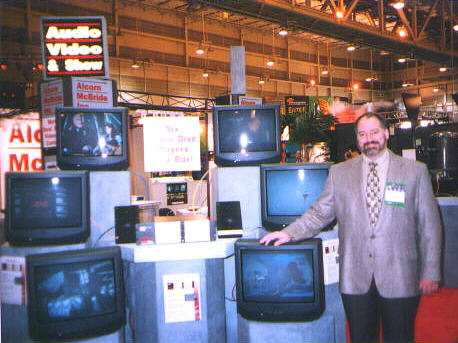

The company’s 2025 IAAPA Expo booth still showcases cutting edge technology,
but also features detailed theming, highlighted by Loren Barrows.
As the industry embraces immersive media, networked attractions and ever more complex storytelling environments, the demand for precision will only increase. The invisible backbone must become even more robust.
If the past four decades are any indication, Alcorn McBride will continue doing what it has always done: solving niche problems others overlook, supporting clients others cannot, and empowering engineers to build systems that make the impossible feel effortless.
What will theme park audio and visual technology look like in the next 40 years? It will be faster, smarter and more interconnected. And somewhere behind the scenes, on Binloop Drive, an impressive team of engineers will be creating it. •