


AT TEMPLE SQUARE IN SALT LAKE CITY, UTAH – THE GLOBAL HEADQUARTERS OF THE CHURCH OF JESUS CHRIST OF LATTER-DAY SAINTS – A NEWLY REIMAGINED VISITORS’ CENTER IS RESHAPING HOW A COMPLEX AND OFTEN MISUNDERSTOOD SET OF BELIEFS IS INTRODUCED TO THE PUBLIC.
by Becci Knowles
Temple Square Visitors’ Center is located adjacent to The Church of Jesus Christ of Latter-day Saints’ iconic Salt Lake Temple, currently in the midst of a once-in-a-generation renovation. Construction at the temple began in 2019, with the lengthy project focused on making the structure less susceptible to earthquake damage. Work is expected to be finished by the end of 2026, and a public open house is scheduled for six months in 2027. With the campus impacted by the extensive temple construction, Church leadership decided to use the time to also refresh and renew their visitors’ center, focusing on creating an experience that allows nonmembers to understand what happens inside the temple, which is typically not accessible to the general public.
At the heart of Temple Square, the refreshed visitors’ center sits within one of the most visited religious destinations in the United States. As the global headquarters of The Church of Jesus Christ of Latter-day Saints, the site carries both symbolic and practical weight, welcoming millions of visitors each year, many of whom arrive with limited context for what they are seeing. This new experience – which opened in May 2026 – is designed to address that gap.


THG Creative
THG Creative
“What we really wanted was to create an experience that would be relatable to all guests,” explains Senior Director in the Temple Department Richard Sutton. “Sometimes, when you tell your own story, you use language that’s familiar to you but not to others. This was the opportunity to share our story in an accessible way and provide insight into the temple for all our visitors,” Sutton adds.
Choosing the path of themed entertainment
Rather than developing the project internally, the Church sought out a themed entertainment studio for help That decision reflects a wider shift in how cultural and religious organizations are approaching storytelling – looking beyond traditional exhibition design toward more experiential, narrative-led approaches. Following a competitive selection process, THG Creative was chosen for its ability to quickly grasp both the emotional and conceptual core of the subject matter and translate it for a global audience. “THG were able to understand what we were trying to communicate quickly and present it in a way that anyone could understand,” Sutton says. THG’s “outsider” perspective was key; the Church needed a different kind of thinking – one informed by architecture, narrative, and experience design.
Understanding the mission
Temple Square Visitors’ Center resists easy categorization. It sits somewhere between cultural exhibition, immersive environment and narrative experience – but its goals are explicit. “As part of a multi-year transformation, the Church approached us to help address misconceptions about what goes on inside the temple,” THG Founder Phil Hettema explains. “The main objective was to create a place where everyone would feel welcome, where people could come with questions or maybe something they didn’t understand, and walk away with that information without feeling like they had been preached at.”
For THG, the starting point was not technology or layout, but translation. The Church had already made the decision to build full-scale replicas of key rooms within the temple but lacked a clear framework for how to present them to a global audience unfamiliar with the context. To help provide that perspective, THG engaged Donna Lawrence Productions to help conduct interviews with over 300 Church members around the world.
From those conversations, common threads began to emerge. “Every word within this journey originates from those interviews,” Hettema says. “It feels personal and from the heart.” The result is an experience shaped by shared perspective rather than didactic messaging.
Exploring the center
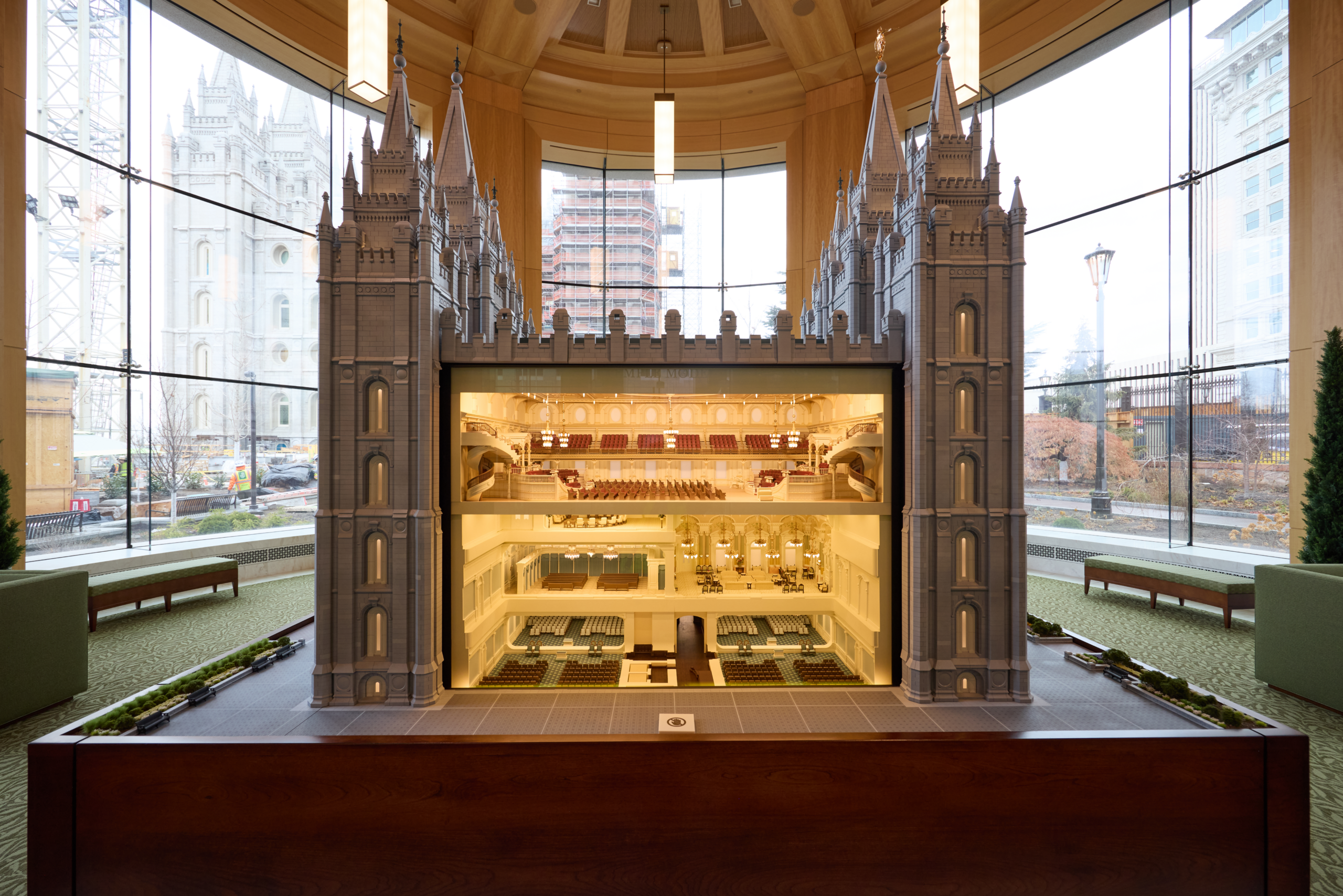
Since many visitors might not arrive with much knowledge of the Church, THG wanted to first provide a birds-eye view – literally – before diving deeper, so the journey through the center is designed to support that. Guests first encounter a highly detailed architectural scale model of the Temple. Jared Peter, Senior Producer at THG, describes the model as “one of the most technically complicated elements of the project.” The model cycles through a show where the exterior walls lower through a coordinated sequence of automation, lighting, and media cues, revealing the interior spaces of the Temple within.
“Anytime you’re dealing with automation at that level, it becomes incredibly complex,” Peter explains. “You’re working with very small tolerances, and everything has to line up perfectly.” The reveal moments function as both literal and metaphorical openings, establishing the core concept of the center for guests. “We wanted guests to see inside of the temple, while also setting the tone of openness, sharing and transparency for the rest of the experience,” says Peter.
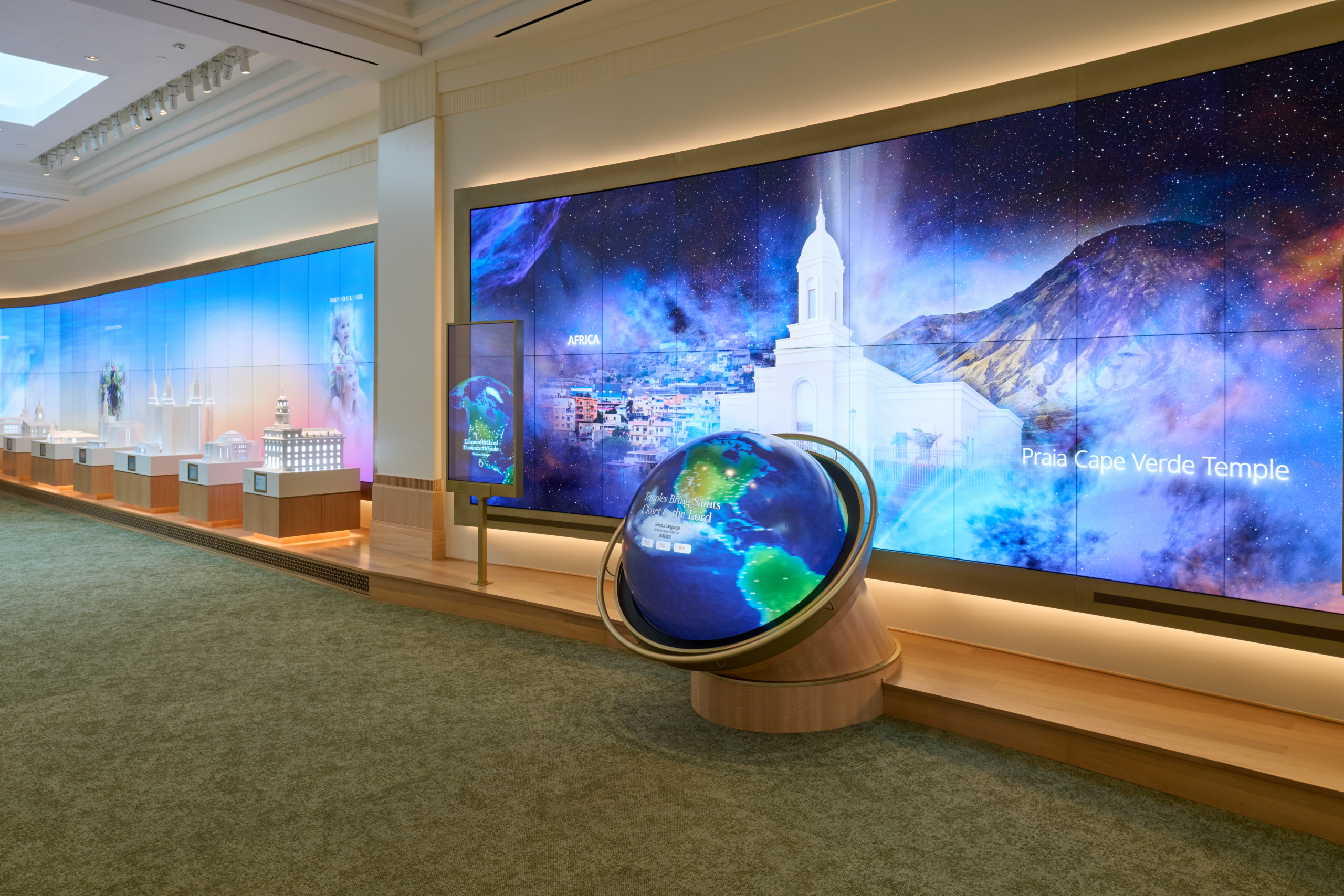
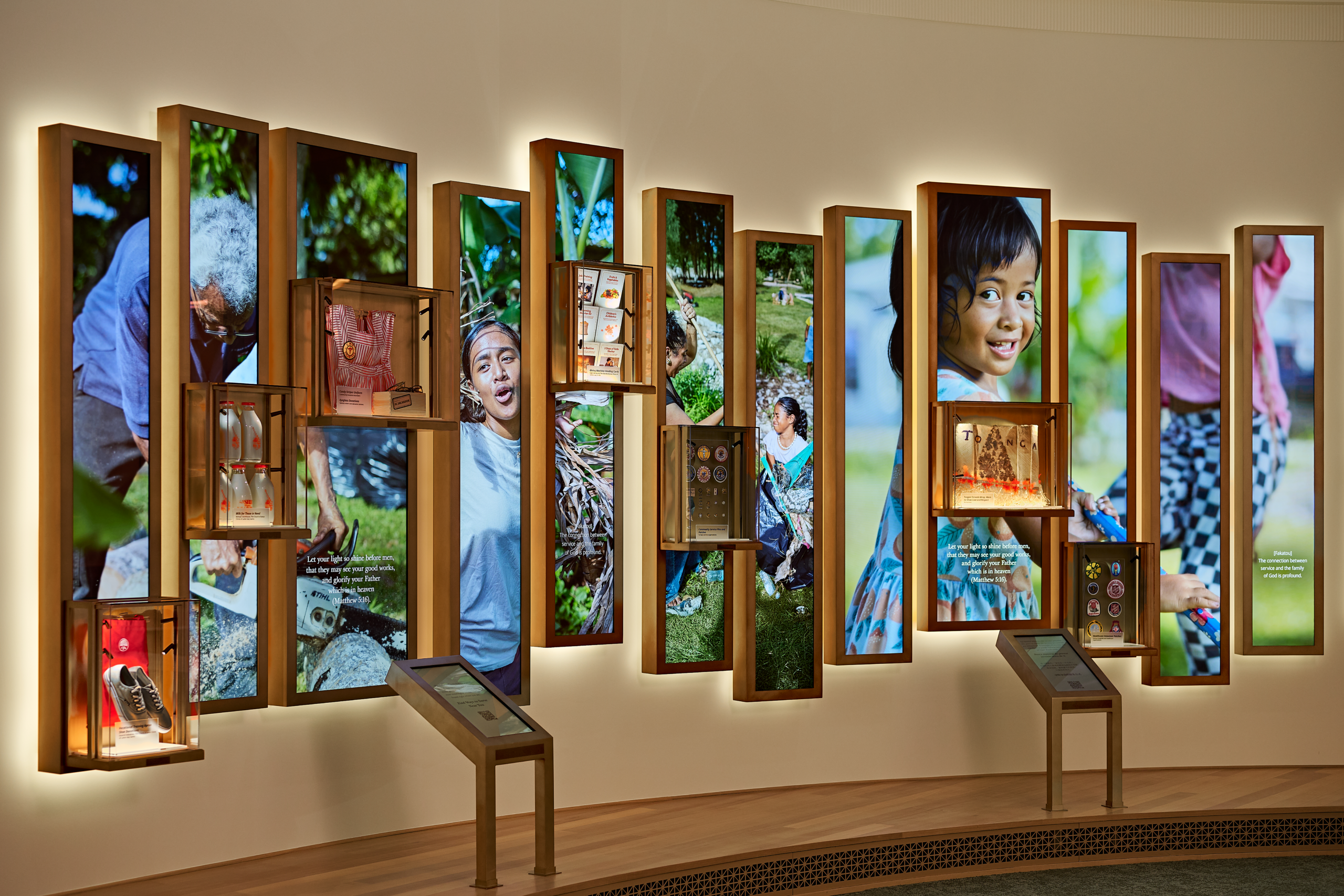
From there, guests travel downstairs into several galleries open for exploration. Large screens on the walls share footage captured around the world, showing both temples and the lives of Church members. Physical models highlight the architectural diversity of 11 temples, while a touch-responsive digital globe allows visitors to explore their locations and context in more detail. Visitors also see a large quilt composed of individual panels crafted by Church members across the world. “We created this space because we really wanted to reinforce that even though you’re here at Temple Square – the headquarters – the Church is worldwide,” explains Hettema.
When they are ready, guests can explore the “Inside a Temple Tour” in small groups. “This part of the Center is a linear experience with a carefully orchestrated narrative that we’ve created,” reveals Hettema.
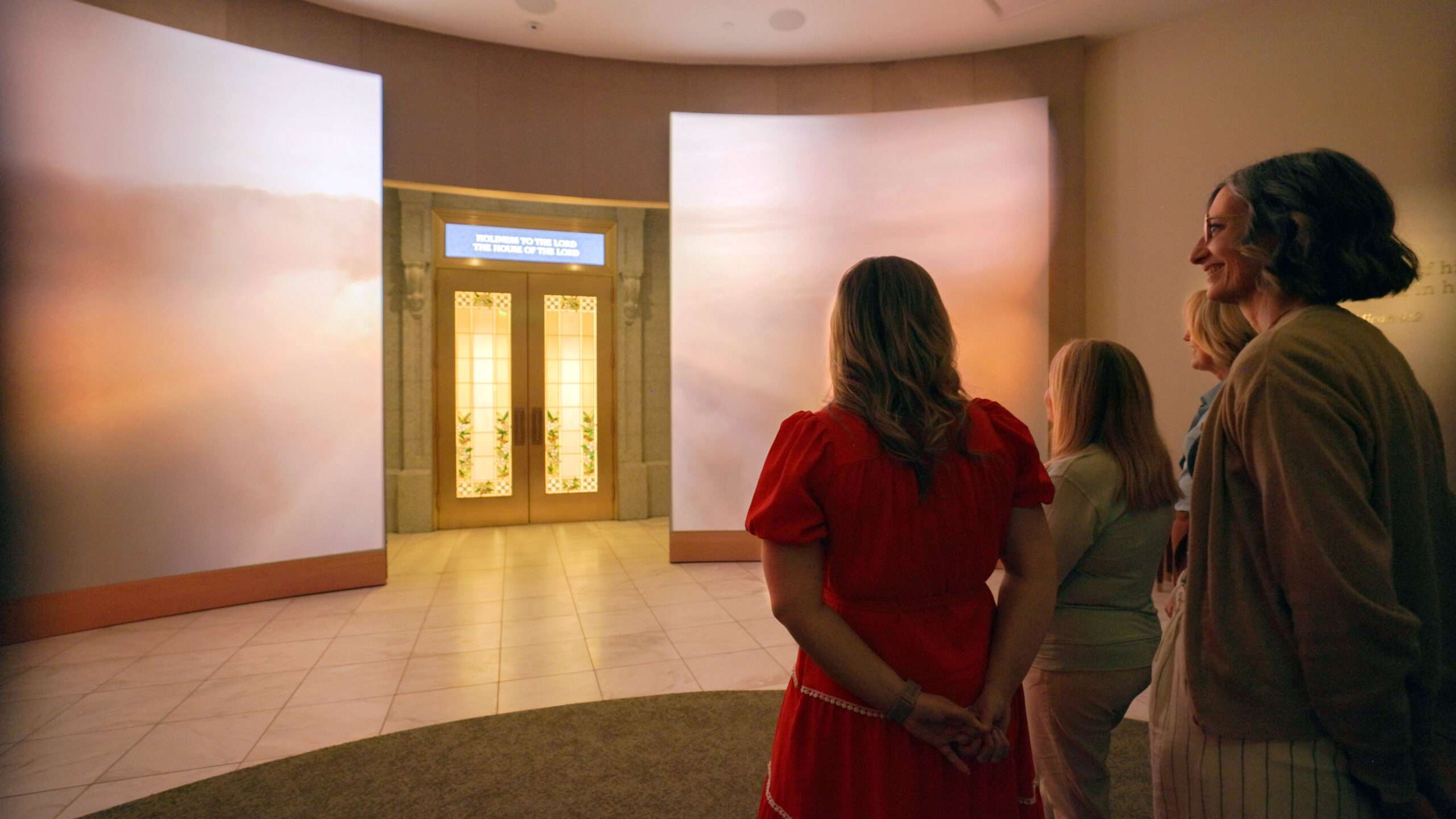
Visitors begin in a preshow room, where a large, curved wall functions as a screen for an introductory film that explains the significance of the temple room replicas guests are about to step into. At just the right moment, the walls slide open, revealing the entrance to the first replica room. The reveal is simple but moving – reflecting the importance the Church places on what goes on in the temple.
“Creating the temple replica rooms was probably the most interesting part of the whole project, because the Church has very traditional ways of talking about what goes on in these rooms,” says Hettema, referring to the baptistry, the instruction rooms, the celestial room and the sealing room. “The language and terminology may be unfamiliar to most people so we had to think of other ways to present this information.”
The solution came from the Church member interviews conducted at the start of the project. “What better way to communicate with regular visitors than with the voices of regular Church members,” says Hettema. Guests hear these stories and interview clips that help provide background for the rooms they are walking through. The result is an experience that privileges personal voice, allowing guests to forge their own connections.
The journey concludes in the celestial room, designed to give visitors time to consider what they have seen and experienced. “This room is very important to the Church, so we chose to make it a quiet and reflective space, much as it is in the actual Temple,” explains Hettema.
Challenges, risk and delivery
“There were two critical aspects for me in this project,” shares Peter. “One was the media work – making sure we were telling their story accurately. The other was production, making sure there was smooth collaboration between media partners and technical vendors.”
The team addressed these challenges by engaging regularly with Church leadership. “It became this seamless back and forth,” says Hettema. “Every bit of text was reviewed by the Church several times.” Each side enjoyed the collaboration and learned a lot from it. “There was no sense of struggling for authority,” Peter says. “It was all focused on what was going to give us the best outcome.”
Peter acknowledges that while THG’s outsider perspective was the reason the Church chose them for the project, “There were moments where it felt like we might be pushing them too far: like building the audio guide around the voices of regular Church members, telling the story in their own words, and the big cinematic reveal as the doors open into the replica rooms. But they’ve told us these are among their favorite parts of the experience.”
The subject matter also brought inherent challenges. Technology, scale, and theatricality had to be balanced against sensitivity and authenticity, ensuring that the experience remained inviting rather than overwhelming. “The aim was not to try to persuade anyone,” Hettema says. “It was about trying to welcome people and begin a conversation.”
This approach also required careful calibration and alignment among the larger team. In addition to Donna Lawrence Productions, THG worked with a multidisciplinary group of partners including Cortina Productions, Midwest Studios, Electrosonic and 4Wall. “Integration, in this context, is not just about systems working together, but about teams aligning around a shared objective,” says Peter.
A higher calling
The project marks the continued growth of the themed entertainment industry into new markets and verticals. As experience design expands beyond traditional attractions into cultural, educational, and institutional spaces, projects such as Temple Square Visitors’ Center demonstrate how those tools can be applied with sensitivity and purpose. Here, the focus is not solely on spectacle, but also on clarity, accessibility and connection.
“We use some gentle theatrics throughout to lead you from one element to the next, but we were very careful, always making sure the project was keyed correctly for the audience and the message we were trying to communicate,” says Hettema.
In this sense, immersive design operates not to change minds, but to invite understanding and encourage meaningful discussion across a diverse global audience. It’s why the Church approached Hettema’s team in the first place.
“Working with THG has been phenomenal,” says Sutton. “We pushed each other and grew together. They brought clarity to our message and creativity to our goals. With this new experience our guests will be leaving with a greater understanding of who we are, what we do and what is important to us. By that metric alone, this project is already an astounding success.” •