


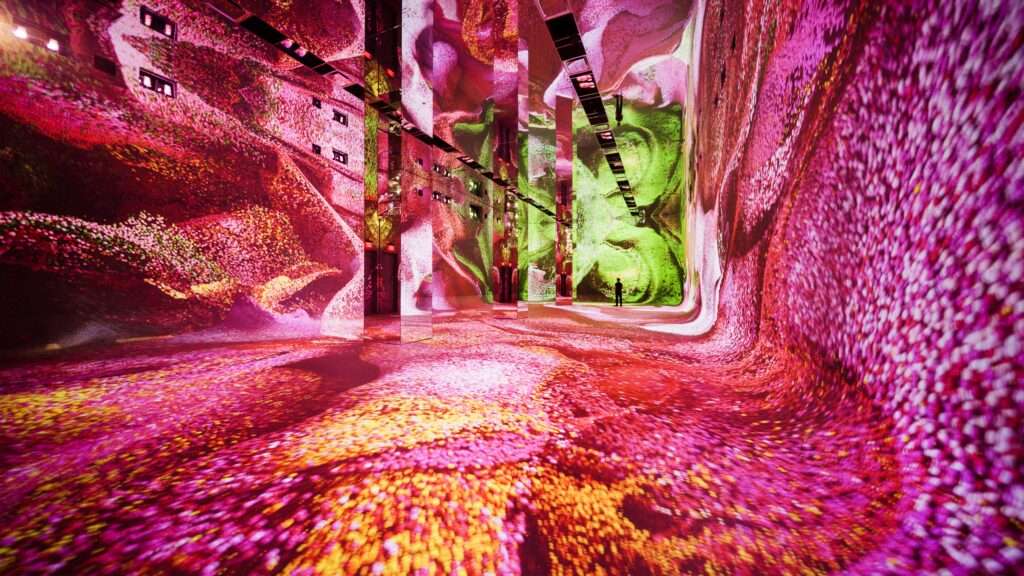
Pioneering AI artist Refik Anadol used Epson projectors to transform data from nature and visitor biometrics into a massive interactive “living sculpture”
by Joe Kleiman
A decade ago, when Turkish-American artist Refik Anadol first arrived in Los Angeles, one of the first places he visited was The Broad, the contemporary art museum in downtown Los Angeles. “It was very exciting for me,” Anadol recalls. “I was new to Los Angeles and so was The Broad. I was looking for inspiration and one of the things that really moved me was Yayoi Kusama’s infinity rooms.”
One installation in particular spoke to Anadol: Yayoi Kusama’s Infinity Mirror Room – The Souls of Millions of Light Years Away. The 2013 installation surrounds visitors with mirrors and flickering LED bulbs hanging from the ceiling, creating an environment in which the boundaries between the physical space and the visitor seem to disappear.
Today, Anadol has created his own interpretation of the immersive art experience. Across the street from The Broad stands DATALAND, a 25,000-square-foot AI art museum that explores the intersection of nature, data, technology and human experience.
The comparison to Kusama is useful, but DATALAND takes the concept in a distinctly futuristic direction. Rather than surrounding visitors with light and mirrors, Anadol uses artificial intelligence, environmental data, biometrics, sound, scent, and massive-scale digital imagery to create an environment that responds to the people inside it.
A museum that responds to its visitors
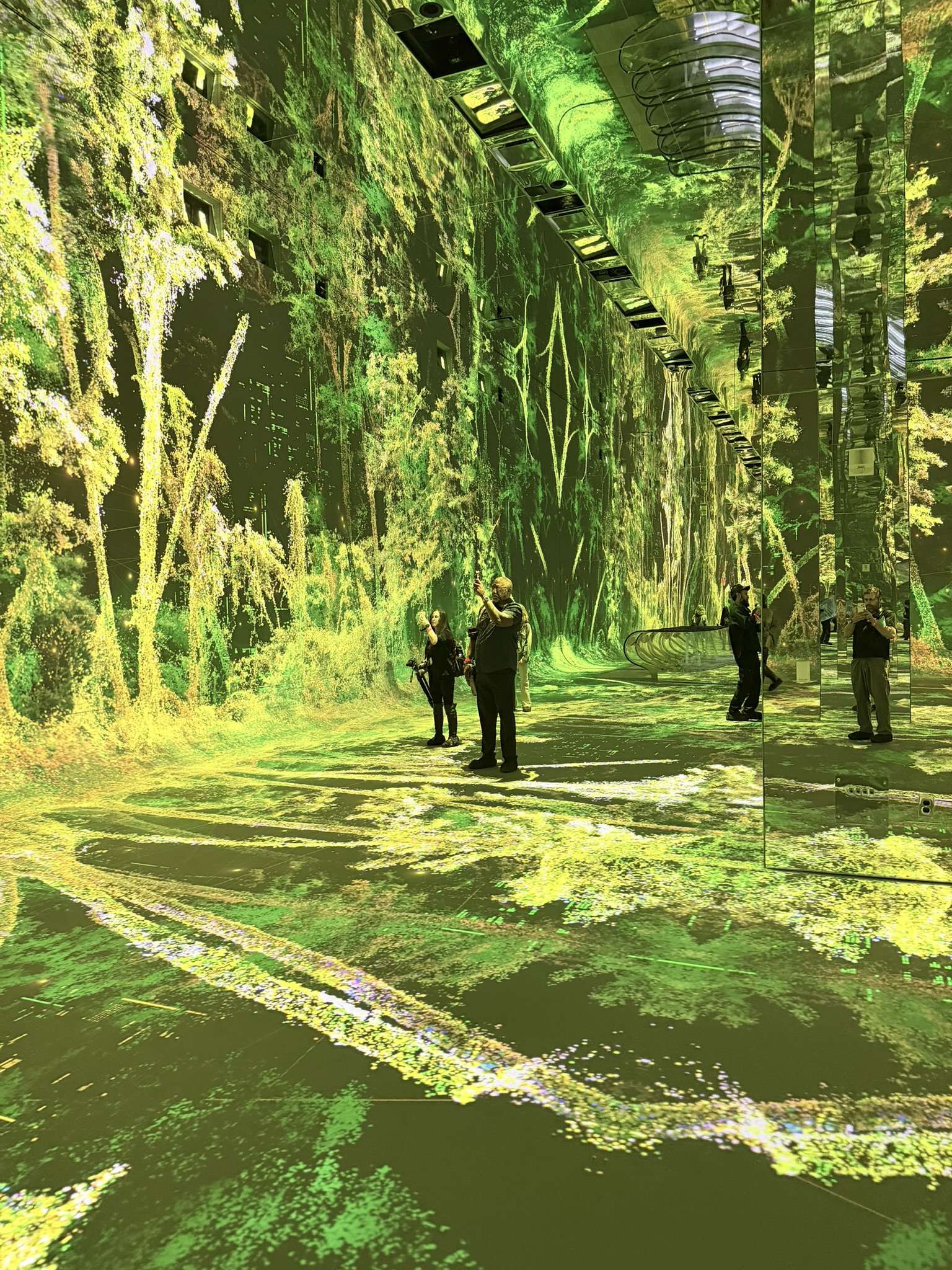
DATALAND’s opening exhibition, encompassing all five of the museum’s galleries, is inspired by the world’s rainforests. Throughout the experience, millions of licensed images of nature are continuously transformed by artificial intelligence using real-time environmental information from sixteen rainforests around the world, including data such as temperature and precipitation.
Technology is intentionally visible as part of the aesthetic language. Some of the imagery evokes the visual vocabulary of sci-fi films like The Matrix or TRON, but at DATALAND, the digital abstractions are continually interwoven with imagery of the natural world.
While guests explore the exhibits, DATALAND collects information from visitors themselves. A biosensing wristband monitors movement, heart rate, skin temperature and skin conductivity, allowing the experience to incorporate the physical presence of the people inside it. The result is an environment that is never the same twice.
“What moves me most is not the technology,” Anadol wrote. “It is watching our dear visitors become quiet together – children, elders, scientists, dreamers – each finding their own reflection inside nature’s memory.”
An infinity room on a massive scale
Visitors descend an escalator into the two-story Data Pavilion, a 92-foot-long, 39-foot-wide and 22-foot-high environment that surrounds them with imagery. The Pavilion uses 84 Epson projectors to create a 40-minute, 360-degree presentation. Rather than treating projection as a large screen placed in a room, DATALAND uses the entire architecture as part of the canvas. The result is effectively an infinity room on a large architectural scale.
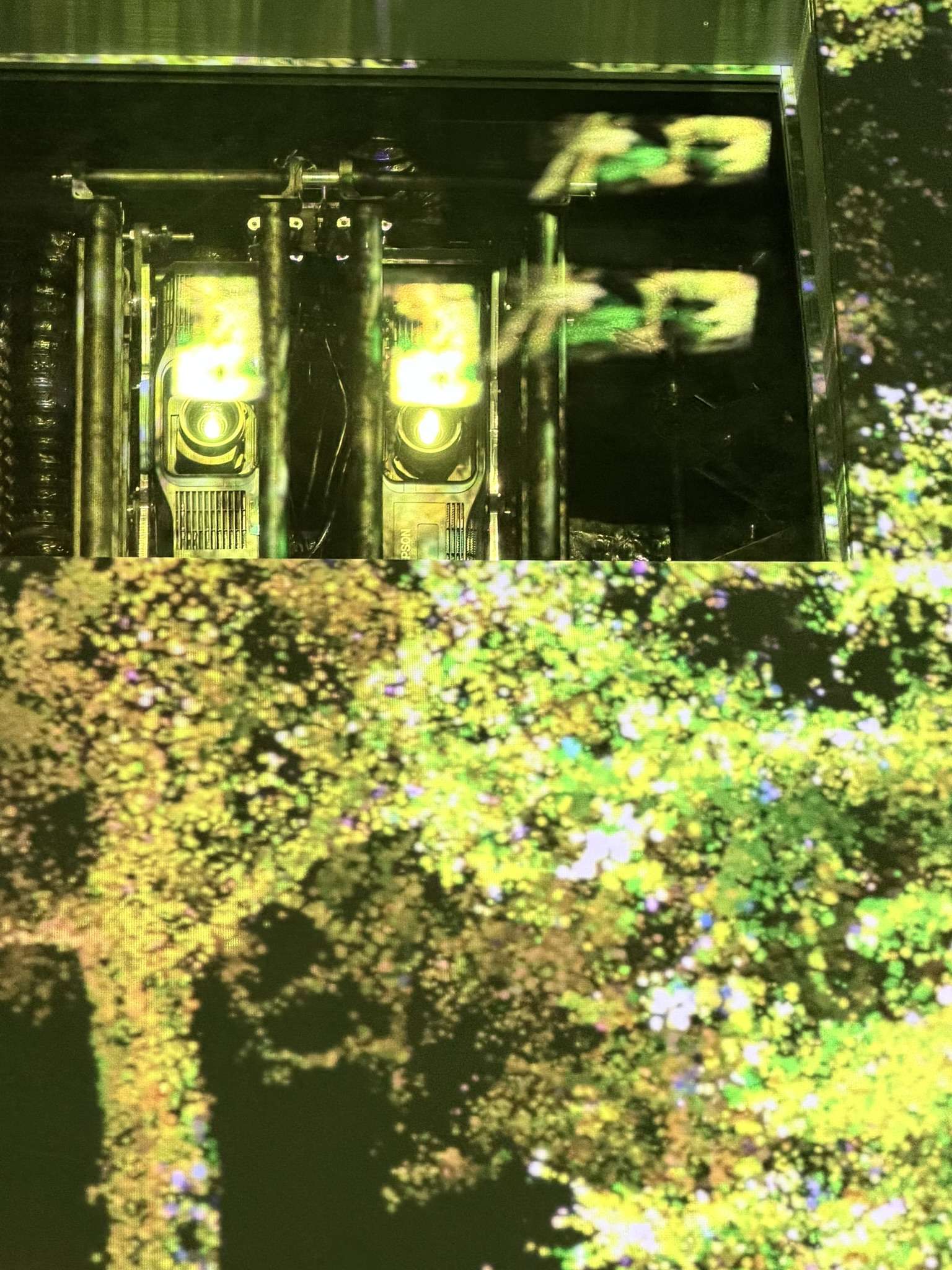
The Data Pavilion relies on pairs of Epson EB-PQ2220B 4K 3LCD laser projectors, mounted in stacked configurations behind projection-port windows near the top of the side walls and in the ceiling. The paired projectors double the illumination available for the imagery while providing the brightness and image quality needed to cover such a large, reflective environment. At 20,000 lumens per projector, the EB-PQ2220B is designed for large-venue applications where brightness and image quality need to remain consistent across a substantial image.
“Refik has long been a collaborator with Epson,” explains Gavin Downey, Epson’s Group Product Manager – Large Venue Projection. “We were able to provide him with gear in the early stages of the EB-PQ Series, and he was able to explore the possibilities of what he could do with our technology in the unique way that he creatively and analytically explores things. He’s not just an artist, he’s a data scientist, a futurist, and more. In DATALAND, he’s doing things that I don’t know that anyone else is doing.”
To create a full 360-degree projection environment, DATALAND employs mirrors on non-projection surfaces, including one of the end walls, the side of the escalators, the ceiling and structural pillars located throughout the room. “Despite the extensive use of mirrors, we are able to create a seamless visual experience through precise projector alignment, exceptional image quality and our team’s technical expertise,” says Anadol.
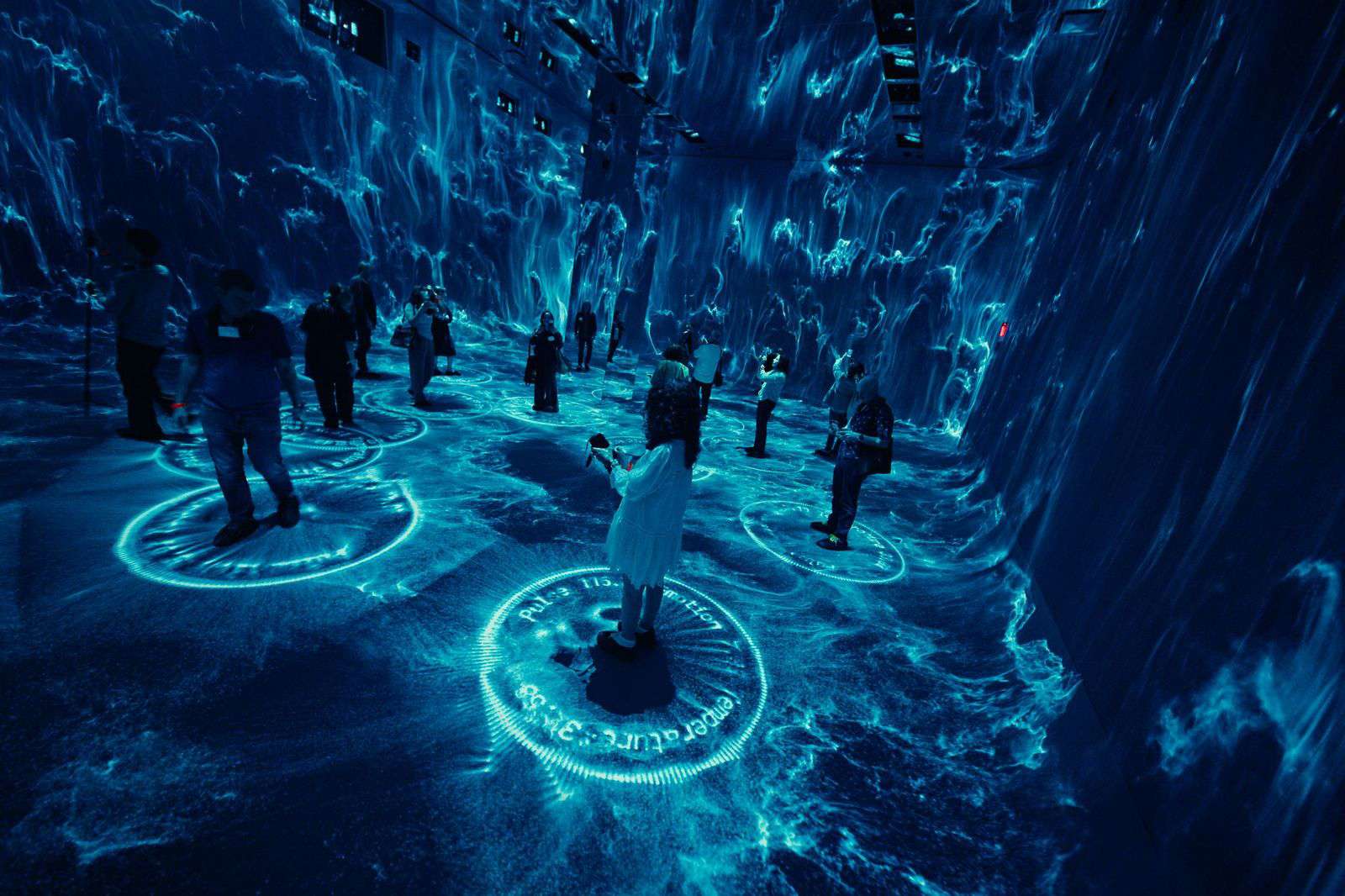
“The fact that elements like mirrors and escalators exist in the space, and the fact that the gallery achieves the effect it does, is a testament to how good the projectors and Refik’s team are,” shares Downey. “There are a lot of lumens in that room, and a lot of mirrors. In almost anyone else’s hands, that would create cross-contamination, a loss of contrast, all sorts of secondary impacts. When you see this, you begin to ask yourself if you would have known how to do it.”
Consistently crisp, stunning image quality
Visitors often can’t tell where the projection ends and mirror reflections begin, which allows for full immersion in the artwork. The image needed to remain bright, detailed and consistent, not just directly in front of the visitor but across the entire environment.
Epson’s 3-Chip 3LCD architecture across its entire projector lineup contributes to that consistency by splitting a blue phosphor laser into red, green and blue light. Each color beam then goes through its own LCD chip before recombining through a prism, after which the resulting image is projected. The technology avoids the rainbow effect and loss of color brightness that can occur with some projectors.
“Epson has consistently improved key areas like contrast and durability, while maintaining the strong color and white brightness performance that our 3-Chip 3LCD technology has always been known for,” adds Downey. “Epson’s continued investment in 3-Chip 3LCD technology is directly tied to the fact that we own and develop the technology ourselves, giving us greater control over its evolution and the ability to continually push performance forward. Those efforts are apparent across the entire EB-PQ Series, which represents a quantum leap for us in full-time color, stunning contrast and exceptional image quality.”
RELATED: How Epson projection makes Cirque du Soleil’s ALIZÉ possible
A partnership built over time
For Anadol and Epson, DATALAND is the latest chapter in a relationship that stretches back more than a decade.
“My relationship with Epson goes back to my first day of being a university student,” Anadol says. “They were extremely friendly when I emailed and asked them to support my thesis project. Back then it was more challenging to use this technology. Over the last twelve years, they’ve continued to collaborate with me.”
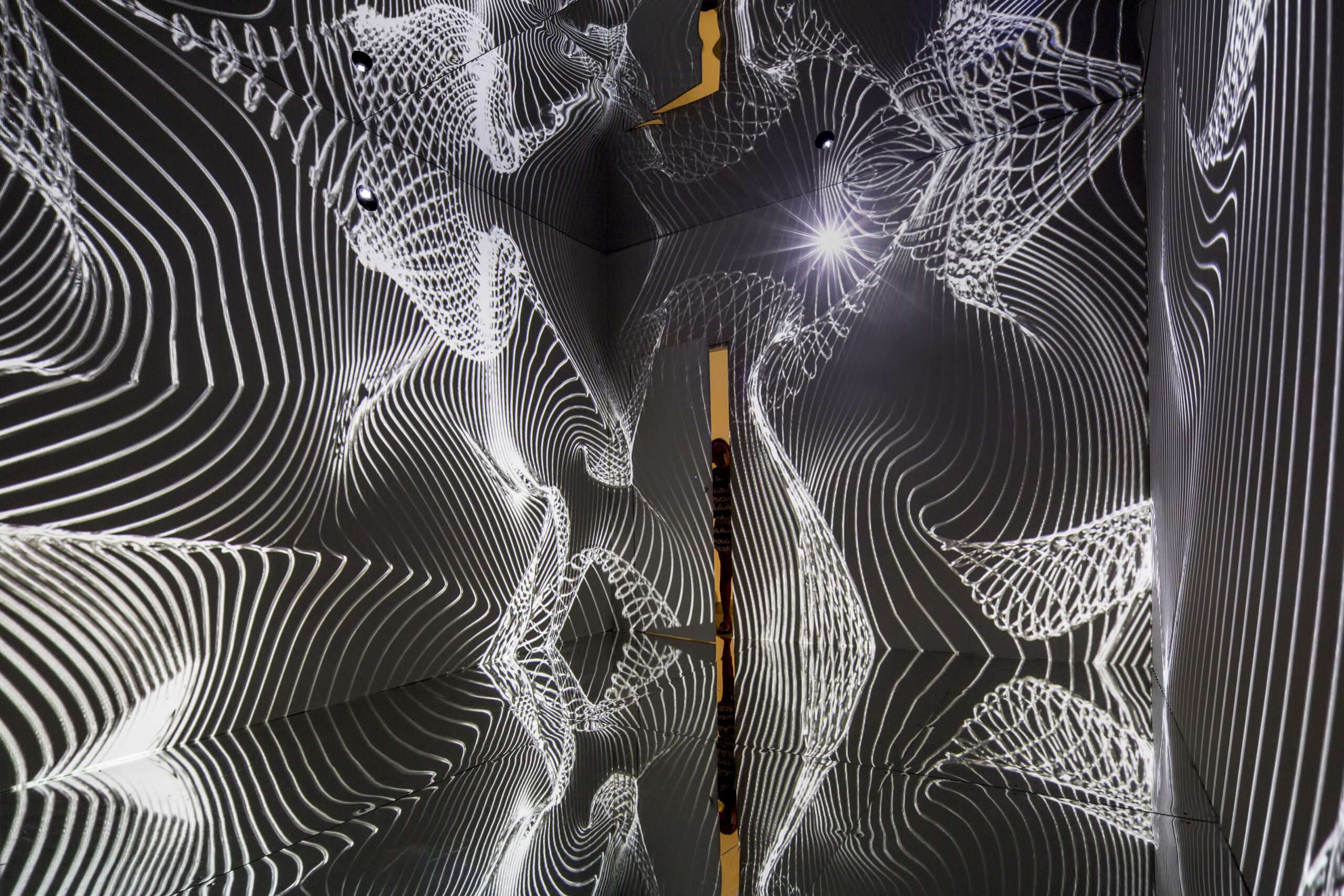
In 2015, Anadol created his first “Infinity Room” experience using Epson lamp-based projectors. Foreseeing the transition from larger lamp-based models to compact and brighter laser driven solutions, Refik accounted for this in the original design. The following year, the installation was displayed at Epson’s booth at InfoComm in Las Vegas, as a showcase for the company’s Pro L-Series laser projectors. Brightness increased by almost 70% just as “Infinity Room” embarked on a global tour of museums, technology conferences and exhibitions.
The collaboration continued across various projects over the years. This includes in 2023 when Epson moved into a new custom-designed headquarters in Los Alamitos, California. Anadol was commissioned to create two original pieces of AI artwork for the facility, displayed on opposite sides of a two-sided massive screen in the entryway lobby and powered by four Pro L-Series laser projectors.
DATALAND represents a much larger expression of this ever-evolving relationship.
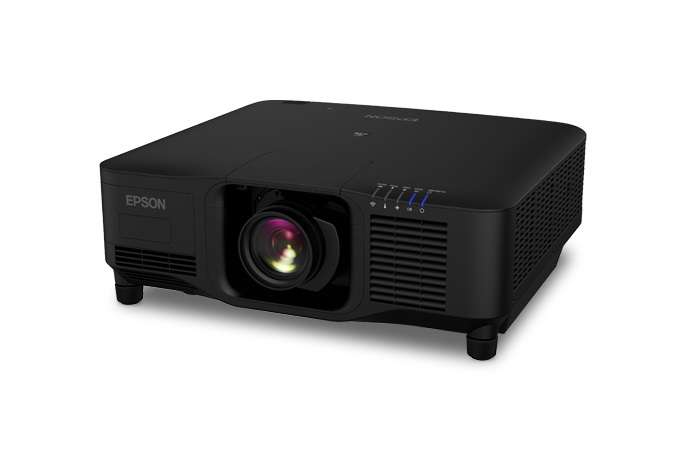
that we own and develop the technology ourselves…Those efforts are apparent across
the entire EB-PQ Series, which represents a quantum leap for us in full-time color,
stunning contrast and exceptional image quality,” says Epson’s Gavin Downey. Image courtesy of Epson.
“The Data Pavilion is really a living sculpture,” says Anadol. “There are more than 200 channels of sound, hundreds of sensors and an 84-projector image system. All of those systems have to work together.”
“The technology can’t be separated from the experience,” says Downey. “The projection, the sound, the sensors, the architecture and the data all must work together. That’s what makes this different from simply putting a very large video wall into a gallery.
For Anadol, that distinction is central to the project. The objective isn’t to demonstrate what a projector can do, or even to demonstrate what artificial intelligence can do. Those technologies are tools in service of something more human: creating a shared environment in which visitors can lose their sense of where technology ends and the artwork begins.
That is why the relationship between Anadol and Epson has endured. “Whenever we have big, challenging projects, Epson always supports us,” Anadol says. “This is more than just a product relationship. It’s about supporting an artist’s journey.”
At DATALAND, that journey has become a physical place – one where data becomes imagery, imagery becomes environment, and the visitors themselves become part of the artwork. •