
SALLY DARK RIDES AND SIX FLAGS BRING PHANTOM THEATER BACK TO KINGS ISLAND FOR 2026
by Martin Palicki
When Phantom Theater opened in 1992, no one could have predicted how it would capture the hearts of Kings Island guests. It was a regional park dark ride: charming, theatrical, spooky, and unique. But over the decade that followed, it evolved into a memorable classic in a way few attractions can. When the ride closed in 2002, the spirit (and spirits) of Phantom Theater stayed behind – if only, perhaps, in the memories of guests. Now, in 2026, the ghosts of the past have been given a new (after)life in the park.
With Phantom Theater: Opening Nightmare, Kings Island has built upon the legacy of the original attraction.
While there are many homages to the original, the ride is truly a reimagining. It leans heavily on nostalgia while also introducing interactivity, modern design and technology. The project is the result of a close collaboration between Kings Island, Six Flags creative leadership, and Sally Dark Rides, and it offers a compelling case study in how legacy attractions can evolve without losing their soul.
Listening to the audience
The return of Phantom Theater began with guests. “At every park, there are attractions that guests say: We’d love to have that back,” says Ken Parks, Vice President of Creative Development for Six Flags. “At Kings Island, Phantom Theater was on the top of that list.”
The team at the park (just outside Cincinnati, Ohio) knew that information based on years of guest surveys, feedback and awareness of social media. But it took a creative spark to move from nostalgia to action. It came during a blue-sky development process that Parks and his team explored over the course of a year. The idea was simple but provocative: what would Phantom Theater look like if it were created today?
Before committing to a full-scale attraction, the team tested the concept through a live production, Phantom Theater Encore, during the park’s 50th anniversary season in 2022. The show reintroduced the characters and basic storyline to audiences while serving as a proof of concept. Perhaps unsurprisingly, it worked. The response was strong enough to validate what many frontline park employees had long known: Phantom Theater still had cultural currency with the park’s audience.
At the same time, Kings Island was evaluating the future of Boo Blasters, the interactive dark ride that had occupied the former Phantom Theater for 15 years. “We asked ourselves: What does this building want to be?” says Kings Island Park President Tony Carovillano. “The light bulbs just started going off. Phantom Theater is such an iconic brand for us. It just made sense.”
Owning the story
With many theme park projects now driven by licensed intellectual property, Phantom Theater represents something increasingly rare: a proprietary attraction with deep local and generational value. “It’s part of Kings Island’s identity,” Carovillano says. “Guests feel like they own it.” That ownership is both emotional and generational. “We have guests who rode it in 1992 coming back with their kids,” he continues. “Now those kids get to experience something their parents loved. That’s powerful!”
Parks sees that as both an opportunity and a responsibility. “Nostalgia is part of the DNA of theme parks,” he says. “But it has to be handled carefully. The goal isn’t to recreate something exactly as it was. It’s to capture the emotional essence and build something that stands on its own.” That balance became the central creative challenge of the project.
A full-circle collaboration
With an idea firmly in place and a location secured, the Six Flags and Kings Island team turned to industry veterans Sally Dark Rides to help advance and finalize the project. “Sally had a history of working on dark rides in this building, and they certainly understood the medium,” says Parks. “There was a clear cohesiveness there that made them the right partner.”
For the Sally Dark Rides team, the project was a chance to create a new dark ride practically from the ground up. The company was tasked with translating the original Phantom Theater into a fully realized modern attraction, from concept through installation. “We were involved from the earliest conversations about what this ride could be,” says Drew Hunter, Vice President of Creative Design at Sally Dark Rides. “From there, we developed the story, designed every scene, created the characters, and ultimately built and installed the experience.”
Sally led the full creative pipeline, including storyboarding, scenic design, character fabrication for over 30 figures, animation and on-site installation, while coordinating with key partners for interactivity, media, and lighting. The result is a cohesive experience in which narrative, technology, and physical environments are tightly integrated. “We were involved in every step of the process, from the first idea to what guests experience today,” Hunter says.
The collaborative dynamic with Six Flags and Kings Island throughout the process was key to the project’s success. According to Hunter, the clarity of vision and responsiveness from the park allowed the project to move efficiently while still evolving creatively. “It was a great marriage,” he says. “They knew what they wanted, but they were also open to ideas. That kind of collaboration makes a huge difference.”
Within that broader partnership, the project also benefited from a meaningful connection to its origins. Rick Bastrup, President of R&R Creative Amusement Designs Inc., (who built the original 1992 Phantom Theater) returned as a contributing creative voice. “There’s an authenticity that comes from that,” Parks says. “You can feel that connection.” Bastrup also appears in a ghostly cameo within the ride, a subtle nod to the original creative team and the legacy they established.
Designing a new narrative
“The biggest challenge was capturing the feeling of the old ride,” says Hunter. “There are people who loved that attraction deeply. You want to honor that while still creating something new.” Rather than attempt a scene-by-scene recreation, the team developed an entirely new storyline built around the concept of “ghost notes” escaping into the theater.
“We started with the understanding that the original ride was passive,” Hunter explains. “You sat and watched. This time, the park wanted interactivity. That meant we needed a narrative to support that.” Hunter created detailed storyboards for all 26 scenes, ensuring that every moment could be both visually compelling and physically buildable.
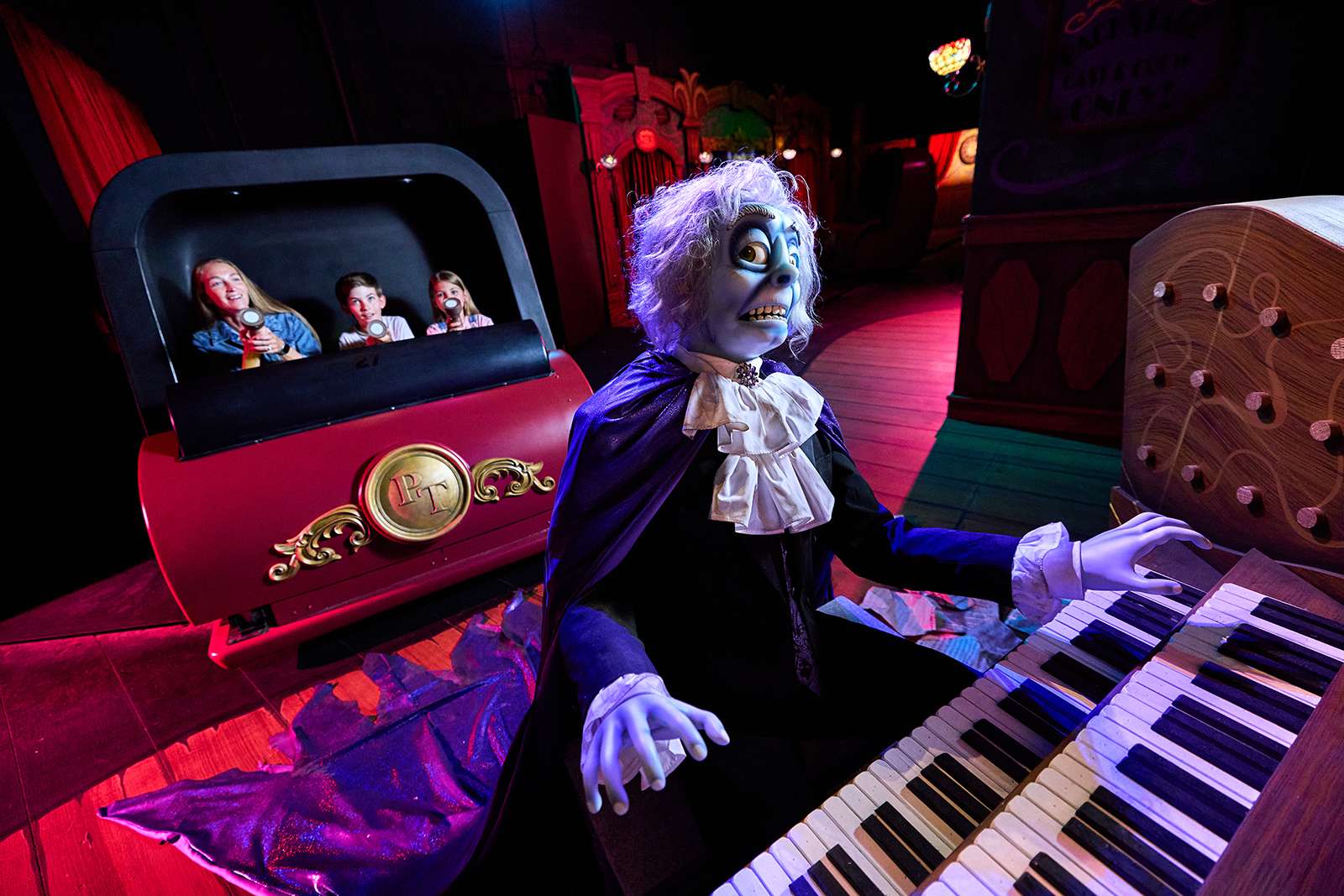
Tone was critical. “The park didn’t want it to be too scary,” he adds. “It’s spooky, it’s whimsical, but it’s accessible and fun. They’re funny phantoms, not frightening ones.” This is reinforced right from the start in the new preshow queue where the main characters Maestro and No-Legs Larry banter with each other in a dialogue rife with puns. They explain that the original performers (and a couple of new ones too!) are back for another performance in the theater. Shortly before showtime, the theater is struck by a bolt of lightning, and all the musical ghost notes escape from Maestro’s organ. Guests are recruited as ushers and asked to use their special flashlights to illuminate ghost notes when they see them, sending them back into the organ so the show can go on!
The attraction utilizes the same original Omnimover-style ride system and track layout. Ride vehicles were renovated to become “enchanted opera boxes” and reconfigured to travel in pairs with additional time between sets to allow for scenic reset. While the floorplan remained roughly the same as the previous attraction, everything else was gutted. New sets, scenescapes and animatronics were designed and produced by Sally Dark Rides. The 6.5-minute ride provides a nice long experience but goes by quickly with the interactive gaming and richly decorated scenes.
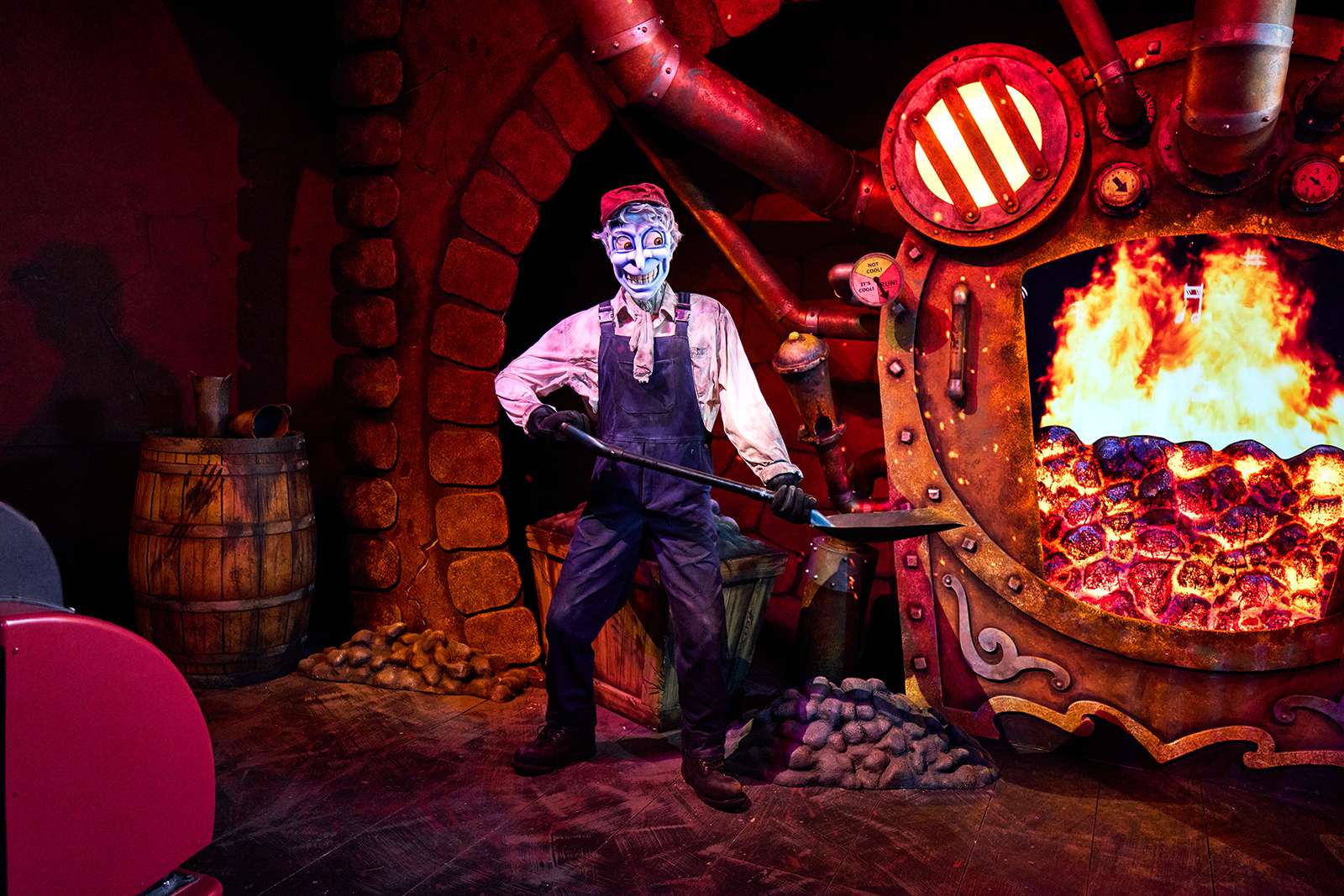
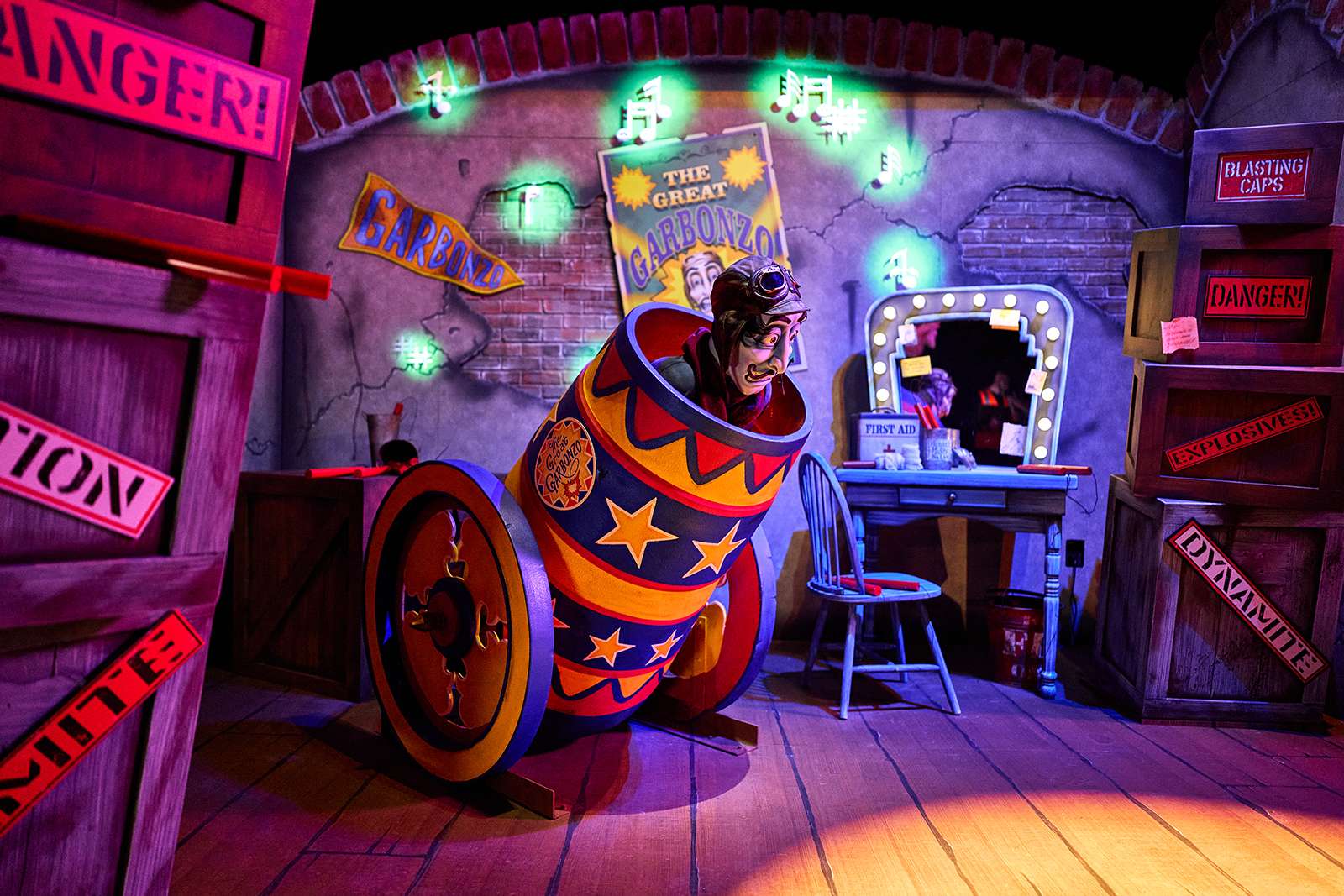
Classic elements returned to Phantom Theater: Opening Nightmare but often in reimagined forms. The boiler room, a fan favorite from the original, is still present, though in a new location. Character spaces like Hilda’s dressing room and Houdelini’s performance area have been updated to reflect new storytelling beats using modern technology. “We didn’t go too far afield,” Hunter says. “We wanted people to recognize those spaces. But we also wanted to surprise them.”
Adding to the experience
Sally Dark Rides worked closely with partners including Alterface, Techni-Lux, and Pure Imagination, along with composer John Citrone who wrote and recorded a custom musical score that references and ties the experience back to the original attraction.

Kings Island

Six Flags

Sally Dark Rides
One of the most significant changes from the original Phantom Theater is the addition of interactive gameplay using handheld “flashlights” from Alterface. Throughout the ride, moving ghost notes are projected directly onto the scenery and sets. “It was important for us to not have distinct screens in the attraction,” explains Hunter. “The projectors put the ghost notes directly onto the walls and scenic elements, appearing to make the gameplay area endless.”
Each flashlight is color coded, and guests see their colored circle of light appear in the projection wherever their flashlight is pointed. The devices are lightweight, provide haptic feedback for when ghost notes are zapped, and intuitive to use. Together, the projection system and interactive devices bring elements of competition and re-rideability. But for both Parks and Hunter, the key is restraint. “The interactivity had to add to the story, not take it over,” Parks says. “The targets are part of the environment,” he explains. “You could ride through and not even realize it’s a game.”
Hunter echoes that approach. “Even if you don’t pick up a flashlight, you have a complete ride,” he says. “But if you do engage with it, it encourages you to come back and experience it again.”
The role of dark rides today
Phantom Theater: Opening Nightmare highlights the evolving role of dark rides in regional parks. “I think every park should have an indoor immersive attraction,” Carovillano says. “It diversifies what you offer and can expand your audience.”
Parks echoes that sentiment, calling dark rides part of a larger programming strategy. “You want something for everyone,” he says. “Dark rides are a big part of that.” Phantom Theater: Opening Nightmare is certainly a major part of Kings Island’s strategy, and a demonstration of how legacy attractions can evolve to meet contemporary expectations while still honoring the past.
By combining nostalgia, interactivity, and collaborative design, Sally Dark Rides, Kings Island, and Six Flags have created an experience that celebrates Phantom Theater while embracing new generations of guests. For an industry often focused on what’s next, Phantom Theater: Opening Nightmare offers a reminder that sometimes the most powerful ideas might be the ones that never really left. •