For years, the audiovisual industry has measured progress in bigger numbers: more lumens, higher resolutions and increasingly sophisticated media servers. While those numbers are still important, the industry also appears to have other priorities, such as making increasingly complex systems easier to deploy, operate and maintain.
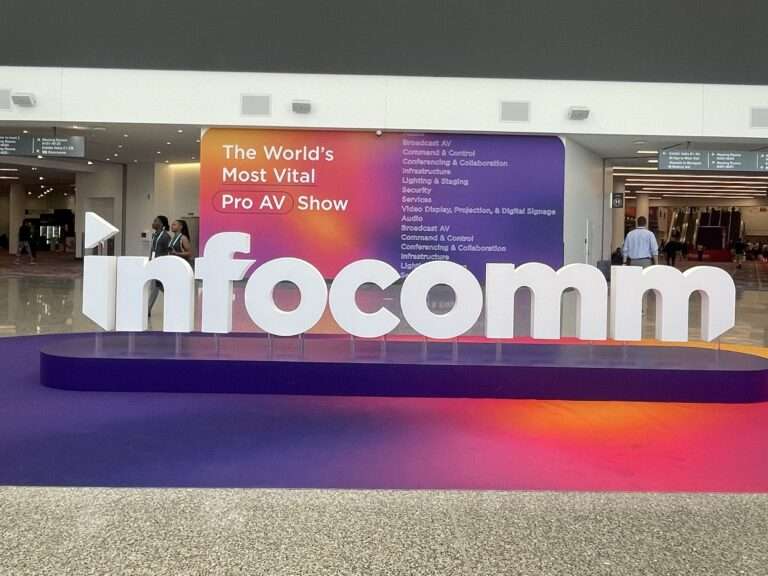
That shift was evident throughout the Las Vegas Convention Center during InfoComm 2026, held June 13-19. Over 28,000 attendees from 94 countries explored products from 800 exhibitors across nearly 400,000 square feet of exhibits. Artificial intelligence, immersive experiences, enterprise collaboration, digital signage, and integrated systems dominated both the educational sessions and product launches.
Making complicated systems simpler
One of the strongest trends was consolidation. Manufacturers are increasingly combining multiple functions into fewer pieces of equipment while reducing the amount of infrastructure required behind the scenes.
Sennheiser’s new Spectera wireless ecosystem is a good example. Built around the FCC’s new WMAS (Wireless Multichannel Audio Systems) regulations, Spectera combines wireless microphones and in-ear monitoring into a single six-megahertz platform. Instead of managing multiple RF systems independently, operators can monitor, automate, and control everything remotely over standard Cat5 or fiber infrastructure. The result is fewer racks, less cabling, fewer failure points, and easier operation.
Recently acquired by Panasonic, media server developer Hive said it wants systems to become almost invisible rather than adding complexity. Fewer servers, fewer connectors, fewer cables, and fewer opportunities for something to go wrong. For operators like theme parks, where reliability is paramount, that philosophy has obvious appeal.
Technology shrinks
Another noticeable trend involved physically hiding technology.
Christie’s North American debut of its Korus Series 1DLP projectors, offer a significantly smaller footprint delivering up to 14,250 lumens, making installation easier in museums and immersive attractions. Lens options allow the projector to be hidden above ceiling tiles with proper cooling.
Similarly, Barco introduced a new U-shaped “snorkel lens” as part of their ILD lens range (for I-series projectors) that makes hiding projectors out of view even easier.
Epson’s EB-XQ2030B 30,000-lumen projector cuts both size and weight dramatically thanks to a redesigned liquid cooling system called Advanced Cooling Engine (ACE), making previously challenging 30,000-lumen installations far easier to accomplish.
The technology becomes almost invisible, allowing designers to preserve the illusion rather than accommodate equipment. That mindset extends beyond projection. Integrated media servers, compact control systems, smaller lighting relays, and simplified networking all contribute to environments where guests see less equipment and more storytelling.
AI finds practical applications
Artificial intelligence was impossible to ignore throughout InfoComm. Microsoft and Cisco both devoted their keynote presentations to AI-powered collaboration, while AVIXA built multiple show floor experiences around AI-driven workplace technologies, customer engagement, and broadcast production.
On the exhibit floor, however, AI often appeared in more practical forms. Rather than replacing operators, manufacturers are using AI to simplify complex workflows.
Disguise’s new version of Mapping Matter includes an enhanced projector and LED library along with AI-tools that help search for custom projector specs, discover compatible lenses and view a 3D mesh of the chosen product.
With SwiftAgent, Barco introduced selectable AI-powered automation in its collaboration products, enabling intelligent speaker tracking, camera control, and smart switching workflows.
Museums and immersive experiences continue driving innovation
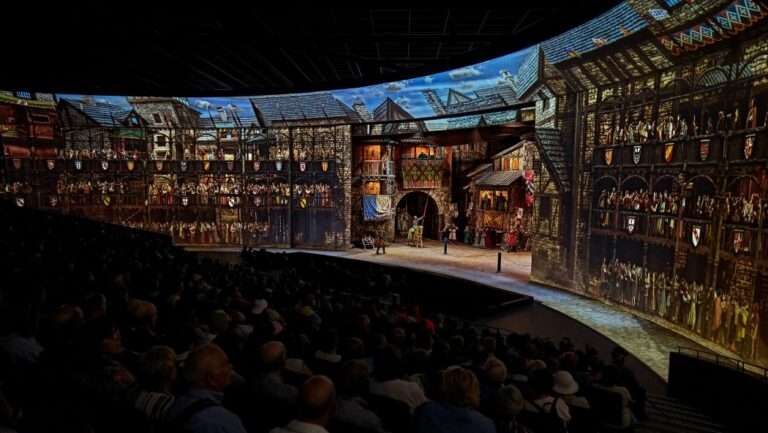
Although InfoComm serves a broad AV audience, museums and immersive attractions appeared to be one of the fastest-growing application areas. Many major manufacturers highlighted museum installations alongside themed entertainment.
- Pixera discussed work at the National World War I Museum and the Obama Presidential Center.
- Christie positioned its Spyder-S video processing platform for museums requiring large-scale LED visualization.
- Epson expanded their lens offerings with the H-Series lens lineup covering a throw ratio range from 0.35 to 11:1, with some options aimed specifically at immersive installations, plus its first dvLED solutions, the LE-C1 Series, ideal for indoor signage applications like brightly lit museum lobbies.
- Barco partnered with Pufferfish on an interactive spherical display, powered by a Barco I600 projector, that could find applications ranging from museums to visitor centers and themed attractions.
These are no longer niche markets. Manufacturers increasingly view museums, immersive art, themed entertainment, and experience centers as primary drivers for product development.
An easier future
Perhaps the biggest takeaway from InfoComm 2026 was an emerging understanding of the role of technology in themed entertainment. The AV industry recognizes that today’s immersive attractions aren’t limited by technology’s capabilities as much as they are limited by complexity and cost.
As systems become larger, operators increasingly value products that reduce maintenance, simplify deployment, automate routine tasks, reduce expenses and improve long-term reliability. For attraction owners, museums, and experience designers, that’s welcome news.
InfoComm 2027 takes place in Orlando, Florida from June 12-18, 2027.