
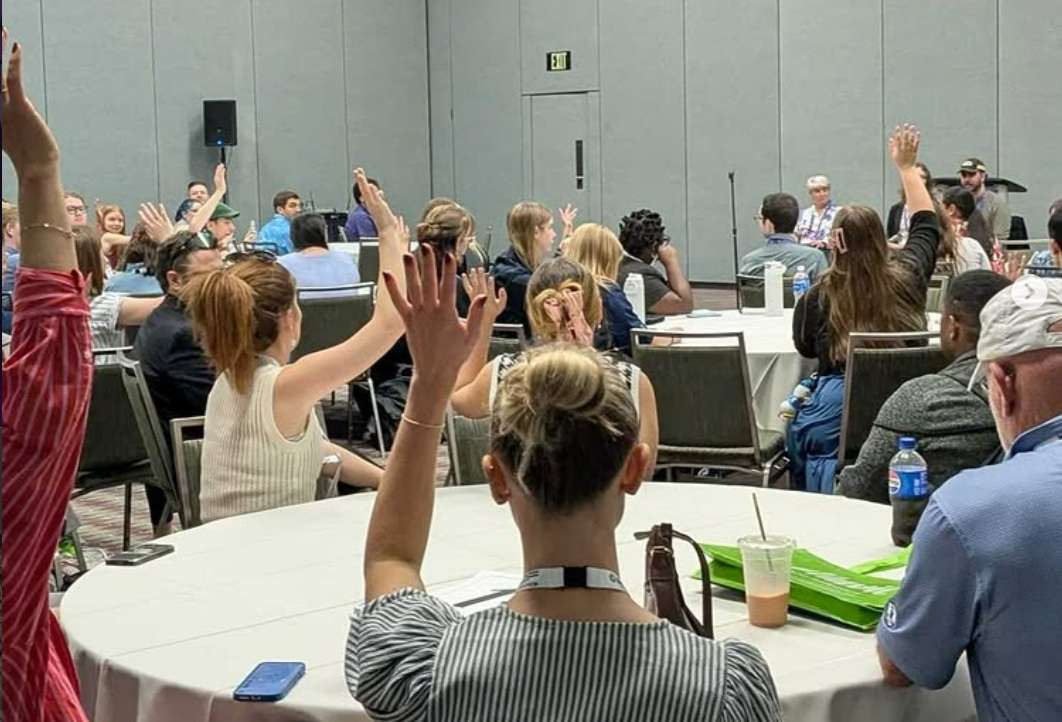
INPARK IS PARTNERING WITH BIG BREAK FOUNDATION TO BRING READERS A SERIES OF COLUMNS THIS YEAR ON ISSUES SURROUNDING DIVERSITY, EQUITY, INCLUSION AND ACCESSIBILITY. THIS IS THE FIRST OF THESE ARTICLES.
by Patrick Kling, Founder & Board Chair, Big Break Foundation

You might be asking yourself how a white, straight male ends up founding a nonprofit focused on inclusion, diversity, equity, and accessibility (IDEA).
That’s a fair question. Conversations around inclusion aren’t simple, and there are real disagreements about the role white men should play in this space. I’m not writing as an expert; but rather, as someone whose thinking changed, slowly and then all at once, through conversations inside the themed entertainment industry.
I grew up in Southern California believing in meritocracy. If you worked hard and treated people well, everything would work out. The idea of someone being denied a job simply because of their skin color or gender felt outdated to me. My family believed we didn’t see color. We were taught that everyone should be treated the same and that talent would rise on its own.
For a long time, I believed that was enough, and that belief followed me into my career.
The first crack in that thinking came in 2019. I was scrolling through Twitter when I saw a retweet of a project team’s photo. The user pointed out that the team was overwhelmingly white and male.
I responded asking what we could do about it. From my experience, the industry felt welcoming. No one I knew was actively trying to keep people out.
I received a blunt reply at first. But instead of ending the conversation, the person suggested I connect with a colleague who was trying to create change within the industry. I did, and we ended up having a long conversation that changed how I saw everything.
They were a person of color who recently landed a spot at one of our industry’s major companies. As they described their background, I was impressed. They were a writer and a musician, and they had a wide range of creative and technical skills. I remember saying how amazing it was that they could do so many things.
“No, Patrick,” they said. “I have to do all of these things. I HAVE to overperform. I have to do the work of five people.”
They explained that many of their white male peers could enter the industry with a single skill straight out of college. To compete, they needed to be exceptional across multiple disciplines just to be seen as viable.
That moment hit me hard. What made it even harder was realizing this wasn’t an isolated story. Study after study shows how people of color – especially Black, Latine and Indigenous applicants – are passed over in hiring decisions. In 2017, PNAS (Proceedings of the National Academy of Sciences) published research demonstrating that people of color receive fewer callbacks than white applicants even with identical qualifications.1 In 2024, researchers at NYU and Yale found employees of color receive fewer promotions.2 And a 2025 article in the Journal of Biomedical and Life Sciences found that even with higher levels of education and skills, Black employees continue to receive fewer economic benefits.3
As I kept learning, another moment stood out. I was watching a conference presentation when the speaker posed a scenario that felt uncomfortably familiar. You’re in a meeting and someone asks, “Does anyone know someone who could do this entry level job?”
The speaker explained that when a room is made up mostly of white people, the referrals that come out of it will usually reflect that makeup. Not because anyone is trying to exclude others, but because systems tend to reproduce themselves. Who we know, and who gets invited in often looks like what is already there.
One of the simplest solutions they offered was also one of the most eye opening. Open up the process. Create more than one door into the industry.
Then I came across a statistic that completely reframed how I understood hiring decisions. In 2016, the Harvard Business Review published research showing that when there’s only one woman or person of color in a final candidate pool, their chances of being hired are effectively ZERO. But, when there are at least two, their chances of landing a job are about 194 times greater, and their odds increase as the candidate pool diversifies.4
For me, the most pivotal point came during a virtual seminar called “The Listening” early in the pandemic. The two presenters pointed out that challenges faced by women and people of color are not problems they can solve alone. Change requires action from those who currently benefit from the system and are in the room.
They explained that many well-intentioned white men – myself included – move through systems that reward us in ways we may not even notice. Ignoring that reality doesn’t make things fair, but acknowledging it gives us a chance to fix what isn’t working.
That’s when I finally understood why saying “I don’t see color” isn’t neutral. It erases real experiences. It ignores the extra effort, pressure, and exhaustion that many people carry just to belong in the same rooms.
If we want people to actually succeed because of their character, talents, and knowledge, we have to create purposeful systems. That means taking responsibility for opening doors and changing how we hire.
IDEA is often oversimplified to just focus on skin color. But it’s more than that. IDEA addresses the real socioeconomic barriers in our industry. There are people who never had the right school, the connections, or the ability to move to the right city at the right time. And yes, there are many white men who are not benefiting from the system either, who are working just as hard and still struggling to break through.
Acknowledging inequity does not mean pretending everyone who looks like me has it easy. It means recognizing that the system itself is uneven, and that different people hit different obstacles along the way. If we want an industry where talent truly rises, then we have to care about all of those barriers, not just the ones that are easiest to see.
That is the work. Not blame. Not guilt. Just building something better, together. •
Patrick Kling is the Founder and Board Chair of Big Break Foundation, a 501(c)(3) nonprofit dedicated to making the location based entertainment industry more inclusive and welcoming to all. He has served as a creative leader on world class theme park and waterpark projects around the globe, with work spanning Nickelodeon, SeaWorld, Paramount, and other major brands.
- www.pnas.org/doi/10.1073/pnas.1706255114
- jamanetwork.com/journals/jamanetworkopen/fullarticle/2827174
- scipublications.com/journal/index.php/JBLS/article/view/1158
- hbr.org/2016/04/if-theres-only-one-woman-in-your-candidate-pool-theres-statistically-no-chance-shell-be-hired

