
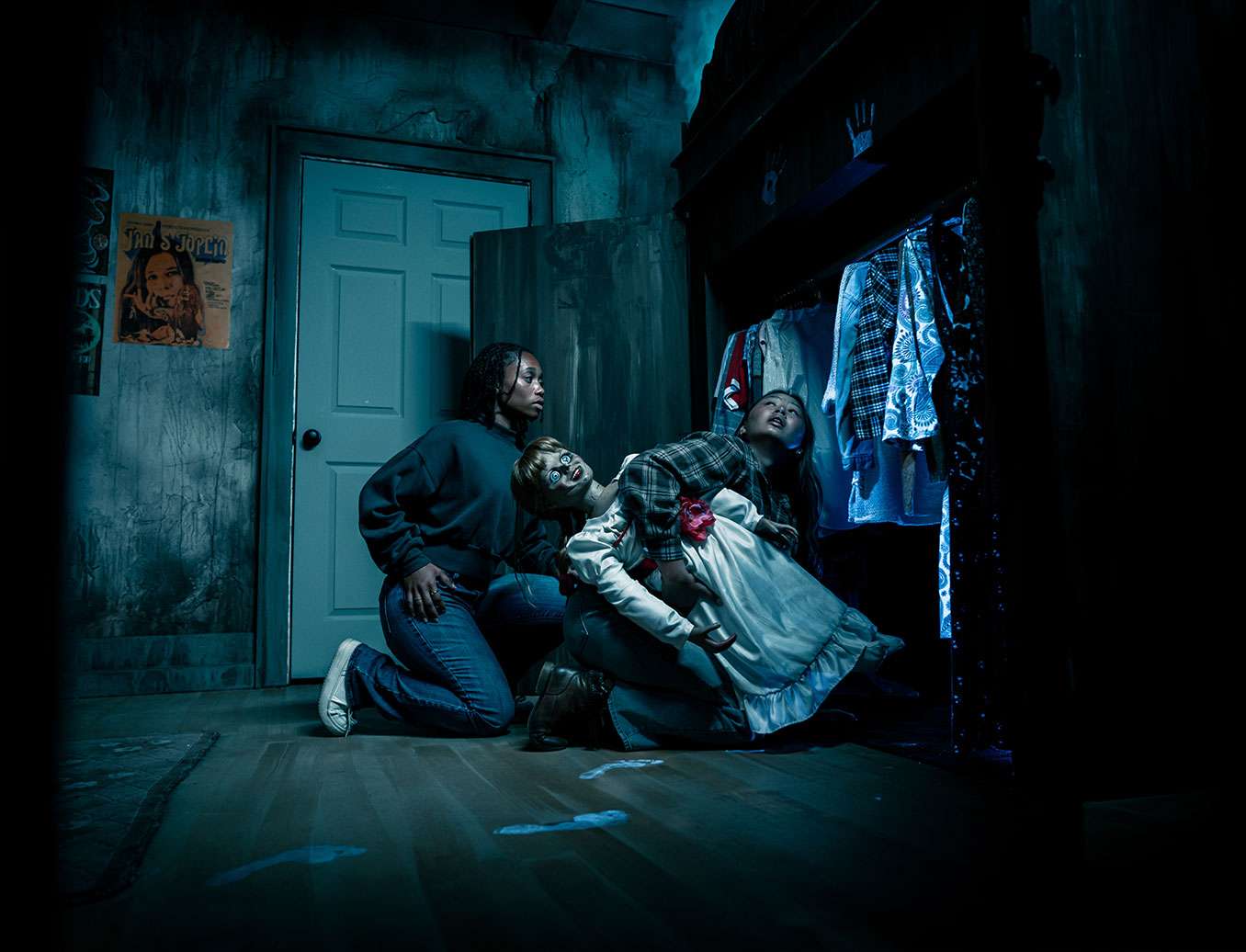
Six Flags, Plague Productions, and Warner Bros. Discovery Global Experiences invest in premium interactive horror with The Conjuring: Beyond Fear
by Phillip Hernandez
Fall is one of the most important and challenging seasons on the theme park calendar. For operators, the goal is to offer compelling experiences while moving large crowds efficiently through the park. That balancing act becomes especially difficult when haunted houses are part of the mix. For chains such as Six Flags, high throughput is essential. Long waits can quickly undermine guest satisfaction, but pushing more people through a haunted house can also mean a faster, more compressed experience with fewer opportunities to build suspense and deliver a scare.
Some parks have experimented with a different approach: slow the experience down, make it more immersive, and charge a premium for the privilege. Busch Gardens Tampa Bay’s Alone and Universal Studios Japan’s Hotel Albert demonstrated the model’s potential, but these experiences have largely remained isolated offerings rather than part of a broader operating strategy.
The Conjuring: Beyond Fear offers a different kind of case study. Developed by Six Flags and Plague Productions in partnership with Warner Bros. Discovery Global Experiences, the 20-minute interactive walkthrough is entering its second season at four Six Flags parks. The attraction offers a premium experience and something rare in the theme park haunt world: exclusivity. By reducing throughput and upping immersion, Six Flags is exploring whether guests will pay a premium to linger longer in a haunted attraction, and whether that model can work at scale.
The experience
The Conjuring: Beyond Fear runs during the fall at Cedar Point, Carowinds, Canada’s Wonderland, and Kings Island. Small groups spend roughly 20 minutes moving through 13 rooms drawn from the Warner Bros. horror film franchise, escorted by one of four guide characters, each themed to a different film in The Conjuring Universe. Rather than filing past scenes, guests are instead given a mission: recover cursed artifacts, carry the Annabelle doll from room to room, and lock her back in her case before the haunting escalates. In its debut season, Six Flags sold the experience under its SCREAMium premium brand as an upcharge option, on top of event admission.
“We wanted it to feel different from an escape room, so we created something that is a blend between both theatrical and maze experiences,” says Kelly Daugherty, Corporate Director of Live Entertainment at Six Flags Entertainment Corporation. For Jon Cooke, founder of Plague Productions, the haunted attraction design studio behind the experience, that north star of guest agency was the starting point. Giving guests a role to play and extending dwell time would be fundamentally different from other theme park haunted houses, and Cooke’s team began to brainstorm: How do we make it more than just a haunted house?
The solution was making interactivity part of the scare. “Going back to basics on haunted houses, a distraction can set up a really strong scare,” Cooke says. “By giving them a mission, we’re giving them actions, and as they are completing these tasks, we’re setting up big scares.” In one scene built from the first film’s hide-and-clap game, guests clap in an apparently normal room, hear a clap answer back, and watch the lights shift to UV, revealing footprints that lead to a wardrobe. The scare comes from above, and guests must then crawl between the walls to get out.
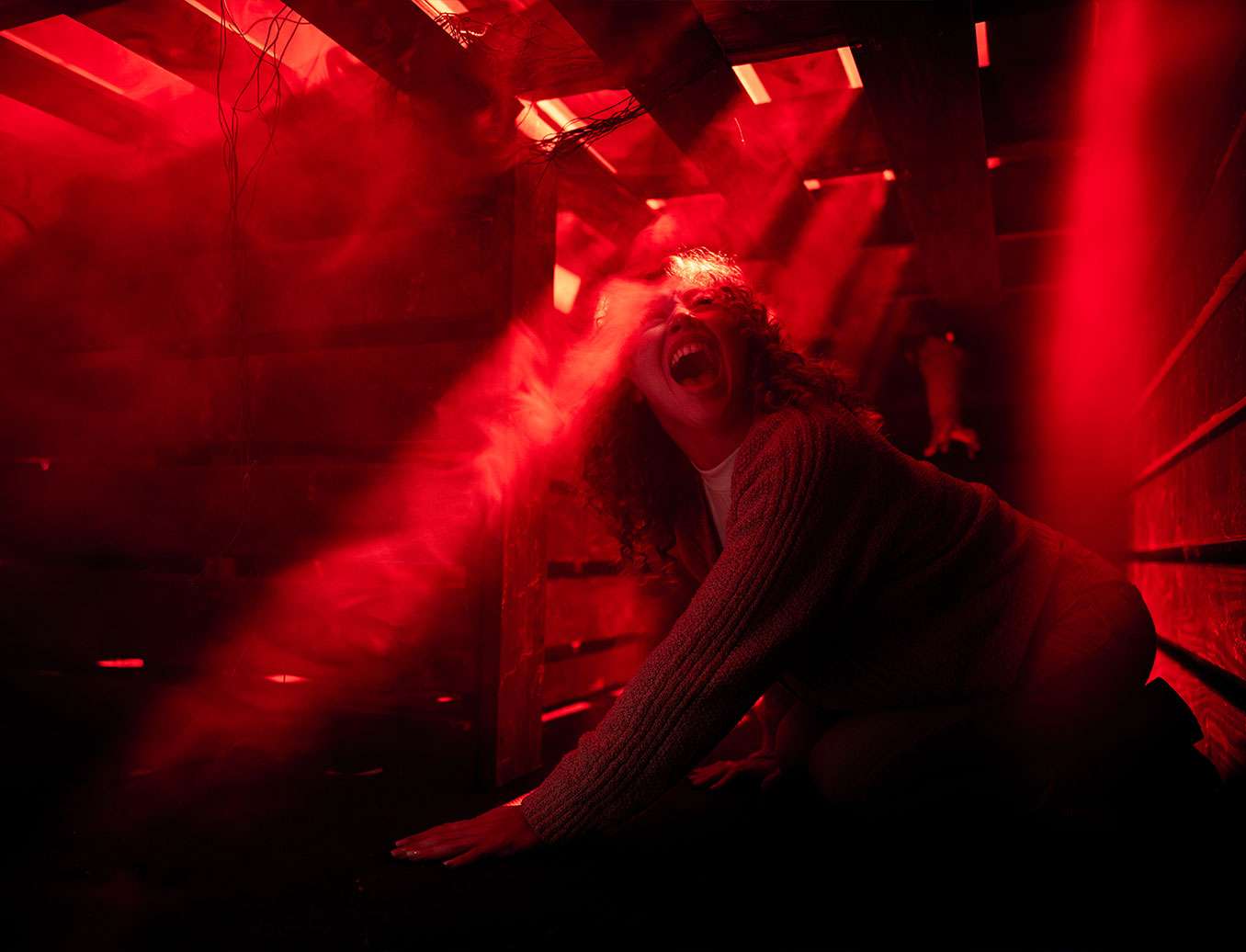
“We were aiming for roughly one minute per scene, but if the scenes take too long, our actors adjust to keep the show on time,” Cooke said.
The four guide characters escort groups through the experience and hand off to one another at the transitions as the story crosses from one film’s world into the next. “One disappearing and another one coming in is what helped bridge those gaps,” Cooke says. The guides set the pacing and the urgency, and they carry the exposition load that a ten-second maze room never could. Live actors throughout the rooms respond to each group in real time, adjusting to guests who lean in and guests who hang back.
The technology backbone
To create an experience this ambitious requires a lot of technology, all housed in permanent buildings. Every scene is networked back to a central control room over a Q-SYS system, with each scene triggered live by an actor. That architecture gives operations real-time visibility into pacing. “If scene seven is supposed to get triggered every 60 seconds but it’s getting triggered every minute thirty, we need to speed this up,” Cooke says. “In real time, we’re able to tell the guides to get through this part faster.” Technicians can also remote in to diagnose and fix bugs without stopping the show. “It’s definitely quite a bit more tech firepower than we’re putting into a standard haunt attraction,” Cooke says.
Lighting follows the same philosophy of dense capability in a small footprint. Gantom fixtures handle roughly 90 percent of the lighting in the experience. “It’s a great product, it’s versatile, and we really love the smaller fixtures,” Cooke says. “Being able to get the firepower out of this tiny fixture that you’d get out of a larger fixture is really good for us from an immersive standpoint, because guests are not seeing these giant fixtures.” The unified control also compresses troubleshooting. “We don’t have to go find the controller behind the wall and chase the cable,” he says. “In real time we know about an issue and how to fix it while keeping the show running.”
Betting on premium and IP
Beyond betting on a premium experience, The Conjuring: Beyond Fear was also a wager that fans would respond to IP at the legacy Cedar Fair properties. After Six Flags debuted IP mazes across the legacy Six Flags parks in 2024 (including The Conjuring Universe, Saw, Stranger Things, Trick ‘r Treat, Texas Chainsaw Massacre, and Army of the Dead), the newly merged company decided to bring branded haunts to parks that had never had them before: Cedar Point, Kings Island, Carowinds, and Canada’s Wonderland.
“With any new experience or attraction, we strive to capture what will resonate for our guests through various survey platforms, so we don’t go blindly into new projects,” Daugherty says. Still, she is candid about the risk. “With anything new, you’re going to take a bit of a gamble, even if you do all of the homework.”
After setting the north star direction, Six Flags reached Plague Productions, with whom they have an extensive working relationship, to execute. Plague Productions has worked with Six Flags and legacy Cedar Fair for most of Cooke’s career, and Daugherty calls the studio one of their most trusted creative and fabrication partners. “Six Flags dictated how we were to use the IP. We got to dictate what the experience was,” Cooke recalled.
Four installations in three months
The trust between Six Flags, Warner Bros. Discovery Global Experiences, and Plague Productions was critical because all four installations had to be completed in roughly three months. Although the four installations share scenes, sequencing, characters, and props, each occupies a unique footprint.
Plague designed the show for quick adaptation, with modular set pieces that reconfigure easily to each space. Programming also helped speed up the install; the control system was programmed once, then copied to the other locations. “The first one was important to get up as quickly as possible to give us time to fine-tune, and from there the other ones fell in line,” Cooke said.
A permanent footprint
Three of the four builds went into spaces that had never housed a haunted attraction, with the parks handling demolition, construction, and power. At Canada’s Wonderland, the experience occupies a level inside the park’s signature mountain that did not exist a month before installation began.
“A park only has so much footprint and so many indoor spaces,” Daugherty explained. “Anytime there’s an opportunity to do an entertainment activation in a space that’s a little more permanent, we will jump on it, because we can quickly reactivate the experience.” A permanent building also protects a technology investment; the density of show control, audio, and lighting inside The Conjuring: Beyond Fear is not the kind of system a park wants to tear down and rebuild every September.
Because the buildings stay dressed, Carowinds reopened its installation this spring for the park’s first Scream Break, a standalone spring event that ran April 3-12, 2026. “That was something we hadn’t done at Carowinds, and that was fun for the guests,” Daugherty says.
Lessons learned
For Six Flags, The Conjuring: Beyond Fear represents more than an experiment in premium Halloween. It is an attempt to rethink the economics and operating model of the haunted attraction itself. By slowing the experience down, giving guests an active role, and investing in permanent infrastructure, the company is testing whether fewer guests can generate greater value when the experience is deeper and more exclusive. If guests continue to respond, the model could offer operators another way to balance the competing demands of throughput, immersion, and revenue. And for haunted attraction designers, it may signal that the future of Halloween is not necessarily about getting more people through the door, but giving some of them a reason to stay longer. •
CREDITS
SIX FLAGS ENTERTAINMENT CORPORATION
Kelly Daugherty, Corporate Director of Live Entertainment
PLAGUE PRODUCTIONS
Jon Cooke, Creative Director / Founder Ted Dougherty, Writer / Show Director Kyle Arnold, Technical Designer
Ray Zupp, Art Director
Pierce Rolli, Production Designer
WARNER BROS. DISCOVERY GLOBAL EXPERIENCES
VENDORS
Gantom Lighting and Controls, Lighting Manufacturer
Q-SYS, A/V Controls