
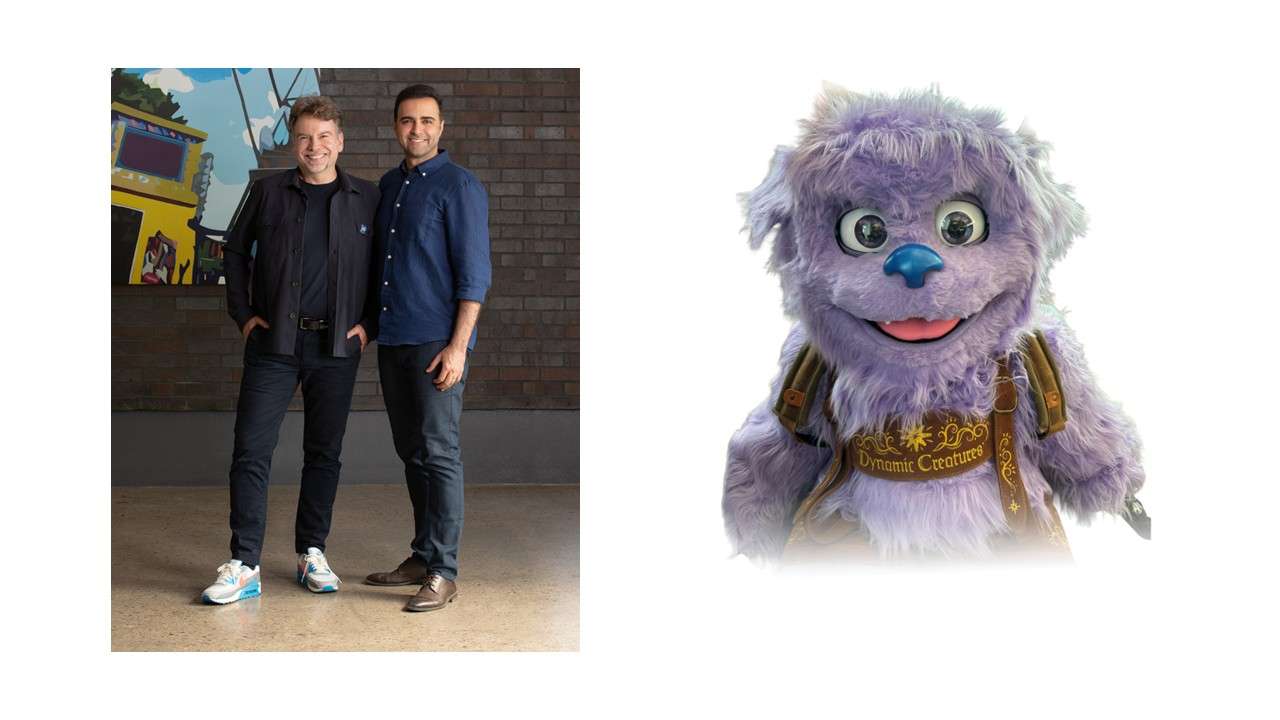
Backed by an official partnership with Boston Dynamics, Dynamic Creatures is bringing interactive robotic characters into entertainment and hospitality
Interview by Becci Knowles
Dynamic Creatures was launched in September by two leaders with extensive experience in robotics and technology. CEO Marc Theermann is the former chief strategy officer at Boston Dynamics and a former senior leader at Google. Chief technology officer Farbod Farshidian is a robotics researcher and former research leader at the Robotics and AI Institute.
At Boston Dynamics, Theermann saw growing interest in using robots for entertainment, from halftime shows to music videos. “We did some fun things,” he says, “but it was never really a focus for the company.” Dynamic Creatures was created to bring that capability into guest-facing environments. “Our characters do more than perform for a crowd,” says Theermann. “They can respond to an individual and create small moments of wonder that people remember.”
InPark: What convinced you that now was the right time to launch Dynamic Creatures?

CEO
Marc Theermann: For years, robots were controlled by classic “if-then” software: If this happens, then you should do this. You needed a lot of expertise and millions of lines of code to make robots perform very interesting behaviors.
Three years ago, reinforcement learning became a force in robotics. That meant robots could teach themselves in simulation, which dramatically expanded the types of behaviors they could perform. Suddenly, their movements became much more natural, and you could build features on top of that to make them look and behave like a specific creature rather than a robot.
The second reason was that hardware prices are dropping dramatically. Put those two things together, and the timing was right to fulfill my lifelong ambition.
InPark: Dynamic Creatures is establishing a category somewhere between traditional animatronics and task-oriented service robots. What does that look like in practice?
Theermann: Traditional stationary animatronics cannot freely move around a park, and their motions are often pre-programmed. What we’re bringing to the table is taking the advances that have been made in autonomous robotics and marrying them with classic animatronics.
The result is a character that is not confined to a stage or a fixed position. It can move through an environment, interact with guests and respond to what is happening around it, while still behaving like the character it is supposed to be.
InPark: Your partnership with Boston Dynamics is a significant part of that proposition. What does it enable you to do?
Theermann: Stationary robots have been around for many years, but Boston Dynamics robots really shine at walking around. They have a quadruped robot called Spot with four legs and a biped called Atlas. Both are among the most advanced robots in the world.
Our partnership allows us to buy these robots, modify them with software and hardware, and then sell them into the entertainment industry.
InPark: If the technology is becoming increasingly capable, how do you make sure the story and character remain in control?
Theermann: We work with IP holders to stay true to their storyline, and with IP holders and their partners to develop those storylines. We have creative people on staff, but most often the story will come from our clients and partners.
The character has to come first. The technology is there to bring that character to life.
InPark: That seems to be where SnowJay comes in. What is SnowJay, and how does it support those guest interactions?
Theermann: What Android is to mobile phones, SnowJay is to robots. It’s an independent robotic operating system that allows us to stay in character with movements and voice at any time.
If you have a character with a very distinctive walk, you want the character robot to always mimic that walk. The same applies to what a robot says. Characters can’t suddenly respond to questions about political affiliations or the stock market. The character has to always stay in its role.
InPark: How much of a character’s behavior is authored in advance, and how much can adapt in real time?
Theermann: To always stay in character, we need to take animations of a specific IP, feed them into our reinforcement learning system and create a robot policy that mimics the behavior of the creature.
That policy allows the robot to maintain the character whether it is teleoperated, puppeteered or acting autonomously.
InPark: So how autonomous can these characters actually be in a theme park?
Theermann: For the foreseeable future, our robots will always use a combination of autonomy and puppeteering, both for safety and for better guest interaction.
As an example, if I give you a controller to drive a Boston Dynamics Spot robot, you cannot drive it into a wall or a human. The robot’s autonomy kicks in and says, “You’re giving me a command that I cannot fulfill.”
At Boston Dynamics, we call this assisted autonomy. You have this in your car. Maybe your car brakes when you’re about to hit another vehicle. You’re still in charge, but the robot helps you. Over time, our plan is to move from teleoperating the robot toward telemonitoring. The person monitoring it might be in a different building or even a different country. We’ll introduce more and more autonomy, and in five years’ time, our hope is that these creatures live in the parks fully autonomously.
InPark: That raises an obvious question about safety and public perception. What do you say to people who are hesitant or fearful of incorporating this type of technology and think of scenarios like Westworld?
Theermann: For the foreseeable future, there will always be a human in the loop. In the beginning stages of these deployments, if anything goes wrong, the human can press a physical button and the robot will stop.
I’m a tech optimist. I’m excited about the future. I think the Western consumer psyche is often imprinted by very dark fictional narratives, which is not the case in Asia. In Asia, people are super excited about robots. For example, Chimelong Spaceship theme park in China recently introduced 300 robots to the park, integrated into many areas of the park’s operations.
This future is coming. If you’re a theme park operator, you can wait on the sidelines or lean in and take advantage of the excitement about untethered characters and the viral PR you can get by deploying something like this.
InPark: What are you hearing from theme park operators, and what do you expect the first deployments to look like?
Theermann: Our theme park clients are excited about the future of untethered characters. It’s been a dream in the theme park industry for many years. At IAAPA Expo Europe, people were thrilled and immediately understood what we were trying to do.
Of course, safety has to come first. The robots should be safe enough to be around humans, and they need to stay in character at all times. I think anything we do with our theme park clients in 2027 will be managed pilot programs, where we send humans and robots at the same time.
InPark: You offer characters built on existing robotic platforms as well as fully original robots. How should an operator think about that choice?
Theermann: Every situation is different, but we will always put story and character integrity first. Depending on the character, we’ll make a hardware suggestion. If anybody wants to build a four-legged robot, Spot is the best choice in the world. People have built different characters on top of Spot already.
InPark: You’ve also talked about a “robot as a service” model. Why does that make sense for this emerging technology?
Theermann: Since everything we do in the foreseeable future is managed, we think the business model will be “robot as a service.”
You might say to us, “I’d like a walking dog character.” We’ll respond, “Why don’t we do a six-month pilot? We’ll come with robots and humans, and you pay as you go.”
Some of the larger theme park owners might want to own the technology outright, and of course we’ll be open to that. But this is such novel technology and such a quantum leap in capabilities. We’re not only adding free roaming capabilities to animatronics, we’re also adding autonomy, and free-form guest interactions at the same time.
InPark: How do you see robotic characters working alongside human performers?
Theermann: I think our creatures are always additive. Nothing beats a magical human interaction with a beloved character. But operators are limited in the characters they can create with humans in a costume. Not to mention that in many theme parks in the Southern United States it’s 110°F outside in summer, and there is a human in a costume that is probably 150 degrees inside. It’s also quite challenging to create a small dragon, a baby dinosaur, a frog, something that swims or something that flies.
I believe the solution is a theme park full of human actors, but that is also populated with hundreds of creatures crawling, flying, swimming and interacting with guests in ways that are impossible with a human in a costume.
InPark: That suggests a very different kind of park environment – one in which characters aren’t necessarily assigned to a show or attraction. What do you think that could ultimately look like?
Theermann: The exciting thing is that these creatures can become part of the environment rather than simply something guests go to see.
A character could encounter one guest, have a completely different interaction with another guest and then continue moving through the park. That creates the possibility for small, unexpected moments that feel personal. And because the creatures can be reprogrammed, those interactions don’t have to remain static. The same character could behave differently as the story or the experience evolves.
InPark: What would you like attraction designers and operators to understand about what is now possible?
Theermann: I want them to know we have just blown the lid off what is possible. Up until now, parks were limited in what they could do with stationary animatronics. Now we can bring to life anything they can dream of in super-magical ways that react very naturally and are incredibly flexible. The possibilities are endless. •

