Home Blog Page 22

Maurer Rides expands lineup of Spike coasters, featuring higher throughput options

0

Munich-based roller coaster manufacturer Maurer Rides is extending its Spike family with two new products: Spike Train and Spike Tandem. Both bring the interactive, software-defined Spike ride feel to the hourly capacity that large parks expect from a headline attraction.

Spike Train – The motorbike coaster, reinvented

Spike Train takes the familiar motorcycle riding position and rethinks it. Riders sit as if on a motorcycle – but this time in vehicles that can be coupled into a train. The result is the hourly capacity of a classic large coaster, combined with the dynamics and interactivity Spike stands for.

With Software-Defined Dynamics, the ride profile is programmable rather than fixed; through interactive control, guests actively shape what happens. This brings the motorcycle riding feel to the scale of a major headline attraction.

Spike Tandem – The immersion coaster, software-defined

Spike Tandem is the immersion coaster of the Spike family. The tandem arrangement brings more riders per train onto the track, and with it the hourly capacity a headline attraction needs. Spike Tandem combines the immersion of a dark ride with the accelerations and speeds of a roller coaster.

This is made possible by the principle of vehicle intelligence: the drive and the ride logic sit in the vehicle, not in the track. The entire ride profile – speeds, stops, backward sections, effects – is fully programmable via Software-Defined Dynamics and changeable by update. And all of this without any additional hardware in the track: friction-wheel drives or brake fins are not required, because every vehicle brings its own drive and braking force through the rack.

A shared foundation: Proven Spike technology

As different as the two products are, their basis is identical: the proven Spike rack-and-pinion drive with 100 percent traction, acceleration at any point on the track, energy recovery during braking and a redundant drive layout. Both vehicles are part of the modular Spike platform – the same technology base that Maurer Rides will present in full this autumn. For parks that means: new capacity on a foundation that proves itself every day across ten installations worldwide.

“Tandem and Train bring the interactive Spike experience to the capacity level large parks need for a headline attraction – with no compromise on the ride feel,” says Jörg Beutler, General Manager, Maurer Rides GmbH.

Boston Children’s Museum to appoint Melissa Higgins as new President and CEO

0

Boston Children’s Museum announced that Melissa Higgins has been appointed President and Chief Executive Officer, succeeding Carole Charnow. Higgins currently serves as Vice President of Programs and Exhibits, where she leads the Museum’s play-based learning experiences and oversees public programs and exhibit development onsite and in the community.

“Melissa has been an innovative and inspirational leader at the Museum for over eight years,” said Charnow. “I could not be more thrilled to welcome her as the Museum’s next President & CEO. Her many years of experience in museums, educational television, and online learning have prepared her well for this exciting opportunity. Plus, she is already highly regarded and deeply respected by her colleagues at Boston Children’s Museum and by the children’s museum field nationwide. We are incredibly lucky to have her as our next leader!”

Since joining Boston Children’s Museum in March 2018, Higgins has risen from Senior Director of STEAM Programming to Vice President of Programs and Exhibits. She has led key initiatives such as the Museum’s STEAM and Art Labs, online play-and-learning resources, the CreatedBy Festival, summer camp programs, and several exhibit redesigns, while securing grant funding and developing partnerships that broaden access to high-quality learning experiences for children and families.

“I believe deeply in the power of Boston Children’s Museum to create positive change and impacts—for families in Greater Boston and far beyond. Over my 8 years at the Museum, I have seen firsthand how this institution catalyzes meaningful, inspiring, and joyful learning,” said Melissa Higgins. “The opportunity to further support the Museum’s mission as CEO is a tremendous honor. As an educator and as a mother, I am excited to develop new experiences for children that meet this moment in playful and impactful ways.”

Earlier in her career, Higgins worked in WGBH’s education department and served as Director of Curriculum Development for the Engineering is Elementary program at Boston’s Museum of Science. She earned a B.A. in Architectural Studies from Connecticut College and an M.A. in Museum Studies from Harvard University Extension School.

“The Board is profoundly grateful to Carole for her extraordinary leadership and lasting contributions to Boston Children’s Museum,” said David Healy, Board Chair. “We are confident that Melissa’s vision, experience, and dedication to children and families will build on that legacy and strengthen the Museum’s role as a vital community resource.” 

Higgins will begin her new role on August 17. After retiring, Charnow will be honored with the title of President Emerita, recognizing her 16 years of distinguished service to the Museum.

Hasbro family entertainment center to arrive at Pigeon Forge in summer 2027

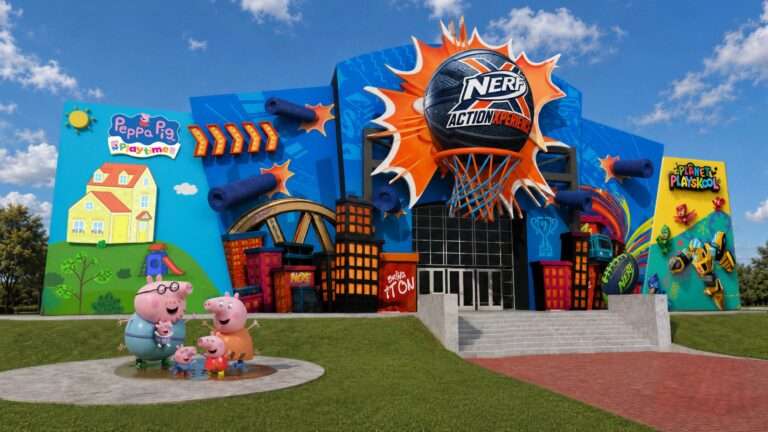
Safe Harbor Development, in partnership with Kingsmen Xperience, Inc, under license by leading games, IP and toy company Hasbro, unveiled plans for The Play District: Powered by Hasbro, an immersive, multi-attraction entertainment destination coming to the Smoky Mountains. The Play District will bring iconic brands like NERF, PEPPA PIG, PLAY-DOH and TRANSFORMERS, to one of the country’s premier family vacation destinations.

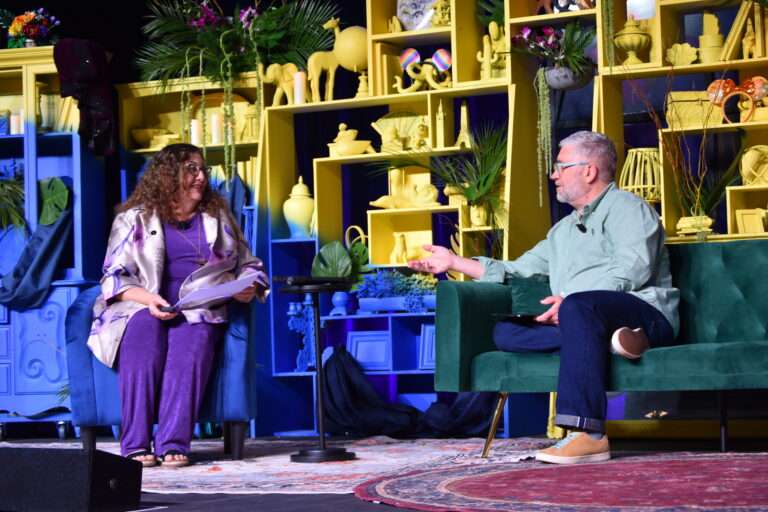
InPark Publisher Martin Palicki recently sat down with an interview with Matt Proulx, Senior Vice President, Global Experiences, Partnerships and Music at Hasbro, to discuss the toy company’s strategy of bringing games to life through experiences.

With plans to open summer 2027, The Play District will be Pigeon Forge’s newest go-to family activity destination, bringing immersive, brand-inspired play experiences together under one roof. Guests can expect three distinct, high-energy attraction areas designed for families and visitors of all ages whether they want to explore, compete or imagine together. The attractions will include:

  • NERF Action Xperience: A dynamic, adrenaline-filled arena where guests can test their skills in competitive challenges. Suitable for kids and adults, this area will feature an obstacle course, curated arcade games, laser tag, a first-of-its-kind NERF ride and more.
  • PEPPA PIG Playtime: Inspired by PEPPA’s iconic house on the hill, guests can enjoy a play-driven family experience in beloved locations from the preschool series.
  • Planet Playskool: A vibrant, sensory-rich, interactive environment where kids and their families can create, play, and explore. Planet Playskool will feature experiences from brands such as PLAY-DOH, TRANSFORMERS, PJ MASKS, MOUSE TRAP and more.

“At Safe Harbor Development, we’ve always believed the best experiences are measured by how people feel when they leave,” said Darby Campbell, Founder & Chairman of Safe Harbor Development. “The Play District: Powered by Hasbro is more than an entertainment venue — it’s a reimagined family destination designed to create happy places and smiling faces. By combining iconic brands with immersive, interactive attractions, we’re creating a place where families can connect, spark their imaginations, and make lasting memories together. If families leave smiling and feeling closer than when they arrived, then we’ve done our job.”

Representing an initial $50 million investment in the Pigeon Forge community, the project is being brought to life by Safe Harbor Development through its affiliate, Indoor Entertainment, LLC, which operates the property.

“This collaboration between Safe Harbor Development, Kingsmen Xperience, and Hasbro allows us to extend our brands beyond the toy aisle and into real-world experiences,” said Matt Proulx, Senior Vice President of Global Experiences, Partnerships and Music at Hasbro. “The Play District will give families the opportunity to step into the worlds they already love to create unforgettable memories.”

Beyond the themed play areas, the approximately 50,000-square-foot venue will offer dedicated space for birthday parties, group events, school and camp outings and team-building activities, making it an ideal destination for gatherings of all kinds. In addition to the attractions, The Play District will also feature food and beverage offerings and on-site retail, including exclusive product.

“Darby Campbell and Safe Harbor Development are renowned for their expertise and success in property development and providing exceptional guest experiences, said Corey Redmond, Senior Executive Vice President of Kingsmen Xperience. “Our partnership with them, along with Kingmen Xperience’s design and project management expertise, will realize our long-awaited plan to bring world-class Hasbro attractions and iconic brands to Pigeon Forge.”

Construction is currently underway, with more details, including opening timelines, ticketing, and more to be shared in the coming months.

The Bureau International des Expositions conducts the 178th General Assembly

0

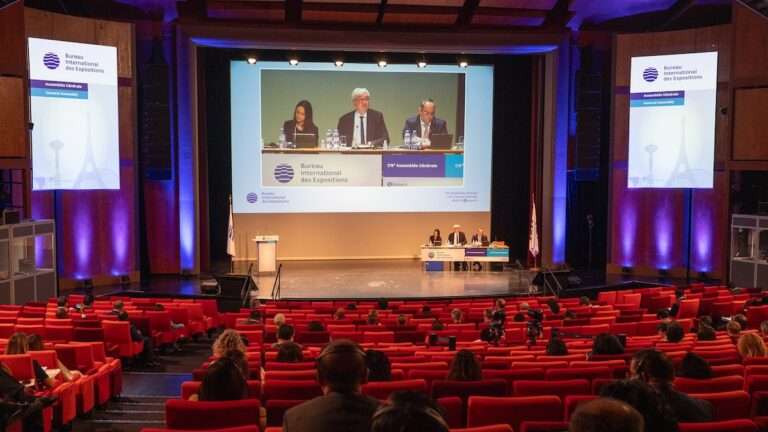
The Bureau International des Expositions (BIE) held its 178th General Assembly in Paris on June 16. Delegates representing the 184 Member States of the BIE attended the meeting, which included reports and presentations from upcoming Expos.

The first part of the session featured reports from the meetings of the four committees of the BIE: the Administration and Budget Committee, the Executive Committee, the Rules Committee, and the Information and Communication Committee. Each committee provided updates on recent work and strategic priorities, contributing to the overall governance and coordination of BIE activities.

World Expos

During the General Assembly, Member States approved the text of the Expo 2030 Riyadh See Agreement, a legal framework that will guarantee the privileges and special conditions for official participants in the next World Expo. Once signed and ratified, the agreement will formalize Saudi Arabia’s commitment to creating the necessary conditions to welcoming hundreds of countries and international organizations for the event.

Presenting an overview of preparations, H.E. Abel Al-Jubeir, Commissioner General of Expo 2030 Riyadh and Minister of State for Foreign Affairs, indicated with satisfaction that 135 countries have confirmed their participation to date. He reaffirmed Saudi Arabia’s commitment to working closely with the BIE and with all Member States to deliver an Expo that reflects the highest aspirations of the international community. Describing Saudi Arabia as a crossroads of civilizations, cultures and trade routes, he highlighted Expo 2030 Riyadh as a platform “where innovation serves humanity, where cultures connect through openness and mutual respect, and where collaboration becomes a catalyst for meaningful and lasting impact.” Talal AlMarri, the CEO of the Expo 2030 Riyadh Company (ERC) presented Member States with key milestones in the Expo’s preparations, including the finalization of the detailed Master Plan and the announcement of the first International Participants Meeting, to be held in Riyadh on November 3–4, 2026. He noted that the 6-million-square-meter site will feature more than 225 pavilions, six signature buildings, and over 61,000 newly planted trees. He further underlined that the Expo’s theme, “Foresight for Tomorrow,” will be explored through five sub-themes: Technology, Planet, Humanity, Culture, and Collaboration, which will translate the theme into a “clear and action-oriented framework.”

Specialized Expos

Member States received an update on preparations for Specialized Expo 2027 Belgrade from Dusan Borovcanin, Advisor for International Relations and Cooperation with the BIE. Mr. Borovcanin indicated that the total number of confirmed official participants now stands at 139, following a successful International Participants Meeting held in March 2026. The Expo’s Program and Content team is working closely with international participants to strengthen thematic coherence, with the Theme Weeks also serving as a key planning tool essential to creating a meaningful program for visitors and participants alike once the Expo opens its gates on May 15, 2027.

The presentation also highlighted progress in the delivery of the Expo with construction work progressing according to schedule as well as ongoing efforts to engage the public, including the launch of volunteer recruitment through the “EXPO Playmakers” initiative, and a series of events marking the one-year-to-go milestone on May 15. Ticket sales and official merchandising will officially begin on September 15, 2026. Addressing the Expo’s legacy, Mr. Borovcanin underscored the efforts to leverage the intangible heritage generated by the event, stating “we are working to ensure that not only infrastructure, but also knowledge, partnerships and public engagement created through Expo continue to serve Belgrade, Serbia, and the wider region long after the closing day”.

Horticultural Expos

Opening in less than 300 days, Horticultural Expo 2027 Yokohama is entering its final stretch of preparations, the General Assembly was told by Organizers. Ambassador Jun Shimmi, the Commissioner of Expo 2027 Yokohama, reaffirmed the Expo’s ambition to go beyond horticulture and address pressing global challenges such as food security, climate change and biodiversity loss, through a focus on carbon-neutral, environmentally-friendly and circular economy solutions. With advance ticket sales now underway and Prime Minister Sanae Takaichi having been appointed Honorary President of the GREEN x EXPO last month, anticipation continues to build.

The Executive Director of the Expo Organizer’s International Department, Taijiro Kimura, presented the master venue and construction of the Expo site and indicated that several of the Expo’s exhibits and facilities are reusing materials from Expo 2025 Osaka Kansai in a demonstration of circularity. Internationally, 70 countries and five international organizations have thus far confirmed their participation. In addition to regular dedicated sessions, a key step in preparations will take place at the International Participants Meeting taking place in Yokohama on June 30 and July 1 this year.

Registration opens for the largest IAAPA Expo ever

0

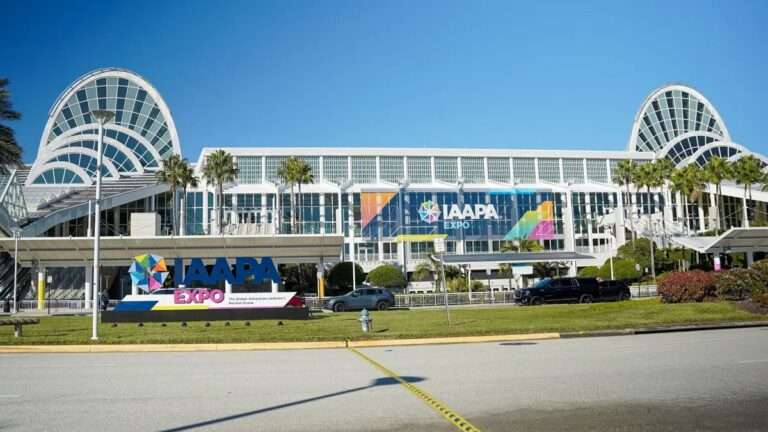
Registration is now open for IAAPA Expo 2026, the premier global event for the attractions industry that brings together professionals from theme parks, family entertainment centers, zoos, aquariums, museums, resorts, and beyond. Set to take place November 16-20, 2026, at the Orange County Convention Center (OCCC), this year’s Expo will mark the event’s largest footprint to date with its expansion into the West Building.

As the largest IAAPA Expo ever, the event will also offer the most educational opportunities in its history. More than 170 expert-led sessions will provide attendees with practical strategies and tangible insights across operations, technology, guest experience, safety, sustainability, and more. Over 1,100 exhibiting companies from around the world will showcase the latest innovations, products, and services shaping the future of the attractions industry.

Expo expands into the West Building

As the attractions industry continues to grow, IAAPA Expo 2026 will expand into the West Building of the OCCC, creating additional space for exhibitors while enhancing the overall attendee experience. Several fan-favorite attractions will be hosted in the West Building, including the Food & Beverage Pavilion, which has doubled in size and will feature live chef demonstrations, the Halloween-themed Haunting Grounds, and the EDUTalk Stage.

The West Building will also introduce new experiences, including the What’s New Theater and Young Professionals Hub, providing attendees with opportunities to learn, connect with peers, and engage with the next generation of industry leaders.

South Building experiences

IAAPA Expo will debut two new themed lounges designed to foster connections and highlight emerging industries. The new Cruise Lounge will serve as a dedicated space for attendees to rest, recharge, and connect on the latest trends shaping the global cruise industry. A new Glamping Lounge will be available for networking and discussions evolving around nature and adventure parks.

Signature experiences return

The Expo will once again feature a robust lineup of networking events. From behind-the-scenes EDUTours and sector-specific receptions to special ticketed events like the Leadership Breakfast and the Women in the Industry Networking Lunch, attendees will have countless opportunities to exchange ideas and gain inspiration from peers across the globe.

Todd Andrus, Executive Director and Vice President, IAAPA North America, said: “IAAPA Expo remains the place where the global attractions community comes together to discover new ideas, build relationships, and shape the future of our industry. With the addition of the West Building, we’re able to create an even more dynamic experience for our members and attendees — one that offers expanded opportunities for business growth, professional development, and collaboration across every segment of the attractions industry.”

“IAAPA Expo is one of the few locations where attractions professionals from around the world come together under one roof,” said Luciana Periales, President and CEO of Neverland Parks and Chair of the IAAPA Board of Directors. “As an operator from Latin America, I have experienced firsthand the value of learning from colleagues across different markets, cultures, and sectors. The connections made at IAAPA Expo often spark new ideas, partnerships, and innovations that continue to shape our businesses long after the event concludes. Together we make a safer, stronger, and more impactful industry.”

IAAPA Celebrates returns to Universal Epic Universe

IAAPA members can enjoy an exclusive evening at Universal Epic Universe. Guests will experience a full night of entertainment, attractions, and food and beverage offerings during one of the most highly anticipated events of IAAPA Expo 2026. The all-inclusive evening provides attendees the chance to celebrate with friends and connect with industry peers.

Epson reveals new 4K laser 3LCD projector at InfoComm 2026

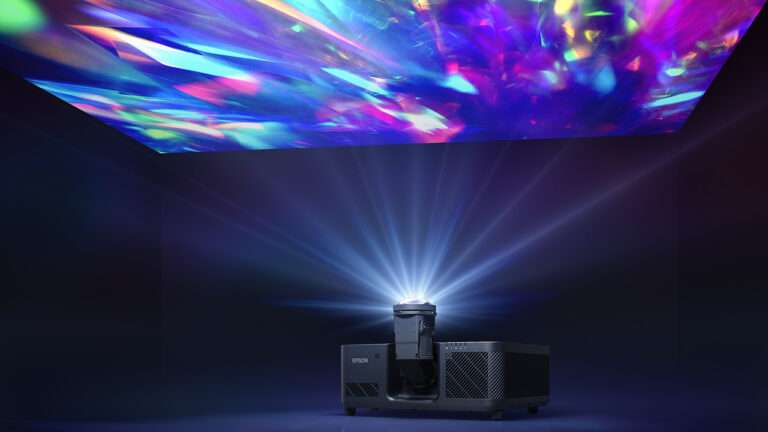
There is a surge of large-display installations across multiple markets – from bright, expansive auditoriums and gymnasiums in higher education to large-scale immersive environments across themed entertainment, live events and landmark installations. Designed to deliver the image performance artists and creative teams need to bring ambitious visions to life, especially in productions where color, contrast and detail are critical to the experience, Epson announced the new EB-XQ2030B 30,000-lumen, 4K Laser 3LCD projector. The EB-XQ2030B pairs 3-chip 3LCD color, impressive black levels and vivid 4K detail at up to 30,000 lumens of brightness, enabling large-scale visuals with the depth and clarity demanded by world-class immersive environments.

“Projection technology continues to evolve at a remarkable pace, and our commitment to leading that evolution has never been stronger,” says Chris Teguh, product manager, Epson America. “Our continued investment in projection technology has enabled this incredible engineering achievement. The EB-XQ2030B pushes the boundaries of what’s possible in large-venue projection, delivering unprecedented brightness, and impeccable image quality in a smaller, lighter footprint. This combination empowers artists and creators to bring their work to life in places that were previously unfeasible.”

Brilliant visuals without the bulk

At its core, the EB-XQ2030B’s 3-chip 3LCD technology produces rich, full-color output, while high native contrast delivers the deep black levels essential for immersive, large-scale experiences. Its 4K Crystal Motion technology produces detail with clarity, enabling immersive and interactive experiences across complex surfaces and demanding environments.

Enabled by Epson’s proprietary Advanced Cooling Engine, its dramatically reduced size and weight, along with optimized airflow for quiet, efficient operation, give system designers greater flexibility to integrate high-brightness projection into a wide range of venues without compromising architecture, sightlines or visual impact. To further enhance flexibility for complex installations and creative applications, Epson is also introducing its new H-Series lenses with an expansive throw ratio coverage (0.35–11:1).

Designed with every stage of transportation and installation in mind, the projector’s precision-engineered chassis balances power with a compact, deployment-friendly form factor. Plus, its hermetically sealed optical engine and filterless design with IP6X-rated dust resistance reduces maintenance and service disruptions in hard-to-access environments, so integrators can count on consistent visuals from installation through long-term operation.

Built to withstand the rigors of permanent deployment and evolving AV ecosystems, a newly integrated Intel SDM slot offers expandable connectivity with support for AVoIP and media player modules to give integrators and creators the freedom to build around current infrastructure and workflows. Additionally, Epson software tools and NFC quick read/write configuration via Epson Projector Configuration Tool simplify setup, monitoring and management across single- and multi-projector systems.

Expanding limits with new H-Series lens family

Alongside the EB-XQ2030B, Epson is expanding its professional lens lineup with the introduction of the new H-Series lenses – a unified family designed to meet the full spectrum of modern installation demands. The new portfolio delivers comprehensive throw ratio coverage from 0.35 to 11:1, combining four all-new lenses and six updated models. Two new ultra-short throw options expand creative possibilities: one featuring an L-shaped lens designed for 90-degree projection onto off-axis surfaces, and a straight UST option with a 0.39 throw ratio, ideal for rear projection and tight spaces. A newly added zoom capability in the ultra short throw range provides even greater flexibility, while long throw options support image delivery across expansive venues. Combined, the range allows floors, ceilings and unconventional surfaces to become dynamic display canvases, with consistent brightness and color across multi-projector setups.

Making their U.S. debut at InfoComm 2026 at booth #N7245 in Las Vegas, the EB-XQ2030B and H-Series lens lineup represent the future of large venue projection – ready for today’s demands and tomorrow’s possibilities.

More feature details include:

  • Vivid 4K detail and depth – 4K Crystal Motion technology delivers fine detail for up-close viewing, while deep, rich blacks create contrast and depth for lifelike large-format visuals
  • Breakthrough thermal design – next-generation laser light array and Advanced Cooling Engine provide brightness in a compact design, backed by a 20,000-hour virtually maintenance-free laser light source
  • Streamlined multi-projector setup – built-in stacking mounts, PixAlign® camera and dynamic contrast synchronization reduce setup complexity while maintaining consistent, seamless visuals across several projectors
  • Built for modern signal workflows – a 3G-SDI in/out and an Intel® SDM expansion slot support media servers, long cable runs, daisy-chaining and modular upgrades for evolving AV-over-IP and signal transport needs
  • Remote management with signal verification – Epson Projector Professional Tool and Epson Projector Configuration Tool let operators control and monitor projectors, verify input signals, and adjust settings from a PC or smartphone
  • Flexible control options – supports protocols such as PJLink, RS-232/ASCII and IP control with compatibility for Crestron®, Extron®, Q-SYS systems and more to fit preferred AV control workflows
Availability

The EB-XQ2030B 30,000-lumen 4K 3LCD laser projector will be available in the beginning of 2027 through authorized resellers. Optimized for 10,000 to 30,000 lumens,1 the new H-Series lens lineup will initially be available on the EB-XQ2030B projector with compatibility across the rest of Epson’s robust Pro-Series lineup to follow via firmware updates.

Dale Mason and “Creature from the Black Lagoon: A Raging Rockin’ Show”

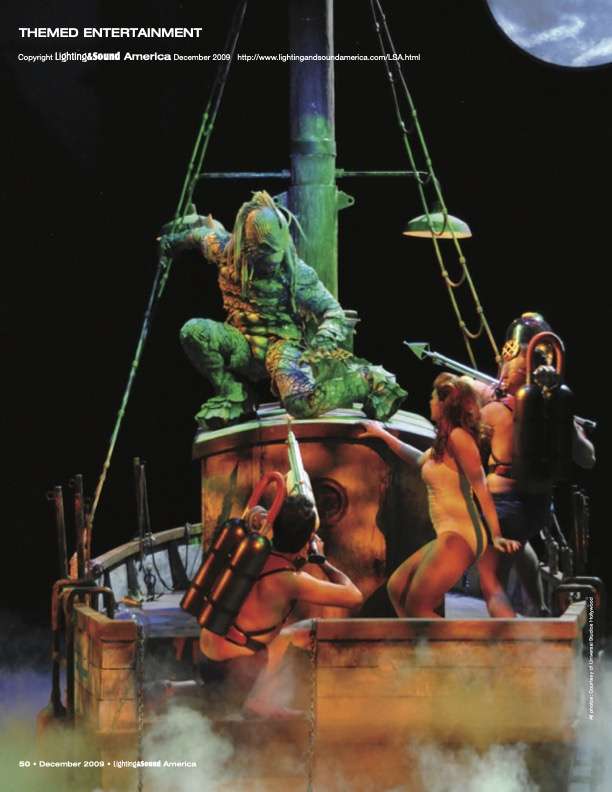
The Universal horror classic film “Creature from the Black Lagoon” served as inspiration for “Creature from the Black Lagoon: A Raging Rockin’ Show” at Universal Studios Hollywood in 2009. Key in the making of this unique, 25-minute musical adaptation were Universal parks veterans Dale Mason and Chip Largman, creative leaders with roots in theater. When we interviewed Mason for this year’s TEA Thea Awards Program to commemorate his receiving TEA Thea lifetime honors, he mentioned “Creature” as a pet project. Lighting&Sound America has kindly allowed us to reprint my feature story about the project from 2009, which we hope you will enjoy. — Judith Rubin

Article reprinted courtesy of Lighting&Sound America magazine (lightingandsoundamerica.com).

View a PDF of the original article here.

Swamp Thing

The Creature from the Black Lagoon returns, in a new attraction at Universal Studios Hollywood

By Judith Rubin

Chip Largman’s background as a theatrical lighting designer, and his position as executive producer for Universal Studios, made him a good choice to helm the adaptation of Creature from the Black Lagoon, the classic 1954 Universal horror film, into Creature from The Black Lagoon—A Raging Rockin’ Show, a 25-minute musical. The attraction opened last spring at Universal Studios Hollywood, and in addition to providing park guests with an entertaining, air-conditioned, sitdown break between thrill rides, “it let us [Universal] to poke fun at ourselves, be irreverent, and raise the bar on production values,” says Largman. He headed up a team of seasoned theatre professionals— several of whom, like himself, also had theme park experience—to create the show, customize the venue, and update the amphibious love story of Kay, the comely ichthyologist, and Gil, the creature of the title. (His theme song: “I’ve Got a Strange New Hunger in My Heart”).

The Creature from the Black Lagoon was a key entry in Hollywood’s mid-’50s science-fiction renaissance. It was directed by Jack Arnold, who also helmed such B classics as It Came From Outer Space, Tarantula, and The Incredible Shrinking Man. Creature was also one of the most successful films in the period’s short-lived 3-D craze. It also spawned a sequel, The Creature Walks Among Us. In both films, a hideous man-fish makes passes at innocent young ingénues. The show at Universal Studios was written by the Off Broadway playwright and television writer Jonathan Tolins, with a score by Fred Barton, who is bestknown for appearing in, and arranging the music for, the long-running spoof revue Forbidden Broadway. It has been staged by Lynne Taylor— Corbett, choreographer of the Broadway musicals Titanic and Swing! and the film Footloose.

The team set out to do the show as a camp spoof, with an OffBroadway feel and original music. “We were thinking Creature meets Little Shop of Horrors meets The Rocky Horror Show,” says Largman. During the design process, however, the style evolved into something closer to cinematic rock opera. “The park’s guests wouldn’t necessarily get the campy references, but they would get the rock power ballads and duets,” says the set designer James Youmans, of Youmans Designs Inc. “We decided we wanted it to be like a movie onstage, so projections had to play a much bigger role, and the scenery couldn’t be flat and campy—it had to be cinematic.” The stage was configured to accommodate a 20′-high-by-40′-wide screen from Gerriets (with a treatment by Adirondack Studios), which operates on a custom-built roller system from Adirondack. (Images are delivered via an edge-blended rear-projection system using a Dataton Watchout media server and Christie projectors.) The main scenic element—the boat—was designed to serve up special effects, explosions, and atmospherics.

Not that the final product is overly serious. “It’s kind of a cross between science fiction, a Broadway musical, an underwater ballet, and hard rock,” says Tom Ruzika, who lit the show. “From a design standpoint, it called for a lot of creativity and several different genres of lighting.”

Largman reached out to Marc Routh, executive producer of Broadway Attractions International, and its affiliate, Richard Frankel Productions, in New York, to put the team together. “It was because of their experience with Young Frankenstein and Little Shop of Horrors,” he says. The Broadway Attractions International team included Mike Bauder (production management technical supervisor); John Kivlen, associate producer; Youmans; Ruzika; sound designer Philip G. Allen, of PGA Sound; Adirondack Studios (scenic fabrication and special effects); Fisher Technical Services (rigging); Paul Rubin, of The Fly Guy Productions (flight choreography); and Fabio Toblini (costumes). Largman shared executive producer responsibilities with Routh. “He was more instrumental on the front end of the project in making recommendations on the production team and advancing the design; when we began putting the show in the theatre, I stepped up and became more engaged,” says Largman. “Because of my affinity toward live production, I took the opportunity to executive-produce. It’s in my blood.”

Into the air and down the hatch

The show was housed in a 1,700-seat converted outdoor arena that has been modified more than once to accommodate shows based on Dracula, Conan the Barbarian, Spider-Man, Fear Factor, and other properties. “There are a number of challenges to staging a production there,” says Largman. “It has a wide view environment and low [20′] ceiling, so the sightlines are very challenging. Tom did a great job from a lighting perspective, and, from a visual perspective, we were very pleased with everyone’s effort and product. Jim Youmans did a terrific job converting the theatre into a total immersive environment with the stage and set pieces. It was also a successful endeavor from a technical standpoint: the right equipment for the job.”

The show’s signature moment is the swim sequence, which emulates the water ballet that takes place between Kay and Gil in the original movie. The boat flies up, and the theatre transforms into an underwater environment via lighting, the cinema backdrop, and atmospheric effects; Kay pushes off and swims a lap over the heads of the audience. Gil catches up with her when she returns to the stage area, and the two swim in parallel, culminating in an ankle grab. “When the boat is out, you can reach up and touch the flying track. It is really hard to get a smooth flight when the wires are that short,” notes Scott Fisher of Fisher Technical Systems, provider of the rigs.

The actors travel on two I-beam track systems: Kay’s oval track that spans the theatre, and the Creature’s straight track, tracing an L over the stage. The flight gear is installed in the underside of ceiling beams. Each flying machine incorporates lift, travel, and rotate mechanisms to provide the necessary degrees of freedom to execute the flight sequences; an automated control system, using Fisher’s proprietary Navigator operating software, is cued by Universal’s Ride Show Supervisor system. “Because of running so many shows a day, the flights had to be automated and repeatable,” notes Fisher. “Traditional stage flying is often manually controlled. Automated flying is used either because it is going to repeat a lot, or because the action is outside the bounds of what humans can manually do.”

“We spent a lot of time programming it, so that the operators could have a one-button operation,” says aerial choreographer Paul Rubin of The Fly Guy. He and Fisher met in the early ‘90s when both were working for the late theatrical flying specialist Peter Foy in Las Vegas, and they have collaborated frequently since. Once Fisher had the system up and running on location, Rubin tested the unit and commenced programming. “We run the sequence with weights in it to visualize it,” he says. Programming Gil and Kay’s synchronized swimming was especially tricky. “We had to make sure that they did not block one another—not just for an audience member in the center seat, but for all 1,700 people.”

With the sequence basically programmed, Rubin put the actors in for about six weeks of rehearsals. “First they learn how to move and dance in the harness when they’re not on the wires,” he explains. “Then they learn body control while in the wires—how to lay on their bellies and on their backs with a swimming motion and look fluid doing it. Then we introduce the singing part of it.” Kay’s harness is worn under a bathing suit with a frilly skirt—Gil’s is under a bulky monster suit. The harness itself is a canvas wrap worn around torso and hips with buckles, straps, and special rotating connectors at the hips, weighing approximately 8lbs. There were five regular casts in rotation this summer, with one backup cast to keep up with the demanding daily schedule.

Rubin also choreographed the show’s finale, where, in a surprise twist, Gil swallows Kay. (Having taken a hit from an human growth hormonetipped harpoon, he balloons into an 18′ giant, and Kay, losing her balance during a duet with Gil, falls into his mouth). Giant Gil is represented by a manually operated puppet designed by Michael Curry and made of carbon fiber. “It’s not your typical theme park fare,” says Largman.

Floating the boat

Most of the show’s action takes place on or around the boat, the Rita. Fisher Technical provided the lift system for this 6,000lb multipurpose set piece using one of the company’s proprietary G Series winches. It is controlled by the Navigator system, along with other moving scenic elements such as the glowing green jungle vine clumps, carved of soft foam and strung with LEDs, which travel on tracks to facilitate transitions, double as underwater seaweed, act as masking for the screen, form onstage partitions, and so forth. The boat is driven around the stage by a battery-powered cart hidden underneath, which is manually operated from a small internal cabin.

Youmans’ boat design was based on the original steam launch seen in the movie. “We were really proud of the boat and the way we fit so much into such a small space,” he says. “It had to move around on stage, had to fly, be attached to flying cable rigs, have room inside to hide props and actors, and fit upstage behind the screen. And it had to be small enough to go away when needed, in a very limited space. The projections and projector were positioned so you could get light on the back of the screen when the boat was not visible.”

Adirondack built the boat, in addition to most of the provided scenic elements, including the stage floor covering, stone work, trees, and vines, as well as the fog and wind effects. (The fog is generated by Le Maitre G300 and LSG units.) Adirondack also provided the automation engineering for the boat and the projection screen panels. The drive unit for the boat is a purchased component from Transbotics, an industrial guide vehicle manufacturer, run by a hidden operator inside the cabin using a joystick; it is dependent on four cameras for visual navigation. “If you have a problem with confined spaces, it is not a good place to be,” says Matt Reardon, project manager for Adirondack.

The stage floor is made of an extremely hardy, melamine-faced laminate. “Because of the weight of the boat and the pirouetting it has to do onstage, we went through several different sample floor processes to come up with a treatment that would maintain its look and support the boat,” says Carl Zutz, sales manager, Adirondack. Durability is a key factor in building for theme parks, he notes: “Stage scenery doesn’t have to stand up to handling by guests, so it doesn’t have to have an impermeable surface, but it does have to be dependable and solid to hold up through the season,” he says. “And here we were, lifting it up over the actors’ heads, so it had to be robust and adhere to safety regulations just as if it were over the heads of guests.”

Gil, rock star

The 21st-century Gil is a bad-boy, rock-star kind of creature who gets the girl with a combination of brutality, gallantry, and song. “It’s primeval, heavy-duty rock ‘n’ roll,” says Ruzika. “The automated lights are dynamically orchestrated with the music.” He had prior experience in this very theatre in the late 1980s, when he spent several years “in the space with Conan,” having been brought in a couple of years after that show opened to implement some modifications. “There I was, 20 years older, crawling around those catwalks, which hadn’t been designed as lighting catwalks. For Creature, I got them updated. I didn’t get everything I wanted but, because it was a musical, I wanted a whole lot of side lights. I had them fabricate outrigger pipes to make it easy to hang and focus, and give me better lighting angles. I was fortunate to get a handful of moving lights, and designed the outriggers to accommodate them. We got the lights into a good position for design as well as maintenance.” The console used was an existing High End Systems Hog iPC. “We didn’t want to invest in a new lighting board, and the Hog did everything: moving lights, conventional lights, LEDs, everything.” The venue’s existing ETC Sensor dimmers were also used.

The lighting package for the show includes approximately 180 ETC Source Fours in various models and degree sizes, 16 Vari*Lite VL3000 Spots units, two VL2500 Spots used as shin busters on the deck, plenty of colors from Rosco and Lee Filters, and gobos, both custom and off the shelf, from Rosco, Gamproducts, and Apollo Design Technology.

The fly sequence called for simple treatment: “Two people on wires, two [Lycian 1200W] followspots,” says Ruzika. “I put custom gobos in the follows to soften them, make it more underwatery. Between the moving lights creating the water effect and the video, it was very pretty.” The followspots were stationed near the back of the house for a past production. “They wouldn’t let me move them,” says Ruzika, “and we had very flat angles, split left and right, that, in a strange way worked very well.” For the rock-concert moments, he adds, “the lights move and flash and sweep through the house exactly to the beat of the music.” Ruzika collaborated with his associate and programmer, Mark Matzkanin, with Dayna Morgan as a new assistant learning the ropes on her first theme park show.

“Universal really put themselves behind this show 110%,” remarks Ruzika. “They bought a whole new lighting package just for the show— boxes of brand new Vari-Lites and brand new Source Fours. It is wonderful to have fresh, out-of-thebox VL3000s.” He notes that a show of this kind requires a vastly longer tech period than a traditional theatre production. “You really have to allow a day per minute to tech through the show. The point where you stop picking at it is the point where a producer, or someone else with a set of fresh eyes, comes in.”

Music from the deep

All the music (except for vocals, which are live) was recorded and produced by Peter Fish. Philip G. Allen used a combination of speaker placement and Meyer Sound LCS (Level Control System) gear to simulate the experience of being in a live rock concert. “I worked with Peter to construct a mechanism for delivery of the music to make it exciting and interesting,” he says. In addition to positioning speakers in front of the audience, at the sides and behind, he placed them overhead pointing down, with others pointed at the roof. “In the scene where Kay dives and swims, we take the sounds of the water and the jungle, and play them through the speakers pointed at the roof. It reinforces the sense of being underwater, in a unique space.”

The speakers are arranged in three main clusters of Meyer line arrays, each with five speakers, plus eight surround locations. The system includes 15 Meyer M1D compact line array units in a left-center-right arrangement, with five boxes in each location. Six Meyer MM-4XPs provide front fill, Six UPA-1Cs are used for rear fill, and eight Meyer UPM-1Ps constitute the surround system. The low end is represented by two Meyer 700HP subwoofers. In terms of monitors, the system includes four UPM-1Ps for downstage foldback, four more UPM-1Ps for overhead foldback, along with four Anchor AN-1000X program speakers and one pair of MAudio BX-5A nearfield units. One Sennheiser SR-3256 and four EK3253 in-ear monitors are also available.

Also in the rig are Renkus Heinz PNX15IT/4A loudspeakers with six P3500 amplifiers, used as band source speakers, and six Meyer UPA-1Cs with Crest 7001 amps, used as rear fill speakers.

The sound is controlled by an LCS Cue Console system. “What LCS does is give the ability to move sound in time from any place in the room to anywhere else in the room in a specified pattern,” says Allen. “The music has movement as well as spatial quality. You can position a sound anywhere you want and leave it stationary, or position it and have it go anywhere in the room, and adjust the timing to fit with the beat. It’s very powerful, but you need a wizard of a programmer. Jake Davis was ours. He’s programmed several shows for Cirque du Soleil using this system; without him, we wouldn’t have gotten its full value.”

The sound was mixed in-house with a pair of mainframe audio servers. “LCS allows you to add and subtract hardware as you need it,” notes Allen, who mostly works in traditional theatre, and also teaches at USC and Cal Arts. “During production, Jake and I each had a control surface. In the finished version, we scaled down to one small mixer operated by the sound engineer, and a computer. The operator is a standard park employee. The mixing consoles were rented from Meyer and can be brought back if needed. This kept the purchase cost significantly lower than for regular gear. It’s a very elegant solution for a place like Universal.”

Allen was as pleased with his new sound gear package as Ruzika was with his lighting equipment. “One thing about installing an entirely new sound system is that you get the benefits of state-of-the-art,” he says. “New speakers are more suited to the job than 20 years ago—and now we understand how to focus the energy of a speaker just where we want it. Sound design and control technology have made enormous strides over just the last 10 years. Every speaker sounds great when you’re standing 6′ away from it, but 60′ is where the rubber meets the road—it should sound just as good there. Part of our job is to distribute sound so it is exciting for everybody without taking anybody’s head off. We’re pleased that Creature was kept under 95dB, even though it is rock ‘n’ roll—it saves the sanity of the crew and the people in the show. Volume isn’t quality—it is just volume.”

When it came to designing the sound effects, “the biggest job was the Creature,” says Allen. “We had to find a voice for Gil, and in this we were helped tremendously by the actors. The Creature spends the first half of the show as a guy in a suit, and then as an enormous puppet. When he becomes the puppet, the actor who plays the part goes backstage and does all the vocals and dialogue. Our job was to give him the kind of sound that befits that size monster, a voice that was human and monstrously big as well. There was a lot of carbonated beverage in the Foley booth one night that produced some fiendishly clever belching and swallowing effects. Jane McKeever, an assistant of mine, created the sounds of the Creature roaring and attacking the boat. The other element of sound effects design was to create a jungle atmosphere as three-dimensional and detail-oriented as the music was—the jungle river, the jungle at night, and the Creature’s cavern all have distinct ambient qualities to them that helps deliver a fully realized theme park experience.” The microphone set up includes five Sennheiser EM-3532 dual-channel receivers, nine Sennheiser SK-5212 body pack transmitters, and ten Countryman E-6 mics. Four Shure SM58s mics are also available.

Overall, the various design and technical disciplines come together to create a vivid and amusing spectacle that pays tribute to the horror films of the past while making use of the technology of today.

As if to demonstrate the enduring appeal of this story—from the last century to this one—the press opening fanfare included a stunt in which Gil, en route to his new venue, escaped the confines of his container and gallivanted around the park. He was captured by armed guards and marched into the theatre, where he met up with Julie Adams, the actress who first played Kay, looking much as she did in the original film.

Sphere announces The Rocky Horror Picture Show for 2027

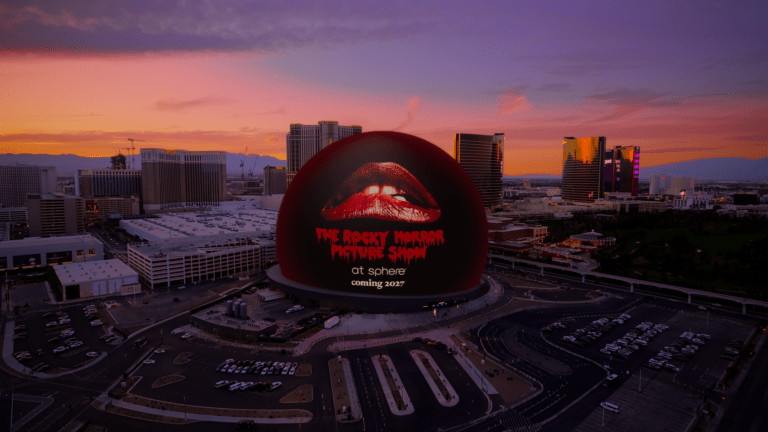
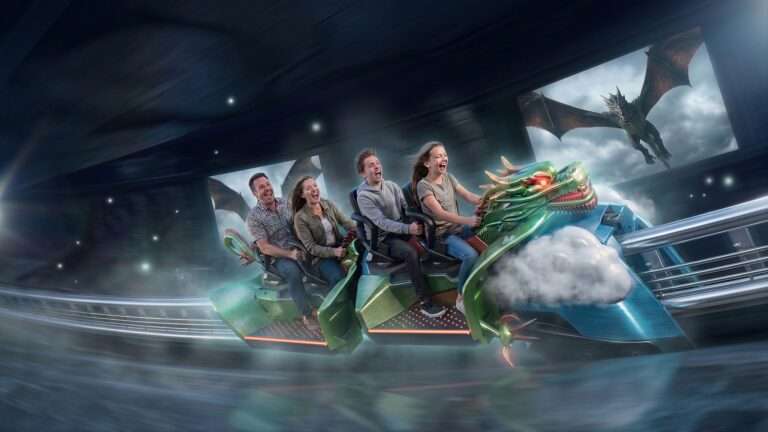
Sphere Entertainment Co. announced the production of a new Sphere Experience – The Rocky Horror Picture Show at Sphere, expected to open in 2027. Sphere Studios will use its advanced technologies to enhance the original beloved 1975 film. This new production is part of The Sphere Experience®, Sphere’s slate of original immersive content including Postcard from Earth and The Wizard of Oz at Sphere, the latter of which has generated over $400 million in ticket sales and has sold more than 3 million total tickets since opening in Las Vegas on August 28th, 2025. 

Jim Dolan, Executive Chairman and CEO of Sphere Entertainment, said: “Through Sphere Studios, we are building a slate of original experiences that push the boundaries of technology and storytelling for this new medium, while always keeping the audience at the center of the experience. Since The Rocky Horror Picture Show premiered in 1975, it redefined audience participation and became a cultural phenomenon. With Sphere, we have the opportunity to take that spirit of immersion to an entirely new level.”

Christie announces new release of Spyder-S video processing platform

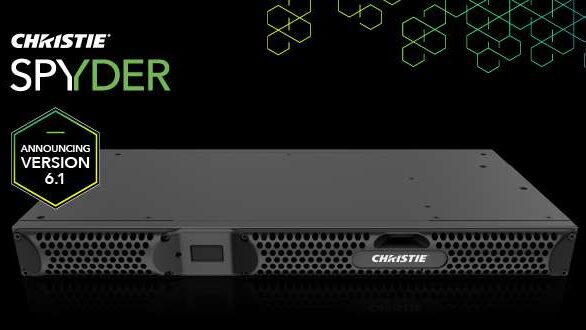
As live events and fixed installations continue to demand larger canvases, greater source flexibility, and increasingly sophisticated visual experiences, Christie is expanding the capabilities of its Spyder-S video processing platform with the release of Spyder-S 6.1.

Built on a modular, distributed architecture, the Christie Spyder-S platform starts with a single 1RU frame and scales to 16 linked frames, supporting more than 200 million pixels on a single canvas without changing software or workflow. The result is greater flexibility, greater scalability, and the highest performance.

Designed for rental and staging, live events, and fixed installations, the new release introduces expanded connectivity, simplified management, and greater creative power. Two new frames expand connectivity: a DisplayPort 1.4 Frame, supporting background inputs up to 7680×2160 at 60Hz, and an SFP Frame supporting 12G-SDI and HDMI 2.0, with fiber for long-distance runs. An enhanced Configuration Manager, combined with broader internal and external controls, makes the platform simpler to set up and control. Added tools for testing, source monitoring of backgrounds and MEs, and safeguards to help ensure live switching always goes as planned. Together, these features unlock the creative power of Spyder-S background inputs and mix effects: backgrounds render without consuming layers, and source mixing uses a single layer instead of two, freeing capacity for more content and larger canvases.

“Live events and fixed installations continue to grow in scale and complexity, placing greater demands on video processing systems,” said Joel Daly, director of product management at Christie. “Release 6.1 gives our customers flexible connectivity for any show or installation, a platform that is faster to set up and manage, and the power of backgrounds and MEs to deliver larger, more immersive visual experiences.”

Spyder-S is built on FPGA technology and purpose-built hardware, delivering deterministic low-latency performance and consistent operation for demanding live environments. The platform supports a wide range of applications, including rental and staging, fixed installations, corporate events, broadcast environments, sports venues, and large-scale entertainment productions.

Daly added, “Spyder-S release 6.1 reflects what our customers need most: a system that grows with each production and delivers consistent, dependable performance. With its modular, distributed architecture and expanded capabilities, this release gives teams a more adaptable platform for taking on increasingly ambitious live events and fixed installations.”

George Washington’s Mount Vernon opens new Education Center, unveiling updated exhibition and experiences regarding the first President and his home

0

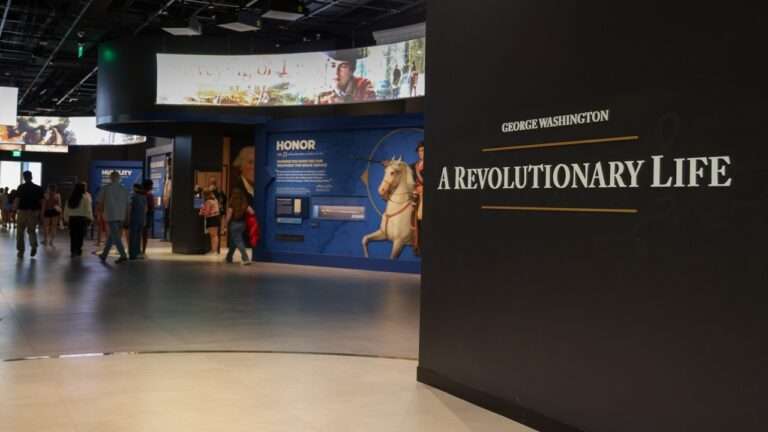
George Washington’s Mount Vernon unveiled its new Education Center, the landmark exhibition George Washington: A Revolutionary Life, celebrating the occasion with a ribbon-cutting ceremony attended by hundreds of donors, elected officials, civic leaders, descendants connected to Mount Vernon’s history, media representatives, educators, and visitors from across the region and nation.

The opening marks a major milestone in the lead-up to America’s 250th anniversary and represents a $20 million investment in civic education and public history. The transformed Education Center features nine galleries, six immersive media experiences, rare artifacts, original documents, hands-on learning spaces, and the most comprehensive exhibition ever created about the life and legacy of George Washington.

Among those attending the celebration were Fairfax County Supervisor Dan Storck, Virginia Senator Scott Surovell, Delegate Paul Krizek, representatives connected to Mount Vernon’s history including Sheila B. Coates, founder and president of Black Women United for Action (BWUFA).

The ribbon-cutting ceremony featured remarks from Anne “Dede” Neal Petri, Regent of the Mount Vernon Ladies’ Association; Carly Fiorina, Virginia 250 Commission Honorary National Chair; and Doug Bradburn, Mount Vernon President and CEO.

“This new Education Center is Mount Vernon’s gift to America as we approach our nation’s 250th anniversary,” said Anne Neal Petri. “We take our educational mission seriously, and this exhibition helps visitors see George Washington as a leader, a citizen, and a human being whose decisions continue to shape our nation. We hope people leave with new knowledge, a deeper understanding of our history, and a greater appreciation for the ideals that define America.”

The new exhibition presents a fresh and expansive interpretation of Washington’s life, incorporating the latest historical scholarship and exploring his experiences as a surveyor, military leader, farmer, president, and citizen. Visitors encounter Washington’s triumphs and failures, his evolving views on slavery, his role in advancing religious liberty, and his enduring influence on the American experiment.

“George Washington was the indispensable leader of a revolutionary age,” said Carly Fiorina. “This exhibition helps tell the full American story while educating and engaging visitors from every background. As we commemorate our nation’s founding, places like Mount Vernon play a vital role in helping Americans understand the ideas, people, and sacrifices that shaped our country and continue to inspire civic renewal today.”

The new Education Center replaces the previous exhibition, which opened in 2006, and reflects significant advances in technology, visitor experience design, and historical research. Through immersive storytelling, authentic artifacts, interactive experiences, and original documents, the exhibition connects visitors directly to Washington’s world while demonstrating the continued relevance of his leadership today.

“We set out to create the most complete and up-to-date exhibition on George Washington anywhere in the world,” said Doug Bradburn. “By combining extraordinary artifacts, groundbreaking scholarship, immersive experiences, and the latest technology, visitors can explore Washington’s life in ways that simply were not possible before. Most importantly, the exhibition helps people understand not only who Washington was, but why his ideas, leadership, and example still matter today.”

Among the exhibition’s highlights are George Washington’s Revolutionary War camp bed, the only complete surviving set of his dentures, archaeological discoveries unearthed during the Mansion Revitalization Project, artifacts connected to the lives of enslaved people at Mount Vernon, objects from Washington’s presidential households, and rare founding-era documents, including an early ratification copy of the U.S. Constitution.

The opening of the Education Center builds upon Mount Vernon’s recent $40 million Mansion Revitalization Project and other major investments across the estate. Together, these projects strengthen Mount Vernon’s role as the nation’s premier destination for exploring the life, leadership, and legacy of George Washington.