
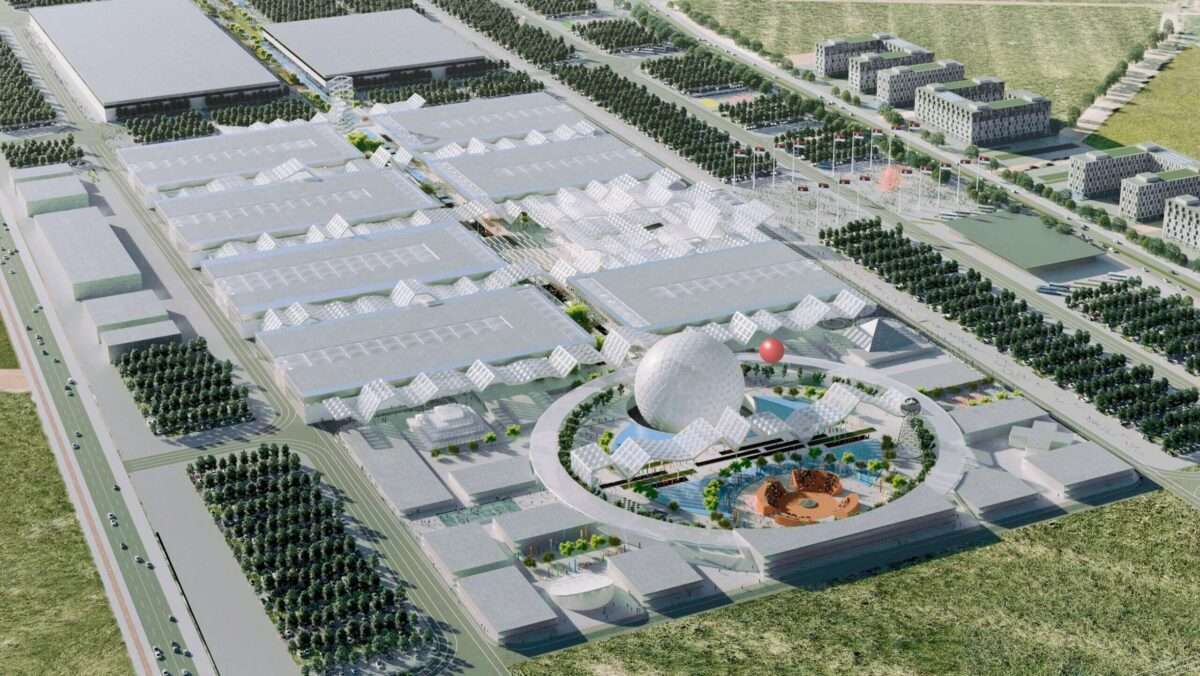
Expo 2027 Belgrade is entering a decisive phase, with more than 130 participating countries now advancing their pavilion interior designs. Several European participants have begun releasing full public concepts — most notably Germany and Austria — offering the clearest early look at how nations are interpreting the Expo theme “Play for Humanity – Sport and Music for All.”
International participants move Into full design mode
Following the March 2026 International Participants Meeting, countries received final architectural and technical specifications for their pavilion shells. Construction of the international zone remains on schedule, with handover planned for December 2026, enabling a five month interior fit out window.
The master plan, led by Fenwick Iribarren Architects, emphasizes modularity, sustainability, and rapid installation. More than 2,500 architects and engineers across Europe are now engaged in design and engineering work supporting national pavilion development.
Germany: “Germany! Out of the Box.”
Germany has published one of the most detailed pavilion concepts to date. Designed by facts and fiction and implemented by Messe Düsseldorf GmbH, the pavilion uses the metaphor of “breaking out of the box” to explore play as a cultural technique and a driver of innovation.
Highlights:
- A sculptural exterior with black, red, and gold elements emerging from the structure
- A “Playground of Innovation” composed of thematic boxes showcasing German creativity in sport, music, science, and technology
- Partnerships with German companies, research institutions, and cultural ambassadors
- Interior fit out beginning after shell handover in October 2026
Germany’s early disclosure signals a mature, well-resourced design pipeline.
Austria: “Join the Flow.”
Austria has also released its full pavilion concept, developed by facts and fiction, ZONE Media, and PLANET architects. The pavilion uses the Danube River as its central storytelling device — a symbol of connection between Austria, Serbia, and the wider region.
Highlights:
- A media driven “river” guiding visitors through interactive zones
- A flexible Innovation Lab showcasing rotating content in green tech, mobility, digitalization, energy, and education
- A pavilion designed as a platform for partnerships rather than a static exhibition
- Strategic framing of the Expo as an economic bridge, reflecting Austria’s strong commercial ties with Serbia
Austria’s concept emphasizes fluidity, collaboration, and innovation.
What these developments signal
The release of Germany and Austria’s pavilion concepts marks a turning point: major participants are now publicly committing to full narratives, architectural direction, and delivery schedules. Their announcements reflect broader trends across the international zone.