
The Enchanted Greenhouse at Six Flags Qiddiya City
by Becci Knowles
In an emerging destination park trumpeting ambition and scale, one of Six Flags Qiddiya City’s most powerful statements blooms behind the doors of an abandoned greenhouse. The Enchanted Greenhouse is not simply a family dark ride filled with foliage, animatronics and interactive effects – it is a living demonstration of what can happen when creative vision, ride technology and interactivity are conceived as one from day one. Rooted in themes of growth and renewal, the attraction mirrors its own message: when the right partners cultivate trust and shared purpose, story and system can flourish together into something far greater than the sum of their parts.
The Enchanted Greenhouse is a trackless interactive dark ride located in the Twilight Gardens land at Six Flags Qiddiya City, which officially opened to the public in December 2025. Developed by a consortium under the creative leadership of Jora Vision, the team included Alterface and ETF Ride Systems. Together, they positioned The Enchanted Greenhouse as a cornerstone immersive family dark ride within the park’s six themed lands.


ETF

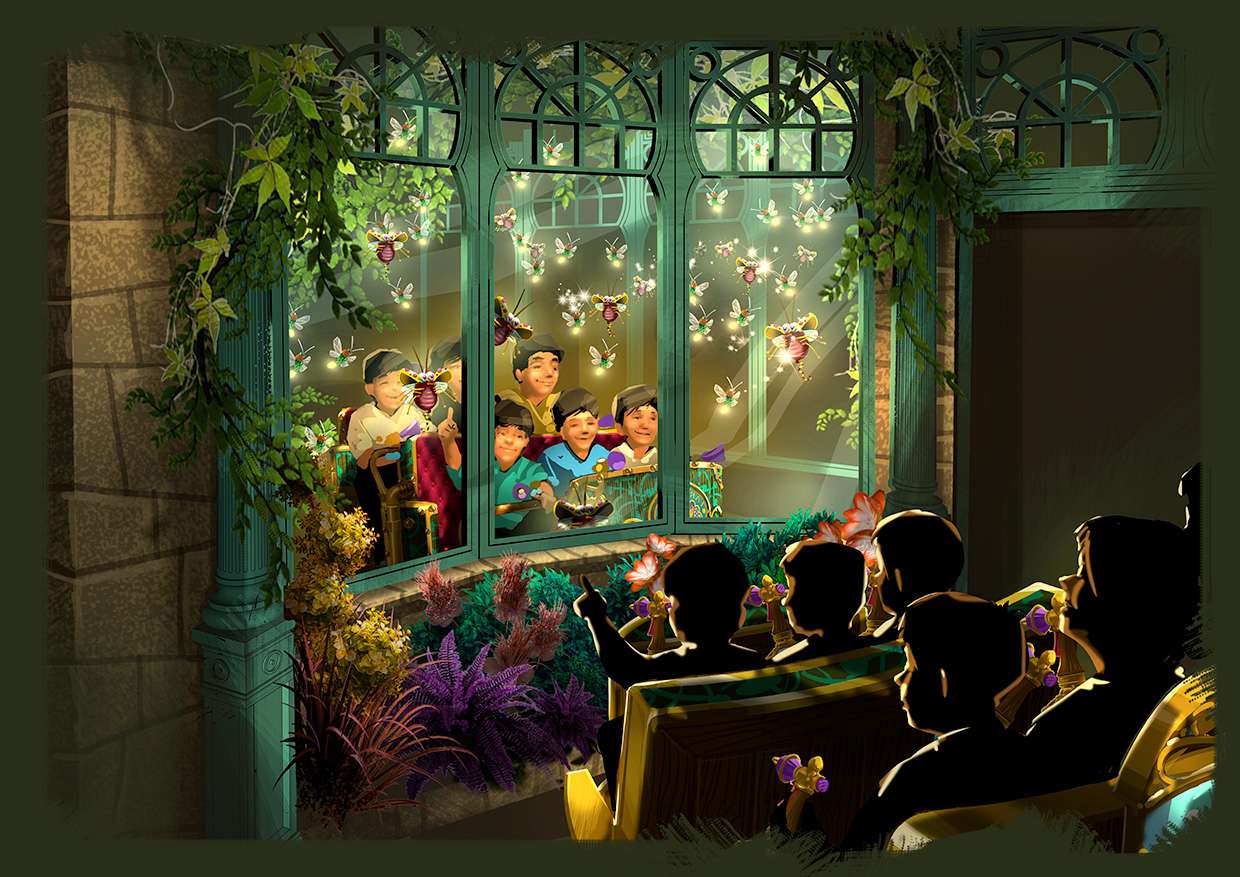
Set inside a long-abandoned greenhouse, the attraction combines dense physical theming, autonomous trackless vehicles and a deliberately non-competitive form of interactivity. Guests travel in one of twelve six-seat vehicles along a 160-meter route using handheld magical dew sprayers to awaken hidden creatures, influence behavior and transform the environment (rather than accumulate points or scores). The whole tale is told by multiple animatronics, 14 multimedia projectors and ground-breaking special effects on the ride vehicle itself, all concealed within immersive decor overgrown with thousands of lifelike otherworldly plants.
The project is significant not because of any single technology, but because story, ride system and interactivity were conceived together from the outset. Rather than a sequential delivery model, The Enchanted Greenhouse was developed as a fully integrated collaboration, allowing narrative intent to be embedded directly into vehicle choreography, timing and guest interaction.
According to the official press release, “The Enchanted Greenhouse is set in an abandoned greenhouse with a symbolic story rooted in growth, love and rediscovery.” For Jora Vision’s Project Director & Creative Producer Robin van der Want and his team, the challenge was translating those abstract themes into physical space, scenes and pacing, particularly for a family audience encountering this type of attraction for the first time.
With a themed surface of 1,300 square meters, the dark ride is relatively compact. Still, through careful scene planning, the experience lasts almost five minutes and includes an extensive preshow. “We really put a lot of effort into building up the story in the queue,” van der Want explains. “The moment people step into the building they are already completely immersed. Throughout the queue they get glimpses of the flora and fauna that await them, and we already introduce interactive effects, so the environment feels alive before the ride even begins.”
The queue incorporates projection mapping, Pepper’s Ghost-style illusions and interactive stations that allow guests to activate hidden creatures and visual moments. An elaborate preshow introduces Farasha, whose name means butterfly in Arabic, guiding visitors into a greenhouse that has been closed for decades and is only now reopening. “We didn’t spare any design effort in the queue,” van der Want says. “From the moment people step inside, they are already part of the environment.”
Once onboard, the experience intensifies. Dense layers of artificial foliage cover ceilings, rockwork and sightlines, creating the impression of a living ecosystem within a compact footprint. “We used many, many square meters of fake foliage,” says van der Want. “Ceilings, rockwork, everything is covered. The scenery changes constantly, so the environment never feels static.”
A key mid-ride transition deliberately alters scale, making guests feel physically smaller as the world around them grows. “That transformation moment is one of my favorite aspects,” he adds. “Suddenly you are under mushrooms, under leaves, everything becomes larger. That is also why the creatures, including the bee, feel so imposing.”
Bespoke vehicles as storytelling devices
The ride vehicles themselves play an active role in reinforcing the attraction’s narrative. Each bespoke vehicle seats six passengers in two rows and features a meticulously crafted body finished in a teal and copper color palette. An elegant butterfly motif is emblazoned across the facade, visually linking the vehicles to Farasha and the ride’s overarching themes of transformation and renewal.
While the narrative is built on universal themes, it was shaped by Saudi cultural context and by the fact that large scale indoor dark rides are still relatively unfamiliar to local audiences. “This is one of the first interactive dark rides of this scale in Saudi Arabia,” van der Want explains. “So, we had to carefully balance local references with something immediately readable for international guests.”
Local influence appears subtly in architectural patterns, materials and detailing rather than overt iconography. “You see Arabian influences in the queue fencing, tiling and motifs,” he says. “They are not pushed forward, but they are there.” The design team worked closely with local curators throughout development. “We asked, ‘Is this appropriate? Will this be understood?’ That dialogue was essential.” The family friendly tone was deliberate. “We designed it as something families experience together,” van der Want notes.
Early guest behavior reflected the novelty of the format. “Some visitors were hesitant to enter,” he recalls. “They would ask, ‘What is in there? Does it go upside down?’ The whole concept of a dark ride inside a building was new.”
From the outset, The Enchanted Greenhouse was conceived as a fully integrated collaboration. From a creative leadership perspective, this allowed Jora Vision to shape story moments that could only exist through synchronized ride systems and interactivity. “As overall art director, we touched everything,” van der Want explains. “Scenery, characters, interactivity, mechanical effects, animatronics. When you separate those disciplines, you lose the intertwined thinking.”
Forming a consortium with Alterface and ETF Ride Systems was therefore a deliberate choice. “It was not just contractual,” he says. “It was a shared creative goal, and that only works when you trust your partners.” That trust also enabled delivery on a compressed schedule. “The sheer planning of this ride would never have worked in the time we had if the partners did not already know each other.”
Trackless navigation as storytelling tool
For ETF Ride Systems, the absence of a physical track was never simply a technical solution. “With trackless technology, you can create unexpected movements,” explains ETF’s Sales Manager, Rob Reijnen. “Splits, merges, roundabouts, dead ends, all of those features are used here.” With the dead end it is possible to increase intimacy, where the ride guests are fully immersed in the scenery. The use of the trackless system also creates more interaction with other vehicles, for example getting chased by the massive animatronic bee on the roundabout. “That would not be possible with a traditional physical track,” he adds. The split and merger in this ride layout create more time for an individual experience for the guests in the vehicles, by means of duplicating scenes.
ETF’s autonomous Multi Mover vehicles also support a nonlinear loading station. “With this feature we create more time for the guests to embark the vehicle, which also allows us to combine operational efficiency with storytelling,” Reijnen explains. Operational moments are folded into the narrative. “At the rear, an illuminated tank houses the vehicle’s dew supply, a functional element that also reinforces the storytelling. As vehicles load and unload, the tank visibly refills, signaling to guests that they are preparing to nurture and awaken the environment ahead. The result is a vehicle design that supports both narrative clarity and operational flow, reinforcing the idea that guests are caretakers rather than competitors.
Designing interactivity without distraction
Alterface’s involvement was guided by a core belief that an interactive dark ride should still be compelling even when guests are not actively triggering effects. “For interactive dark rides, the ultimate goal is engagement,” says Alterface CEO Stéphane Battaille. “Scoring is one way to do that, but it is not the only way. Here, the reward is awakening the environment and making it more beautiful.”
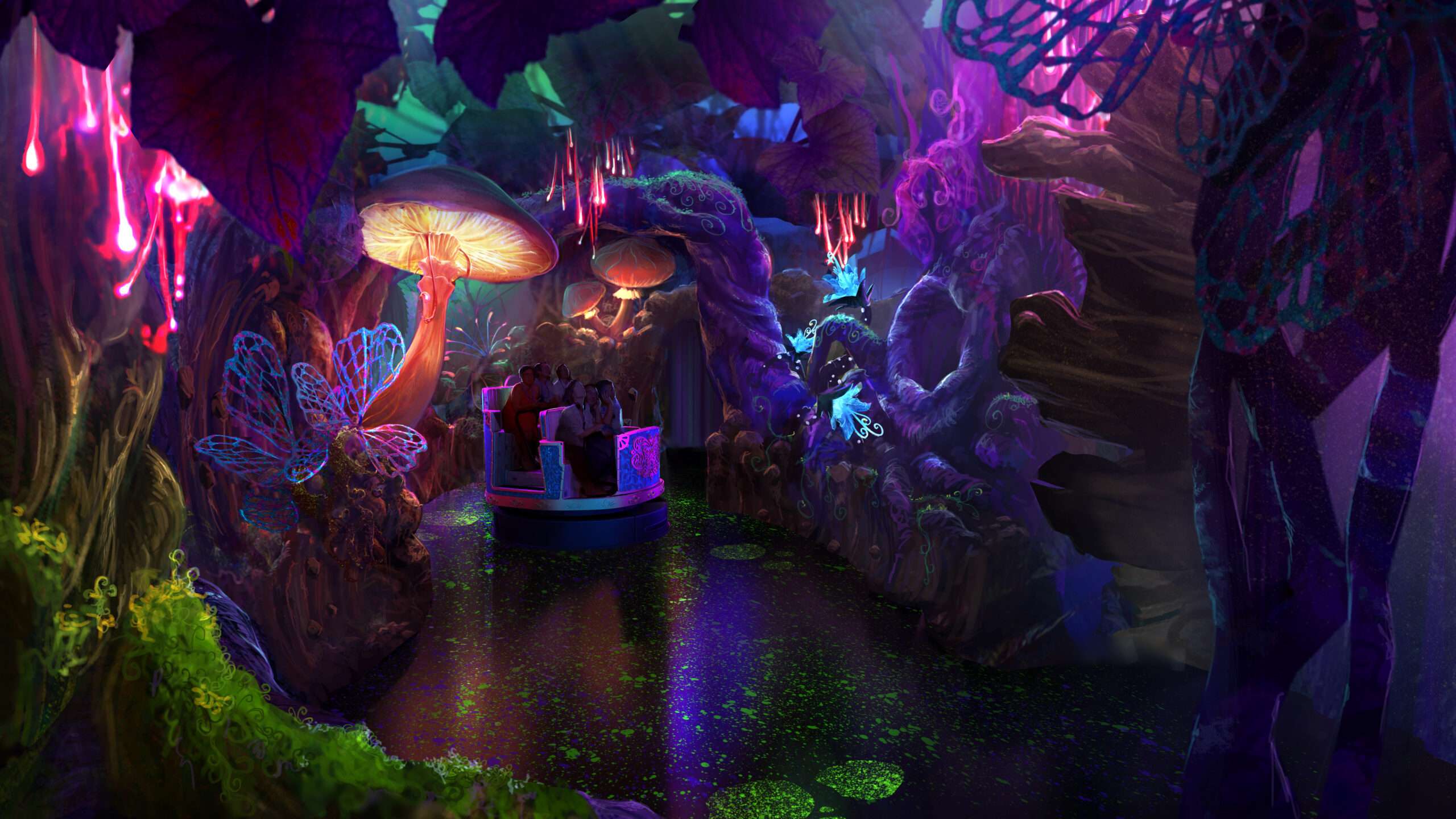
Guests use specially designed magical dew sprayers to reveal hidden creatures, transform plants and unlock surprising effects throughout their journey. The interaction follows a hide-and-seek logic, encouraging exploration rather than rapid fire action. “We did not want to explain how to play,” Battaille says. “It must be extremely intuitive. You do not collect objects or compete, you just interact and the world responds.”
The ornate dew sprayer itself reinforces that philosophy. Featuring a golden body with a detailed orb at its base, it resembles a horticultural tool rather than a weapon. “It looks like a sprayer, not a gun,” says Battaille. Alterface blended physical interactives, media content and projection mapping so guests can interact with their entire surroundings. “People are encouraged to work together,” he explains. “It becomes a collective experience where you transform the environment as a group.” That design choice fundamentally changes guest behavior. “It becomes a family experience. You share the moment together instead of being in your own bubble chasing points.”
While the attraction integrates physical effects, ghostly illusions, projection mapping, lighting, music and media into a single interactive experience, the challenge, Battaille says, is ensuring that complexity never feels technological. “If people say, ‘nice projection mapping,’ we have failed. Technology is a magic trick; the technique should disappear.” The same principle applies to interactivity. “As soon as people understand the trick, the magic is gone. Story always comes first. Technology should support narrative, not overshadow it,” he adds.
One shared answer
Interestingly, each company converged on the same “bee-spoke” element that represents the attraction’s unique level of integration between creative design, interactivity and ride systems.
“The scene where you are chased by the animatronic bee embodies the full collaboration,” says van der Want. “You have the vehicle movement, the animatronic, the interactive eyes and the show system all working together.”
Alterface integrated the interactive eyes and behavioral responses, ETF supplied the trackless chassis and movement logic, and Jora Vision designed and themed the creature and scene. “It is the first interactive animatronic on a vehicle,” Battaille claims. “We had been thinking about it for a long time, and this project made it possible.” From ETF’s perspective, the scene reflects long standing trust. “That level of detail was only possible because we fully trust each other’s expertise,” says Reijnen.
For the industry, The Enchanted Greenhouse is less of a showcase of individual technologies than a case study in integration. Developed for a new destination park in an emerging market, the attraction demonstrates how aligning creative intent, interactive design and ride systems from the earliest stages can unlock experiences that are efficient, culturally responsive and distinct.
Beyond the attraction itself, The Enchanted Greenhouse also represents a significant milestone for the European themed entertainment industry. All three consortium partners are based in the Benelux region, and the attraction was designed, engineered and largely built there before being shipped to Saudi Arabia for installation. As van der Want says, it is “something we as a Benelux region can be genuinely proud of: a globally scaled, culturally responsive dark ride conceived and delivered by companies working seamlessly together, thousands of kilometers from the park it now anchors.” •

