
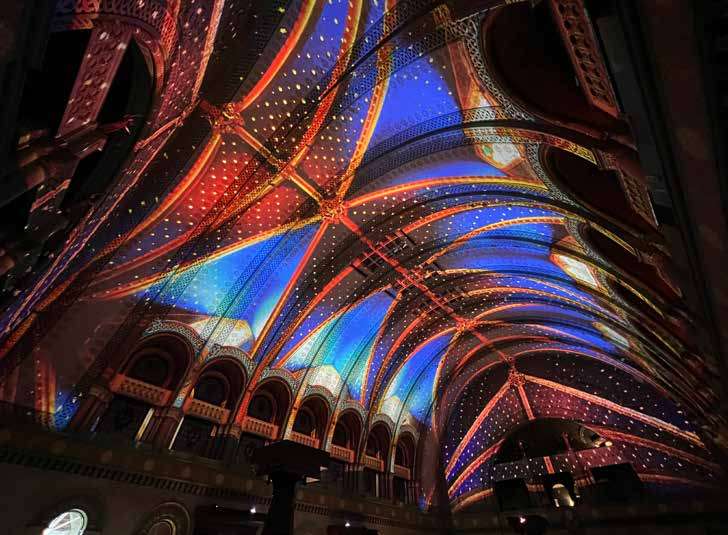
ENHANCED LUMENS, COLOR GAMUT AND RESOLUTION FROM CHRISTIE PROJECTORS COMBINE WITH NEW MEDIA FROM DREAMLAB IMMERSIVE FOR A FIRST-CLASS UPGRADE TO THE HISTORIC UNION STATION IN ST. LOUIS
by Judith Rubin
Since opening in 2014, the Grand Hall Experience in downtown St. Louis, Missouri, has helped focus attention on the re-transformation of historic Union Station as a hospitality and entertainment destination under the direction of Lodging Hospitality Management (LHM), which acquired the complex in 2012. The Grand Hall Experience is a free attraction running a nightly series of immersive shows, projection-mapped on the ceiling and walls of the lobby/lounge of St. Louis Union Station Hotel (Curio Collection by Hilton). The shows highlight the period architecture while telling stories that speak to local history and feature local celebrities.
LHM has continued to invest in this successful attraction to keep it at its best over a decade-plus of steady operations including special events. In fall 2025 the projection system received a comprehensive, state-of-the-art upgrade with all projectors provided by Christie®: two Griffyn® 4K50-RGB projectors and 12 projectors from the Jazz Series, model DWU2400A-JS. At this writing, the existing show library was in the process of being re-rendered and two new shows were in production by DreamLab Immersive, which also specified the new Christie projectors.
“We didn’t just patch things up, we rebuilt the system to suit a next-generation immersive show environment,” says John Miceli, DreamLab founder and executive creative director. Miceli has been creatively affiliated with the project since it first opened. “LHM recognized that a refresh would not only delight guests but also reaffirm the Grand Hall’s position as a must-see, immersive destination.”
The team at LHM give positive marks to the new system, and foresee a good run from the Christie projectors with notable improvements in show quality and guest experience, while anticipating improved operations and business benefits. “The system is very heavily used every day, almost like a theme park installation,” says Greg Buerkle, audiovisual director at St. Louis Union Station. “The Grand Hall is our crown jewel. I think people are going to notice the improvements we have made.”

Christie

DreamLab Immersive

Raising the bar
The Grand Hall began life as the waiting room of the venerable train station that was built in 1894 in the Romanesque Revival style and was, in the 1940s, the nation’s busiest. Preservation dictated that the installation preserve the character of the ornate interior, concealing the technology that would display media on the 65-foot, vaulted barrel ceiling and two curved walls or endcaps.
“The primary goal was to bring the experience up to current technological standards, upgrading to higher resolution, smoother frame rates, richer color, and more dynamic shows, while preserving the architectural integrity and magic of the space,” says Miceli.
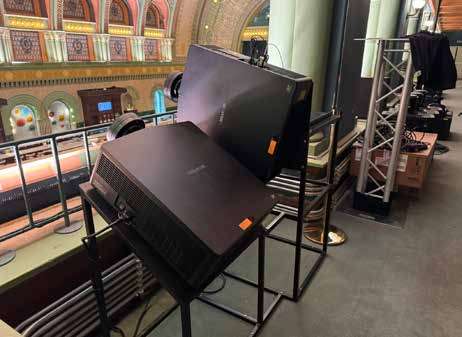
The workhorses of the installation are the two Christie Griffyn 4K50-RGB pure laser projectors selected for the endcap projections, ably supported by the Christie Jazz Series projectors covering the barrel-vaulted ceiling. Miceli outlined the projectors’ power to deliver better imagery. “First, brightness: the Griffyn 4K50 is powerful enough to overcome the ambient light in the Grand Hall during the day to expand on the ability to play daytime shows without washing out the projection. Second, color: the RGB pure laser architecture delivers a broader and more saturated color gamut, allowing us to produce vivid, painterly visuals and delicate tones that weren’t as achievable with older lamp-based or single-source projectors. Third, resolution and frame rate: combined with our upgraded server infrastructure, we could push true 16K imagery at 60 frames per second [fps], giving the shows a smoother, more cinematic feel.”
“They are able to get super high contrast and amazing, accurate color reproduction with these new, best-in-class projectors,” says Ernest Bakenie, senior director of sales, themed entertainment, Christie. “Going to 60 fps doubled the frame rate, supporting more fluid images. And this technology delivers true blacks, so the contrast really pops, and you can see more details in the content. It really makes a difference.”
Other Griffyn features include Christie TruLife+™ electronics, proprietary RGB pure laser illumination architecture with a sealed optical path. This model also delivers 50,000 lumens at full brightness, native 4K resolution and includes Christie’s electronic color convergence (ECC), which enables color alignment to be adjusted by remote control.
The Griffyn produces a wide color gamut, approximately 98% of the Rec. 2020 color space. This expansive color palette leaps beyond the earlier benchmark of Rec. 709 associated with HDTV and is a producer’s dream in terms of visual richness and range, and precise color matching. “We’re bringing the content to life like it’s never been seen before,” says Bakenie.
Buerkle praised the projectors’ ability to deliver so much so efficiently. “It was exciting to get them up there and start to see their performance and the immediate increase in brightness. During the daytime, we used to have a noticeable difference in visibility due to ambient light. Now, the new projection punches right through.”
The compact form factor was a boon to installation and promises well for future maintenance. “We had to move the new projectors up to the historical Grand Hall without an elevator,” says Buerkle. “Due to being smaller and lighter, they required less manpower to lift.” [A Christie Griffyn 4K50-RGB weighs in at 197 lbs; a Jazz at 65 lbs.] “Some of the projectors are placed in areas that are not very accessible, and due to taking up less space and being lighter, they’re going to be much easier to clean. We’re expecting to bring maintenance costs down.”
He continued, “Of course we are always concerned about servicing. We were looking at a lot of factors when we purchased the new Christie projectors, such as how long we can expect to keep an installation like this running with the existing equipment. That was a big factor. We’re seeing indications that we’ll get good life performance out of them.”
The new system and higher resolution also provided the capability to enlarge the projection area. “We now have a much wider field,” says Miceli. “The re-rendered library and the new shows will make the most of it, bringing the view farther down the walls while also further enhancing the room’s architecture.”
The overhaul also includes new digital VYV Xenon media servers, selected by DreamLab for performance, reliability, and compatibility with high-frame-rate content.
Reading the room
By any standard the Grand Hall Experience is unique due to its content, setting and presentation. But it is further distinguished by having set a new model for the industry when it first opened – as a permanent, indoor projection mapping installation on a large scale. In 2015, the attraction was recognized with a TEA Thea Award.
LHM has continued to redevelop Union Station into a competitive entertainment and hospitality destination, expanding its leisure offerings with an aquarium, a Ferris wheel and new restaurants, with more on the horizon. Today’s Union Station stands as a leading element within a corridor of downtown St. Louis improvements and attractions serving locals, tourists and business travelers.
Because the Grand Hall Experience takes place in a working hotel lobby and lounge as opposed to a theater or ride, it had to have the right ambience to complement the primary functions of that space and not overwhelm the room or the guests. It had to be respectful to the nature of the space and why guests were there.
“It really is about enhancing the venue,” says Bakenie. “The media has to be purposefully complementing the beauty of the architecture and the history of the venue, not detracting from it. And that’s what a great creative team can do, along with the proper technology and the proper tools. You’re not just sitting there and seeing objects on the ceiling. It’s actually an event that evokes emotions. And in order to get an emotion, you have to have the right tools.”
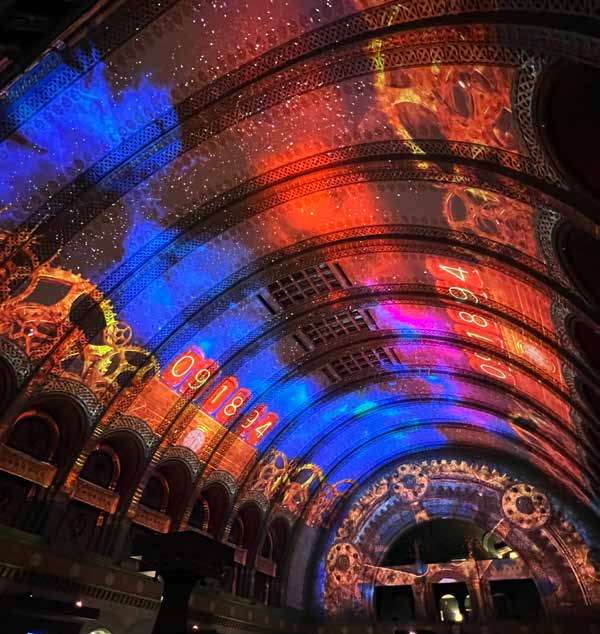
“This refresh represents not just a technical upgrade, but a reaffirmation of what immersive storytelling can be in an historic space,” says Miceli. “The Grand Hall Experience fuses artistry and technology in ways that deepen emotional connection, celebrate architectural heritage, and create memories in a location that is steeped in history.”
“It was like seeing a whole new show, with the difference in the vibrancy and the lumen level,” says Buerkle. “And now we’re able to get so much more punch out of a smaller body. Instead of a three-foot-long monster sitting on a truss, you have a projector that’s the size of a large shipping box. The advancement of technology is an amazing thing.”
Other areas of St. Louis Union Station have also benefited from updates. “About two years ago we upgraded an installation in our aquarium with Christie projectors, and the performance has been excellent,” says Buerkle. “I look forward to seeing the performance of these newest ones.”
Buerkle continues, “Content-wise, we’re really trying to make this place a destination and that’s a big part of the current upgrade. The Grand Hall Experience is a central facet of St. Louis Union Station. It drives business to our hotel and helps people appreciate our city. I think it’s going to be good for us.”
It is because of the operator’s continual reinvestment in the attraction, and the team’s dedication to high quality and thoughtful choices, that the Grand Hall Experience has retained its wow factor, even as industry standards and public expectations keep rising. The praise given to this attraction when it first earned a Thea Award still rings true: In the words of the Thea Committee, “The project has not only rejuvenated a National Historic Landmark, but it is an engaging, dynamic space that allows the audience to see the architecture in a whole new way with gorgeously rendered, uniquely stylized and fully-developed moments in time or place.” •
Acknowledgment: The writer thanks Ken Saba for providing valuable assistance in gathering information for this article.