
How the Schiele Museum turned a structural repair into the largest exhibit project in its history
by Philip Hernandez
Before visitors see the entrance to the Schiele Museum‘s new Hall of Dinosaurs, they hear it. Low-frequency footfalls from subwoofers carry all the way out to the lobby, enticing guests before a single fossil comes into view. At 4,200 square feet, the Elizabeth Williams Robinson Hall of Dinosaurs is the largest dinosaur exhibit in the Carolinas and the largest exhibit project in the Gastonia, North Carolina museum’s 65-year history. The museum originally planned it as a more traditional gallery of dinosaurs on display, but by the time it opened on September 26, 2026, it had become an interactive exhibit about time, with the dinosaurs as its stars.
A museum the community built
The Schiele Museum of Natural History opened in 1961, and the Charlotte metropolitan region has rallied around it ever since. “This is the cultural institution that many people hold up as being what they’re most proud of,” said Tony Pasour, Assistant Director at the Schiele Museum. That support has funded a full in-house exhibits department under Michael Caron, Head of Exhibits, a sculptor and fabricator whose crew of artists and technicians builds the museum’s exhibits themselves, including most of the new hall.

Schiele Museum

Schiele Museum
upLIGHT
The gallery the hall replaced dated to the early 1980s, and in 2014, structural issues forced the museum to clear it so contractors could install helical piers beneath the floor. “Like with any home renovation, if you have to clear out the entire kitchen and rebuild it, you’re not going to bring back the old appliances,” Pasour said. After years of assessment, interrupted by COVID, the museum committed in 2022 to a plan that had started as a single Appalachiosaurus and grown into what Pasour calls “a one-of-a-kind permanent dinosaur exhibit that would be the largest in the Carolinas,” funded through the Paleo Project campaign with strong community support. “The original idea was to put some dinosaurs on some platforms,” Pasour said. “We’re really good at things like that.” The team would soon discover platforms weren’t enough.
Sometimes it takes partners
At the board’s urging, the museum went looking for technology partners. “We don’t need technology. We’ve got a dinosaur right here,” Pasour recalled thinking. Caron’s crew could fabricate almost anything, but interactive technology had challenged the museum before, and as a regional institution used to working independently on tight budgets, their options were limited. Caron’s brief to every candidate fit in a sentence: make these bones “make sense and come to life in the 21st century.”
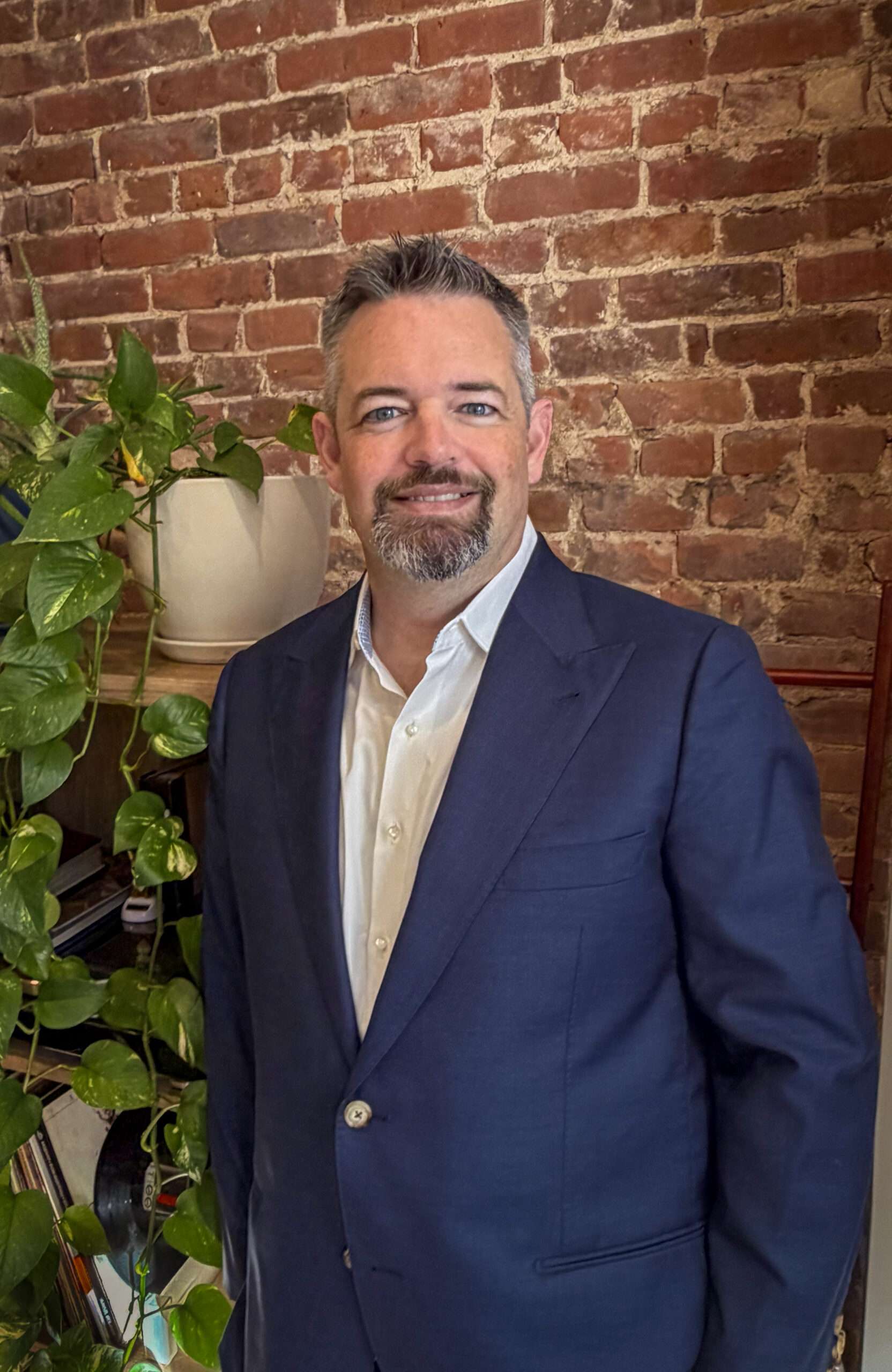
Most of the answers, he said, “looped back to very traditional elements like theater, stage, sound,” which led the museum to upLIGHT, a Brooklyn-based multidisciplinary design studio with roots in theatrical lighting. Principal Designer Greg Bloxham immediately understood the vision, and upLIGHT took on the exhibit’s entire experience technology stack and video content. “I had no idea lighting could do any more than just shine a light on that story,” Pasour said. “The light can actually be part of the story.”
An exhibit about time
Light helps encourage a visitor where to look. Bloxham compares the work to puppetry. “We build this whole rig of lights and effects, and then we start pulling the strings,” he said. In this case, the strings pull guest’s attention towards the fossils. upLIGHT lit the specimens with techniques borrowed from film and television and kept the audience areas low and dappled, so the crowd recedes and the dinosaurs on their pedestals come across as the stars. “It’s lit the same way I would light a celebrity,” Bloxham said.
That same control makes the hall feel larger than bones. Lighting design helps highlight “the element of time,” Bloxham said, and the exhibit uses dinosaurs that lived tens of millions of years apart to tell a story about change and adaptation, what he calls “an exhibit that is about time, in a sneaky way.”
The guest journey
The hall sits at the far end of the museum’s long, linear building, past a Quetzalcoatlus in the lobby and a Gastonia specimen that marks the halfway point, so every visitor passes the museum’s other galleries on the way.
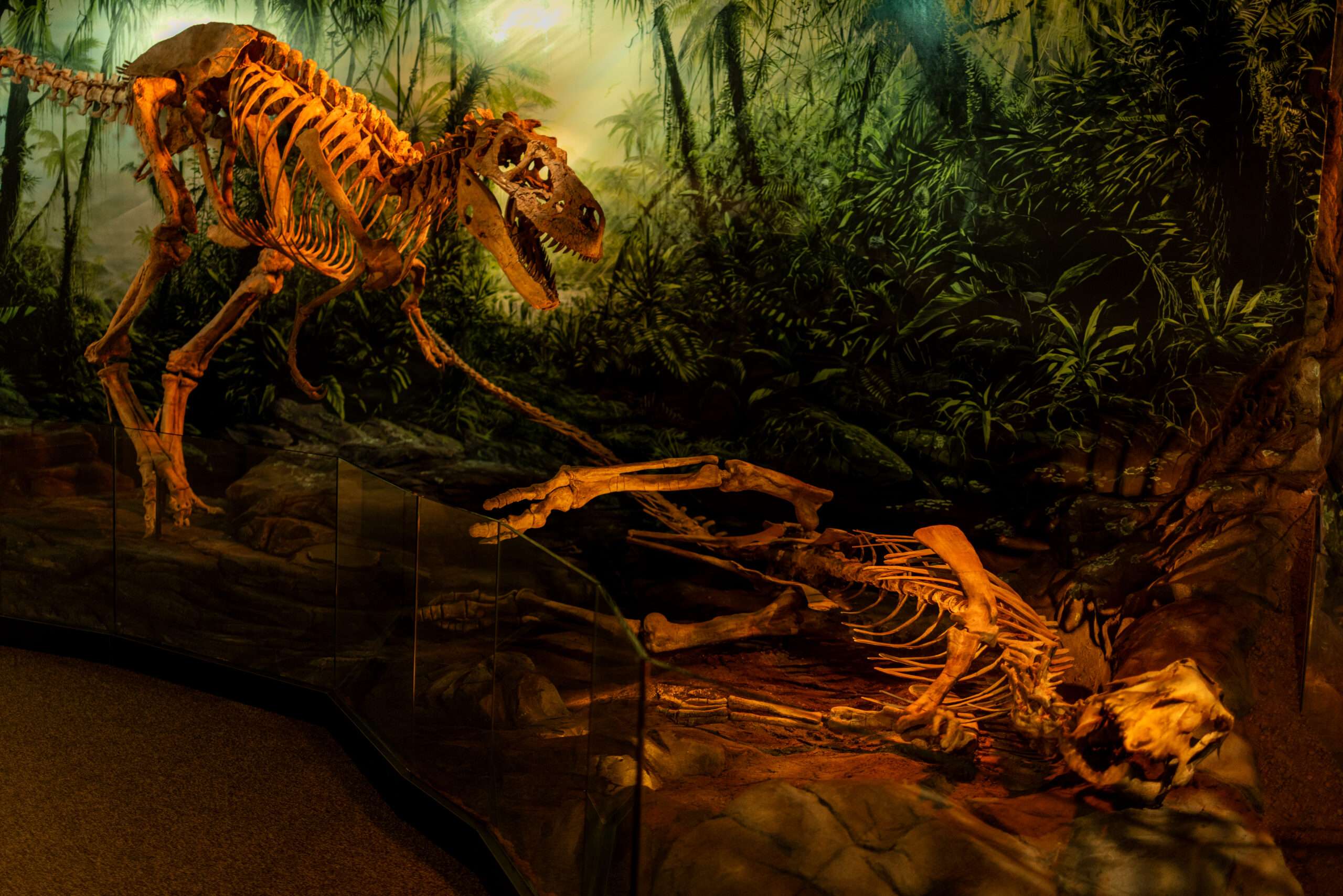
The hall opens with a familiar scene: an Appalachiosaurus, the East Coast T. rex, standing over an Eotrachodon it has just killed, both Carolina dinosaurs. “There are not a lot of surprises out front,” Caron said. String instruments hold a sustained note while the subwoofers deliver the footfalls audible from the lobby. “We’re setting expectations so that we can confound them later on,” Bloxham said.
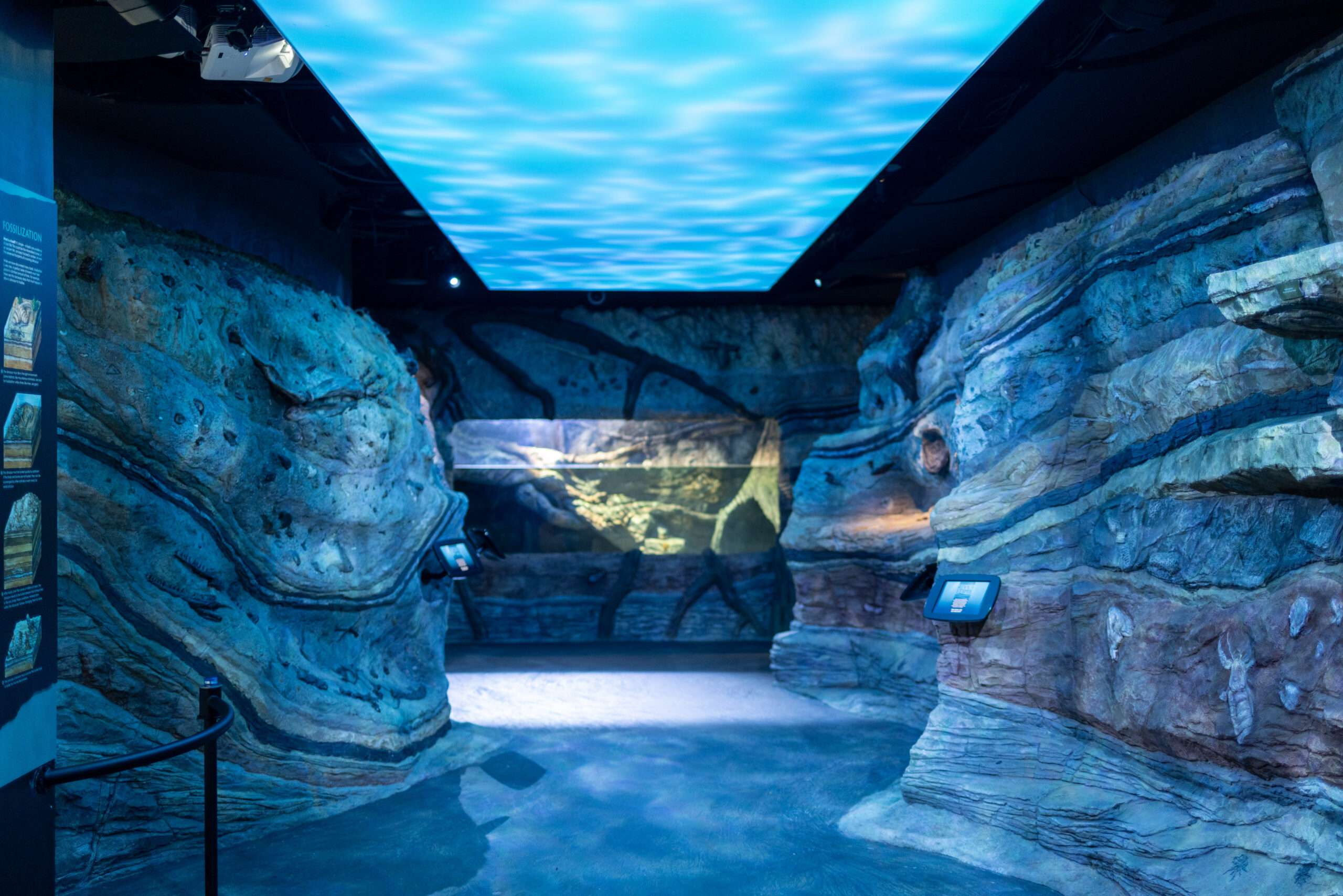
In the River of Time, visitors walk down a riverbed past stratified rock layers holding more than 100 fossils and casts. Partway down, an interactive video lets guests spin a dial and scroll down through the strata on screen, each turn carrying them further back in time. The corridor ends at a live alligator snapping turtle, a living relative of the ancient creatures ahead.
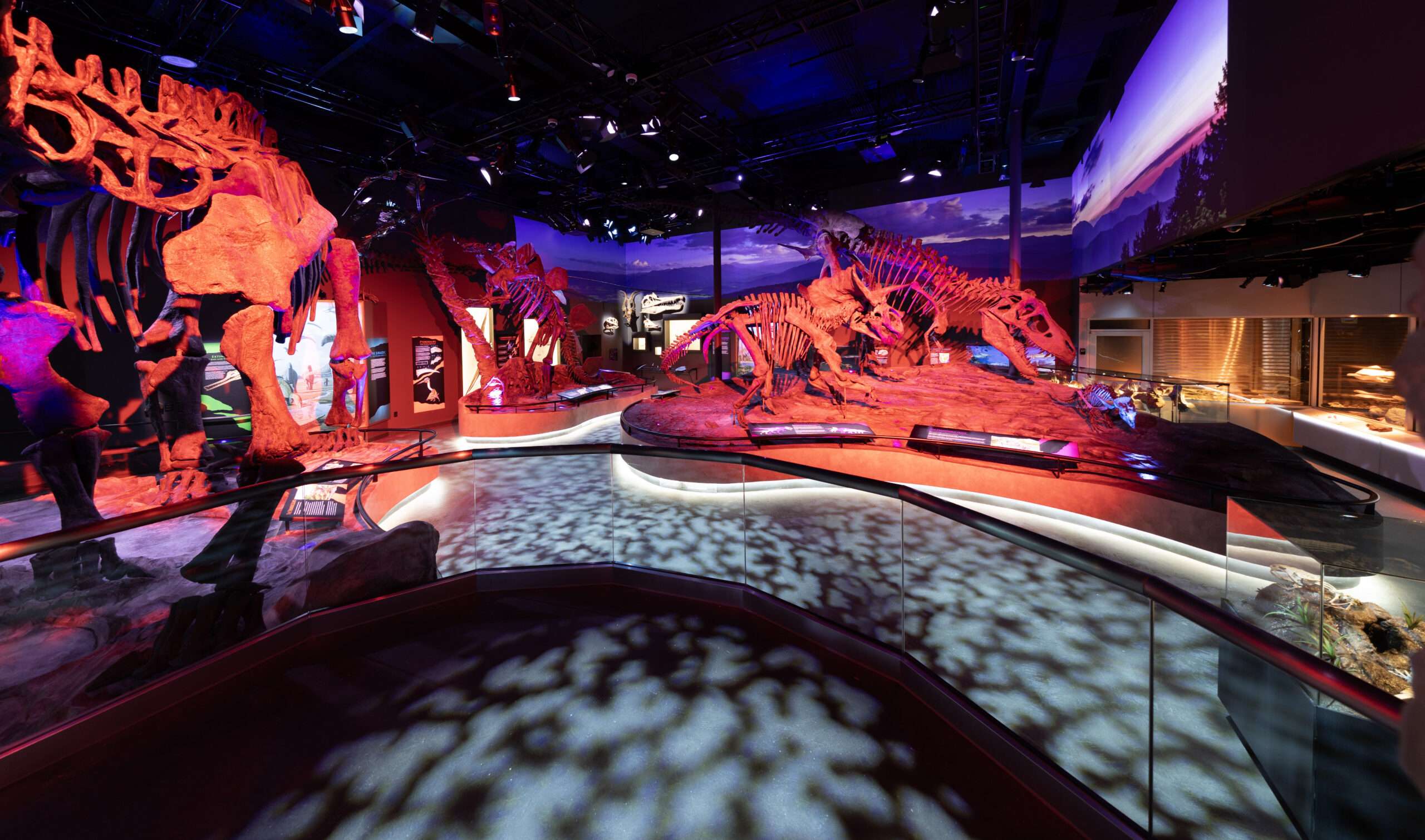
Around the corner, the Overlook opens onto the main gallery. An 80-foot Apatosaurus towers over the platform, and across the gallery a T. rex lunges at a fleeing baby Triceratops while the mother slams into the predator from the side. From the Overlook, visitors stand eye to eye with the specimens, then descend a ramp to the gallery floor, where, as Caron puts it, “you’re actually staring up at them from below.” Bloxham describes the sequence as an iris. “We are containing you and showing you one specific vista architecturally up until the Overlook, and then once you go down into the main gallery, you can choose your own adventure,” he said. “Then we narrow that iris back down again for the Continuum.”
At the crossroads between the Overlook and the floor sits a two-sided Dromaeosaurus that Caron sculpted, fleshed and feathered on one side, bare skeleton on the other, with a black mirror behind it. Two zones of light crossfade so the raptor appears to transform from skeleton to living animal and back, an effect inspired by Pepper’s Ghost.
“That skeleton represents the science and what we know,” Pasour said. “The element that Michael added, a fleshed-out interpretation of life, represents the imagination that we use to build on our knowledge.”
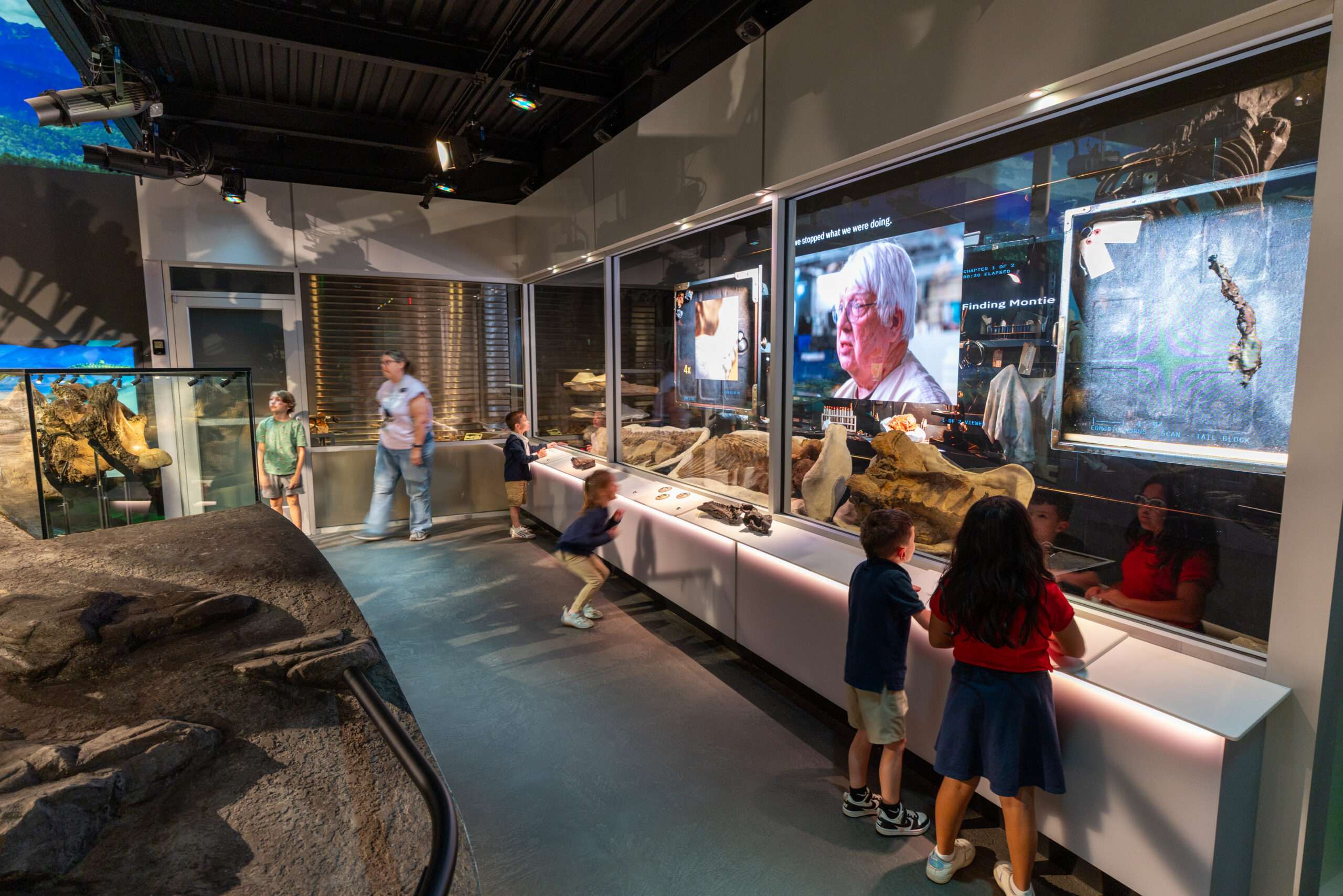
In one corner, an authentic Edmontosaurus fossil nicknamed Montie, roughly 32 inches by 18 feet, lies in front of a 20-foot-wide LED video wall. Three stations face the wall. At one, a joystick and dial steer a virtual microscope across the fossil. At another, two dials spin high-resolution 3D scans. At the third, touch buttons call up films that upLIGHT shot in Wyoming, Colorado, and North Carolina. Dr. Kraig Derstler, the paleontologist who discovered the specimen, and Dr. Nickolas Brand, the museum’s Curator of Collections and Research, appear on the wall to point out its healed bite marks from a T. rex attack. “People aren’t going to come to this exhibit to see Montie,” Pasour said. “They’re going to see Montie and realize this is the most valuable thing in the entire exhibit.”
The exhibit ends in The Continuum, a space the early drawings labeled only “exit hallway.” Bloxham thought about the theme park “kiss goodnight,” and pitched turning the hallway into the story’s resolution phase. Having walked visitors backward in time, the Continuum carries them forward again. A wall-sized video runs the length of the hallway, moving from the extinction of the dinosaurs through the rise of mammals to the first humans, and eight zones of speakers along the wall each play a soundscape matched to the era on screen. As a visitor walks the hallway, they move from one sound field to the next, so the crossfade a sound mixer would perform in a theater happens with each step. “Their time is over,” Bloxham said of the dinosaurs, and the room’s point is that ours is not. Lines of light create what he calls a celestial moment before visitors exit directly into the museum’s next gallery, Henry Hall of the American Indian, where the human story picks up.
Fifty speakers and a thirty-minute day
The main gallery has no windows, so upLIGHT created a faux sky. A 270-degree edge-blended projection wraps the top of the room with mountains, plant life, and clouds. The gallery lighting follows a 30-minute cycle that runs from daylight through sunset, a night sequence, and dawn, then starts the day again. The weather is randomly generated, so some days in the gallery are rainy, and 50 individually controlled speakers play exhibit-specific music and sound that shifts with the sky. The fossils never move, but the light on them never stops changing.
Gantom 7 seven-color spotlights embedded directly into the rockwork drive the night sequence, while Gantom Juni fixtures frame the exact areas of highlight on the raptor and Montie displays and recessed R4 fixtures light the Montie display from the ceiling. “In the night sequence especially, all the dinosaurs get a beautiful underlit glow,” Bloxham said. “You can see up into the rib cages in a very different way.”
Four video areas serve the hall across three edge-blended projection systems and the LED wall, and two are interactive: the River of Time dial and the Montie fossil wall.
Rather than wire the hall with pressure plates and break-beam sensors, upLIGHT put ordinary cameras throughout the gallery and gave them three jobs. The first is triggering. When a guest crosses a virtual line drawn in the camera’s view or steps through a doorway, the system can raise the sound, shift the lighting, or start a video loop, so the hall reacts to movement without a sensor at every threshold. The second is a system the team calls the Roar 5000. Speakers are placed among each dinosaur group, and at random intervals one of them roars. The cameras track how many people gather at each island, and the roars go more often to the emptiest one. “We’re using those as a way to invite people to come over,” Bloxham said.
The third job is measurement. The cameras feed a custom guest interaction monitoring system that tracks dwell time in designated zones, and Pasour’s team receives an automatically generated monthly report on where visitors linger and where they don’t. Every speaker and light reports its health to a web dashboard. “This is the technology backbone that you need to put in your building, not just for this first major exhibit, but for the next five exhibits,” Bloxham said.
Dinosaurs on pedestals
The Schiele built most of the new hall with its own hands, as it has for decades. The one part it handed to an outside partner was the one it had never done, and that trade-off turned a gallery of specimens into a story. “Had we not done it at all, we would have this wonderful gallery of dinosaurs on pedestals in pretty traditional exhibit lighting, and the story would be much more one-dimensional,” Pasour said. “Once you put artifacts on display for the public, you are telling a story, whether you’re doing it intentionally or not,” Bloxham added. “So you might as well use every tool you have to make it a good one.” •
PROJECT CREDITS
Schiele Museum of Natural History
Tony Pasour, Assistant Director Michael Caron, Head of Exhibits
Dr. Nickolas A. Brand, Curator of Collections and Research
upLIGHT
Greg Bloxham, Principal Designer Jackson Shelton, Composer
Don Dorsey, Sound and Music Design Consultant
Kristel Stark, Media Producer and Editor Robert Machado, Director of Photography Jeremy Le, Location Lighting and Camera Operator
Ella Gand, Production Assistant
Erik Herskowitz, Associate Lighting Designer David Waggoner, Design Manager
Zo Haynes, Project Manager and Programmer Justin Kirkpatrick, Draftsman
Paige Pinckney, Visuals Technician Alex Alam, Theatrical Electrician and Integrations Technician
Vendors
Gantom Lighting, Lighting Manufacturer upLIGHT, Experience Technology and Media Design
Rygid Audio Video, AV Installer Christie and ViewSonic, Projection Q-SYS, Audio and Show Control QSC and Genelec, Speakers Fabulux, LED Wall
ETC, Rosco, Chauvet Ovation, City Theatrical/ Environmental Lights, and Universal Fiber Optics, Additional Lighting Manufacturers Squeek Lights and Victor Zeiser, Lighting Supply
Lail, Electrical
Triebold Paleontology, Skeleton Casts and Fossil Preparation