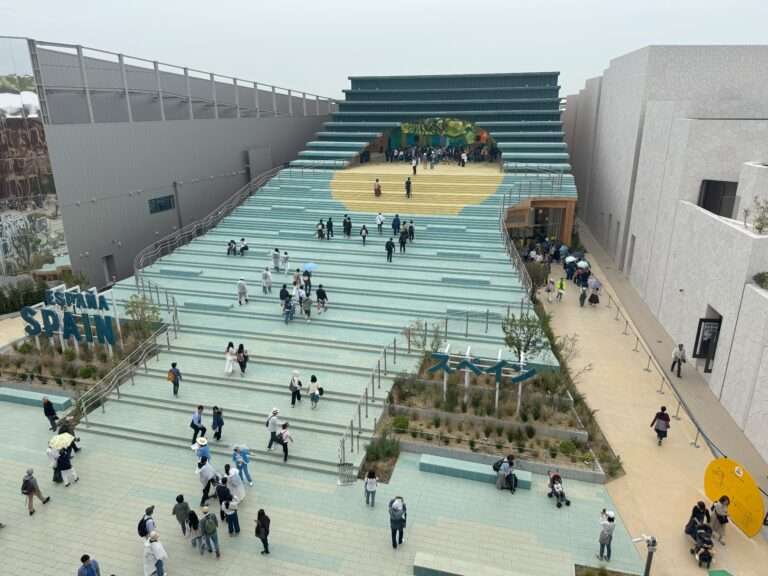
Expo 2025 Osaka’s defining feature is The Grand Ring, which encircles the expo site and provides views of the pavilions and surrounding bay area. Shown here from atop The Grand Ring are the France, USA and Philippines pavilions Photo by Paul Williams
I’m writing as I return from my media preview of Universal Epic Universe in Orlando, Florida. Simply put, the park is stunning. Because of production deadlines, InPark’s main coverage of Epic Universe will appear in our next issue. But I had just enough time to share some initial thoughts with you here.
So much thought and care has been put into everything – from overall concept design to individual shows and attractions. And the amount of technology built into the park is unrivaled.
But honestly my biggest takeaway from the week is hope. I have been open about my recent concerns for the industry as well as the global economy, largely thanks to the instability inflicted by our own government here in the United States. While I still have those concerns, the opening of Epic Universe provides a much-needed shot of optimism for me – and, it seems, the thousands of people who have dedicated their lives to creating magical and engaging visitor experiences both in Central Florida and around the world.
Expo 2025 Osaka is another bright spot on the landscape, and our coverage of that event in this issue highlights some of the best pavilions and experiences to be had there. Although Expo and Epic are different in many ways, they both seem to share a common purpose of inspiring a passion for exploration (both the world as we know it and the celestial universe!). Additionally, I think they both want guests to engage in a more thoughtful way with their experiences. Guests are referred to as “travelers” once inside Epic’s central Celestial Park and inspirational quotes are inscribed around the park and attractions. It’s fun, of course, but it’s also refreshingly cerebral.
Obviously, I cannot predict the future of the industry, but I am hopeful that an amazing new park like Epic Universe helps create an additional surge of interest and investment in themed entertainment. In turn, that should further encourage and reward the professionals and companies that bring these experiences into existence. And what could be better than that?
Luoman’s acquisition of Holovis is a game changer for immersive experience
When Stuart Hetherington founded Holovis in 2003 along with Joe Jurado, it was the classic tech startup story. Starting small, Holovis quickly established roots in the dome and projection cave environments. The company soon expanded and evolved, focusing on incorporating and adapting new technologies into immersive experiences, with pioneering applications of AR, VR, projection mapping and more. The company also grew geographically. In addition to its headquarters in the U.K., Holovis opened offices in Orlando, Shanghai and Abu Dhabi. Now, 20+ years later, Holovis is recognized in the industry for its innovative approach and delivery of complex AV and interactive installations worldwide.
In 2021, Holovis entered into a partnership with Shanghai Luoman Lighting Technologies Inc., an urban lighting design and integration company established in China since 1999. The agreement allowed Holovis easier access to the Chinese market and provided Luoman the opportunity to expand into the leisure and entertainment sectors.
Stuart Hetherington, CEO, Holovis
Luoman announced the acquisition of Holovis in 2024, transforming Luoman into a major international player in entertainment technologies while building on the global reputation and client list Holovis has established.
InPark asked CEO Stuart Hetherington to delve into the details of this game-changing acquisition and what it signals for the future of immersive experiences.
What are the benefits of being part of the Luoman Lighting group?
With the architectural and outdoor lighting solutions from the Luoman teams now being part of our portfolio, we have significantly expanded our turnkey capabilities and offerings to both new and existing clients. The Holovis and Luoman teams can also share resources, capabilities, and experience – not just in China, but globally.
Additionally, we are jointly working on several confidential development projects to take immersive experiences and attractions to the next level using XR technology for the creation of unique immersive storytelling solutions, and these will be announced in due course.
How will your role and the overall leadership structure of Holovis change?
One of the essential aspects of a successful acquisition is to maintain stability and continuity in both businesses while leveraging the synergies and expertise from both companies and their executives for mutual gain, something that we worked very hard on throughout the process. We spent nearly three years working in partnership with Luoman under a joint venture before deciding to go ahead with the acquisition, to prove the relationship and the operating requirements of both businesses. Since the acquisition, there has been no change in the core leadership and operations of Holovis, with our VP team continuing to drive the daily operations and strategy of the business under my leadership as CEO of Holovis, and with the full support of the Luoman team and its CEO, Claire Sun.
How is the company growing as a result of the acquisition?
The architectural and outdoor lighting solutions from the Luoman teams are now part of the Holovis portfolio.
Luoman has a significant client base across China, the Far East, and the Middle East. Holovis has operated in China for the past 12 years and also has a notable presence in other themed entertainment hot spots, including the United States, Western Europe and the Middle East. We are investing in the further expansion of the group, with an initial focus on our latest offices and expanding team in Saudi Arabia, and in our innovation and development programs to create some unique solutions and products to enhance our offerings and portfolio. This puts Holovis and Luoman in a strong position to address the evolving entertainment and experiential sector in China and the opportunities we see, as well as globally with both existing and new clients.
What are the key strategic priorities for Holovis in the Chinese market?
While we already have a large team, innovation, and demo center set up in Shanghai, our priorities are to continue to grow the multidisciplined team and skillsets locally, as these are needed to deliver major ongoing and future projects in China, while also using these resources to support our wider operations and projects in other countries. We are also investing in dedicated software and game development teams and strategic partnerships in China to support our global operations.
What exciting new developments or projects can we expect to see from the combined teams of Holovis and Luoman?
We are already seeing the major benefits in the coming together of both companies, with major new joint projects being won in the Middle East that require Holovis’s core immersive, complex AV, and attractions design capabilities, as well as major packages of work for the Luoman team in designing and delivering all lighting aspects of the projects.
We have also just signed several turnkey projects in both China and Europe that will be co-invested in by the group as joint owner-operators and in partnership with several major IP owners who are licensing their IP to these specific projects. This is a very exciting position for Holovis and Luoman to be in, and we’re thrilled to be taking the business into new ventures and even greater opportunities where we are investing in the unique experiences and attractions we will be building alongside our other partners. •
Maurer Rides’ B Corp certification accelerates the industry’s path to a greener future
interview by Becci Knowles
Maurer Rides CEO Jörg Beutler discusses the company’s vision for a sustainable future and its unique achievement as a roller coaster manufacturer having earned the prestigious B Corp certification.
Maurer Rides CEO Jörg Beutler
For nearly a century and a half, Maurer Rides has been a driving force in engineering and manufacturing. Founded in Munich, Germany, in 1876, the company has evolved from its origins to become a global leader in the design and production of roller coasters and transport systems. Today, Maurer Rides has over 1,000 employees and operates six production sites around the world.
Maurer’s journey into the amusement industry began in 1993 with the acquisition of the roller coaster operations of Bayrische Hütten Stahl (BHS)/Anton Schwarzkopf. This significant and strategic expansion brought with it a rich legacy of roller coaster design and technology. To sharpen its focus on the roller coaster market, Maurer established the subsidiary Maurer Rides GmbH in 2003, which now functions as a specialized and independent entity within the Maurer Group.
Maurer Rides has consistently pioneered the development of influential technologies within the roller coaster industry. A prime example is the introduction of the Maurer X-Car in 2004, an innovative system for inverted rides without shoulder restraints that changed the rider experience. The company has also developed the XTRAC multi-body simulation package for designing innovative track figures and the Maurer XBEND method for precise, three-dimensional bending of track tubes.
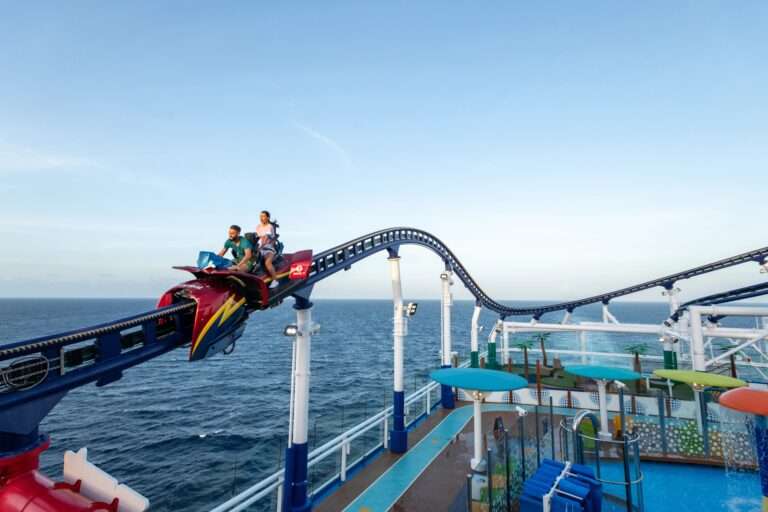
More recently, Maurer Rides unveiled the Spike drive technology, considered a transformative advancement for developing and manufacturing of roller coasters as well as other rail-bound transport systems. The Spike ASM (Adaptive Spike Motor) drive unit is touted for exceptional power density and for enabling “unprecedented” acceleration and versatile track designs, making it possible to surpass prior energy and gravity constraints, thereby elevating the thrill factor while also enhancing the sustainability of operations.
In a landmark move that reaffirms its commitment to a sustainable future, Maurer Rides has now become the first roller coaster manufacturer worldwide to earn the prestigious B Corp certification.
Awarded by B Lab, a global nonprofit that measures a company’s social and environmental impact, B Corp certification recognizes companies that meet the highest standards of social responsibility, environmental sustainability, transparency, and corporate governance. With only around 100 B Corps in Germany altogether, Maurer Rides is part of an exclusive group.
What key factors drove Maurer Rides to pursue B Corp certification, and why was this the right moment for your company to take this step?
We’ve been interested in sustainability for a long time, and it’s something I’m also interested in on a personal level. We started by doing a big analysis of how sustainable we are and wrote a long report about it that met the standards of the Global Reporting Initiative, or GRI. We did all of this with our own staff and didn’t use any external consultants. But we wanted to make sure we were on the right track, so we asked for external certification. We decided that B Corp was the best fit as it’s a general certification that’s open to all industries. Getting the certification was a logical next step for us, but it took a lot of effort.
B Corp certification validates ethical conduct and social responsibility as well as sustainability. Does partnering with a B Corp certified manufacturer help other industry members move toward those goals?
Yes. Although supply chain legislation in Europe has been somewhat watered down, all companies are called upon to question and verify the sustainability status of their suppliers as part of their own sustainability efforts. Working with certified suppliers is rated much higher in this respect. In addition, the park operators can be sure that certified suppliers have all the data necessary to assess the sustainability of their products, such as the carbon footprint or the energy consumption of the roller coasters over their life cycle.
Maurer Rides’ innovative Spike drive technology powers attractions like the Desmo Race at Mirabilandia, offering thrilling experiences with enhanced sustainability
Ethical business conduct and social responsibility are key factors for sustainable business. I am sure that it will become increasingly important for theme parks to pay attention to how these areas are covered by their suppliers.
We see ourselves as pioneers of sustainable engagement in our industry. In doing so, we hope to give the movement a boost. We believe it is our responsibility to live up to this challenge and continue to be a leader in this area. We expect our customers to put pressure on suppliers to insist on high standards. B Corp certification is good preparation.
Can you provide specific examples of how Maurer Rides plans to reduce its environmental footprint?
Of course, we are constantly working to reduce the energy consumed in the manufacture of our products. We also optimize the energy requirements of our products. It is more difficult to reduce the carbon footprint of our suppliers. For example, the carbon footprint of steel production is currently very high, and we have few alternatives for this material. What we can do is assess the amount of recycled steel in our suppliers’ steel production and monitor the market for the availability of green steel, which will become increasingly available in the future.
Tell us about changes made within the company to help meet the high standards required for B Corp certification.
We have continued to raise our standards, particularly in the environmental area. The development of various policies, such as the Code of Conduct, the Responsible Business Policy and the Whistleblower Policy, has also helped us make progress in the government sector. We already had a high standard in the social area, but we still have some weaknesses, for example, in finding enough female employees to ensure a more balanced ratio.
I hope that sustainability efforts and related certifications will increasingly become the standard in our industry. Getting involved early on is not only important in this respect but can also lead to more sustainable and therefore more future- oriented products from a broader perspective.
What other initiatives or innovations is Maurer Rides pursuing to enhance sustainability in the amusement park sector?
One focus is the increasing consideration of energy efficiency and reducing the carbon footprint when building new roller coasters. We are also keeping an eye on life cycle costs and are working on interesting concepts in this area as well.
B Corp certification is consistent with our values, practices and products. We believe that our Spike drive systems are a particularly energy-efficient and sustainable technology. With the introduction of the Spike ASM Launch, this technology is now available for roller coaster trains and high-capacity requirements. And new Spike products are in the pipeline that will be a great addition to the many facets of roller coasters. •
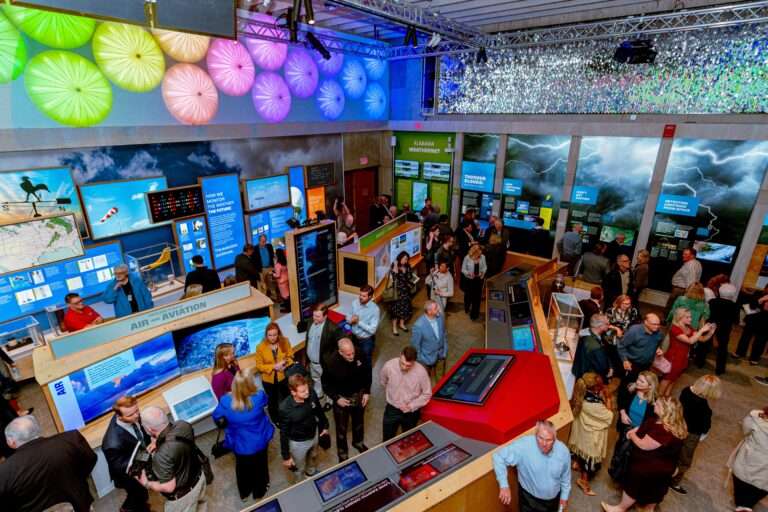
The new “How We Know the Weather” exhibit at the U.S. Space & Rocket Center unites powerhouse teams from the design, technology and weather industries
by Andrew Friedenthal
We perhaps take for granted the ability to turn on the television or navigate to a website and receive a reasonably accurate forecast for what the weather is going to be tomorrow. Weather is inherently unpredictable, but somehow experts have managed to figure out a way to predict it.
But what actually allows us to do that? The short answer is tons of data. The longer answer involves Bob Baron, founder, president, and CEO of the Baron Critical Weather Institute, a nonprofit organization dedicated to critical weather information-sharing across the state of Alabama. Baron is the driving force behind “How We Know the Weather” at the U.S. Space & Rocket Center in Huntsville, Alabama – an immersive new museum exhibit that explores and explains the science of weather.
“The focus of the Institute has been to bring world class instrumentation in support of public safety, educational outreach, and economic development,” explains Baron. This was the motivation for Baron to develop the exhibit, with a goal of helping both children and adults learn about the importance of meteorology. Baron found a host for the exhibit in the Rocket Center, which was looking to revitalize its campus in the post-COVID landscape and had 2,500 square feet of space available.
With a vision and a venue, Baron began to assemble a dedicated team – headed by design-build firm Design Force and AV/ technology consultants TechFulcrum. Together, the team faced the challenge of taking all of the massive amounts of information behind weather prediction systems and turning that into an engaging exhibit that allows visitors to experience the science – and data – of weather prediction for themselves.
Commanding the data
The Baron Institute selected Design Force, in part because of the company’s history of working with the Rocket Center and other prominent institutions. For this project, however, Design Force worked with the team at the Baron Critical Weather Institute, rather than the Rocket Center itself.
Design Force owner Phillip Sowder brought TechFulcrum onto the project, having worked with their team before on multiple collaborations. The partners applied their complementary skillsets, with Design Force addressing the creative elements and TechFulcrum designing a technology package to support the narrative experience. “Design Force is a fantastic creative partner,” says TechFulcrum founder and CEO Scott Arnold. “Their ability to blend aesthetic sensibility, storytelling, and attention to the practicalities of installing and operating an exhibit make our job – and the project owner’s job – much easier.”
Entranced visitors admiring the solarium
Photo courtesy of Jeff White
The newly assembled team approached the project with an expectation of precision. “Because this is scientifically oriented, we had to make sure that everything was extremely accurate,” explains Baron. His for-profit company, Baron Weather, provided much of the information Design Force and TechFulcrum were tasked with interpreting. Kim Grantham, Vice President of Marketing for Baron Weather, was responsible for sourcing Baron Weather software, data, and resources to support several exhibit areas. “We were the beneficiaries of data contributions from NASA and NOAA as well,” adds Kathi Tew, chief operating officer and chief financial officer at the Baron Institute.
In fact, the amount of data the exhibit would be receiving and synthesizing rivaled or even exceeded that of actual weather prediction centers. “We knew the exhibit would be unique in having a live feed from both the polar orbiting satellite and the geostationary satellite, as well as worldwide lightning and radar information,” explains Baron. “We understood from the start that the data going into that exhibit would be massive, high- quality and state of the art.”
The team was then faced with the task of taking all that data, combining it with complicated information from expert scientists, and creating a multilayered experience that provided both information and excitement for visitors with varying levels of interest. “We had the challenge of having a treasure trove of digital data, but very little of it existed as tangible, easily understandable content,” explains Sowder. “We had to balance everything out to make it fun for everyone and also make it visually appealing.”
The solution was to create a series of stations that combine interpretive graphics, digital displays, and hands-on interactivity, combined with several key immersive experiences that ensure the message of the exhibit is fully absorbed by visitors.
Adding to the complexity, much of the data being sourced by the exhibits would come from live feeds such as the Baron Weather Lynx visualization software that translates live weather information into engaging and easy-to-understand graphics presented on the large Weather Command LED screen.
“One of the tricky parts was to take the story points we wanted to cover and figure out how to pair them with live data streams that, like the weather, can be unpredictable sometimes,” says Arnold. “We couldn’t have accomplished this without the help and efforts of Kim Grantham and the team at Baron Weather.”
Exploring the space
The entranceway to the exhibit, known as the “solarium,” houses a three-dimensional recreation of the sun that uses actual imagery taken of the celestial body. “We wanted to take high-resolution satellite imagery of the sun and create a compelling story that encouraged guests to explore further,” says Arnold.
Developing the display was a technical and creative challenge. The solarium’s “sun” is a large dome protruding out towards guests from a flat, black, shiny background. Images of the sun’s surface are rear-projected onto the dome (and, to create the sun’s corona, onto the semi-transparent background surface) – a process that TechFulcrum had perfected in a past project where they created a three-dimensional eyeball. Arnold wanted to use this particular solution rather than creating the sun out of a full sphere, because it was important to show the undulating, bubbling nature of the sun’s surface, which could only be accomplished by projecting onto the dome from behind.
Examples of the exhibit’s interpretive graphics and data feeds. Near real-time data helps create many of the displays in the exhibit. Photo courtesy of Steve Babin
Contrasting with the black background, from a distance this sun appears to be floating in mid-air, and closer up it shows off the details of its surface that are key to understanding the importance of this celestial body. “It’s a great draw to pull you in, but it’s also a way to talk more about how the sun impacts weather on Earth,” says Arnold.
Touchscreens on the wall to either side of the sun provide an interactive way for visitors to learn more about it, and how data from satellites informs the images they’re seeing on the dome, including the constant motion and rotation of celestial gases and occasional eruptions of plasma.
From there, guests enter the exhibit’s main room that features more than 30 interactive displays, including touchscreens and hands-on models. One offers guests the ability to see static electricity in action with a long-haired wig. Another highlights the pattern wind makes over moving tiles. Each display is independent, allowing guests to visit whatever stations they are drawn to, and in any order.
Nearly all of the displays incorporate the data that Baron, NASA, and NOAA provide, with many showing live data feeds of weather phenomena from around the planet. “All this amazing data is really what powers a lot of this experience,” says Arnold. “When guests look at an explanation of ground-based lightning detection, they’re seeing live incoming data of ground-based lightning detection from around the world.”
Nestled in a far corner of the room is another show-stopper that, though less reliant on live data, is an example of a tactical experience designed to appeal to visitors in a more visceral manner: a recreation of a tornado.
Visitors enter a simulated storm shelter and see a TV playing, only to find the broadcast interrupted by a tornado warning. Two digital display “windows” (which Theory Studios helped to create) on the side walls show what’s happening outside as the tornado forms and passes by. Safe within the shelter, visitors watch as the lights flicker in time with thunder and lightning (before blacking out entirely) and feel the rumbling of the storm thanks to bass- heavy sound design by Dan Newman that goes along with the visuals. The sonic effects are created by low-end transducers placed in the wall and benches, a low-frequency sub-woofer for the storm effects, and midrange overhead speakers for the rest of the audio fill.
The popular experience offers a high throughput – a three-minute experience with one minute of loading/unloading, cycling automatically during operating hours.
The long-term forecast is good!
Although the solarium and the tornado shelter may be the biggest hits with younger visitors, the entire exhibit is already proving quite popular. Sowder recalls that he was installing an update to one exhibit when a child came up to him just to proclaim, “This is my favorite area at the Rocket Center!”
Sowder credits that reaction to the successful collaboration between the Baron Institute, Design Force, and TechFulcrum: “The team makes everything successful, and the end result is that the public really loves the exhibit.”
What’s more, the Rocket Center plans to deploy the exhibit as a part of other offerings that the center provides, including use in Space Camp programming to showcase both the benefits of satellite technology and the importance of accurate weather prediction for aviation.
“Museums have this rare chance to shape how people feel about science,” says TechFulcrum experience designer/developer Christian Lozano. “And when you make it tactile, honest, immersive, and impressive, it sticks.”
“How We Know the Weather” is open now at the U.S. Space & Rocket Center. •
Andrew Friedenthal has a Ph.D in comic books – well, American Studies – and now works as a writer in the themed entertainment industry, basically living the dream of his 11-year-old self. With a body of work encompassing plays, screenplays, arts criticism, journalism, academic books, articles, and plenty of copywriting and content marketing, he is obsessed with getting to the heart of any story, regardless of format. Though based out of Austin,TX, where he lives with his wife and daughter, his New York heritage ensures he will always stand “on line” at a theme park, not “in line.”
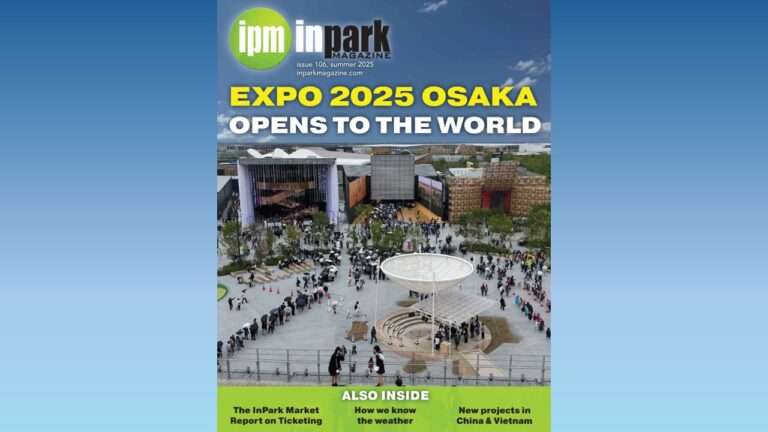
Osaka, Kansai, Japan hosts the World’s Fair, bringing together people from around the world to experience food, culture, architecture and technology
by Martin Palicki
Expo 2025, officially known as the World Expo 2025, debuted on Yumeshima Island in Osaka, Kansai, Japan, on April 13, 2025. The event runs through October 13, 2025, and features the theme “Designing Future Society for Our Lives.” Over 150 countries and regions are participating in Expo, with over 28 million visitors expected over the six-month run.
Expo 2025 Osaka builds on nearly 200 years of world’s fairs and marks a return to Osaka as a host site. Expo ’70 welcomed over 64 million visitors to Osaka with the theme “Progress and Harmony for Mankind.”
World’s Fairs have a long connection to the attractions industry, contributing such inventions as the Ferris Wheel (Chicago, 1893) and even played a key role for the development of future theme park attractions for none other than Walt Disney (New York, 1964). More recently, many suppliers to parks and attractions also lend their expertise to expo pavilions, which often emulate small theme park attractions.
InPark has been a leader in reporting on Expos and has extensively covered the selection and development of Osaka for the 2025 fair, thanks in large part to the work of our own World’s Fair Editor, Jim Ogul and our former Editor Judith Rubin.
Osaka marks my third World’s Fair, having attended Shanghai (2010) and Dubai (2020) previously. I visited Expo 2025 Osaka shortly after its opening along with Tina Kreitlow and Paul Williams. We also covered Expo 2020 Dubai together through several articles and podcasts. Although we experienced nearly everything together, our responses and reactions were different. Some of Tina and Paul’s thoughts are captured in sidebars to this main article. What follows is my take on the experience, and recommendations for fellow industry professionals planning to visit.
The reviewer’s dilemma
There was much discussion in our group about whether it is fair to compare Expo 2025 to Expo 2020 Dubai. The amount of money invested, the sheer size and scale, and the added year of preparation the pandemic afforded to the delayed Expo 2020 seem to make for an uneven playing field. But I don’t see how one can NOT make the comparison – particularly in relation to core experience metrics: Did I have fun? Did I learn something? Did I try something new?
On these questions, and on other fronts, I feel Expo 2025 Osaka underperforms. To be fair, elements of Expo 2025 are brilliant. The Grand Ring is iconic. Much of the architecture is stunning. The welcoming and kindness of the Japanese hosts is notable. Many individual pavilions and experiences shine (more on that later). But there were key elements of the overall experience that left me feeling disappointed. I departed feeling not nearly as enthusiastic about Expo as I felt after Dubai.
Under-designed and over-engineered
The simplicity of Dubai’s three-petal design made sense to me. Each petal represented one of that event’s sub-themes, with a major theme pavilion serving as a focal point and anchor. In Osaka, The Grand Ring is the event’s defining feature, but pavilions seem somewhat randomly placed both inside and outside the ring, with little cohesion between areas. The Future Life Zone, for example, is located on a narrow strip far away from the central Ring, while The Future of Life pavilion is located in the center of the expo site with other “Signature Pavilions.” A glitchy Expo map app didn’t make things any easier.
Restaurants – outside of Japanese-style food halls – were difficult to access. One of the pleasures of Expo is enjoying different cuisines, but restaurants in many countries were only available with advanced booking or an unreasonably long wait.
However, by far the single most discouraging element was the over-engineered and unnecessarily complicated pavilion reservation system. First, a couple of notes: As of this writing, Expo organizers continue to tweak and adjust the reservation system, so it appears to be a work in progress. Also, as media we were effectively treated like staff, and as such didn’t have actual tickets, which means we could not access many of the reservation systems. Even among those that we could access there was no uniformity. Some required online booking (often involving a lottery), others offered a QR code on-site to waitlist for entry. At least one required in-person reservations. Some pavilions allowed stand-by queuing only at certain times of the day while others advertised their “no reservation required” status as a badge of honor. Several pavilion operators told us they quickly abandoned the reservation system shortly after opening in order to simplify the process and give everyone the chance to visit, even if it meant standing in a longer line. But the inconsistencies of the system, the reliance on extensive pre-planning and a need for a little bit of luck were major negatives. The net effect was one of discouragement and defeat – we ended up abandoning efforts to visit every pavilion we had planned to see. Although certainly noble in intent, the reservation system proved too difficult to access and manage, turning what ought to be a fun experience into a chore.
Pondering pavilions
Despite these flaws, several pavilions really stood out as must-see experiences. A special thank you to Christian Lachel of BRC Imagination Arts for helping us out with a starting guide.
Brazil’s pavilion centers around a special, artistic experience that lasts nearly 15 minutes. Photo by Paul Williams
Brazil: Brazil’s pavilion went all in on artistic expression and experience – and I loved every minute of it. Most people will walk quickly through the main experience, but it’s worthwhile to sit and take in the whole show. While the interpretation is up for grabs, there’s a definite narrative arc and a Brazilian samba at the end that makes you want to get up and dance.
Guests use tablets equipped with AR technology to scan icebergs and unveil people, places and things associated with areas around Canada. Photo by Tina Kreitlow.
Canada: This clever integration of AR into the experience starts with guests being handed tablets and welcomed into a giant room full of fabricated icebergs. Viewing each iceberg through the tablet showcases a different area of Canada. The level of detail in the AR animations is exquisite, with plenty of Easter eggs and subtle nods to Canada’s history. The technology and implementation help make Canada’s pavilion a leader in interactive experiences at Expo.
The Future of Life pavilion raised interesting questions on the use of AI and androids, culminating in an unusual performance of robotic creatures. Photo by Paul Williams.
Future of Life: Billed as a creative exploration into how robots and AI will be further integrated into our lives in the future, the pavilion features a host of projection mapping technology and animatronics, with the added bonus of cute, bouncing robots. The show finale presents one vision of a future 1,000 years away. It’s decidedly artistic, very entertaining, and more than a little bit unnerving.
Larger pavilions, such as host country Japan, often utilize stunning architecture to help convey a message and encourage visitors to explore within. Photo by Tina Kreitlow.
Japan: While the country’s 2020 pavilion was one of the highlights of Expo, their offering this year focuses less on showmanship and more on meaningful technology. The pavilion is beautiful and houses a journey that takes guests through three areas highlighting cycles of nature. A focus on the benefits of algae showcases how nature can offer solutions to problems we create.
The Kuwait pavilion featured an assortment of experiences, including multimedia shows, interactive play areas, a meditation room, and a huge domed theater presentation. Photo by Paul Williams.
Kuwait: The Kuwait pavilion presents a collection of visitor experiences designed to appeal to a wide variety of guests with a fun pre-show, interactive stations, kids play area (including a slide), a quiet reflection room, and an impressively huge domed theater show. The experience provides a multifaceted view of Kuwaiti life and history, with just the right blend of media, tech and whimsy.
Under the Midnight Rainbow show: Presented nightly on the waterfront, this show (produced by ECA2) brings together fountains, projection, lasers, fire and music to tell a story about all living creatures, air and water. Select performances are followed by a drone show in the sky above.
The USA pavilion builds to an immersive rocket launch experience before parading guests past fragments of a moon rock. Photo by Paul Williams.
USA: InPark has extensively covered the USA pavilion, with notable experience design firm BRC Imagination Arts helping craft the guest experience inside. InPark’s own World’s Fair Editor Jim Ogul also provided consulting for the pavilion. The result is a well-orchestrated story of American ingenuity, culminating in a simulated blast-off into space. There’s even a catchy theme song and cute mascot. All 50 states are represented in the media within the pavilion – and not just the largest cities in each state. Perhaps most importantly, even with large queues the facility is designed with throughput in mind and the line moves quickly. The majority of the time, presentations are in Japanese, but English shows are scheduled regularly.
The Women’s Pavilion recycled part of the exterior of Japan’s pavilion from Expo 2020 Dubai. Photo by Tina Kreitlow
Women’s Pavilion: With a building façade repurposed from the Japan pavilion at Expo 2020 Dubai, the Women’s Pavilion builds on Japan’s impressive showing there with an engaging and immersive presentation. Guests follow one of three women’s stories before joining together to examine how women are represented and treated around the world. It’s a thought-provoking and well-executed experience. •
People make all the difference
by Tina Kreitlow
Going to Expo 2025 Osaka, Kansai, is an opportunity to immerse yourself in the gracious culture of Japan. As a first-time visitor to the country, I found the people to be kind, helpful, considerate and full of life. Few places in the world take this level of pride in attention to detail and making sure visitors have what they need for an enjoyable visit. Experiencing Japan is a key part of experiencing Expo.
On the Expo grounds, there are many ways to evaluate and sort the country pavilions, but it soon became clear to me that there were essentially two groups: those with native country staff and those who utilized local Japanese workers as pavilion guides and greeters.
While the Japanese teams were gracious and had exuberant enthusiasm for their adopted countries, for me the experience was lacking that personal connection. Brazil, for example, offered an entertaining pavilion that was well designed and executed, but I missed the ability to connect with actual Brazilians and talk about their country, their hometowns and their life experiences. The passion and storytelling of their people was absent.
Comparatively, I resonated more with pavilions like Indonesia, Kuwait and the USA. Each was exceptionally designed to showcase their countries, but the added benefit of native staff made all the difference. In Indonesia, I commented on how beautiful the flowers and trees were. A worker shared that the staff arrive early each morning to wipe down and care for the indigenous plants so they continue to look as they do back home.
While touring and eating lunch in Kuwait we experienced people who eagerly shared about their country, wanting to ensure guests left with an understanding of their culture.
The USA pavilion is not only staffed with 80 U.S. youth ambassadors but also features an artist-in-residence series that brings American performers to Expo audiences. The result in each of the three pavilions is an experience that is authentic, engaging and memorable.
While Expo pavilions are frequently recognized for their unique architecture, technology showcases or experience design, the people within the pavilion are really the ones that can make the biggest difference or create a lasting impact for visitors. In my opinion, one of the most valuable elements of Expo is the bringing together of people from around the world with common goals and missions, eager to share and learn from one another. The more countries – and the more people from those countries – that participate makes a richer experience for everyone.
The Grand Ring is a grand landmark
by Paul Williams
World Expos are celebrations of international culture, innovation and collaboration to solve global challenges. They include individual national perspectives on a central theme, but like the Olympics and other major international events, Expos allow the host nation to imprint its own unique viewpoint on the entire event.
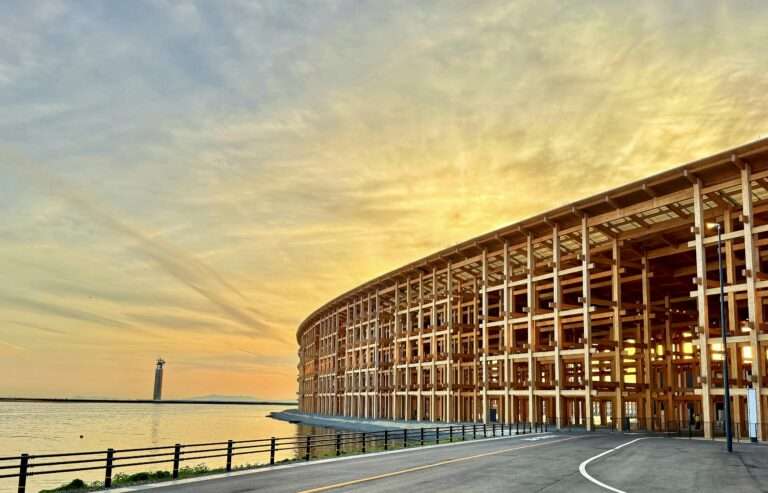
Expo 2025 in Osaka Kansai, Japan, certainly achieves this with its most distinguishing feature: The Grand Ring, designed by architect Sou Fujimoto.
Inspired by the theme “Unity in Diversity” and constructed with techniques used in Japanese temples and shrines, The Grand Ring encircles the event site with what has been certified by Guinness World Records as the world’s “largest wooden architectural structure.” The massive framework will undoubtedly make a lasting memory for many visitors. Elegantly simple with clean sightlines from all angles, the Ring is imposing with its 20-meter maximum height and 2-kilometer circumference while also being understated with its simple cedar, cypress and pine materials and natural landscaping. To me, the Ring evokes the Hinomaru, or “ball of the sun,” in the Japanese national flag. As the main boundary for Expo activities, it is filled with the intense energy of thousands of daily visitors and the fire of human imagination.
While Expo 2025 does not have a central gathering and connecting place (such as Al Wasl Plaza at Expo 2020 Dubai), the Ring connects the site from the outside in and back with multiple access points. A brisk 45-minute walk along the Ring’s Skywalk allows visitors to survey the entire Expo site with a bird’s- eye view of the unique pavilion architecture as well as the Osaka skyline and Osaka Bay. Conversely, the Ring can be seen from many and often unexpected ground-level vantage points. With the constant movement of strolling attendees along the Skywalk, it provides a dynamic visual pulse that quietly energizes the Expo campus. That pulse turned into a drumbeat on May 11, 2025 as over 12,000 musicians used the Skywalk to form the world’s largest marching band, setting yet another world record for Expo 2025 and uniting the event through sight, space and harmonious sound.
The Grand Ring may leave lasting impressions, but it’s not expected to remain, and in fact was designed to be easily disassembled. Current plans call for a small section to be preserved as part of future redevelopment of Yumeshima Island after the Expo ends on October 13, 2025.
With a nod to German heritage, Michael Keller Zehnder takes the Bavarian Inn Lodge from legacy resort to year-round destination with a new 170,000-square-foot waterpark and family fun center
by Becci Knowles
The Bavarian Inn, a Zehnder family legacy since 1950 in Frankenmuth, Michigan, has dramatically broadened its offerings with the new Bavarian Blast Waterpark and additional family entertainment attractions. (A little background: As a top tourist destination, Frankenmuth is a quaint, family-friendly city located about 100 miles north of Detroit and is known for its German heritage and classic Bavarian architecture.)
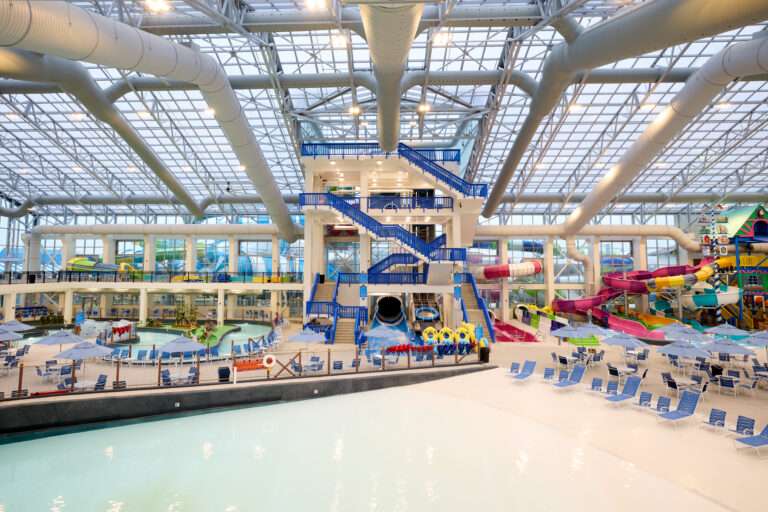
Now under the leadership of fourth-generation owner Michael Keller Zehnder, the Bavarian Inn Lodge has added this 170,000-square-foot attraction to its already extensive indoor amenities. The waterpark boasts 16 water slides, diverse water play areas for all ages and what’s billed as Michigan’s only swim-up adult bar. This expansion is a strategic move to widen the resort’s appeal and provide a unique guest experience, transforming it into a year-round destination.
WhiteWater created a varied and engaging range of slide experiences so that there would be something for every visitor to Bavarian Blast.
The Bavarian Blast Waterpark is designed to immerse guests in a Bavarian-themed festival atmosphere, extending the resort’s established brand of hospitality into its new entertainment arm. The park features a three-story castle, anchoring the immersive theme with its grand scale and traditional Bavarian architectural style, and an open-air roofing system that maximizes natural light, creating a bright and inviting outdoor ambience, even within an indoor setting. The design choice of the latter not only enhances the guest experience but also contributes to energy efficiency by reducing the need for artificial lighting during daylight hours.
Two key players in the waterpark sector, Aquatic Development Group (ADG) and WhiteWater, collaborated on the project, bringing their specialized expertise to the table. ADG served as the waterpark concept developer, wave equipment supplier and overall park specialty builder, responsible for the overall design and functionality of the park, while WhiteWater designed, engineered, and installed the park’s 16 new water attractions, ensuring a mix of thrills and family-friendly fun.
A feature-rich experience
A highlight of the park, designed by ADG, is the three-stage show featuring the resort’s mascot, Willy the Dragon. This interactive entertainment feature captures the spirit of a Bavarian festival, with Willy sounding the alpenhorn before a water blast dramatically signals the arrival of waves in the main wave pool. This integration of live entertainment with the water attractions creates a dynamic and memorable experience for visitors of all ages.
Global creative company Adirondack Studios provided creative design, sampling and mockups, fabrication and installation services for the whimsical characters and environments located throughout the waterpark, including fiberglass characters, aluminum animals, animal water sculptures, brightly colored Bavarian-style birdhouses, and the theming of a two-story castle backdrop to the park’s wave pool.
“Our goal was to provide a variety of experiences for our guests that catered to their many senses, thus creating lasting memories to cherish for generations,” says Zehnder, adding that Adirondack was brought on board following a recommendation by ADG.
Getting it right from the start
Ray Lauenstein
Ray Lauenstein, Director of Business Development at ADG, explains that the company’s role in the project began with “taking the owner’s initial ideas and aspirations for Bavarian Blast and fleshing them out into a comprehensive and actionable final concept plan.” This involved a “specialty design-build” approach, including detailed architectural and engineering design of all pools and their water circulation systems. The scope of work included strategically integrating the 16 water slides provided by WhiteWater to optimize guest flow and visual appeal, as well as master-planning operational logistics and back-of-house infrastructure.
Lauenstein emphasizes the complexity of the project, highlighting the need for detailed coordination between guest- facing attractions and essential back-of-house infrastructure. “What you don’t see is truly half the battle,” he says. “It’s all the complex underground work and the sophisticated back-of- house systems.”
He describes the intricate web of decisions, such as balancing the desire to enhance the guest experience with the practicalities of engineering and maintenance. In addition to the three-story tower, swim-up bar, and the wave pool show are other unique points of interest, such as at the mezzanine level where the mat racer water slide ends, providing a focal point as well as potential for future food and beverage options. ADG also worked to incorporate the resort’s branding into the park through thematic touches such as custom-designed lily pads.
WhiteWater wows with slide portfolio
WhiteWater’s contribution centered on creating a varied and engaging experience so that there would be something for every visitor to Bavarian Blast. Onno Meeter, President of Water Parks at WhiteWater, described a slide package that includes themed options for younger visitors, high-thrill experiences for adrenaline seekers, a family raft ride that encourages group participation, and interactive slides that deliver a sense of friendly competition.
Meeter highlights the inclusion of a family raft ride, “specifically designed for groups to experience together, fostering a strong sense of shared adventure and camaraderie,” as well as the exhilarating competing slides, such as the Parallel Pursuit, where riders race head-to-head. These types of slides not only provide excitement but also create opportunities for social interaction and shared memories.
WhiteWater also brought its thematic design expertise to the project, working closely with ADG to ensure the slides complement the Bavarian theme. Meeter explains that the company offers a unique slide customization process called veiling, which involves applying specialized visual treatments directly onto the slide’s surface to enhance a narrative – in this case, one slide with butterfly patterns and another with goldfish. This attention to detail extends the theming beyond the park’s architecture and into the attractions themselves.
Several slides also feature WhiteWater’s AquaLucent effects, an innovative finish technology that adds an element of light and movement for greater visual stimulation and excitement. These effects were selected for adding to the park’s overall atmosphere of fun and festivity. Says Zehnder, the AquaLucents “dramatically enhance the overall guest experience by introducing vibrant and dynamic bursts of color along the ride paths.”
Collaboration is key
The success of Bavarian Blast was the result of effective collaboration between project owner Zehnder and the external teams of ADG and WhiteWater, each contributing their unique expertise to the project. The Bavarian Inn Lodge’s German heritage was a key consideration throughout the project, influencing the design and theming of every aspect of the waterpark.
Meeter credits ADG’s expertise in managing complex and integrated projects, highlighting its ability to translate the client’s vision into reality. He also acknowledges the vital role of Adirondack Studios in bringing the authentic Bavarian theme to life throughout the waterpark, contributing to the immersive environment that sets Bavarian Blast apart.
In parallel, Lauenstein emphasizes the importance of robust project management to ensure that different teams work in coordination. “Different teams can easily end up operating in relative isolation,” he explains, “which can lead to conflicts, duplicated efforts, and inefficiencies.” ADG made a concerted effort to foster open communication and ensure that all stakeholders considered the interconnectedness of the various project elements from the initial conceptual design stages. This proactive approach to project management was crucial in overcoming the challenges inherent in such a large-scale development.
Navigating unique challenges
Like any project, Bavarian Blast presented several challenges, including coordinating indoor and outdoor construction, integrating complex water systems with slide structures, and adhering to the client’s vision and budget.
Lauenstein points out that integrating indoor and outdoor components was a key challenge, particularly ensuring that the water slides and pools that transitioned between these two environments were properly sealed to prevent air leaks, crucial in Michigan’s harsh winters.
The kids play area reflects the park’s Bavarian theme and is integrated with other design elements
Highlighting ADG’s role in navigating the owner’s vision, Lauenstein explains that the Zehnder family had a very clear idea of what they wanted to achieve, and fitting all those desired elements into the available space required innovative solutions. The children’s play area proved challenging to integrate with other design elements. Lauenstein recounts that the initial plans for the area went through revisions “nine or ten times” because of spatial conflicts with other features, such as building access and the location of the hot tub spa. To overcome this, ADG “called time out” and brought in fresh perspectives, ultimately leading to a solution that satisfied the owner’s requirements and worked within the park’s layout. “It was good to have Michael push us on that one and to have WhiteWater maintain flexibility,” Lauenstein says.
Close collaboration between ADG and WhiteWater extended from master planning to on-site installation and commissioning, with the teams working together to ensure correct and safe slide installation and seamless integration with pool structures and water systems. This communication was vital for maintaining the project schedule and meeting safety and guest satisfaction standards. Speaking separately, Lauenstein and Meeter tell me that positive relationships and mutual trust facilitated problem-solving and communication throughout the project.
Lauenstein is keen to emphasize ADG’s ongoing partnership with the Bavarian Inn’s Zehnder family. “For us at ADG, it’s not simply a matter of constructing the park and then walking away,” he says. “We deeply understand the significant long-term investment that the esteemed Bavarian Inn resort has made in this ambitious project, and we firmly aim to be a supportive and reliable partner throughout the entire operational lifecycle of the waterpark.” This includes operational check-ins and a responsive service department, ensuring the success and enjoyment of Bavarian Blast for years to come. •
VinWonders Nha Trang adds “Rise of the Ocean Princess” nightly stunt show thanks to Renaissance Entertainment and TechFulcrum
by Joe Kleiman
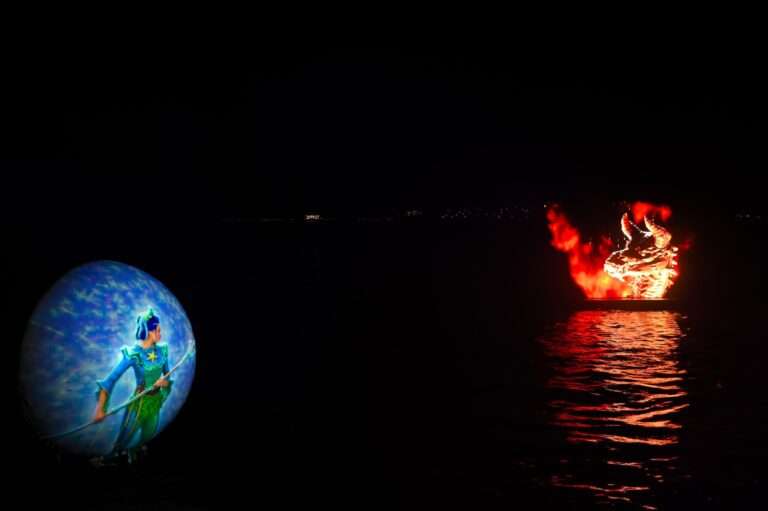
“Rise of the Ocean Princess” is a show that successfully combines live actors and stunt performers, projection through multiple mediums, a powerful score, lighting and atmospheric effects, and pyrotechnics – all on the open ocean.
Anchoring the newest addition to VinPearl Nha Trang resort, on Vietnam’s eastern shore, is a stunt show performed nightly on the open sea, “Rise of the Ocean Princess.” The show is a featured attraction of VinPearl Harbour, a new shopping and dining district with three distinct zones: Monaco, Fontville, and Indochine.
The new VinPearl Harbour complements the resort’s five luxury hotels, championship golf course and VinWonders Nha Trang amusement park which includes a theme park, large- scale aquarium, and waterpark.
VinPearl Nha Trang resort was developed by VinPearl Group on Hon Tre Island in Nha Trang Bay and is accessible only by aerial gondola or high-speed boat. The area was historically a government and religious center that has transformed over the past few decades into one of Vietnam’s dynamic resort destinations. It draws an international clientele, with many of its guests from Russia and Germany.
Jon Binkowski, CEO and Creative Director, Renaissance EntertainmentLisa Enos Smith, Executive Producer, Renaissance EntertainmentScott Arnold, Founder/CEO, TechFulcrum
The concept and team come together
“The client knew they wanted a stunt show,” says Renaissance Entertainment CEO Jon Binkowski, who was creative director on “Rise of the Ocean Princess,” working alongside the VinWonders internal creative design team. “They did their due diligence in looking at various shows throughout the world.” They were particularly impressed by “The Bourne Stuntacular” at Universal Studios Florida, according to Binkowski. “They recognized they wanted something with that kind of power, scale, and production value.”
The Bourne show, which had replaced the long running Terminator 2: 3D, received high industry honors as a 2021 recipient of the TEA Thea Award for Outstanding Achievement – Live Action Spectacular. Renaissance worked as an extension of the Universal Entertainment and Universal Creative teams on the project, with the Thea Awards Program crediting Binkowski as Creative Director and his business partner Lisa Enos Smith as Executive Producer.
“VinWonders approached us,” says Binkowski. “They wanted a waterfront show that would provide the same kind of punch, but at a more modest price point.” This would help make the most of both the natural and human assets available to stay within their budget.
Scott Arnold and his firm TechFulcrum were the perfect partners for Renaissance to manage technical direction and design for audio, video, lighting, and overall show control. “Enlisting Scott was a no-brainer,” says Binkowski. “We’ve worked together for over 30 years and know one another’s thought processes well. TechFulcrum was right there with us as we were conceiving the design of Bourne!” Rounding out the technical team were special effects designers/fabricators Technifex, lighting designer Chris Werner, sound designer Dan Newman, and TechFulcrum’s in-house video designer, Roger Bates.
Renaissance also turned to writer Stephen DeWoody, director Tito Enriquez, producer Lyn Lin, associate producer Zoe Lau, costume designer Ann Closs-Farley, props designer Adam Milicevic and sound designer and composer Gareth Prosser.
Trails of pyrotechnics fly off jetskis as flyboarders high in the air join the illuminating and dynamic display.
Through resourcefulness and creative thinking, Binkowski and Arnold were instrumental in delivering a high caliber stunt experience at a moderate cost, tying into IP of the resort’s existing dark ride and spectacles.
“This was our first project in Vietnam,” shares Arnold. “The first project in a country is always the most challenging. We’ve worked in China, but China and Vietnam are two different cultures. Some things are handled the same, but some are handled very differently. There’s a lot of learning on the go.”
Arnold and his team were able to acquire some of the technical elements from Vietnam, while others had to be imported. “Running out to the store for material or supplies was not always the easiest task,” Arnold says. “We ended up making friends with people who could get us the things we needed.”
New roles for existing characters
From the outset, VinPearl’s creative team knew which storyline they wanted for the show – that of The Ocean Princess from the tale of Princess Tata, whose characters appear multiple times in the park: as live action characters, during a nighttime spectacular, and in a dark ride designed by Jora Vision. “The story of Tata is a simple one, which translates well to the stage show,” says Binkowski, “She is a princess of light who battles a princess of darkness.” Since the live performers varied slightly in appearance depending on who was portraying the character, Binkowski used the animatronics in the dark ride as a standardized template for designing the characters in the show.
According to VinWonders, through the characters of Tata World, “‘Rise of the Ocean Princess’ unfolds a tale of courage, rivalry, and the eternal struggle between light and darkness, offering audiences an unforgettable journey into the depths of imagination.”
Finding the right venue
The overall design and build process was rather quick, with the entire project taking less than a year from design to opening. “It’s a simple show,” says Binkowski. “We had two main characters, the townspeople, and then the supporting cast for each of the two princesses. It all takes place on water, and, really, the only set pieces were the two towers on either side of the stage. The entire story is told through a small cast, stunt actors, projections and effects.” The basic, good-versus-evil storyline plays well to a broad international demographic.
The designers originally considered placing the show in the dive show arena. “It was a protected area, with no waves or tides,” says Binkowski. We couldn’t include fast moving jet skis or flyboarders.”
The team then started looking at spots along the shoreline. Arnold says: “At first we had this really long and narrow grandstand, but we needed to work within their space, so it was condensed to about a 1,000-person seating area – which is small – but it also places everyone closer to the action and makes it more intimate.”
The aforementioned towers also experienced a design change. In an early iteration, they were simply dive towers with metal stairs. As more effects were added, they took on a more solid nature. Scott Heineman, scenic designer and art director for Renaissance Entertainment, created a design that supports the show’s speakers and lighting, while also housing environmental effects, such as bubbles and flames, and still functions as a platform for high divers. The overall goal was to make the towers blend organically with the surrounding architecture as well as the show, rather than appear as an equipment platform.
“Execution of items like the towers is frequently challenging,” says Arnold. “The client is responsible for building the towers to meet the designer’s specifications. Some of the things we ask for are outside the normal realm of what the client is used to, because of the specialized nature of our business. Add to that the safety elements required for the divers, and a simple tower suddenly becomes much more complex. Because we had to rely heavily on the client and their construction teams – and it is different than traditional construction – we worked to help guide them through the process.”
Sound and fury
Another challenge arose when the client decided to enlarge the venue after substantial construction was complete, and the audio equipment was being installed per the original design. “We were able to adjust what we had in order to make it work,” says Arnold. “It’s a pretty traditional audio system, consisting of left and right front speakers with subwoofers. We added front fill speakers on the stage, which are disguised as tie-off points for boats.”
For the music, Binkowski wanted to provide a high- energy score while minimizing cost. He accomplished this by arranging for a special licensing agreement with the distribution company Extreme Music that represents the duo Two Steps from Hell, well-known for composing music for movie trailers, including the Harry Potter and Pirates of the Caribbean franchises. “Extreme Music gave VinWonders a deal to use specific Two Steps songs and created a sequence for them,” Binkowski explains. “VinWonders has the rights to this sequence in perpetuity and it can only be used for this show.”
The two princesses (in media) were cast in Los Angeles and filmed on green screens at A Very Good Space in Van Nuys. Binkowski and Smith then approached their friends at Theory Studios to add animation. The Ocean Princess, the princess of good and light, appears in a pearl floating offstage. Her image on the spherical screen is projected from a single Christie Crimson 3DLP laser projector. “We considered using multiple projectors and blending the image,” Arnold explains. “But we were happy to avoid that. Eliminating blending simplified the process and makes it easier to ensure consistent show quality over time.”
The dark princess appears on an LED screen floating in the water. “We were able to do something cool with that,” says Binkowski. “After we filmed the actor, we added animation where she transforms into a ferocious dragon.”
Piecing together the components for the floating screen required elaborate teamwork, collaboration and problem- solving. “The LED screen has a supporting structure,” explains Arnold. “The barge it rests on was purchased from China and shipped in pieces in a cargo container and assembled on site. Then everything was built on top of it. The support frame for the LED tiles was built from Vietnamese materials. We needed something that was sound and would not deteriorate quickly. It was not as clear-cut to source materials and build in Vietnam, so we had to be much more nimble than normal. This was true for all show elements. Jet skis, for example, needed a particular kind of fiberglass resin – and that was driven to Nha Trang from a completely different part of the country. The end result is fantastic and would not have happened without all our partners working together.”
Add H20
The corrosive nature of sea water demands proper execution of technical design and installation of AV equipment, housing, and supports for a project of this kind. There are safety issues as well. TechFulcrum and its staff have decades of experience working on projects for cruise ships and major marine animal parks, such as SeaWorld and Chimelong. According to Arnold, marine park environments tend to be harder on the equipment, which also includes electrical boxes and show action equipment, because artificial salt water uses a different chemical composition than natural sea water, which makes it more corrosive to electronics. With Nha Trang, natural sea water became part of the show.
Jet skis with trailing pyrotechnics circle the evil princess, displayed on an LED screen, in the open bay.
At the front of the stage, fountains spurt into the air. There are also high-pressure hoses that the heroes use to push the villains off the stage. Binkowski says, “The fountains are special saltwater units designed and fabricated by Technifex. We use fresh water for the air and water bursts on the towers, so that it doesn’t cause any irritation on the cast or the audience if the water hits them. For the hoses, we’re hitting stunt actors in wetsuits, so it’s natural salt water.”
Stunts were coordinated by Australia’s H20 Events company lead by Jack Ellison, which had also worked with Renaissance and TechFulcrum on a nighttime show at Chimelong Ocean Kingdom. “VinWonders has had stunt shows before,” says Binkowski, “but this is the first time they’ve had one with jet skis and flyboards involved.”
The show’s master control system, programmed by TechFulcrum, interacts with a number of system controllers, with most of the show running off time code. Pyrotechnics are launched wirelessly via a FireOne firing system. Additionally, QSC Q-SYS functions as both the Show Control system (for non-life safety elements) and as the audio DSP.
The stunts and the pyrotechnics take place in a natural tidal saltwater environment that is in a public waterway. “Fishing boats can come through the area,” says Arnold. “We always have to know when to pull back and what has to stop. We’re always keeping an eye on waves and the wind being too strong.” Binkowski added “I can’t express strongly enough how tough it is to do a show on the open ocean dealing with salt, tidal fluctuations, battering waves and changing winds. It is to the credit of our entire team, as well as out client, that we were able to create a safe, exciting show that is able to work in relative harmony with Mother Nature!”
Noticeable from afar, the use of fireworks – designed by Skylighter Fireworks of Australia – is good for word of mouth. “We did that not only to increase guest length of stay at the retail and dining complex, but we wanted something that can be seen from across the water that would entice people staying on the mainland to visit the island,” explains Binkowski. All pyrotechnics are initiated from the water. In addition to pyro launching in the air from barges, the show also features it streaming from jet skis and from the boots and backs of flyboarders high in the air, who also manually spin a giant rope full of pyro, creating a spiral effect. “You get a lot more intensity from pyro emanating from a person or a jet ski close up than you do by shooting a six-inch shell a football field away,” says Binkowski.
A unique experience
“This show gave us a chance to do things we haven’t done elsewhere,” says Binkowski. “The pearl interacting with the LED screen on the barge plays with the audience due to the smaller arena. Shooting pyro off the jet skis and the flyboarders was a first for this market.”
For many in Vietnam, such a show will be a first. For overseas tourists, it will be unique in its setting on the open ocean, interacting with the waves and tides.
“Introducing audiences to something they haven’t experienced before is so much fun and very rewarding,” says Binkowski. “And seeing the smiles on the faces of the international visitors shows me we’ve succeeded.” •
How RWS Global approaches the creation of globally successful destination experiences
IPM exclusive interview by Becci Knowles
As RWS Global continues its international expansion into location-based entertainment (LBE) experiences in Asia, marked by the November 2024 launch of its new Shanghai headquarters, the leadership of both Veronica Hart, Chief Growth Officer, and Mark Amos, EVP, Creative Design & Client Relations, is proving instrumental. Their combined vision is driving the company’s growth, which also includes new offices in Orlando and the Kingdom of Saudi Arabia. This expansion builds upon RWS Global’s established presence in New York City, Cincinnati, London, and Sydney, supported by dedicated full-service rehearsal spaces at RWS Studios in New York City and the United Kingdom.
With their award-winning global talent, RWS Global integrates intellectual property (IP) partnerships with world-class brands to produce unique immersive entertainment. Here, we delve into the core of RWS Global’s approach to destination design, guided by Veronica’s strategic growth initiatives and Mark’s creative expertise.
What emerging trends are you seeing in the global market, and how is RWS adapting and innovating to meet these new demands?
Veronica Hart
Veronica Hart (VH): We see a rising demand to have turnkey offerings across fully integrated entertainment and sports experiences, including in fast-growing markets such as China and KSA. To meet this demand, we’re laser focused on delivering an unmatched, guest-first journey through ideation, creative design and operational execution on a global scale. As we grow, we can thoughtfully leverage our headquarters and divisional expertise and drive partnerships across destination design, live entertainment, immersive experiences and retail and merchandise. It’s critical to have offices and key RWS Global team members where our clients and projects are. We have also invested in proprietary technology like PV4, our content playback system that we developed for venues, attractions and events as well as Harmony Helper, a tool for our performers.
What unique advantages does your company’s international network provide to your clients when approaching destination design projects?
Mark Amos (MA): The RWS Global destination design division (formerly JRA) has been a prominent force for projects in the Middle East and Asia for well over a decade, and it continues to expand. This growth, supported by the opening of our new office in Shanghai, reflects our ongoing commitment to create, design and produce entertainment projects globally. This coverage isn’t exclusive to destination design, as our integrated live entertainment, sports and operations teams are also represented around the world.
Mark Amos
Our company’s international growth translates to great strategic benefits for our clients and project teams. For starters, someone is always online, providing 24-hour accessibility in nearly any department. With our resources being closer geographically, we can often accommodate the differences in time zones, be available quicker for in-person connections and save money on travel costs. This also extends to the relationship with our clients and the project output, as our local teams can support comprehensive cultural and demographic sensitivities, ensuring we always align with the guest and client expectations.
As noted, your global destination design division grew out of JRA, which RWS Global acquired in 2021. Tell us more about how you’re building on JRA’s substantial legacy within the industry.
MA: Keith James (former JRA President and current RWS Global Chairman, destination design) has been a pioneer for the industry and for JRA in expanding into the global markets we now service as RWS Global. With a robust portfolio of projects and great client teams, it’s a legacy we’ve advanced with pride. Not all conversations are project specific. Sometimes we’re just a resource to guide and connect with other teams. It’s critical that we are stewards of the industry with our legacy and experience.
For our clients and projects, it’s the experience we’ve gained in these regions regarding processes, code requirements, design standards, etc. Our investment in pursuing this knowledge and our ability to leverage it on behalf of our clients for their projects are why we’ve been successful in these markets. Listening first, learning and adapting set us apart and have contributed to our growth and stability in foreign markets around the globe, especially in the Middle East and Asia markets.
Could you elaborate on the key principles and philosophies that guide RWS Global’s approach to creating compelling guest experiences?
MA: It breaks down into three major categories: the client and IP relationships, creative excellence and creative delivery. Our client and brand relationships are critical for clear communication, exceeding expectations and being able to understand how to deliver success. We’re partners with their interests in mind, focused on delivering their vision, using our experience and processes. We custom build each of our project teams so that they can best support our client team and their project(s).
Bluey x CAMP experience, designed, produced, cast and operated by RWS Global
Creative excellence starts with the story. The story is key, and we have committed to deliver storytelling content and experiences for projects regardless of scale, budget and complexity. It’s what drives success and repeat visitation. Creative delivery supports the execution of all the previous communications and creative development. Creativity extends to all facets of our work, including design production, creative problem solving in project management and implementation. We ensure the vision for each project is executed in space, with the right people and the right scheme for successful operations.
The company works across a variety of sectors. How does experience in one inform and enrich your approach to the others?
MA: The range of projects we serve benefits our clients who work across multiple sectors, but also our team and their growth and development. All creative and design RWS Global team members work on a variety of projects even if they have a specialization. This allows them to learn the unique attributes that are core to those individual project types and carry them forward to enhance and grow the capabilities of others. For example, in children’s museums, ASTM requirements and channeling the guest vantage point of a child are critical for alignment of accessibility, safety, education and repeatability. These learned attributes can carry in and serve our clients with more opportunities when working on FECs or theme parks – providing more enrichment and a broader accessible range of compliance. In our cruise ship projects, we’re often limited in space, having to support various programming capabilities. This leads to challenges with facility limitations like power usage and Wi-Fi. Taking these lessons into our work on temporary and pop-up experiences allows us to support more metric-driven throughput and lower facility impacts, which saves on budget, making for more successful ventures.
Please tell us about some exemplary recent or upcoming projects.
MA: I’m excited to say that we have several projects in our current pipeline that showcase our global nature and cross-utilization of our amazing team around the globe. Unfortunately, most of these are confidential until the projects are announced. That said, our ability to bring live entertainment, gamification systems and state-of-the-art ride systems will showcase the collaboration between disciplines and departments while maintaining the creative continuity, highlighting the benefit of having all these services within one agency.
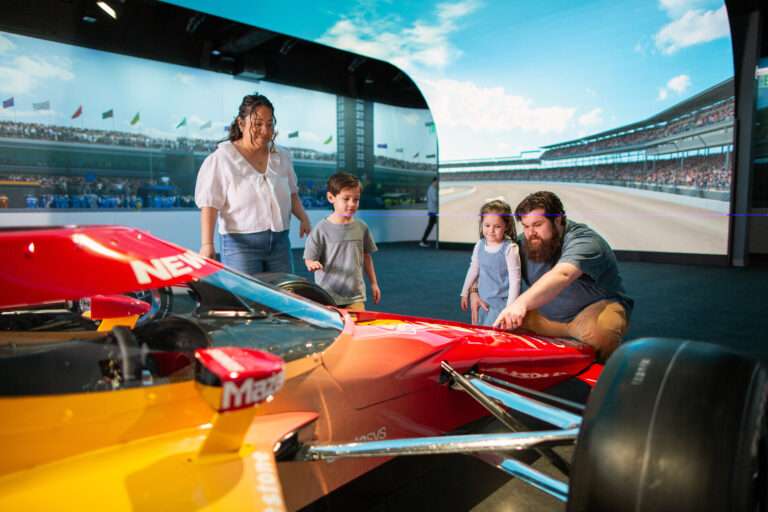
The recently reopened Indianapolis Motor Speedway Museum is a good example of the beginnings of this type of cross-utilization effort. Scriptwriters and AVC (Audio Video Control) designers in our U.K. office collaborated with our lighting designers and creative team members in our U.S. headquarters to provide seamless integration of creative and technical services. The more of these projects we deliver, the better we get at developing the right balance to support our local clients, anywhere.
How do you ensure that projects involving IP and branding are engaging across various cultural contexts?
VH: We specialize in adapting global brands thoughtfully for local audiences, respecting cultural nuances while delivering emotional resonance. RWS Global partners with the world’s biggest brands and entertainment providers to vision and execute IP-driven attractions, stage shows, exhibits and immersive experiences.
View Boston, master planned, designed and implemented by RWS Global
Our in-house creative and production teams collaborate seamlessly with IP owners to extend their brand narratives into fully immersive destinations, combining storytelling, theatricality and technical excellence customized for each market appropriate for the scale of the project. Across our sports business, we work to ensure we are celebrating fandom and elevating the experience.
On a personal note, having worked on world-renowned entertainment brands throughout my career and as Chair of the Board for Licensing International, I am passionate about developing experiences that put the guest first and bring brands to life.
As Chief Growth Officer, you have a keen eye on the future. What are RWS Global’s strategic priorities for the continued growth and expansion in the global market?
VH: Across the board, I prioritize strategic partnerships and turnkey delivery where it’s efficient and our divisional expertise on projects big and small, from ideation through operations, helping clients diversify revenue and drive guest engagement.
Our expansion across key markets has been a massive priority for me and RWS Global, as illustrated by the opening of our Orlando office, as well as our strategic partnership with Max Matching in China and the office in Shanghai we opened last year. Now that we’re also opening an office in Riyadh, we can continue to mature and build our destination design, live entertainment, immersive experiences and retail and merchandise business.
In the U.S. and Europe, strategic priorities include expanding our presence across more attractions and sports sectors and continuing to expand live entertainment and sports in Asia. •
After 25 years in the entertainment industry – spanning theme parks, live events, high-profile launches, and everything in between – I have learned a thing or two about what it takes to build a career in themed entertainment. I have sat in nearly every seat; from entry-level assistant, mid-level project manager, executive consultant, and educator. I have built teams, written job descriptions, and coached individuals through growth and sometimes hard exits. I have overseen program launches, led the creation of a leadership academy, developed curriculum, and guided thousands of students into careers that have shaped the magic we all love. And yet, if you asked me if I am qualified to give career advice, my honest answer would be, “Probably not any more than you are.”
Themed entertainment is one of the most complex and nuanced industries out there. It’s not just rides and costumes, it is a high-functioning, collaborative dance between business strategy, storytelling, engineering, technology, consumer psychology, and creative design. We create experiences that transport people to galaxies far, far away, or drop them straight into the middle of a dragon’s fiery breath, sometimes literally. To pull off something like that, you need more than passion. You need a strong foundation, real experience, and a touch of calculated pixie dust.
That foundation often comes through education. What I have seen is that the individuals who thrive in this industry are the ones who understand how to weave together knowledge from multiple disciplines. The ones who have studied the science behind storytelling, the math behind mechanics, and the psychology behind guest experience. The ones who have had the chance to fail safely, learn deeply, and connect with mentors who have already walked the path. That’s what higher education offers – not just theory, but immersion.
In fact, one of the greatest values of a strong educational program is access. Students are often taught by professionals who have spent decades building attractions, managing creative pipelines, and navigating the ever- changing landscape of entertainment. These are the same people who know how to turn a fantastical concept into a functioning, safe, and breathtaking reality. And, let’s be honest – there is a lot of science and math behind that magic. Higher education helps creatives demystify those skills and gives technical thinkers a window into the emotional core of an experience. It creates hybrid thinkers, which is something this industry increasingly needs.
My own career pivot led me on an unexpected road into higher education. After years on the road, I sought more balance and found purpose in teaching the next generation of magic makers. Over 12 years, I transitioned from professor to academic leader. I shaped curriculum, taught countless courses, and worked alongside industry professionals to ensure that what is taught in classrooms mirrors and advances what is needed in the field. In recent years, I have taken that a step further by bridging the gap between education and industry, collaborating directly with hiring managers and companies to align talent development with real-world needs.
We live in a time where employers are looking for unicorns: individuals with cross-disciplinary experience, creative insight, and the ability to navigate the fast-moving, ever- evolving world of entertainment. That’s a tall order, and one not easily met through job experience alone. Higher education gives you the space to become that unicorn.
Once that foundation is set, experience is what sets you apart. The most valuable team players I have worked with had winding career paths that spanned roles, industries, and disciplines. They bring a unique set of skills and perspectives that those with linear trajectories often do not. Give these people an impossible task and not only will they say yes, but they’ll also suggest how to make it better. So, how do you become that person? Say yes to projects and opportunities that challenge your limits. Step outside your comfort zone. That may mean ignoring imposter syndrome, leaning in, and speaking up, even when it is easier to stay quiet.
Once you have collected those experiences, the final touch is that calculated pixie dust. Remember the unicorn that everyone is trying to hire? Here’s a little secret: you are the unicorn. We all are unicorns. The magic lies in how you tell your story. That pixie dust is your ability to connect the dots and help others see how your unique journey, whether it started in retail and led to live events or began in construction and ended in animal training, fits their needs. It is not about having the perfect path – it is about making that path make sense to them and the role you are seeking. Your job is to match your story to their job description, drawing clear connections rather than hoping others find them for you.
So whether you’re just starting out, rebooting your career, or figuring out how to stand out in a saturated market – know this: you are not alone. The job market isn’t easy, and the path isn’t always clear. And if you’re still unsure whether you are qualified? You are. You just need to gather the right tools to build the future you want.
Because here’s the truth: there is no singular or linear path in this industry. Whether you are fresh out of school, mid- career and stuck, or seeking a pivot into something entirely new, themed entertainment doesn’t ask for a perfect resume. It asks for curiosity, resilience, and a deep understanding that making magic is anything but a simple, straight line. •
Annie Quaile is an Emmy-nominated producer and project manager with over 25 years of experience in themed entertainment, live events, and arts education. She has worked for major brands like Universal Parks & Resorts and FedEx, has previously led academic programs at Full Sail University, and currently serves as Assistant Director of Industry and Alumni Engagement at SCAD, bringing together industry and education to support the next generation of creative professionals.