

Visual Terrain debuts Luminous Terrain, making playing with light fun for everyone
by David Green
In 2009, Lisa Passamonte Green, CEO and Principal-in-Charge of U.S.-based lighting design firm Visual Terrain, received a call from artist Dan Corson. Since they had attended San Diego State University together, Dan had become a successful artist, using light in many of his installations. He described to Passamonte Green the concept for a new public art project, called “Rays,” that he envisioned to be a canvas for a giant ever-changing light environment that echoes patterns of the past and updates them for the future. Located on the five-acre Great Lawn at Tom Hanafan Rivers Edge Park in Council Bluffs, Iowa, these “living lights” would move, and interact and play games with the guests.

Passamonte Green was immediately drawn to the project. “The guests could play with the lights,” she said, “and even more fun, the lights would play with the guests.” Dan asked Passamonte Green to assemble a team to execute the artwork, so she called Bandit Lites for integration and programming, and Beaudry Interactive to develop the interactive system that made everything possible. (At the grand opening celebration, Yessian Music provided a soundtrack for the installation.)
The team delivered “Rays” to great fanfare in 2013. The installation presented a “show” mode and an “interactive” mode, the latter including a set of eight different games the lights could play with the guests, including:
- Cat Laser Toy: Guests try to “catch” a spot of light, which continually avoids them.
- In the Spotlight: Lights randomly select and follow a guest as they walk through the park. However, another guest can steal the spotlight through clever intervention with the light.
- Stealing Dorothy Hamill’s Spotlight: All the lights in the park randomly select a guest and make them the star of the show (just like the famous figure skater).
- Flash Mob: If a group in the park acts together, either jumping up and down, or running in the same direction, the lights react in a crazy, celebratory fashion (called a “ballyhoo”), bouncing, whirling, and changing colors all over the park space.
“Rays” opened and ran continuously, without significant maintenance or intervention, until the park and control room were submerged by a 100-year flood in 2019.
Reinventing “Rays”
The loss of the installation was fresh in Passamonte Green’s mind when the Covid-19 pandemic struck in 2020. As many projects went on hold, she looked for a way to keep her team busy during the lull. She thought, “What if we could make a version of ‘Rays’ that could be presented as a standalone product that anyone, anywhere, could install and their guests could experience light in new and playful ways?”
That brainstorm led Passamonte Green to develop Luminous Terrain, an outdoor interactive lighting experience. With Dan Corson’s blessing, she reassembled the teams from Bandit and Beaudry Interactive, two companies with whom Visual Terrain has collaborated frequently. Leveraging advances in lighting and interactive technology since 2012, Luminous Terrain is a self-contained, fully autonomous lighting experience.
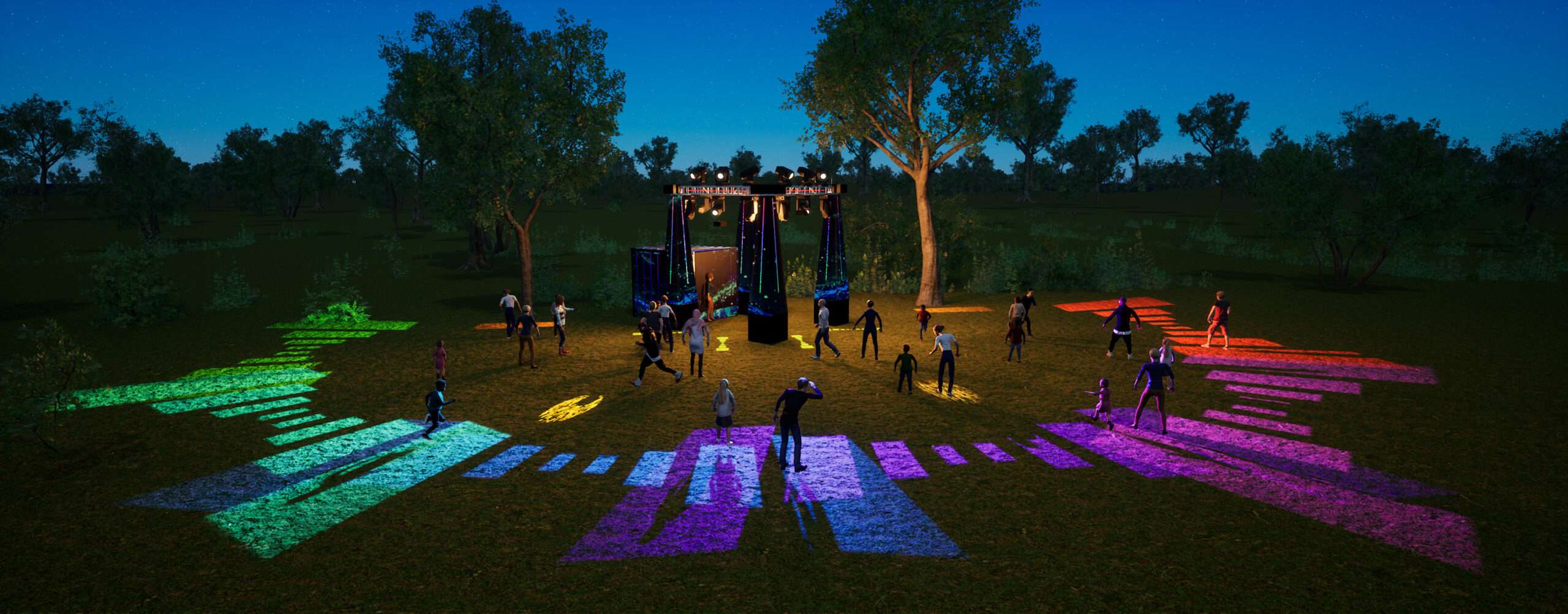
Luminous Terrain maintains many of the features of “Rays,” while advancing the level of play thanks to new technology, better lighting fixtures, and reflection on the implementation of the experience over the years it was operating.
“The beauty of Rays and the beauty of Luminous Terrain is that the technology gets out of the way,” said John Jenkinson, Director of Integration for Bandit Lites. “From an integrator’s perspective, the less you read technology and the more you read a game, that was the coolest thing about Rays. If we do our jobs well, as a team, it’s completely transparent.”
Exploring a Luminous Terrain
“What might look like playful, spontaneous illumination is actually a carefully orchestrated blend of sensing technologies, adaptive algorithms, real-time control systems and flexible lighting designs all working together,” said David Beaudry, Principal and Founder of Beaudry Interactive. “Luminous Terrain came about through extraordinary collaborations. Our team’s passion for interactive design and guest empowerment dovetails with Visual Terrain’s gift for storytelling through light. The result is a living canvas of light, a space where invisible technology empowers guests to become artists of light, shaping the story through their very presence.”
During the development of Luminous Terrain, different concepts were considered, but ultimately, the team decided on a four-sided 12’x12’ truss structure with 14 moving lights as the first priority. Equipment support is provided by a secure Mobile Control Center that houses the electronics and provides a place for electrical terminations from the existing infrastructure.
The team designed 12 games to be a part of the Luminous Terrain experience while anticipating that clients might have their own ideas, especially when integrating the system with existing IP. “It was critical to us,” said Passamonte Green, “to be able to support the ideas and branding of any clients. With Beaudry Interactive as a core part of the creative team, we are able to offer any custom and proprietary programming needed. We can really customize any installation to provide support not just for creative concepts and varying game play, but also branding and IP support for wherever the installation might go.”
She continued, “We also have the ability to add sounds or music to the experience, or it can be completely silent. What’s most important is that we’ve designed the play to be intuitive, so that no spoken or text instructions are needed. As soon as someone enters the space, Luminous Terrain becomes aware of them and can begin to interact, ‘suggesting’ the mode of play to engage the guest.”
As the system started coming together, mockups were conducted at Visual Terrain’s facility in Santa Clarita, California and Beaudry Interactive’s headquarters in nearby North Hollywood. The team quickly realized that scalability would allow for more flexibility in the types of places where Luminous Terrain could operate.
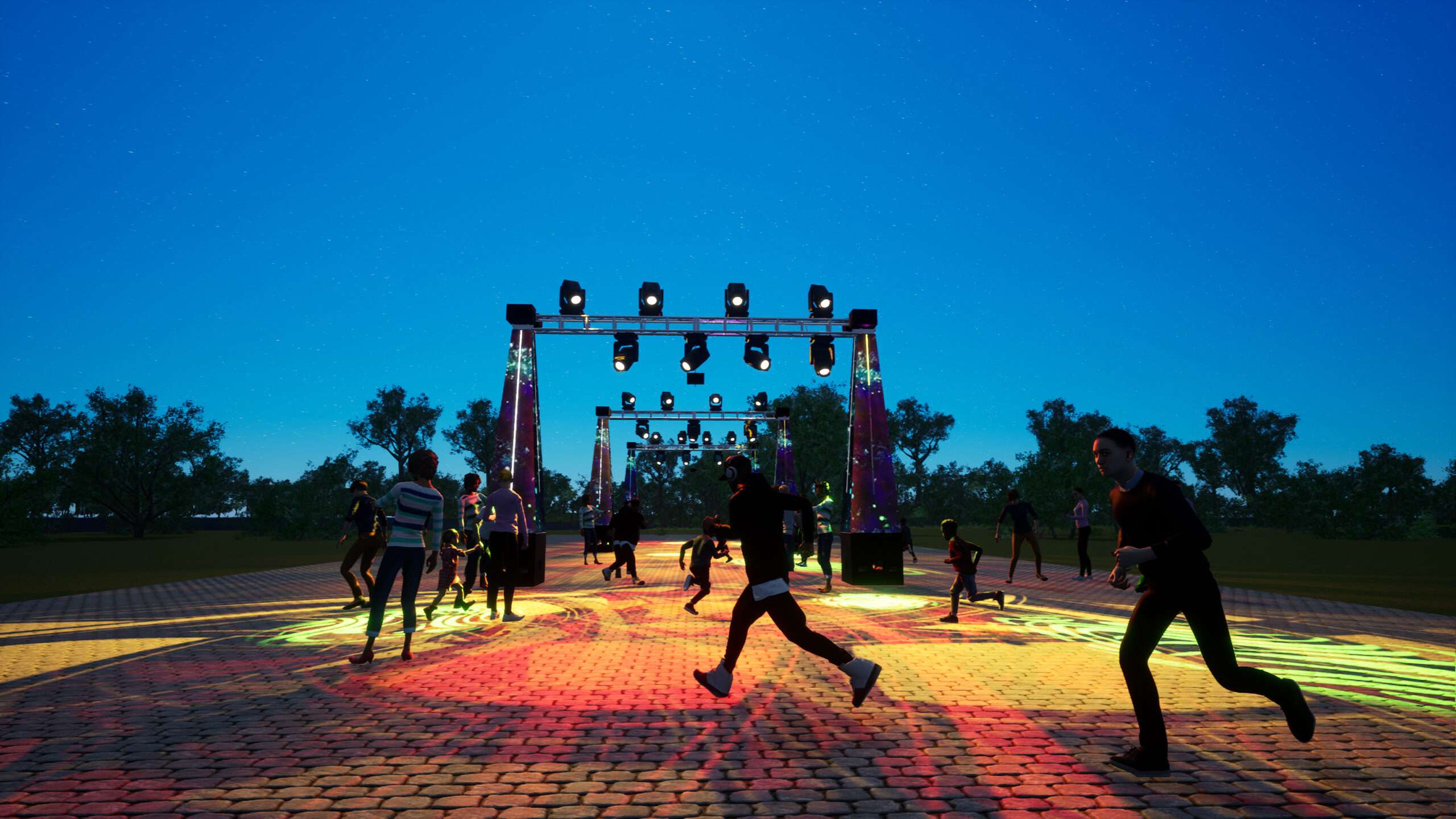
“Our first impulse was to create something that could more effectively replicate the scope and functionality of ‘Rays,’” said Passamonte Green. “But realizing that not every client has a five-acre space to play with, we considered how the experience could work in smaller areas – and larger ones, too.”
The results of that process were: 1) to design a linear “goalpost” version, to be able to create an experience that follows a set path, rather than the free-form playing-field area supported by the four-sided version; and 2) to design a mini version that had just three moving lights and could be put into areas where less space is available for play. The mini version in particular lowered the barrier to entry for smaller clients, or those who might first want to test the market before committing to a full system.
Thinking inside the box
The team also designed an indoor version. “The format of ‘Rays’ had initially led us to conceive Luminous Terrain as exclusively an outdoor interactive experience,” said Passamonte Green. Although that is the design ideal, we realized that it is also well-suited for certain indoor environments, such as ice rinks, arenas, and pop-up experiences. The types of games and play might have to be adjusted, but being indoors actually frees us up to not have to use weatherproof equipment, and we can also move the control center to an equipment closet on site.”
Now conceptually proven, Luminous Terrain is seeking its first installation. “We can imagine it being installed in theme parks, aquariums, music festivals, city parks, arenas, and even large interior building spaces,” Passamonte Green said. “The interactivity can be dialed up to full-on play mode or dialed down to be more reflective and subtly interactive, for, say, a hotel lobby or airport terminal.”
Valeria Beaudry, Principal of Beaudry Interactive, said, “To me, Luminous Terrain is all about possibility – the way it can turn any space, from theme parks to public plazas, into a living landscape of light, transforming passive presence into playful participation and simple curiosity into moments of genuine connection.” •