Home Blog Page 6

There’s a new dome in town

Orlando Science Center updates its dome theater with state-of-the-art digital projection

by Joe Kleiman

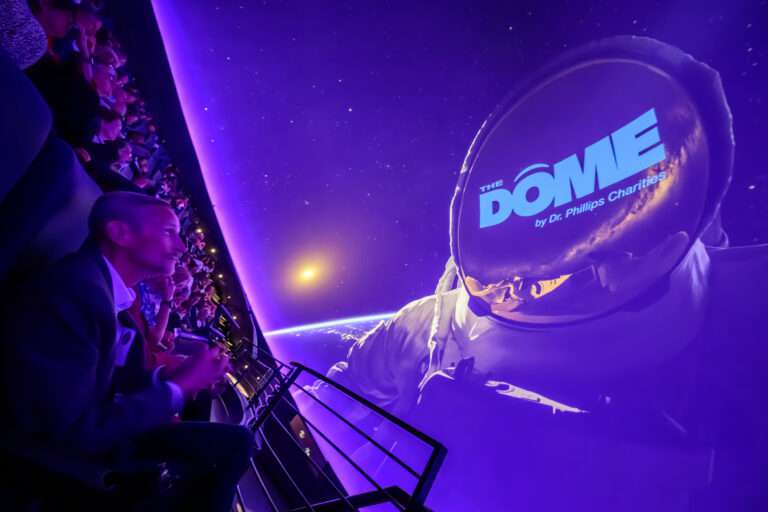
After thirty years as a film-based giant screen theater, the former Dr. Philips CineDome at Orlando Science Center (OSC) in Orlando, Florida, has been upgraded to house a versatile digital system, and renamed The Dome by Dr. Phillips Charities, under the aegis of JoAnn Newman, OSC’s President and CEO since 2009.

“Orlando Science Center is a home for bold experiences that inspire curiosity and wonder,” says Newman. “The Dome is a step forward in how we present storytelling that educates and inspires contemporary audiences.”

RFPs for the new system were issued in September 2024, and the contract for the winning bidder, dome visualization specialist SSIA Technologies, was finalized in August 2025. Construction took place at a rapid pace, with the grand opening taking place a year later, on June 1, 2026.

The redesigned theater is equipped to offer a broader variety of shows and presentations. It features nine Christie RGB laser projectors, and Sky-Skan DigtalSky Dark Matter™ (DSDM) proprietary visualization software. The eight primary projectors provide a combined 8K image on a 79-foot diameter dome screen, with pixel counts up to eight times the resolution of a conventional 4K digital cinema.

The new system has enabled OSC to bring back star shows for the first time in fifteen years. What had been a film theater now has complete fulldome capabilities, with The Dome able to present planetarium shows and other science visualizations in both pre-rendered and real-time formats, in addition to giant-screen features. The Dome’s versatile new systems now also allow it to offer the kinds of special programming that has enabled fulldome theaters around the world to grow their audiences, extend their hours, and bring in ancillary revenue, such as laser shows, and live musicians and DJs performing against a backdrop of real-time digital visualizations.

Creating a multi-purpose fulldome venue

OSC culled an experienced, knowledgeable team, resulting in a smooth and informed process and cutting-edge technology. The end result is a venue that is on par with some of the best digital dome theaters and planetariums in the world today.

To begin the process, OSC engaged Paul Fraser of Blaze Cineworks, who has consulted for numerous museums and science centers planning upgrades, expansions or new builds featuring digital display systems. With decades of experience, Fraser is well versed in the nuts and bolts of both giant screen and digital fulldome operations, having been an executive with IMAX and Ogden Entertainment, where he oversaw the opening of new theaters.

Fraser worked closely with Stephen Holt, OSC’s Vice President of Facilities & Exhibits, who acted as Project Manager and Owner’s Representative.

“We started with planning and budgeting, then procuring the major systems and services needed to upgrade the dome theater,” says Fraser. “My job is to make sure that clients have the best information possible so that they can choose what’s right for them.”

Understanding the nature of the original space is crucial. “When converting a giant screen theater or a planetarium to fulldome digital, a lot of factors come into play,” says Fraser. “A giant screen dome theater has a steeper incline than most planetariums. This creates specific issues, such as where to place the projectors.”

A new projection booth was built on the fourth floor of The Dome at the Orlando Science Center to house four of the Christie Griffyn projectors and a separate digital cinema projector. Four other projectors are located at the base of the dome.

“Paul was an invaluable advisor throughout,” says Holt. “He brought deep industry expertise, thorough research, and a strong focus on long-term value. His guidance throughout procurement, vendor negotiations, technical decisions, and problem-solving helped OSC make informed decisions and achieve an exceptional project outcome.”

As the RFP went out, Fraser and the OSC team concentrated on two key factors:

  • As an educational institution, OSC considers the giant screen films, planetarium shows, and science visualization presentations in The Dome on an equal footing to the physical exhibits in the museum. To make them fully accessible, these programs are included with museum admission, in keeping with a decades-long policy. Compatibility with a broad range of content would, therefore, play a key role in determining the new system.
  • With The Dome getting a full $7 million top-to-bottom makeover, including new seating, new sound system, and a new screen, everything needed to remain within OSC’s allocated budget.
Software to meet the client’s needs

The AV and visualization systems were specified and installed by SSIA Technologies, a contracting partner of fulldome visualization company Sky-Skan International. The two companies share ownership of DSDM visualization and show control software, and SSIA maintains the exclusive rights to license the software in a number of global markets, including North America. Annette Sotheran-Barnett, co-CEO and Founder of SSIA, explains, “While we are integrators, we understand and appreciate the needs of planetariums, as many of us at SSIA are former planetarium educators, programmers and technicians.”

Most programming at The Dome is delivered through DSDM and SSIA’s proprietary control system, SCS. “While our controls are intuitive,” Sotheran-Barnett shared, “we were fortunate that OSC’s theater director, Amy Quesinberry, is a former digital fulldome theater installer, making staff training that much easier. In fact, Amy and the education team at OSC were able to open the new theater with an original production produced in-house ready to go.”

SCS unites all of the various systems in the theater into a single show control. This not only includes the visualization servers, projectors, and the 30,000-watt 7.1-channel audio system featuring arrays of JBL speakers, but also lighting and multiple SkyLase laser projectors from Audio Visual Engineering, which are mounted behind the dome screen and employed for separately ticketed laser shows synched to music in the evenings.

To provide the best surface for visualizations, the dome screen’s panels were entirely replaced with Spitz NanoSeam panels. “The new screen delivers a remarkably seamless viewing experience. The individual panels visually disappear, creating a continuous surface that allows audiences to become fully immersed in the imagery,” says Holt.

SSIA created two three-minute preshows for The Dome that were combined into a single, six-minute experience. The first part employs lighting behind the screen to illuminate the speakers and showcase the sound system, reminiscent of an audio preshow OSC had years ago.

The second part is an animated flight rendered out of DSDM that takes viewers from the Hubble Space Telescope down to Florida, over Orlando, and into OSC, culminating inside the dome itself. With audio designed by award-winning giant screen sound mixer Brian Eimer, this original production highlights DSDM visualization software capabilities and the powerful image of the Christie Griffyn projectors, building anticipation for the main feature to follow.

The right projector for the job

Christie offers several projector models for the fulldome market [see “Ultimate contrast,” InPark Magazine Issue #82]. The model selected was the Griffyn 4K35-RGB, able to project at 36,500 lumens (OSC is maintaining the projectors at a light output of 75% and 80% to extend laser life while minimizing image degradation). “The Christie Griffyn was clearly the best projector for this dome application,” says Fraser. “Every single response we had to the RFP recommended it.”
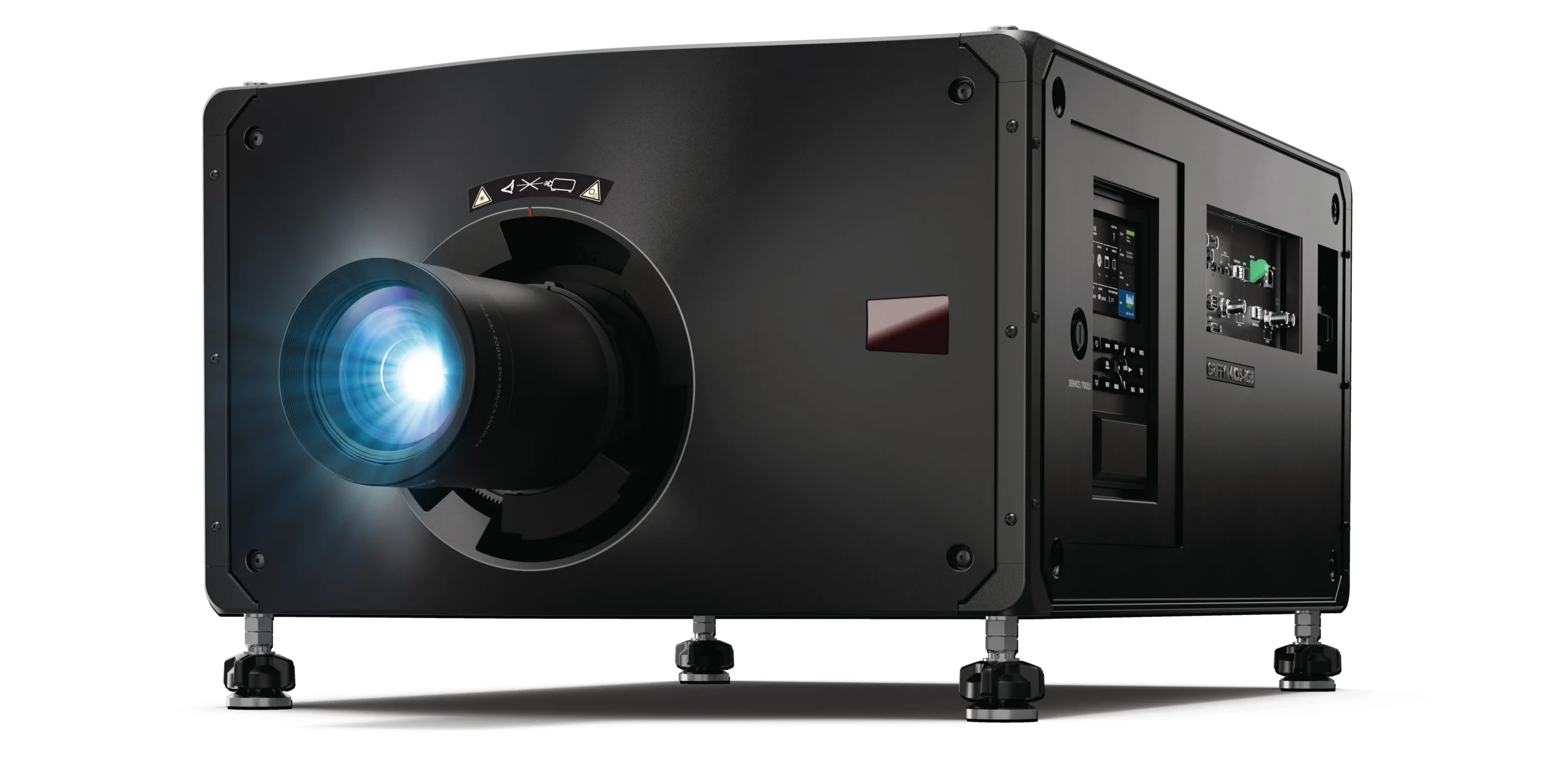
The Christie Griffyn 4K35-RGB pure laser projector features a variety of inputs, providing flexibility when linking with image generators. Photo courtesy of Christie

In addition to its light output, the projector model is highly versatile, taking up a relatively small footprint, allowing for mounting in just about any configuration. Three DLP chips in each projector meet digital cinema standards for color, while modular construction improves maintenance while lowering repair costs.

“One key thing about Christie is that almost all of our models for fulldome are 3 chip DLP. We made a specific choice ten years ago to go pure RGB laser,” says Joel St-Denis, Director of Product Management at Christie. This delivers the versatility OSC was seeking to maximize both content options and image quality. RGB laser projectors generally meet rec. 709, the international standard for HDTV color gamut. The Griffyn is a DLP projector, which uses chips called DMDs (Digital Micromirror Devices), made up of millions of microscopic reflection mirrors — one for each pixel in an image. Each mirror can be individually controlled to tilt back and forth rapidly, in an on or off position. When a mirror tilts toward the light source, it reflects light onto the projection surface and creates a bright pixel. When it tilts away from the light source, it reflects light away and creates a dark pixel. With its three DMDs, the Griffyn not only surpasses rec. 709 and p3 (the international standard for digital cinema), but reaches 98% of rec. 2020, the international standard for 4K and 8K projection. At such a high color gamut, the Griffyn projectors are able to showcase more than 70% of colors visible to the human eye and in high dynamic range, resulting in brighter colors and darker blacks with ultra-high resolution detail.

Four Christie Griffyn projectors are located at the base of a new Spitz NanoSeam fulldome screen.

The new system utilizes eight Griffyn 4K35-RGB projectors, sufficient to cover the entire screen. At 36”x25”x15” and 180 pounds, the projectors have a relatively small form factor allowing versatility in their installation. Four of the projectors are housed at the base of the dome screen, while four others are housed in a newly constructed booth at the back of the theater on the building’s fourth floor. “The four projectors housed in the fourth-floor booth cover the central and lower portions of the dome, while the four projectors positioned near the front of the theater cover the central and upper portions, including the zenith. Together, they create a unified image across the entire dome surface,” explains Holt.

Additionally, a ninth projector, a Christie CP4435-RGB, was mounted in the fourth-floor booth. Using a Dolby digital cinema server, this projector is DCI-compliant and will allow OSC to show theatrical films distributed directly by the major studios.

“Our modular projector construction allows for easy upgrades to the system,” explains Doug Boyer, Christie’s Director of Sales and Business Development, Pro AV. “It also allows for easy onsite replacement of the laser optical system, reducing the cost and downtime traditionally experienced with sending a projector to a service center.”

“We work with a lot of projectors in a lot of challenging situations,” says George Barnett, co-CEO and Founder of SSIA. “The Christie projectors were very easy to work with. They have intuitive software and user interface which makes installation, alignment and calibration simple. They are extremely well engineered.”

The transition of The Dome has impressed its toughest in-house critics – long-term OSC veterans like Newman, Holt, and Quesinberry, each with over a decade of service at the museum. “There’s a moment in one of our ocean films when an enormous whale swims across the dome, and the experience is breathtaking. You genuinely feel as though you’ve been transported beneath the ocean’s surface, watching this incredible animal pass right in front of you. It’s a powerful example of how immersive this new technology can be,” says Holt.

Respecting the past, anticipating the future For the time being, OSC is concentrating on giant screen films and planetarium presentations during the day, and laser shows in the evenings, with future fulldome offerings under consideration for the years ahead. The Dome continues OSC’s seventy-one year legacy of being an integral member of the Orlando community, an important resource for school groups and families as well as a destination for visitors.

“The Dome holds a special place in the hearts of so many Central Floridians. There’s a tremendous sense of nostalgia surrounding this theater, and it has been incredibly rewarding to see the community embrace its return. We’ve preserved what made this space so special while introducing technology that opens the door to entirely new experiences for generations to come,” says Holt.

With a state-of-the-art digital dome system in place and vast programming possibilities, the future of this venue is much broader and brighter. OSC is positioned to be more competitive as an Orlando destination attraction, while continuing to serve local audiences and fulfill its scientific and educational mission. The transition has opened new opportunities for new audiences to engage and embrace the next generation of visual wonders. •
Dynamic Creatures: Characters on the move

Backed by an official partnership with Boston Dynamics, Dynamic Creatures is bringing interactive robotic characters into entertainment and hospitality

Interview by Becci Knowles

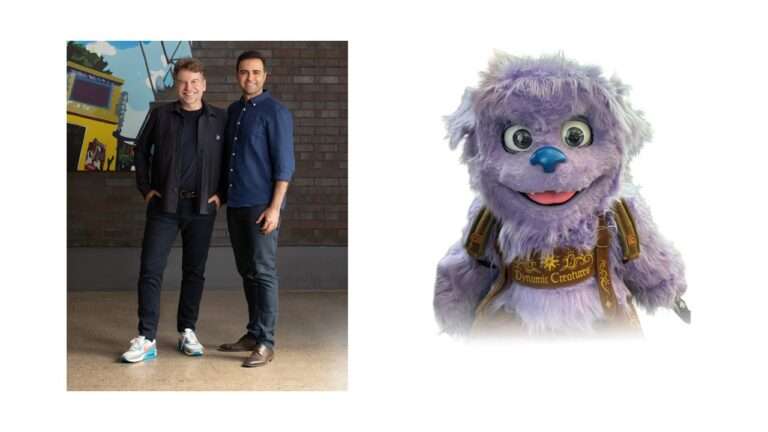
Dynamic Creatures was launched in September by two leaders with extensive experience in robotics and technology. CEO Marc Theermann is the former chief strategy officer at Boston Dynamics and a former senior leader at Google. Chief technology officer Farbod Farshidian is a robotics researcher and former research leader at the Robotics and AI Institute.

At Boston Dynamics, Theermann saw growing interest in using robots for entertainment, from halftime shows to music videos. “We did some fun things,” he says, “but it was never really a focus for the company.” Dynamic Creatures was created to bring that capability into guest-facing environments. “Our characters do more than perform for a crowd,” says Theermann. “They can respond to an individual and create small moments of wonder that people remember.”

InPark: What convinced you that now was the right time to launch Dynamic Creatures?
Marc Theermann
CEO

Marc Theermann: For years, robots were controlled by classic “if-then” software: If this happens, then you should do this. You needed a lot of expertise and millions of lines of code to make robots perform very interesting behaviors.

Three years ago, reinforcement learning became a force in robotics. That meant robots could teach themselves in simulation, which dramatically expanded the types of behaviors they could perform. Suddenly, their movements became much more natural, and you could build features on top of that to make them look and behave like a specific creature rather than a robot.

The second reason was that hardware prices are dropping dramatically. Put those two things together, and the timing was right to fulfill my lifelong ambition.

InPark: Dynamic Creatures is establishing a category somewhere between traditional animatronics and task-oriented service robots. What does that look like in practice?

Theermann: Traditional stationary animatronics cannot freely move around a park, and their motions are often pre-programmed. What we’re bringing to the table is taking the advances that have been made in autonomous robotics and marrying them with classic animatronics.

The result is a character that is not confined to a stage or a fixed position. It can move through an environment, interact with guests and respond to what is happening around it, while still behaving like the character it is supposed to be.

InPark: Your partnership with Boston Dynamics is a significant part of that proposition. What does it enable you to do?

Theermann: Stationary robots have been around for many years, but Boston Dynamics robots really shine at walking around. They have a quadruped robot called Spot with four legs and a biped called Atlas. Both are among the most advanced robots in the world.

Our partnership allows us to buy these robots, modify them with software and hardware, and then sell them into the entertainment industry.

InPark: As the technology is becoming increasingly capable, how do you make sure the story and character remain in control?

Theermann: We work with IP holders to stay true to their storyline, and with IP holders and their partners to develop those storylines. We have creative people on staff, but most often the story will come from our clients and partners.

The character has to come first. The technology is there to bring that character to life.

InPark: That seems to be where SnowJay comes in. What is SnowJay, and how does it support those guest interactions?

Theermann: What Android is to mobile phones, SnowJay is to robots. It’s an independent robotic operating system that allows us to stay in character with movements and voice at any time.

If you have a character with a very distinctive walk, you want the character robot to always mimic that walk. The same applies to what a robot says. Characters can’t suddenly respond to questions about political affiliations or the stock market. The character has to always stay in its role.

InPark: How much of a character’s behavior is authored in advance, and how much can adapt in real time?

Theermann: To always stay in character, we need to take animations of a specific IP, feed them into our reinforcement learning system and create a robot policy that mimics the behavior of the creature.

That policy allows the robot to maintain the character whether it is teleoperated, puppeteered or acting autonomously.

InPark: How autonomous can these characters actually be in a theme park?

Theermann: For the foreseeable future, our robots will always use a combination of autonomy and puppeteering, both for safety and for better guest interaction.

As an example, if I give you a controller to drive a Boston Dynamics Spot robot, you cannot drive it into a wall or a human. The robot’s autonomy kicks in and says, “You’re giving me a command that I cannot fulfill.”

At Boston Dynamics, we call this assisted autonomy. You have this in your car. Maybe your car brakes when you’re about to hit another vehicle. You’re still in charge, but the robot helps you. Over time, our plan is to move from teleoperating the robot toward telemonitoring. The person monitoring it might be in a different building or even a different country. We’ll introduce more and more autonomy, and in five years’ time, our hope is that these creatures live in the parks fully autonomously.

InPark: That raises an obvious question about safety and public perception. What do you say to people who are hesitant or fearful of incorporating this type of technology and think of scenarios like Westworld?

Theermann: For the foreseeable future, there will always be a human in the loop. In the beginning stages of these deployments, if anything goes wrong, the human can press a physical button and the robot will stop.

I’m a tech optimist. I’m excited about the future. I think the Western consumer psyche is often imprinted by very dark fictional narratives, which is not the case in Asia. In Asia, people are super excited about robots. For example, Chimelong Spaceship theme park in China recently introduced 300 robots to the park, integrated into many areas of the park’s operations.

This future is coming. If you’re a theme park operator, you can wait on the sidelines or lean in and take advantage of the excitement about untethered characters and the viral PR you can get by deploying something like this.

InPark: What are you hearing from theme park operators, and what do you expect the first deployments to look like?

Theermann: Our theme park clients are excited about the future of untethered characters. It’s been a dream in the theme park industry for many years. At IAAPA Expo Europe, people were thrilled and immediately understood what we were trying to do.

Of course, safety has to come first. The robots should be safe enough to be around humans, and they need to stay in character at all times. I think anything we do with our theme park clients in 2027 will be managed pilot programs, where we send humans and robots at the same time.

InPark: You offer characters built on existing robotic platforms as well as fully original robots. How should an operator think about that choice?

Theermann: Every situation is different, but we will always put story and character integrity first. Depending on the character, we’ll make a hardware suggestion. If anybody wants to build a four-legged robot, Spot is the best choice in the world. People have built different characters on top of Spot already.

InPark: You’ve also talked about a “robot as a service” model. Why does that make sense for this emerging technology?

Theermann: Since everything we do in the foreseeable future is managed, we think the business model will be “robot as a service.”

You might say to us, “I’d like a walking dog character.” We’ll respond, “Why don’t we do a six-month pilot? We’ll come with robots and humans, and you pay as you go.”

Some of the larger theme park owners might want to own the technology outright, and of course we’ll be open to that. But this is such novel technology and such a quantum leap in capabilities. We’re not only adding free roaming capabilities to animatronics, we’re also adding autonomy, and free-form guest interactions at the same time.

InPark: How do you see robotic characters working alongside human performers?

Theermann: I think our creatures are always additive. Nothing beats a magical human interaction with a beloved character. But operators are limited in the characters they can create with humans in a costume – not to mention that in many theme parks in the Southern United States it’s 110°F outside in summer, and there is a human in a costume that is probably 150 degrees inside. It’s also quite challenging to create a small dragon, a baby dinosaur, a frog, something that swims or something that flies.

I believe the solution is a theme park full of human actors, but that is also populated with hundreds of creatures crawling, flying, swimming and interacting with guests in ways that are impossible with a human in a costume.

InPark: That suggests a very different kind of park environment – one in which characters aren’t necessarily assigned to a show or attraction. What do you think that could ultimately look like?

Theermann: The exciting thing is that these creatures can become part of the environment rather than simply something guests go to see.

A character could encounter one guest, have a completely different interaction with another guest and then continue moving through the park. That creates the possibility for small, unexpected moments that feel personal.

And because the creatures can be reprogrammed, those interactions don’t have to remain static. The same character could behave differently as the story or the experience evolves.

InPark: What would you like attraction designers and operators to understand about what is now possible?

Theermann: I want them to know we have just blown the lid off what is possible. Up until now, parks were limited in what they could do with stationary animatronics. Now we can bring to life anything they can dream of in super-magical ways that react very naturally and are incredibly flexible. The possibilities are endless. •

Sustaining IDEA in a shifting landscape

A conversation about why themed entertainment is uniquely positioned to lead

by Simone Bonnejonne, Development Director, and Nicolle Figueroa Rosado, Program Director, Big Break Foundation

Over the past year, we’ve written about why inclusion matters to the location-based experiences (LBE) industry and what a more inclusive future could look like. This time, we wanted to tackle a harder question: How do we make that future sustainable?

So, we sat down to talk about it. We explored what makes LBE uniquely positioned to build IDEA into the ways our industry works, what causes roadblocks to this work, and what it might look like to make inclusion part of the systems and collaborative practices we already use every day. Here’s that conversation.

Simone: When I think about what makes LBEs uniquely equipped to embrace inclusion, I keep coming back to intentionality. Design is already an intentional process in our industry.

Nicolle: The industry is collaborative by nature. There are some forms of art that are much more siloed, but this industry brings teams of experts and creatives together to create an experience.

That collaboration gives us an opportunity to bring in perspectives that we individually might not have. Those different viewpoints challenge us and help us create something more powerful than any one person could create alone.

Simone: We could push that process even further by thinking about the environment around the work. If designers, creators, experts and engineers are able to show up with their authentic lived experiences, they’re going to create attractions that reflect a multitude of audiences. Collaboration is important, but so is the inclusive environment around that process.

Nicolle: There’s a practical business case for that as well. Done right, inviting a diverse set of perspectives to the table can strengthen both what we create and how we create it.

If someone responsible for fabrication is involved early enough, for example, they can help inform the design based on what is actually achievable. That can prevent bottlenecks later on and create cost-saving efficiencies.

Inclusion isn’t separate from better processes, better communication or innovation.

Simone: So if we know that broader perspectives can improve workflows and outcomes, what are the roadblocks to making inclusion part of the process?

Nicolle: Time is a big one. There’s always urgency, another deadline, another thing that needs to get done. That leaves very little room to pause, reflect, evaluate and iterate.

Simone: Time scarcity is where I get hung up, because that’s the one resource I don’t think any of us can manufacture. We can’t stop business for three months and say, “Okay, we’re going to think about inclusion now.” Instead, it has to become a daily choice.

Nicolle: That’s where I see a lot of overlap between IDEA and efficiency. Both require intentionality. We have to be willing to ask: Is this working? Is there a better way?

IDEA is work. But if that work helps people stay longer, retain institutional knowledge, communicate their ideas and thrive, then we’re building a more sustainable business that is able to weather the changes.

It doesn’t have to be all or nothing. Start small. Make your meetings more inclusive by establishing team agreements. Give everyone an opportunity to contribute. Establish how you’ll handle disagreement. Give an emerging professional an opportunity to participate and learn. You don’t have to reinvent your organization in one day. But you can start changing how people experience working together.

Simone: Engaging employees at all professional levels is crucial in establishing IDEA as part of your systems. If you have an IDEA committee, what happens when the person leading it leaves?

You need continuity. Ideally, you’re building your entire team to be IDEA champions, creating a chain of people who can carry the work forward.

Nicolle: IDEA stalls if it doesn’t leave the leadership loop. Oftentimes, an organization can have great intentions, but get stuck in “a strategy bubble,” developing and refining a detailed plan of action in isolation.

IDEA sustainability requires communication, opportunities for employees to shape the strategy, and a pathway from employee input to decision-makers. IDEA councils, employee resource groups and affinity groups can help, but only if those groups are actively engaged in strategic conversations.

Simone: And IDEA has to tie into every role.

Nicolle: Exactly. For an engineer, that might mean creating through the lens of Universal Design. For marketing, it might mean accessible communications or inclusive language.

Even seemingly small choices matter. Leaders, for example, can help set healthy work-life boundaries by limiting emails to established working hours. Need to write an email at 10 p.m.? Schedule it for the morning! These choices may not look like IDEA initiatives, but they’re shaping the culture people experience every day.

Simone: That’s where I think LBE has another interesting opportunity: the design process itself.

Nicolle: I like to think about it as building an IDEA design toolkit. There isn’t one methodology that works for every project. Universal Design can help create experiences for the broadest possible range of guests. Inclusive or Participatory Design can bring specific communities directly into the process. Design Justice can give those communities greater ownership of the design process.

The point isn’t that one methodology is the answer. It’s having enough tools to choose the approach that fits the project.

Simone: Once the experience is built, we’re not done. The operations team becomes an essential part of inclusion. Frontline workers, for example, need to understand what accessibility features are available, how to access them, and how to maintain them. But they also need to be empowered to tell creative and design teams when something isn’t working.

Nicolle: I’d advocate for involving operations at the start of a project, especially if an experience is being expanded or refurbished. These team members have a wealth of visitor insights: they know what guests are asking, and what isn’t working in practice.

Simone: That’s a unique aspect of LBEs: our products aren’t static. We can watch people interact with them. We can learn from those interactions. We can adapt the experience as the audience’s needs change.

Nicolle: Exactly. The experiences we create are a living, breathing work of collective art. We have continuous opportunities to observe, learn and improve our spaces – that is an incredible amount of data we can leverage to inform our designs and make them available to a diverse audience. And it’s already available to us.

Simone: Maybe sustaining IDEA isn’t about preserving one particular initiative forever. Maybe it’s about building organizations that know how to keep learning. The language, landscape and people in the room may all change. But if we’ve built inclusion into the way we design, hire, lead, operate, evaluate and create, then the work naturally evolves as the needs do.

Nicolle: As an industry, we already have the creativity, adaptability and collaborative mindset necessary to drive IDEA forward. We know how to imagine something that doesn’t exist yet, bring different people together to build it, invite people into it, listen to how they experience it, and make it better.

Simone: We can apply that same process to inclusion. The goal isn’t to build IDEA alongside the work; it’s to build it into the work. If we do that well, the next generation of LBE professionals won’t have to ask how to sustain inclusion. They’ll simply inherit an industry where it is already part of how we create. •
Niagara Takes Flight: A new perspective

Brogent Technologies delivered the flying theater experience Niagara Takes Flight at Table Rock Centre in 2025. A year later, Niagara Parks’ Missy Sauer and Brogent’s Stefan Rothaug discuss the creative and technical decisions behind its first-year success.

by Becci Knowles

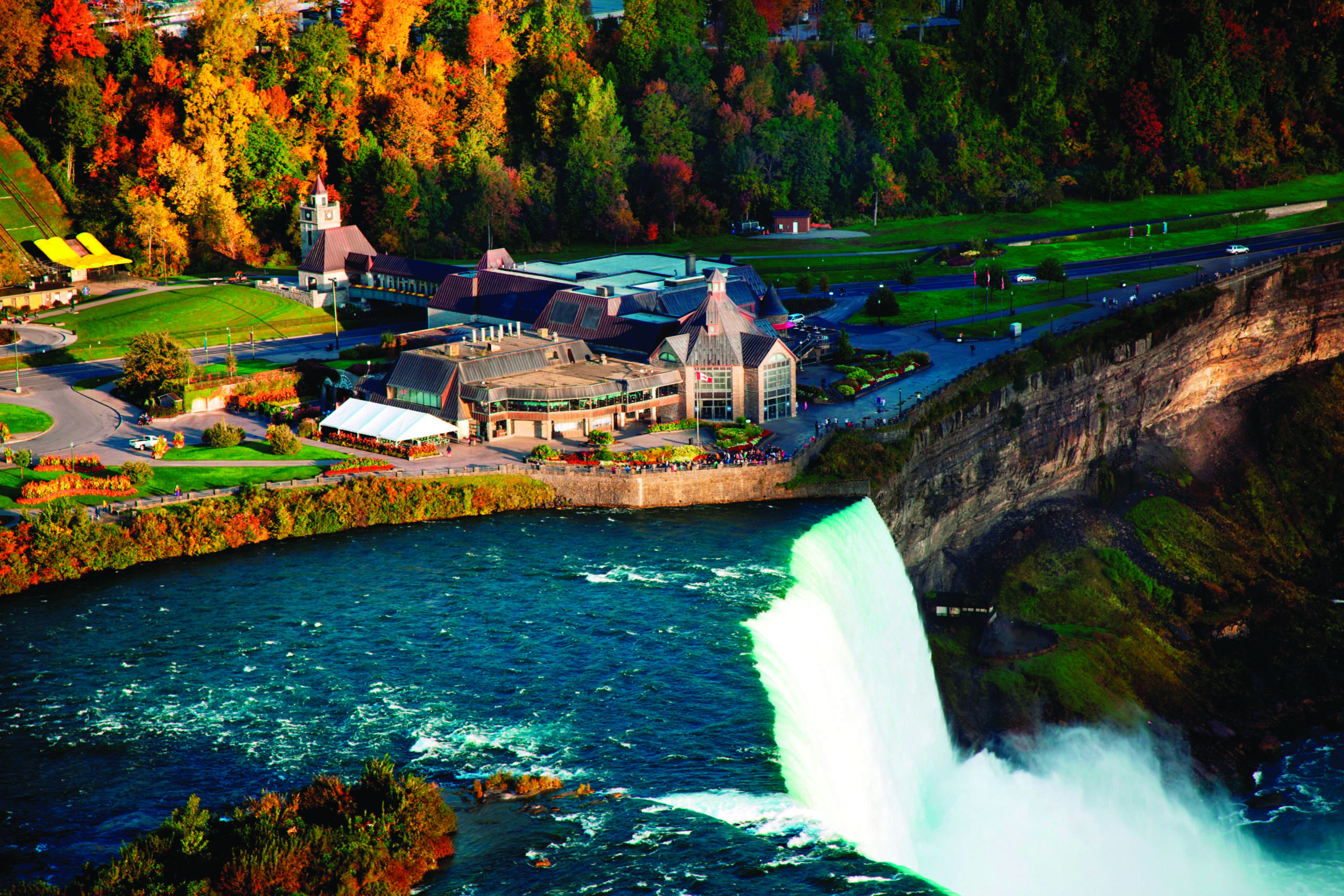
Niagara Takes Flight offers a way to reveal more of the region than visitors can discover from the ground or during a single visit. The flight covers approximately 56 kilometers along the Niagara River, taking guests over rapids, gorges, forests and historic sites across different seasons and times of day.

With a full year of operation behind them, Sauer, director of attractions and retail at Niagara Parks, and Rothaug, head of marketing and sales at Brogent Technologies, reflect on the project’s delivery, the response from guests and how performance has compared with expectations.

What did you want Niagara Takes Flight to add to the visitor experience?
Missy Sauer, director of attractions and retail at Niagara Parks, welcomed more than 450,000 guests to Niagara Takes Flight in its first year. Photo courtesy of NPC.

Missy Sauer: Niagara Takes Flight was replacing an older attraction called Niagara’s Fury. It was about 17 years old, the technology was outdated and we knew we needed to do something new, while retaining some of what guests loved about that experience.

A lot of our visitors think of Niagara as Niagara Falls – the waterfall – not the immense park that we oversee here. Many of our international guests only come here once in a lifetime. How do we show them what winter in Niagara looks like if they’re here in the spring, or what summer looks like if they’re here in the winter?

The attraction is about 30 minutes long in total and there are four distinctive areas that guests flow through before entering the actual flying theater. The journey begins with the marquee, which is a replica of the Rainbow Bridge and creates that initial wow moment. Guests then move through a geological chronology of Niagara, followed by the Ancestors Room and its indigenous storytelling. From there, they enter the Waterfall Room, where James Cameron takes guests through the last 100 years of Niagara’s history. They then move into the Transport Through Time room, where the storytelling continues and we prepare them for their flight, before finally entering the flying theater.

What can the flying theater show guests that they cannot experience from the ground?
Stefan Rothaug, head of marketing and sales at Brogent Technologies, discusses how imagery, motion and effects work together to create the sensation of flight. Photo courtesy of Brogent.

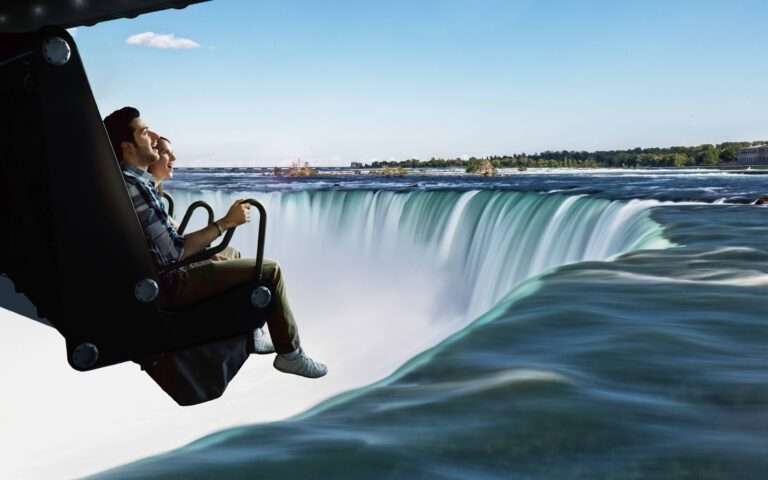
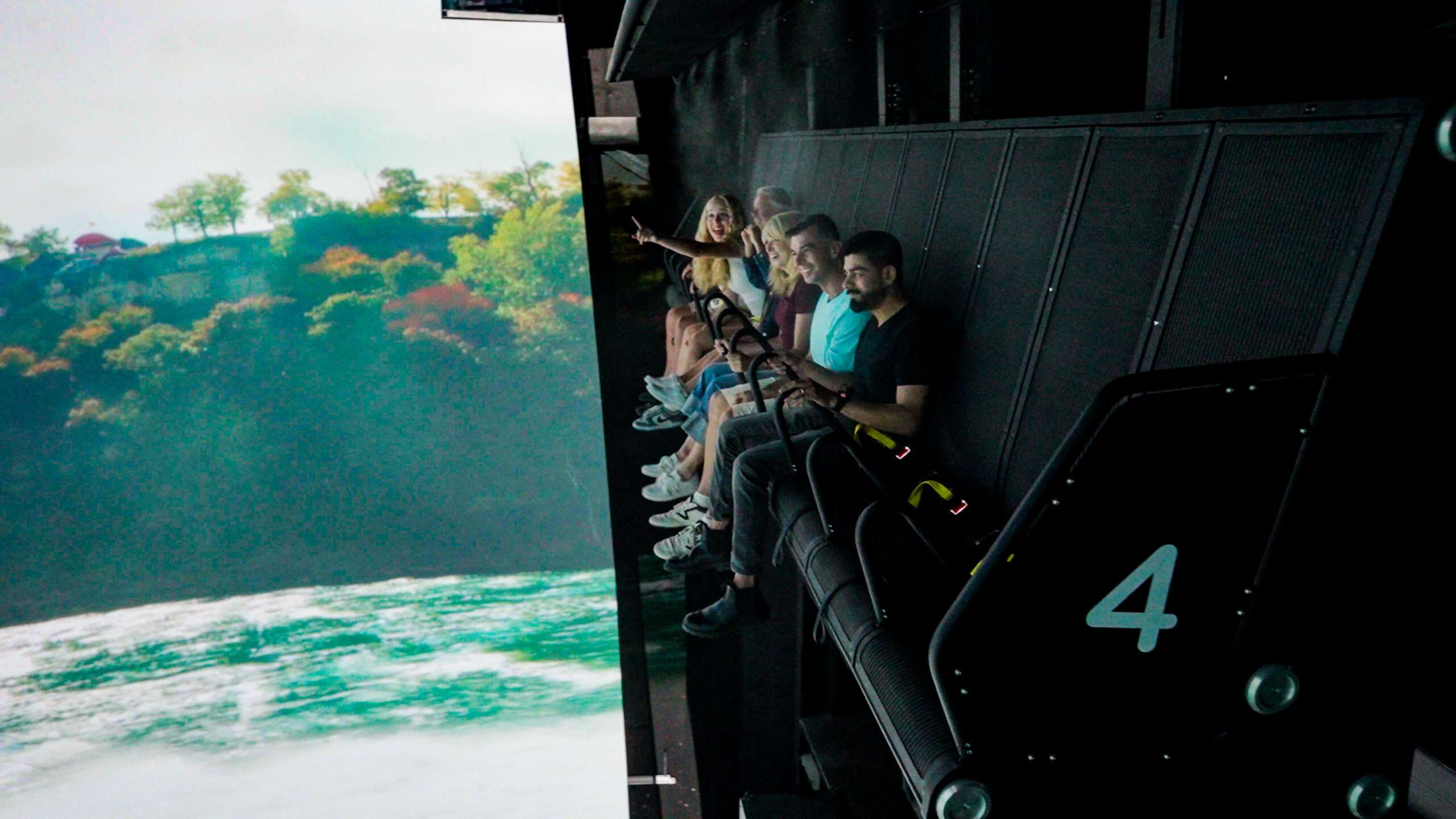
Stefan Rothaug: One of the most striking moments comes when guests fly directly over the Falls, looking down as the water rushes beneath them toward the edge before plunging below. It is a perspective that no ground-level viewing point can provide. Through the combination of spherical-screen imagery, the suspended gondola, synchronized motion, wind, and mist, guests feel as though they are truly flying over the Falls, giving them a visceral sense of its height, scale, and power.

Ultimately, we hope that when guests step outside the theater and stand in front of the real Falls again, they see them differently, carrying with them the memory of having flown over the Falls and a deeper understanding of the place they have just experienced.

How did you bring the creative and technical teams together?

Rothaug: Our long-time partner and Creative Director, Rick Rothschild, played a key role in shaping the content and its overall creative direction. FORREC also played an important role in the attraction design, including the development of the preshow environment and guest journey leading into the flight. Additionally, Rio Mitchell directed the attraction’s three pre-show media experiences.

Indigenous artist Sara General contributed original artwork to the attraction, while Niagara Parks’ Indigenous Advisory Panel helped guide the storytelling and design.

The result is a truly integrated attraction, where the technology, physical environment, content, and cultural storytelling work together as one continuous journey. Rather than experiencing a series of individual elements, guests are guided seamlessly from the preshow into the flight, with every component contributing to the story and emotional impact of Niagara Takes Flight.

What made Brogent the right partner for Niagara Parks?

Sauer: What was really important to us was that we chose a company that understood what Niagara Parks is. We are the stewards of this incredible natural place. We have a responsibility to protect and preserve it while also creating meaningful experiences for our guests. That responsibility influenced how we approached the attraction and why it was so important that the experience feel authentic to Niagara.

Brogent understood that the technology needed to support the story and the destination rather than overpower it. They were very adaptable, and they listened.

How did you decide which stories to tell?

Sauer: The pre-show spaces are part of the attraction; they’re not queuing areas. It was important that these stories were told from the Indigenous perspective. We worked closely with our Indigenous partners and working group, with Niagara Parks providing the space for those stories rather than interpreting them ourselves.

Niagara Takes Flight explores approximately 56 kilometers along the Niagara River, revealing the landscapes and historic sites beyond the Falls themselves. Photo courtesy of NPC.
How did Niagara Parks help bring the project to life?

Sauer: One of the things that made this project possible on such an ambitious timeline was the incredible range of resources we have within Niagara Parks. We have our own police service, road crews and teams across the organization who could help us navigate permits, road closures, filming locations and all of the logistics that came with a project of this scale.

But what was really special was the sense of pride and community that developed around it. We reached out to our employees, their families and members of the local community to participate as extras in exchange for passes to our attractions, and people genuinely wanted to be involved.

That brought a wonderful human element to the film. The people you see in many of those scenes aren’t simply extras; they’re our employees, their families and people from the community who have a connection to Niagara and wanted to be part of telling its story.

From the time we started to the time we opened was about a year, which is almost unheard of for a project of this scale. At one point, the team asked, “Do you really think you can get 400 people here?” We were confident we could, because we knew how much people love Niagara Falls and wanted to be part of this project. They showed up and are thrilled when trying to find themselves on the screen!

How did you work with the filmmakers, and which scenes presented particular challenges?

Rothaug: For Niagara Takes Flight, this required close collaboration between Creative Director Rick Rothschild, Director Mike Quigley, lead drone pilot Gabriel Kocher, and Brogent’s content production and technical teams.

The team paid particular attention to how the footage created visual cues for movement. For example, travelling through a gorge uses the surrounding rock walls to establish speed and distance, while wider landscapes allow guests to appreciate the sense of height and scale. One of the more challenging sequences was the flight through the Niagara Parks Power Station, where large equipment and confined spaces required careful consideration of scale, movement, and lighting to maintain both realism and guest comfort.

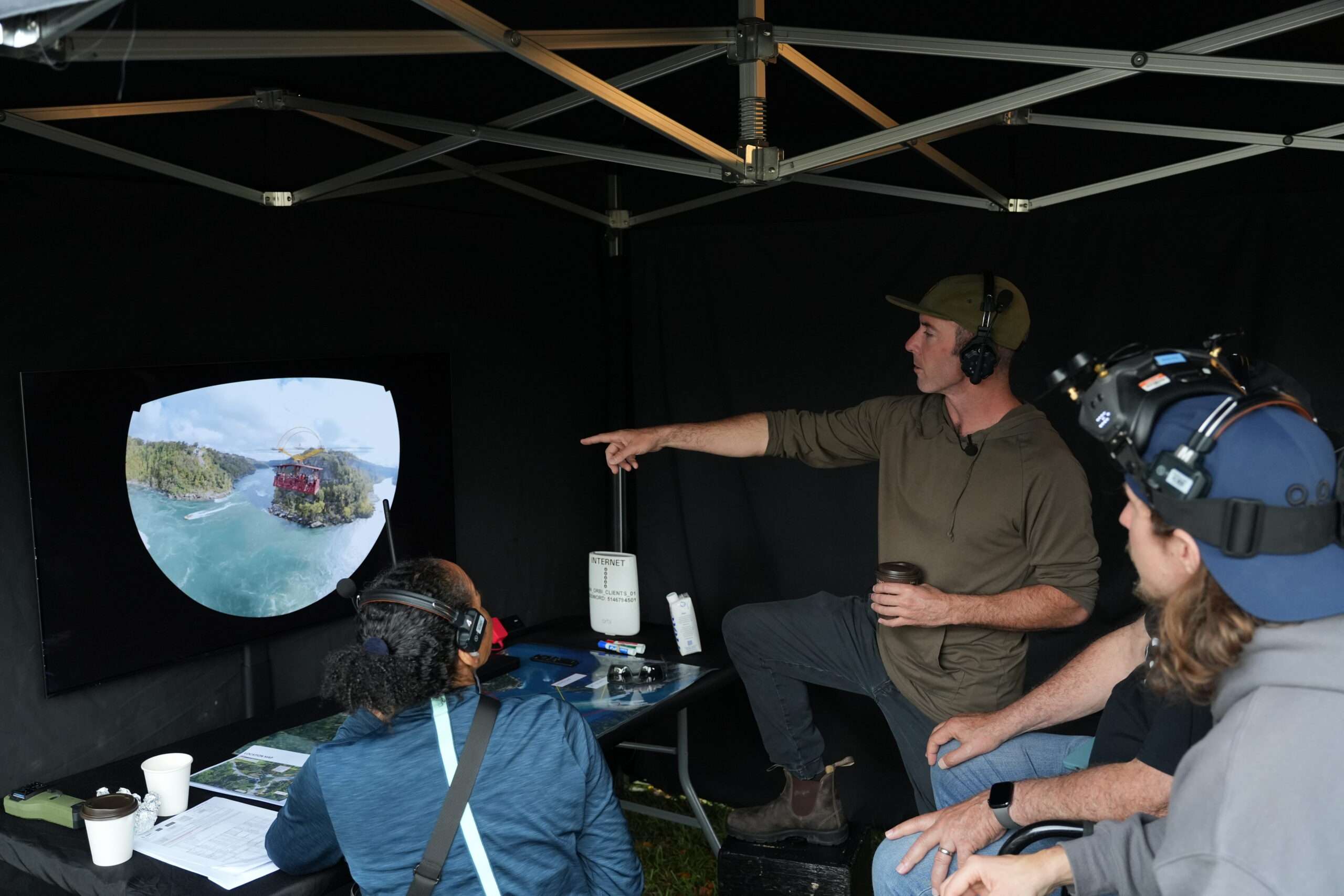
Importantly, the process did not end with filming. The team repeatedly reviewed the footage on the spherical screen and recalibrated the experience, with some sequences requiring additional filming when they did not translate as expected.

At Fort Erie, the challenge was very different. The battle reenactment involved more than 100 participants, requiring careful aerial planning to capture both the scale of the event and the details needed to tell the story clearly. The team had to choreograph the flight paths and camera movements so that guests could understand the action and geography of the scene.

How did you choreograph the motion and effects?

Rothaug: A good example is the opening sequence, which begins in an underground base. Rick Rothschild and Brogent’s content production team refined this scene dozens of times, using visuals, water mist, and echoing water sounds to establish a sense of depth and stillness before the flight begins. The experience then shifts dramatically as the gondola launches out of the cave. The timing had to be carefully calibrated so that the movement matched the exact moment the visuals break through the opening. When the two align, guests feel as though they are physically being launched from underground into the sky.

Creating the flight required close collaboration between the filmmakers and Brogent’s teams, with footage repeatedly reviewed on the spherical screen to align imagery and motion. Photo courtesy of Brogent.

The same principle applies as the journey approaches the Falls, where water sounds, wind, and mist gradually intensify as the visuals draw closer. At other moments, we deliberately hold back and let the landscape speak for itself.

How does scent contribute to the experience?

Sauer: Scent plays an important role throughout the film in bringing the different environments to life. There’s a water scent, which we call the sweet smell of Niagara, and a floral scent in the rose garden scene. The rose garden wasn’t one of my favorite scenes initially, but as we refined it and added the scent, it completely changed the experience for me. It quickly became one of my favorites. In the Christmas scene, we use fresh pine. In the battle reenactment scene, we bring in the scent of gun powder.

Is there a particular guest reaction that has stayed with you?

Rothaug: One of the most valuable things we have learned from watching guests is how much anticipation contributes to the experience. The journey begins the moment they enter the attraction. The grand entry makes a strong first impression, and as guests move through the preshow spaces, you can see their curiosity build as they begin to wonder what is waiting for them.

The elevator room is particularly effective in building that anticipation. By the time guests step through and face the final reveal, you can sense that everyone is ready for something to happen. Then, as the seating platform rotates and the ride begins, there is often a collective “wow” across the room. That moment has stayed with us because it happens almost instinctively. You can see the surprise on people’s faces before they even begin the flight.

What does this project tell us about the possibilities for flying theaters in other locations?

Rothaug: Niagara Takes Flight demonstrates that flying theater experiences can be adapted to a much wider range of locations and project requirements than people might initially expect. We had to work within the tight constraints of the existing building, carefully planning every detail, from structural reinforcements to the precise layout and installation of complex equipment.

Guests experience Niagara’s landscapes from a suspended gondola, with spherical-screen imagery and synchronized movement bringing the aerial journey to life. Photo courtesy of Brogent.

The technology provides a flexible platform that can be shaped around the identity of each destination, whether that means showcasing a natural landmark, telling a region’s history, or introducing audiences to its culture and heritage.

How has the first year compared with your expectations?

Sauer: We thought success would mean serving around 300,000 guests. The capacity of the ride is 240 guests an hour, and in our first year we saw more than 450,000 guests. We far surpassed our hopes for how many people would come.

We try to use every hour of every day to maximize the number of guests who can experience the attraction. Right now, we’re sitting at a 4.7 Google rating, which we’re really happy about – but we think it’s closer to a five!

We achieved our goals. It’s a financially successful operation, and the guests are very happy with what they’re seeing.

It’s not the type of attraction you only need to experience once. Every time you see it, you’ll see something different. The manager told me there’s someone with a season pass who has ridden more than 60 times, and they say they notice something different every time they go through. •
Bringing bones to life

How the Schiele Museum turned a structural repair into the largest exhibit project in its history

by Philip Hernandez

Before visitors see the entrance to the Schiele Museum‘s new Hall of Dinosaurs, they hear it. Low-frequency footfalls from subwoofers carry all the way out to the lobby, enticing guests before a single fossil comes into view. At 4,200 square feet, the Elizabeth Williams Robinson Hall of Dinosaurs is the largest dinosaur exhibit in the Carolinas and the largest exhibit project in the Gastonia, North Carolina museum’s 65-year history. The museum originally planned it as a more traditional gallery of dinosaurs on display, but by the time it opened on September 26, 2026, it had become an interactive exhibit about time, with the dinosaurs as its stars.

A museum the community built

The Schiele Museum of Natural History opened in 1961, and the Charlotte metropolitan region has rallied around it ever since. “This is the cultural institution that many people hold up as being what they’re most proud of,” said Tony Pasour, Assistant Director at the Schiele Museum. That support has funded a full in-house exhibits department under Michael Caron, Head of Exhibits, a sculptor and fabricator whose crew of artists and technicians builds the museum’s exhibits themselves, including most of the new hall.

The gallery the hall replaced dated to the early 1980s, and in 2014, structural issues forced the museum to clear it so contractors could install helical piers beneath the floor. “Like with any home renovation, if you have to clear out the entire kitchen and rebuild it, you’re not going to bring back the old appliances,” Pasour said. After years of assessment, interrupted by COVID, the museum committed in 2022 to a plan that had started as a single Appalachiosaurus and grown into what Pasour calls “a one-of-a-kind permanent dinosaur exhibit that would be the largest in the Carolinas,” funded through the Paleo Project campaign with strong community support. “The original idea was to put some dinosaurs on some platforms,” Pasour said. “We’re really good at things like that.” The team would soon discover platforms weren’t enough.

Sometimes it takes partners

At the board’s urging, the museum went looking for technology partners. “We don’t need technology. We’ve got a dinosaur right here,” Pasour recalled thinking. Caron’s crew could fabricate almost anything, but interactive technology had challenged the museum before, and as a regional institution used to working independently on tight budgets, their options were limited. Caron’s brief to every candidate fit in a sentence: make these bones “make sense and come to life in the 21st century.”

Most of the answers, he said, “looped back to very traditional elements like theater, stage, sound,” which led the museum to upLIGHT, a Brooklyn-based multidisciplinary design studio with roots in theatrical lighting. Principal Designer Greg Bloxham immediately understood the vision, and upLIGHT took on the exhibit’s entire experience technology stack and video content. “I had no idea lighting could do any more than just shine a light on that story,” Pasour said. “The light can actually be part of the story.”

An exhibit about time

Light helps encourage a visitor where to look. Bloxham compares the work to puppetry. “We build this whole rig of lights and effects, and then we start pulling the strings,” he said. In this case, the strings pull guest’s attention towards the fossils. upLIGHT lit the specimens with techniques borrowed from film and television and kept the audience areas low and dappled, so the crowd recedes and the dinosaurs on their pedestals come across as the stars. “It’s lit the same way I would light a celebrity,” Bloxham said.

The entrance to the Elizabeth Williams Robinson Hall of Dinosaurs at the Schiele Museum in Gastonia, North Carolina.

That same control makes the hall feel larger than bones. Lighting design helps highlight “the element of time,” Bloxham said, and the exhibit uses dinosaurs that lived tens of millions of years apart to tell a story about change and adaptation, what he calls “an exhibit that is about time, in a sneaky way.”

The guest journey

The hall sits at the far end of the museum’s long, linear building, past a Quetzalcoatlus in the lobby and a Gastonia specimen that marks the halfway point, so every visitor passes the museum’s other galleries on the way.

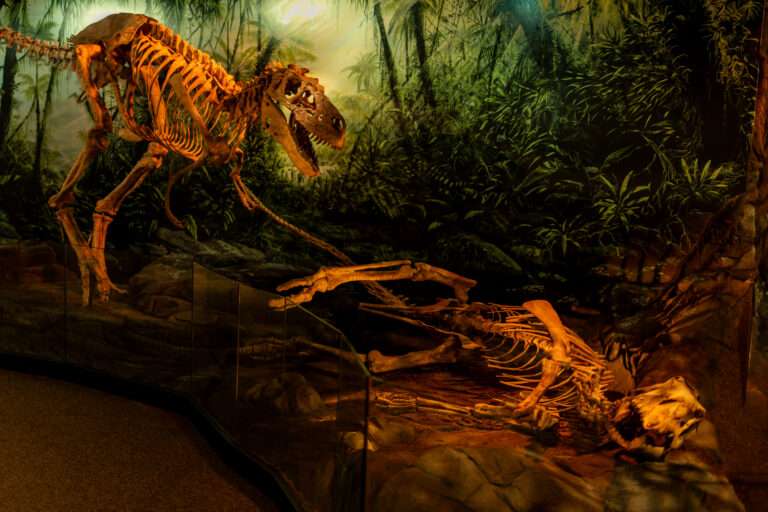
The hall opens with a familiar scene: an Appalachiosaurus, the East Coast T. rex, standing over an Eotrachodon it has just killed, both Carolina dinosaurs. “There are not a lot of surprises out front,” Caron said. String instruments hold a sustained note while the subwoofers deliver the footfalls audible from the lobby. “We’re setting expectations so that we can confound them later on,” Bloxham said.

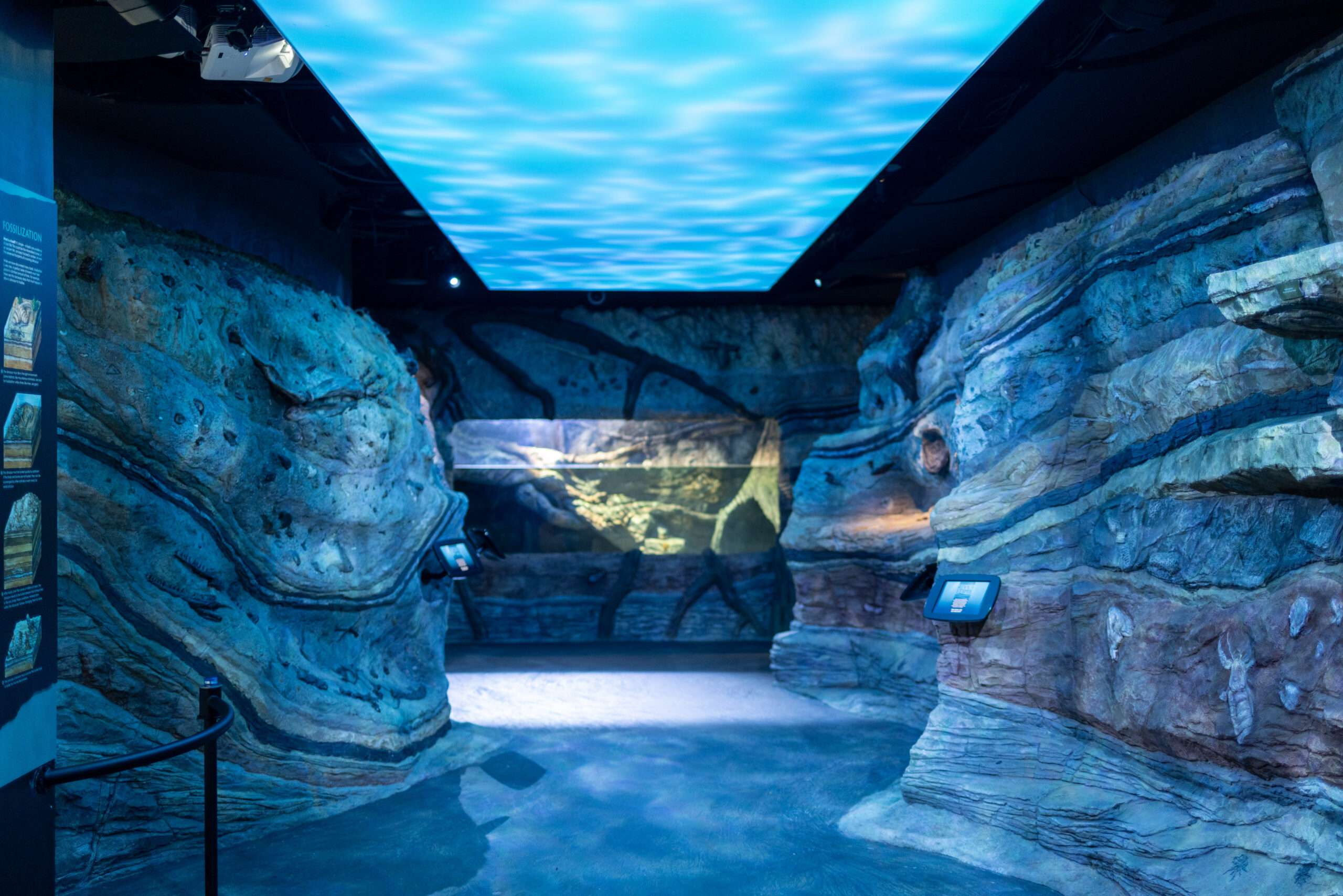
In the River of Time, visitors walk down a riverbed past stratified rock layers holding more than 100 fossils and casts. Partway down, an interactive video lets guests spin a dial and scroll down through the strata on screen, each turn carrying them further back in time. The corridor ends at a live alligator snapping turtle, a living relative of the ancient creatures ahead.

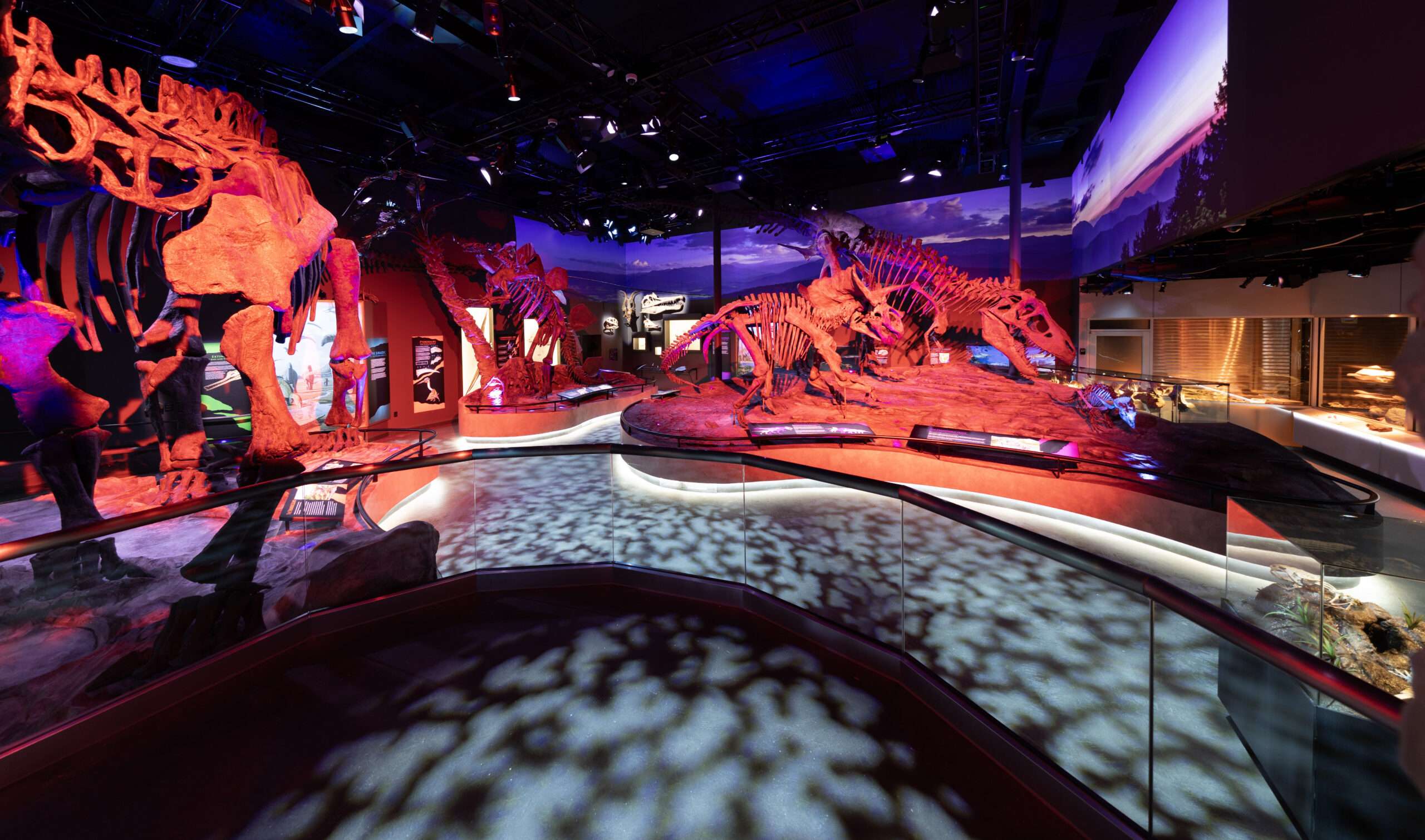
Lighting and effects simulate different times of day and weather to make the dinosaurs constantly appear differently.

Around the corner, the Overlook opens onto the main gallery. An 80-foot Apatosaurus towers over the platform, and across the gallery a T. rex lunges at a fleeing baby Triceratops while the mother slams into the predator from the side. From the Overlook, visitors stand eye to eye with the specimens, then descend a ramp to the gallery floor, where, as Caron puts it, “you’re actually staring up at them from below.” Bloxham describes the sequence as an iris. “We are containing you and showing you one specific vista architecturally up until the Overlook, and then once you go down into the main gallery, you can choose your own adventure,” he said. “Then we narrow that iris back down again for the Continuum.”

At the crossroads between the Overlook and the floor sits a two-sided Dromaeosaurus that Caron sculpted, fleshed and feathered on one side, bare skeleton on the other, with a black mirror behind it. Two zones of light crossfade so the raptor appears to transform from skeleton to living animal and back, an effect inspired by Pepper’s Ghost.

“That skeleton represents the science and what we know,” Pasour said. “The element that Michael added, a fleshed-out interpretation of life, represents the imagination that we use to build on our knowledge.”

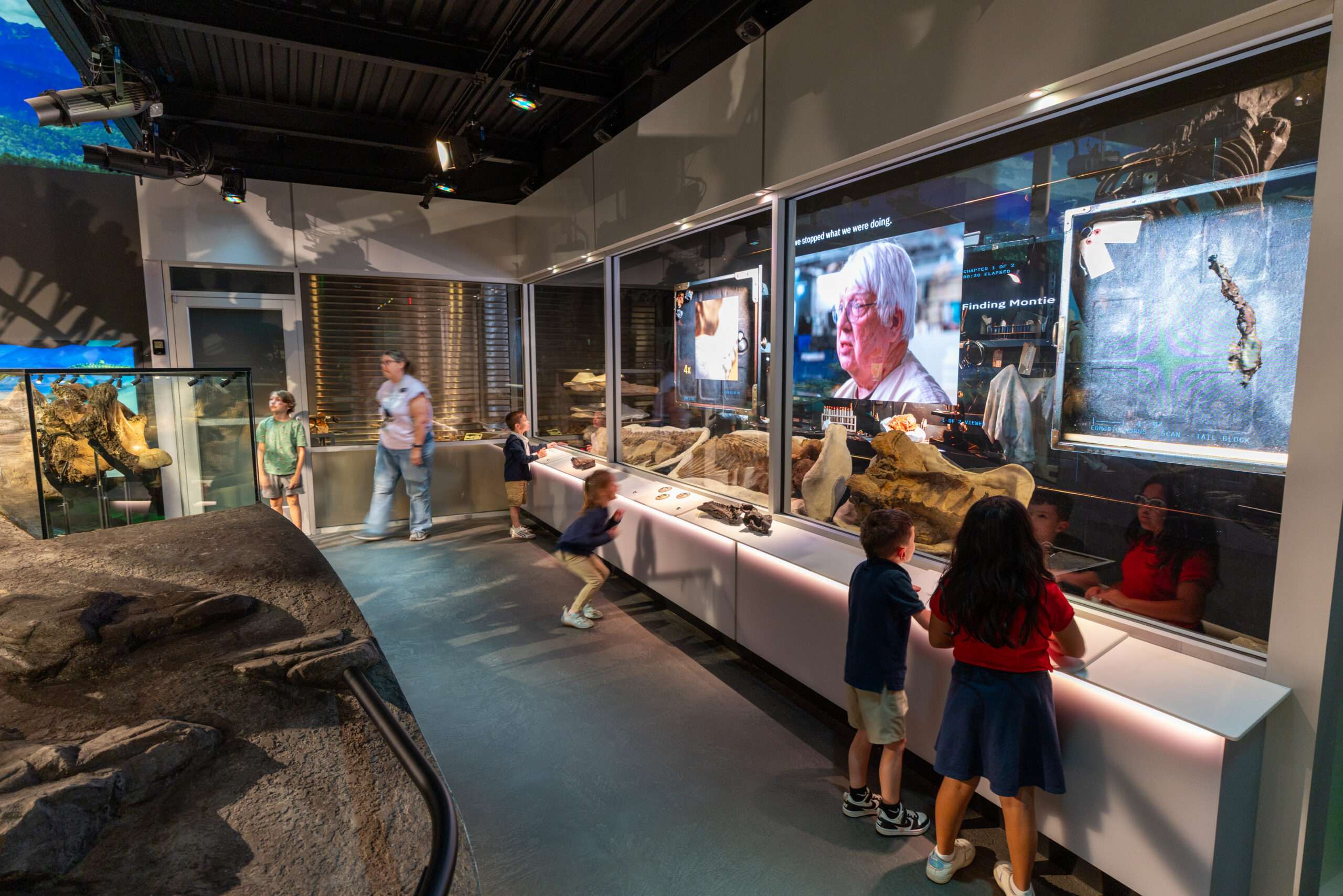
In one corner, an authentic Edmontosaurus fossil nicknamed Montie, roughly 32 inches by 18 feet, lies in front of a 20-foot-wide LED video wall. Three stations face the wall. At one, a joystick and dial steer a virtual microscope across the fossil. At another, two dials spin high-resolution 3D scans. At the third, touch buttons call up films that upLIGHT shot in Wyoming, Colorado, and North Carolina. Dr. Kraig Derstler, the paleontologist who discovered the specimen, and Dr. Nickolas Brand, the museum’s Curator of Collections and Research, appear on the wall to point out its healed bite marks from a T. rex attack. “People aren’t going to come to this exhibit to see Montie,” Pasour said. “They’re going to see Montie and realize this is the most valuable thing in the entire exhibit.”

The exhibit ends in The Continuum, a space the early drawings labeled only “exit hallway.” Bloxham thought about the theme park “kiss goodnight,” and pitched turning the hallway into the story’s resolution phase. Having walked visitors backward in time, the Continuum carries them forward again. A wall-sized video runs the length of the hallway, moving from the extinction of the dinosaurs through the rise of mammals to the first humans, and eight zones of speakers along the wall each play a soundscape matched to the era on screen. As a visitor walks the hallway, they move from one sound field to the next, so the crossfade a sound mixer would perform in a theater happens with each step. “Their time is over,” Bloxham said of the dinosaurs, and the room’s point is that ours is not. Lines of light create what he calls a celestial moment before visitors exit directly into the museum’s next gallery, Henry Hall of the American Indian, where the human story picks up.

Fifty speakers and a thirty-minute day

The main gallery has no windows, so upLIGHT created a faux sky. A 270-degree edge-blended projection wraps the top of the room with mountains, plant life, and clouds. The gallery lighting follows a 30-minute cycle that runs from daylight through sunset, a night sequence, and dawn, then starts the day again. The weather is randomly generated, so some days in the gallery are rainy, and 50 individually controlled speakers play exhibit-specific music and sound that shifts with the sky. The fossils never move, but the light on them never stops changing.

Gantom 7 seven-color spotlights embedded directly into the rockwork drive the night sequence, while Gantom Juni fixtures frame the exact areas of highlight on the raptor and Montie displays and recessed R4 fixtures light the Montie display from the ceiling. “In the night sequence especially, all the dinosaurs get a beautiful underlit glow,” Bloxham said. “You can see up into the rib cages in a very different way.”

Four video areas serve the hall across three edge-blended projection systems and the LED wall, and two are interactive: the River of Time dial and the Montie fossil wall.

A fossilized dinosaur named Montie provides the inspiration for several interactive activities in the exhibit.

Rather than wire the hall with pressure plates and break-beam sensors, upLIGHT put ordinary cameras throughout the gallery and gave them three jobs. The first is triggering. When a guest crosses a virtual line drawn in the camera’s view or steps through a doorway, the system can raise the sound, shift the lighting, or start a video loop, so the hall reacts to movement without a sensor at every threshold. The second is a system the team calls the Roar 5000. Speakers are placed among each dinosaur group, and at random intervals one of them roars. The cameras track how many people gather at each island, and the roars go more often to the emptiest one. “We’re using those as a way to invite people to come over,” Bloxham said.

The third job is measurement. The cameras feed a custom guest interaction monitoring system that tracks dwell time in designated zones, and Pasour’s team receives an automatically generated monthly report on where visitors linger and where they don’t. Every speaker and light reports its health to a web dashboard. “This is the technology backbone that you need to put in your building, not just for this first major exhibit, but for the next five exhibits,” Bloxham said.

Dinosaurs on pedestals

The Schiele built most of the new hall with its own hands, as it has for decades. The one part it handed to an outside partner was the one it had never done, and that trade-off turned a gallery of specimens into a story. “Had we not done it at all, we would have this wonderful gallery of dinosaurs on pedestals in pretty traditional exhibit lighting, and the story would be much more one-dimensional,” Pasour said. “Once you put artifacts on display for the public, you are telling a story, whether you’re doing it intentionally or not,” Bloxham added. “So you might as well use every tool you have to make it a good one.” •
PROJECT CREDITS

Schiele Museum of Natural History

Tony Pasour, Assistant Director Michael Caron, Head of Exhibits

Dr. Nickolas A. Brand, Curator of Collections and Research

upLIGHT

Greg Bloxham, Principal Designer Jackson Shelton, Composer

Don Dorsey, Sound and Music Design Consultant

Kristel Stark, Media Producer and Editor Robert Machado, Director of Photography Jeremy Le, Location Lighting and Camera Operator

Ella Gand, Production Assistant

Erik Herskowitz, Associate Lighting Designer David Waggoner, Design Manager

Zo Haynes, Project Manager and Programmer Justin Kirkpatrick, Draftsman

Paige Pinckney, Visuals Technician Alex Alam, Theatrical Electrician and Integrations Technician

Vendors

Gantom Lighting, Lighting Manufacturer upLIGHT, Experience Technology and Media Design

Rygid Audio Video, AV Installer Christie and ViewSonic, Projection Q-SYS, Audio and Show Control QSC and Genelec, Speakers Fabulux, LED Wall

ETC, Rosco, Chauvet Ovation, City Theatrical/ Environmental Lights, and Universal Fiber Optics, Additional Lighting Manufacturers Squeek Lights and Victor Zeiser, Lighting Supply

Lail, Electrical

Triebold Paleontology, Skeleton Casts and Fossil Preparation

A collaborative journey: Refik Anadol’s DATALAND comes to life, illuminated by Epson projectors

Pioneering AI artist Refik Anadol used Epson projectors to transform data from nature and visitor biometrics into a massive interactive “living sculpture”

by Joe Kleiman

A decade ago, when Turkish-American artist Refik Anadol first arrived in Los Angeles, one of the first places he visited was The Broad, the contemporary art museum in downtown Los Angeles. “It was very exciting for me,” Anadol recalls. “I was new to Los Angeles and so was The Broad. I was looking for inspiration and one of the things that really moved me was Yayoi Kusama’s infinity rooms.”

One installation in particular spoke to Anadol: Yayoi Kusama’s Infinity Mirror Room – The Souls of Millions of Light Years Away. The 2013 installation surrounds visitors with mirrors and flickering LED bulbs hanging from the ceiling, creating an environment in which the boundaries between the physical space and the visitor seem to disappear.

Today, Anadol has created his own interpretation of the immersive art experience. Across the street from The Broad stands DATALAND, a 25,000-square-foot AI art museum that explores the intersection of nature, data, technology and human experience.

The comparison to Kusama is useful, but DATALAND takes the concept in a distinctly futuristic direction. Rather than surrounding visitors with light and mirrors, Anadol uses artificial intelligence, environmental data, biometrics, sound, scent, and massive-scale digital imagery to create an environment that responds to the people inside it.

A museum that responds to its visitors

DATALAND’s opening exhibition, encompassing all five of the museum’s galleries, is inspired by the world’s rainforests. Throughout the experience, millions of licensed images of nature are continuously transformed by artificial intelligence using real-time environmental information from sixteen rainforests around the world, including data such as temperature and precipitation.

Technology is intentionally visible as part of the aesthetic language. Some of the imagery evokes the visual vocabulary of sci-fi films like The Matrix or TRON, but at DATALAND, the digital abstractions are continually interwoven with imagery of the natural world.

While guests explore the exhibits, DATALAND collects information from visitors themselves. A biosensing wristband monitors movement, heart rate, skin temperature and skin conductivity, allowing the experience to incorporate the physical presence of the people inside it. The result is an environment that is never the same twice.

“What moves me most is not the technology,” Anadol wrote. “It is watching our dear visitors become quiet together – children, elders, scientists, dreamers – each finding their own reflection inside nature’s memory.”

An infinity room on a massive scale

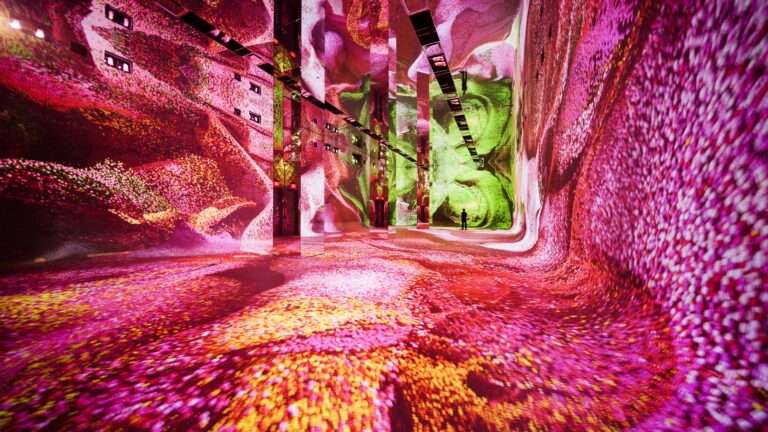
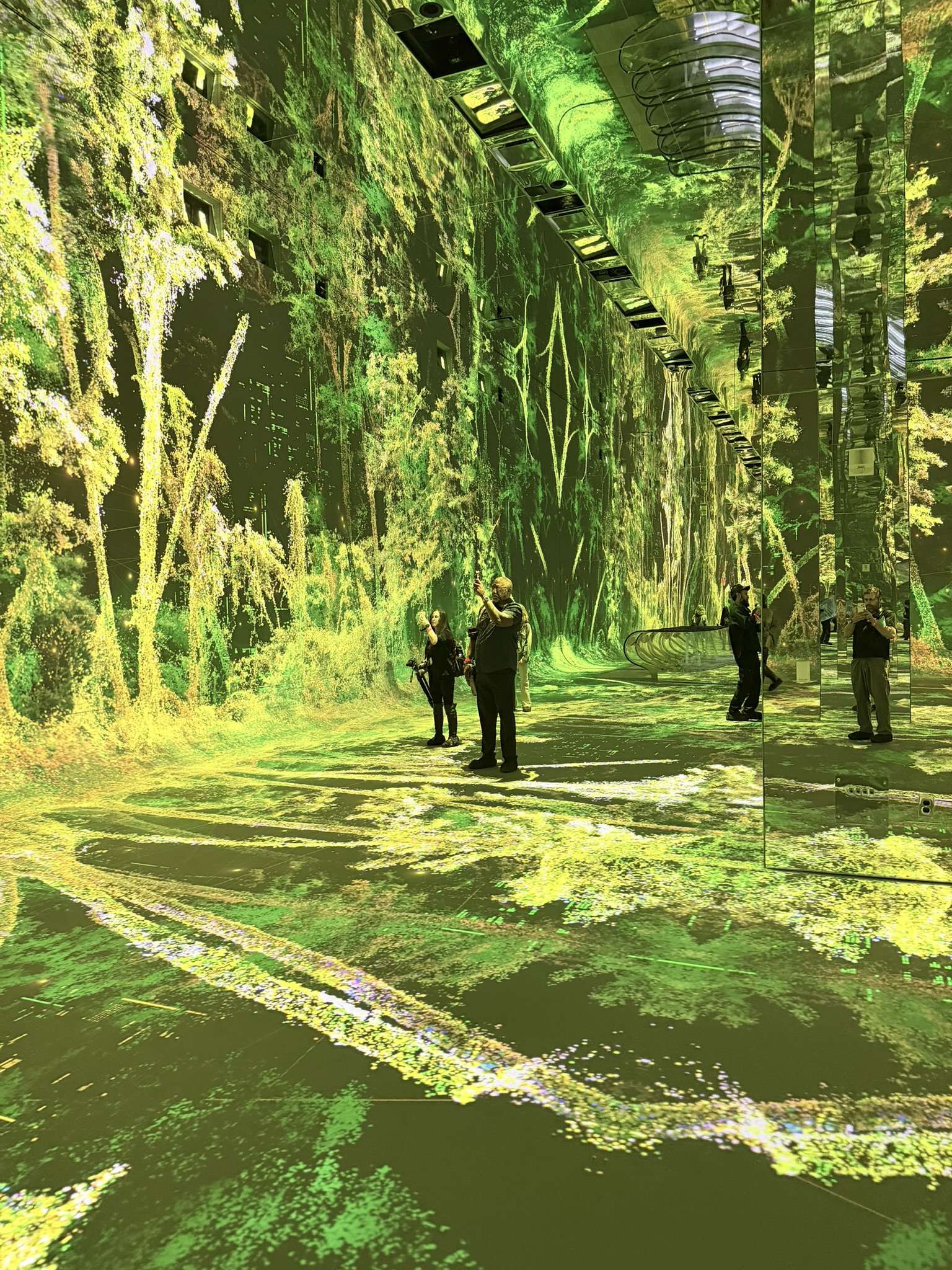
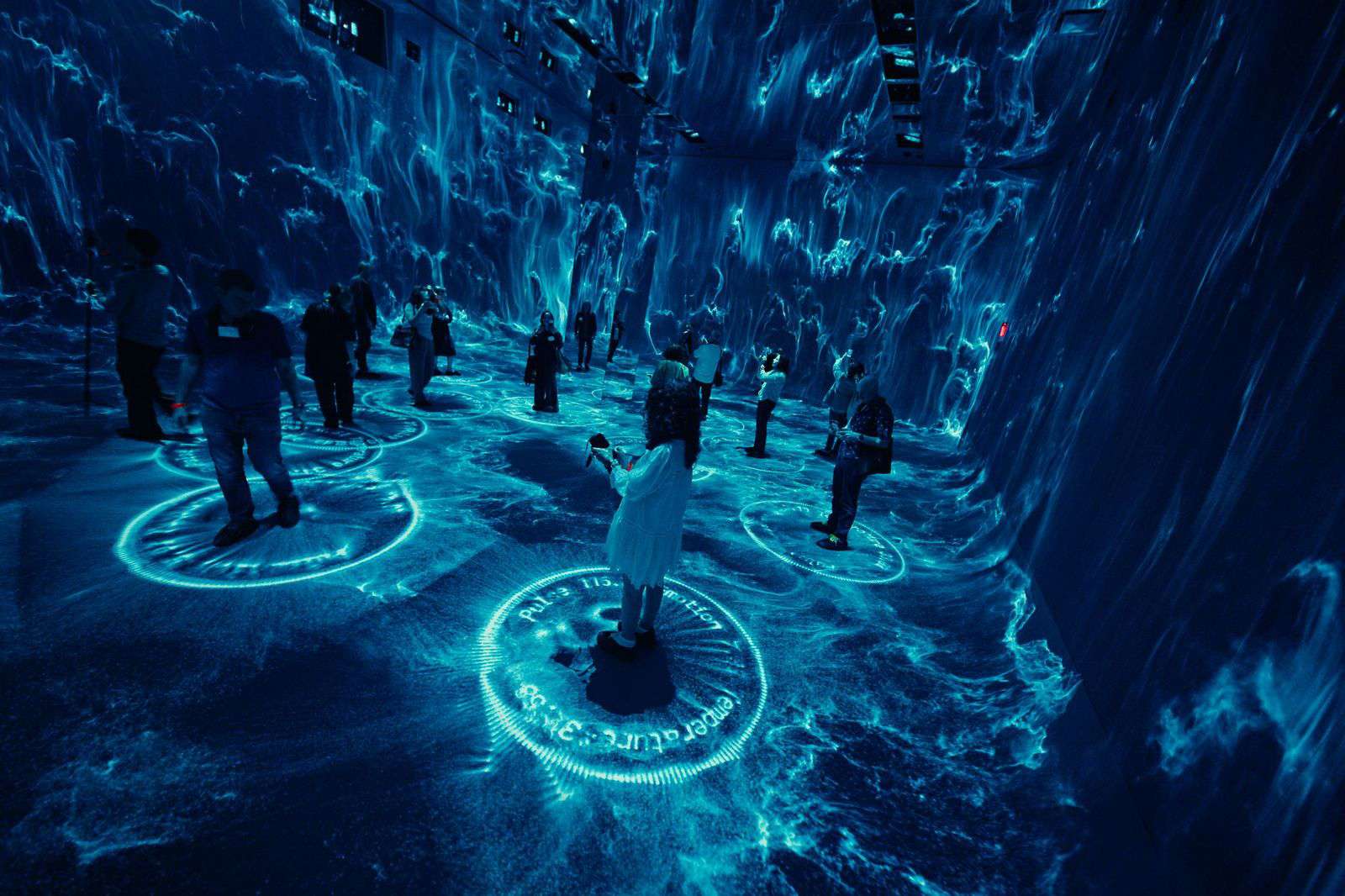
Visitors descend an escalator into the two-story Data Pavilion, a 92-foot-long, 39-foot-wide and 22-foot-high environment that surrounds them with imagery. The Pavilion uses 84 Epson projectors to create a 40-minute, 360-degree presentation. Rather than treating projection as a large screen placed in a room, DATALAND uses the entire architecture as part of the canvas. The result is effectively an infinity room on a large architectural scale.

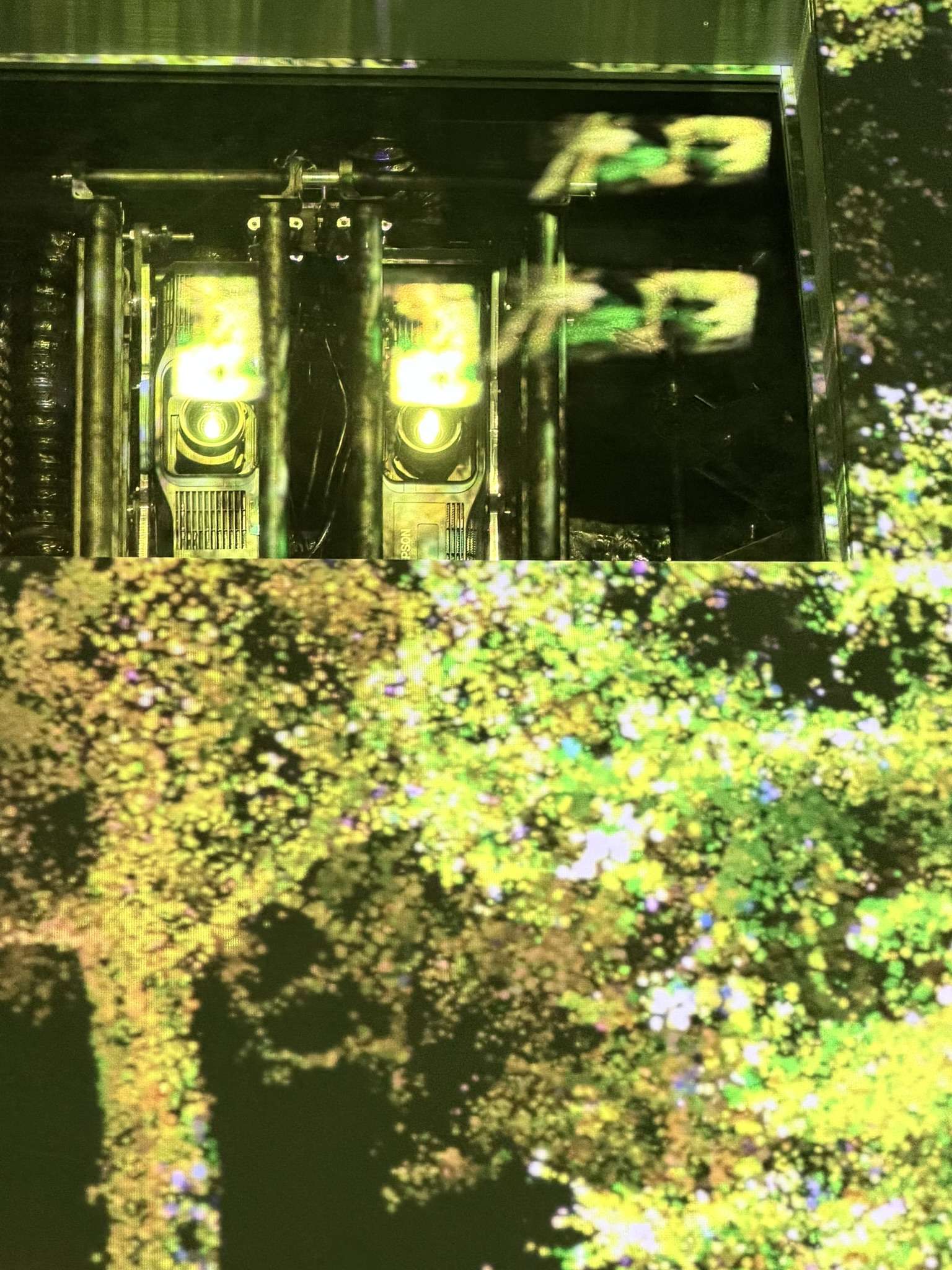
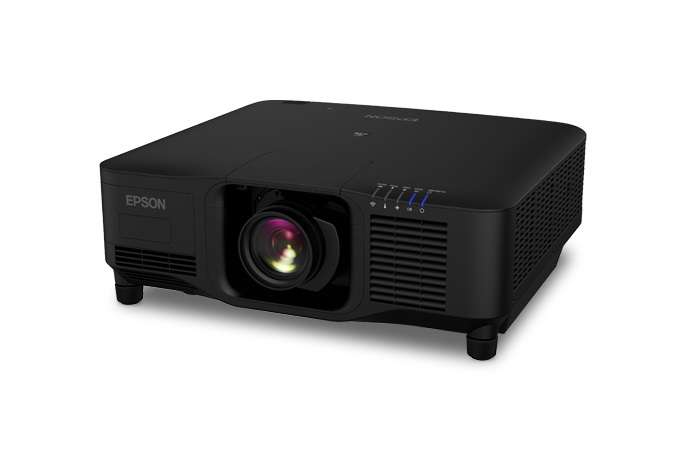
The Data Pavilion relies on pairs of Epson EB-PQ2220B 4K 3LCD laser projectors, mounted in stacked configurations behind projection-port windows near the top of the side walls and in the ceiling. The paired projectors double the illumination available for the imagery while providing the brightness and image quality needed to cover such a large, reflective environment. At 20,000 lumens per projector, the EB-PQ2220B is designed for large-venue applications where brightness and image quality need to remain consistent across a substantial image.

“Refik has long been a collaborator with Epson,” explains Gavin Downey, Epson’s Group Product Manager – Large Venue Projection. “We were able to provide him with gear in the early stages of the EB-PQ Series, and he was able to explore the possibilities of what he could do with our technology in the unique way that he creatively and analytically explores things. He’s not just an artist, he’s a data scientist, a futurist, and more. In DATALAND, he’s doing things that I don’t know that anyone else is doing.”

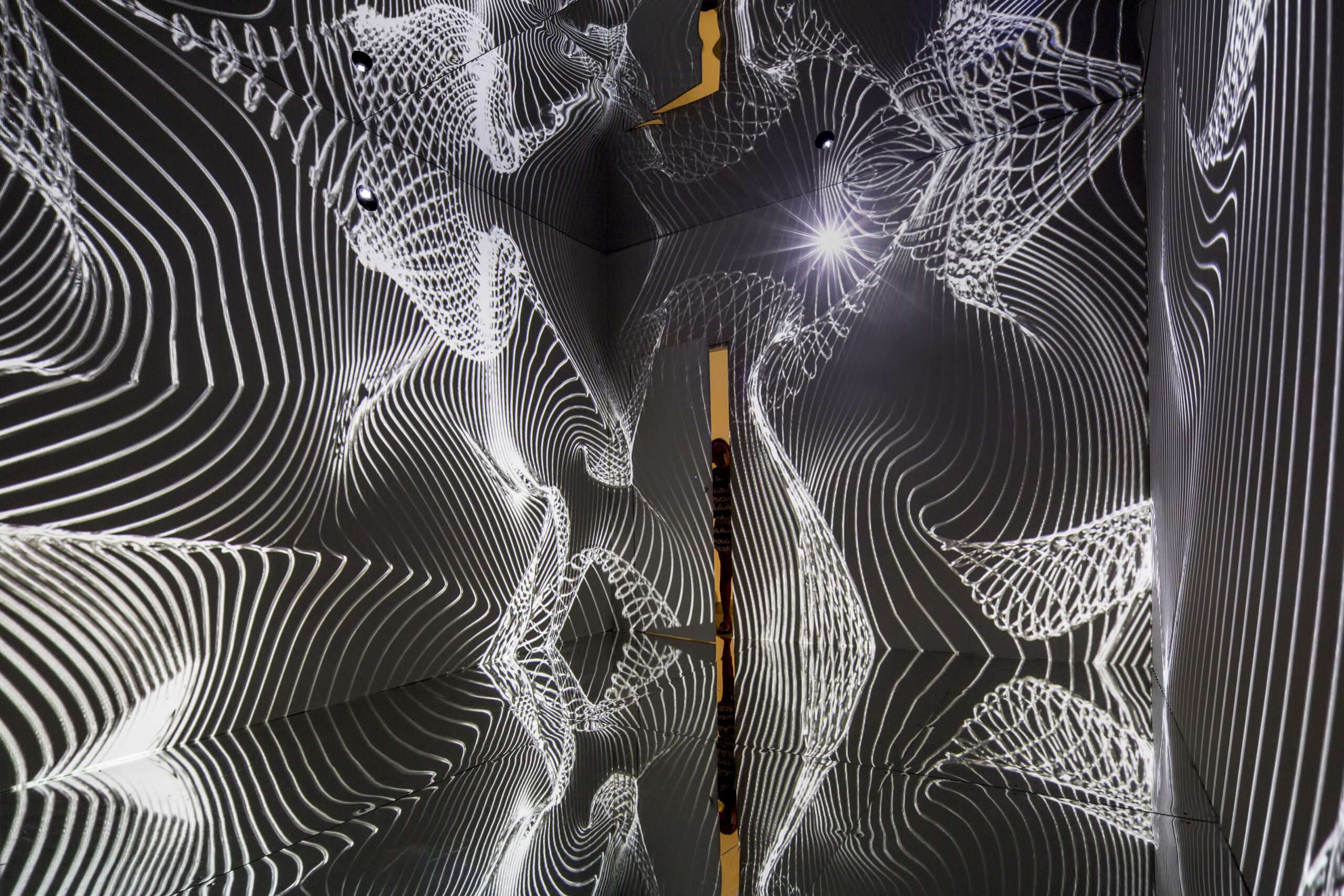
To create a full 360-degree projection environment, DATALAND employs mirrors on non-projection surfaces, including one of the end walls, the side of the escalators, the ceiling and structural pillars located throughout the room. “Despite the extensive use of mirrors, we are able to create a seamless visual experience through precise projector alignment, exceptional image quality and our team’s technical expertise,” says Anadol.

While digital rain and waterfalls descend along the walls of the Data Pavilion to an exclusive recording or Mahler’s Third Symphony by the Los Angeles Philharmonic, motion trackers encircle each guest, displaying real time information from their biometric sensors. © 2026 Refik Anadol Studio on behalf of DATALAND.

“The fact that elements like mirrors and escalators exist in the space, and the fact that the gallery achieves the effect it does, is a testament to how good the projectors and Refik’s team are,” shares Downey. “There are a lot of lumens in that room, and a lot of mirrors. In almost anyone else’s hands, that would create cross-contamination, a loss of contrast, all sorts of secondary impacts. When you see this, you begin to ask yourself if you would have known how to do it.”

Consistently crisp, stunning image quality

Visitors often can’t tell where the projection ends and mirror reflections begin, which allows for full immersion in the artwork. The image needed to remain bright, detailed and consistent, not just directly in front of the visitor but across the entire environment.

Epson’s 3-Chip 3LCD architecture across its entire projector lineup contributes to that consistency by splitting a blue phosphor laser into red, green and blue light. Each color beam then goes through its own LCD chip before recombining through a prism, after which the resulting image is projected. The technology avoids the rainbow effect and loss of color brightness that can occur with some projectors.

“Epson has consistently improved key areas like contrast and durability, while maintaining the strong color and white brightness performance that our 3-Chip 3LCD technology has always been known for,” adds Downey. “Epson’s continued investment in 3-Chip 3LCD technology is directly tied to the fact that we own and develop the technology ourselves, giving us greater control over its evolution and the ability to continually push performance forward. Those efforts are apparent across the entire EB-PQ Series, which represents a quantum leap for us in full-time color, stunning contrast and exceptional image quality.”

RELATED: How Epson projection makes Cirque du Soleil’s ALIZÉ possible

A partnership built over time

For Anadol and Epson, DATALAND is the latest chapter in a relationship that stretches back more than a decade.

“My relationship with Epson goes back to my first day of being a university student,” Anadol says. “They were extremely friendly when I emailed and asked them to support my thesis project. Back then it was more challenging to use this technology. Over the last twelve years, they’ve continued to collaborate with me.”

Refik Anadol’s Infinity Room was on display at Epson’s InfoComm 2016 booth in Las Vegas, upgraded with Epson 3LCD laser projectors. Photo courtesy of Epson.

In 2015, Anadol created his first “Infinity Room” experience using Epson lamp-based projectors. Foreseeing the transition from larger lamp-based models to compact and brighter laser driven solutions, Refik accounted for this in the original design. The following year, the installation was displayed at Epson’s booth at InfoComm in Las Vegas, as a showcase for the company’s Pro L-Series laser projectors. Brightness increased by almost 70% just as “Infinity Room” embarked on a global tour of museums, technology conferences and exhibitions.

The collaboration continued across various projects over the years. This includes in 2023 when Epson moved into a new custom-designed headquarters in Los Alamitos, California. Anadol was commissioned to create two original pieces of AI artwork for the facility, displayed on opposite sides of a two-sided massive screen in the entryway lobby and powered by four Pro L-Series laser projectors.

DATALAND represents a much larger expression of this ever-evolving relationship.

“Epson’s continued investment in 3-Chip 3LCD technology is directly tied to the fact
that we own and develop the technology ourselves…Those efforts are apparent across
the entire EB-PQ Series, which represents a quantum leap for us in full-time color,
stunning contrast and exceptional image quality,” says Epson’s Gavin Downey. Image courtesy of Epson.

“The Data Pavilion is really a living sculpture,” says Anadol. “There are more than 200 channels of sound, hundreds of sensors and an 84-projector image system. All of those systems have to work together.”

“The technology can’t be separated from the experience,” says Downey. “The projection, the sound, the sensors, the architecture and the data all must work together. That’s what makes this different from simply putting a very large video wall into a gallery.

For Anadol, that distinction is central to the project. The objective isn’t to demonstrate what a projector can do, or even to demonstrate what artificial intelligence can do. Those technologies are tools in service of something more human: creating a shared environment in which visitors can lose their sense of where technology ends and the artwork begins.

That is why the relationship between Anadol and Epson has endured. “Whenever we have big, challenging projects, Epson always supports us,” Anadol says. “This is more than just a product relationship. It’s about supporting an artist’s journey.”

At DATALAND, that journey has become a physical place – one where data becomes imagery, imagery becomes environment, and the visitors themselves become part of the artwork. •

Vekoma: 100 years in motion

by Martin Palicki

As Vekoma celebrates its 100th anniversary in 2026, the company has considerably more to recognize than being in business for a century. Its history is one of continual reinvention – from agricultural machinery and industrial steelwork to one of the world’s leading roller coaster and attraction manufacturers.

Vekoma began in 1926 as a local farming equipment business in Vlodrop, in the Netherlands. Over time, the company expanded into steel construction and eventually found its way into the amusement industry. Today, Vekoma’s attractions are installed in more than 40 countries, with more than 450 specialists working across concept design, engineering, manufacturing, installation and after-sales service.

Vekoma’s transition into amusement rides began in the 1970s, when the company applied its steel fabrication expertise to the growing roller coaster market. A relationship with U.S. manufacturer Arrow Development gave Vekoma experience with coaster technology and eventually led to licensed production. By the end of the decade, Vekoma was developing rides under its own name.

A new chapter began in 2018, when Vekoma became part of Japanese entertainment-equipment company Sansei Technologies. The acquisition expanded Vekoma’s global manufacturing and sales network while preserving its established brand and identity.

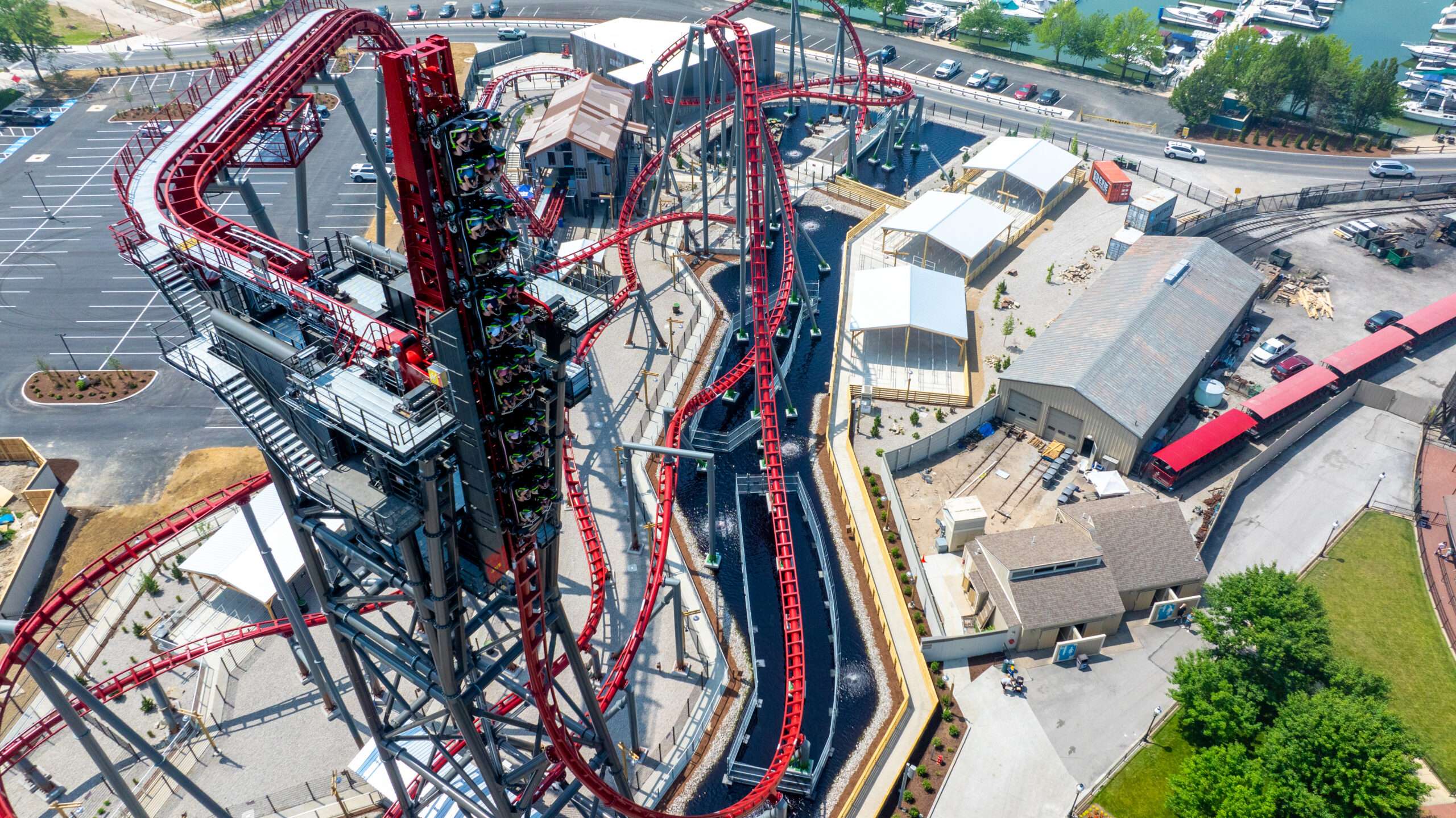
Siren’s Curse, a Vekoma Tilt Coaster, opened at Cedar Point in 2025.

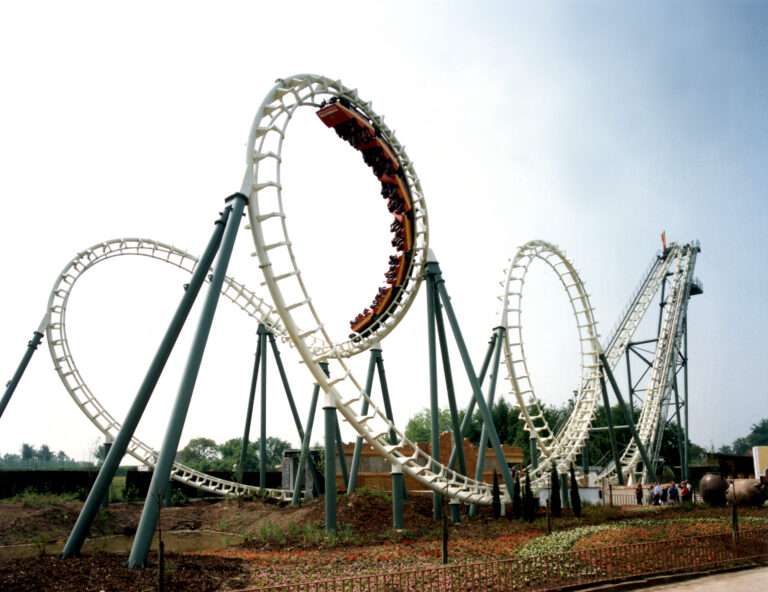
The company’s coaster legacy includes the Boomerang, a design that has become one of the industry’s most recognizable ride concepts. Its forward-and-backward operation makes efficient use of a relatively compact footprint, while giving riders the unusual sensation of experiencing the course in both directions. Vekoma continues to develop and build on the concept today. Its Super Boomerang combines the familiar shuttle principle with launches, a twisted drop and a reverse run through the course. The model made its North American debut at Six Flags Great Adventure in 2025.

The company’s combination of established engineering and new applications is evident throughout Vekoma’s current portfolio. At Cedar Point, Siren’s Curse brought the company’s Tilt Coaster concept to North America in 2025. The 160-foot attraction stops on a section of track that rotates the train 90 degrees before riders plunge into the rest of the ride at speeds reaching 58 mph. The experience also incorporates onboard audio and LED lighting.

Vekoma also continues to expand the possibilities of family thrill rides. Flying Fox opened at Kentucky Kingdom in May 2026 with 1,380 feet of track, a 65-foot maximum height and a 38-inch minimum height requirement. At Six Flags Fiesta Texas, the forthcoming Werewolf Gorge will combine four launches, a mid-course rollback and 32 airtime moments across 4,120 feet of track. Vekoma says the attraction will be the world’s longest family launch coaster.

The company’s work also extends beyond traditional roller coasters. SEAQuest Legends of the Deep, currently being built at SeaWorld Orlando, uses a suspended ride system that allows vehicles to swing and rotate through indoor environments, supplemented by onboard audio and dynamic lighting. The concept received an IAAPA Brass Ring Award for Best New Product.

Similarly, Vekoma is currently working on a new dark ride for Gröna Lund called SCORE! Announced at IAAPA Expo Europe 2026 in London, the new dark ride will feature trackless vehicles from Vekoma that utilize advanced radar-based technology for movement and positioning.

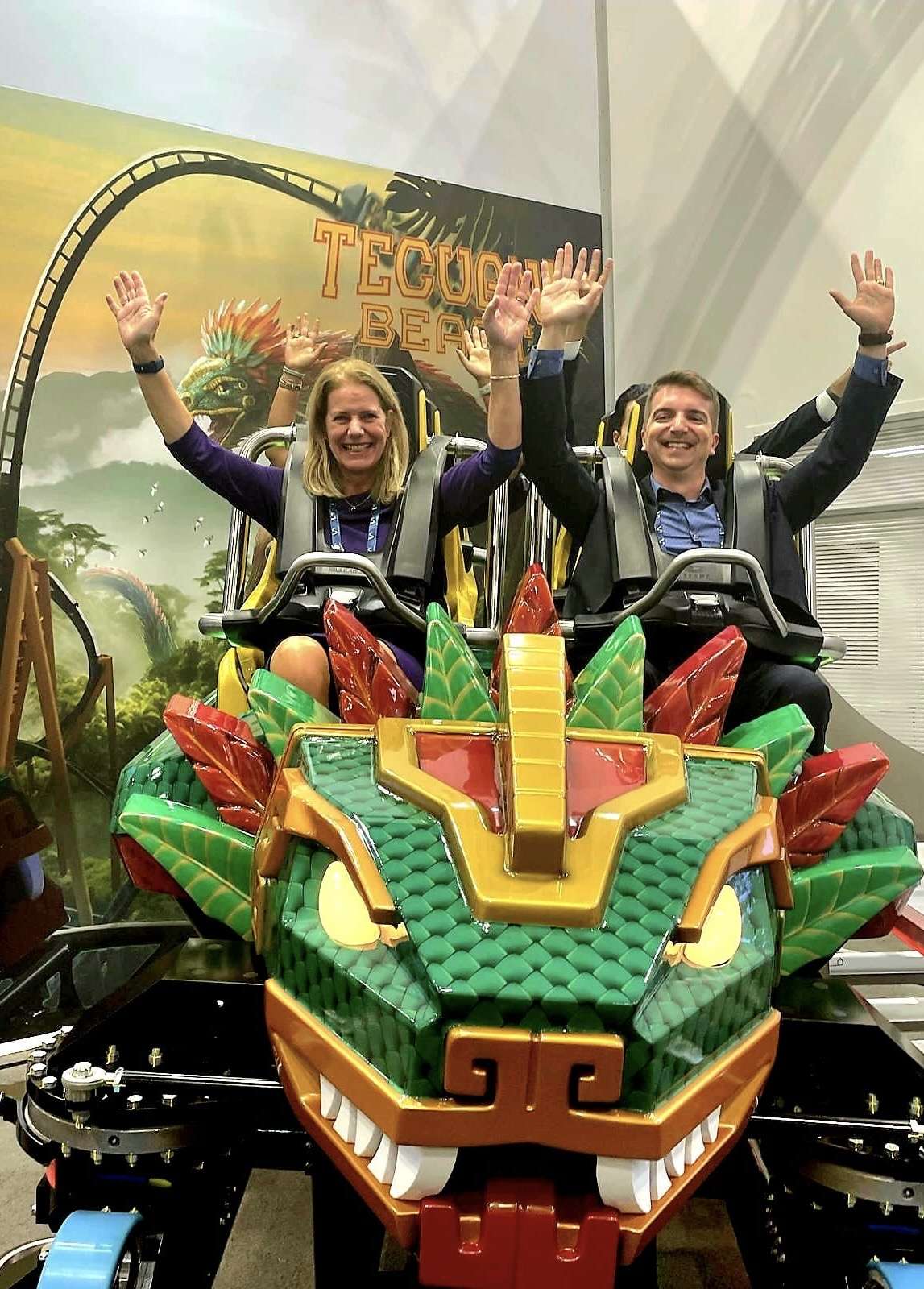
Vekoma CEO Anne-Mart Agerbeek and Vice President of Sales & Marketing – Americas Ricardo Tonding Etges on one of the company’s coaster cars on display at IAAPA Expo.

Vekoma is also applying its engineering capabilities to extending the life of existing attractions. Its recent refurbishment of Big Thunder Mountain Railroad at Walt Disney World included new track and passenger trains while retaining the attraction’s established themed environment. The ride reopened with a reduced 38-inch height requirement.

The anniversary offers an opportunity to celebrate more than a collection of famous rides. Vekoma’s century is ultimately a story of adaptation – applying engineering expertise to new markets, learning from challenges and continually reinventing what a roller coaster can be.

Perhaps Vekoma CEO Anne-Mart Agerbeek says it best: “For one hundred years, Vekoma has been shaped by the passion, talent, and determination of its people. Every generation has built upon the achievements of those before them, creating a legacy that continues to inspire us today. As we look ahead, we do so with pride in what we have accomplished and confidence in what we can achieve together. It’s our turn to carry that legacy forward. The greatest tribute to our first century is to keep building the future!” •

From concept to opening: How Dream Garden builds FECs for different markets

Dream Garden was founded in 2009 in Wenzhou, China, and has delivered indoor playgrounds and FECs across Europe, Asia, Australia, the Middle East and Latin America. Its recent international portfolio includes a multi-attraction FEC in Hetauda, Nepal; a themed playground at Belamionix Mall in Bosnia and Herzegovina; Happy Panda in Osorno, Chile; Alturas Mall in Guatemala; Cosmic Planet in Indonesia; and KIDDO in Caracas, Venezuela.

by Becci Knowles

An empty commercial space can look deceptively simple: little more than four walls, a ceiling and a floor. Turning that empty box into a successful family entertainment center, however, is complex. Business strategy, customer demographics, attraction mix, circulation, safety, engineering, theming, manufacturing, logistics and installation are just a few pieces of the puzzle. And when the empty box is thousands of miles from the company designing it, the complexity increases further.

For Dream Garden Amusement, which has delivered more than 100 indoor playground and FEC projects across international markets, that challenge is central to the process.

From its base in Wenzhou, China, the company works with operators to translate an initial brief into a finished entertainment venue, adapting the approach to the building, the market and the people who will ultimately use the space.

Start with the brief
Stefan Zhang
Founder and CEO

The process begins with understanding the operator’s objectives rather than immediately selecting equipment, says Dream Garden founder and CEO Stefan Zhang. “We first look at the site dimensions, ceiling height, target age groups, expected capacity, project budget, local market and the type of experience the operator wants to create.”

From there, the design process develops around three overlapping considerations: business, operations and creativity. The business requirements include budget, target customers, capacity and commercial objectives. Operational considerations include entrances, circulation, supervision, staff access, maintenance and safety. The creative side encompasses the theme, color palette, visual identity and overall play experience.

The approach reflects a fundamental challenge in FEC development: maximizing the number of attractions is not necessarily the same as maximizing the value of the space. “We do not believe that a good FEC is created simply by fitting as much equipment as possible into the available space,” says Zhang. “The layout needs to feel natural, provide clear movement between different activity zones and offer different levels of challenge.” The finished venue, he says, must balance play value, visual impact, safety, operations and commercial objectives.

Design for the building

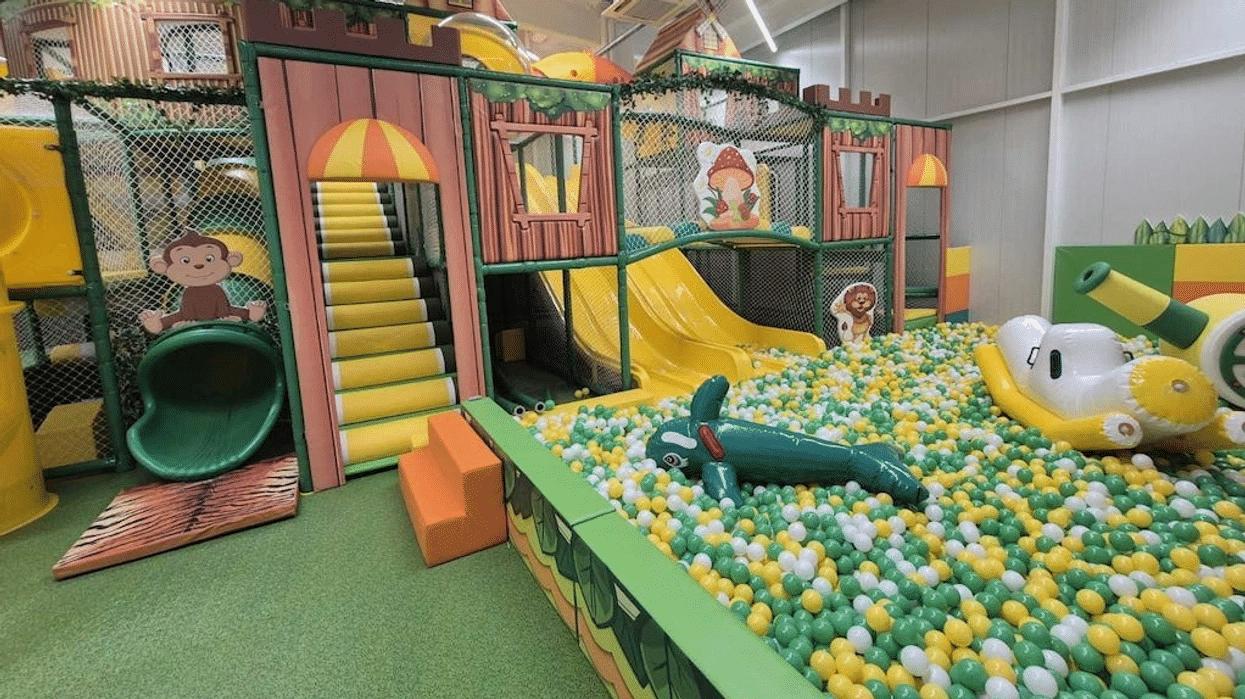
The building itself can have as much influence on the final concept as the operator’s brief. In a shopping mall, for example, an indoor playground needs to function as an attraction while also contributing to the larger environment around it. For shopping-mall projects, the design must also accommodate columns, fire routes, ceiling restrictions and existing building services. At Belamionix Mall in Zenica, Bosnia and Herzegovina, Dream Garden designed a nature-inspired children’s playground that combines multi-level soft play, slides, climbing, ball play and separate zones for different age groups. The project was designed to have a strong presence within the mall while providing families with another reason to spend time there.

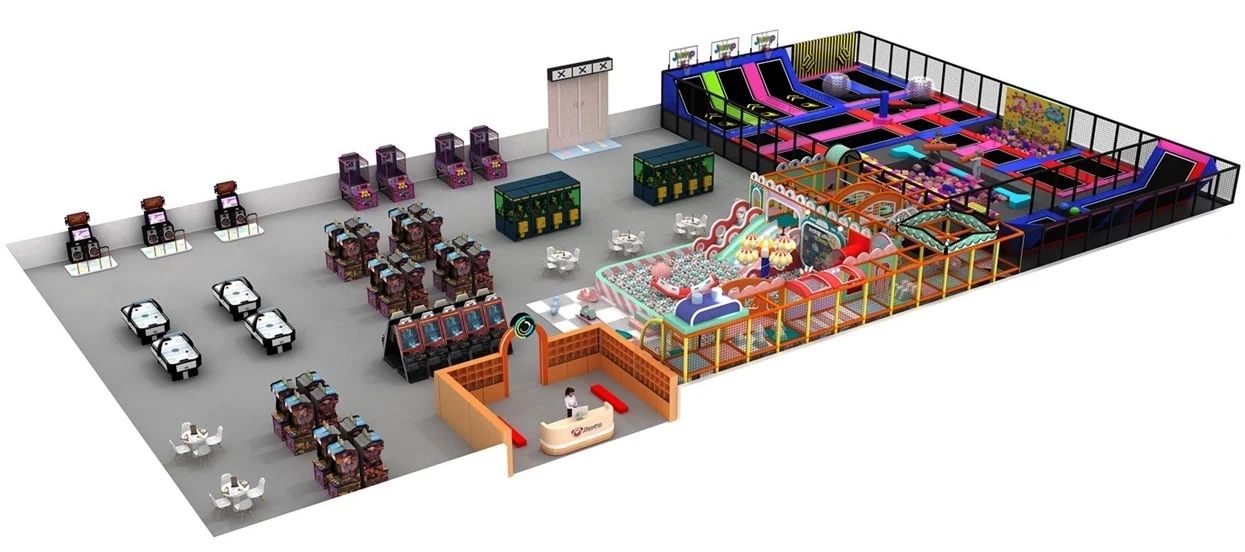
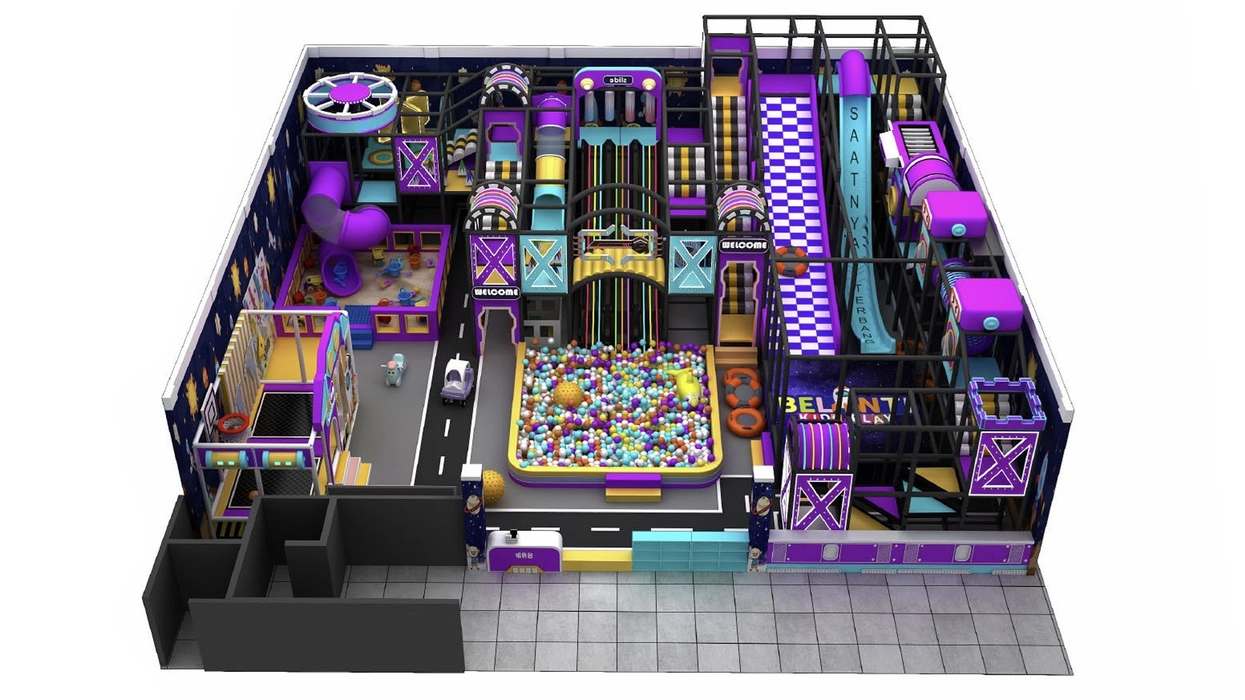
This layout rendering shows how arcade games, soft play and trampoline activities can be organized into distinct zones, with circulation considered alongside the attraction mix.

Standalone FECs offer greater freedom in zoning, allowing operators to combine elements such as soft play, active play, trampolines, climbing, interactive games, party rooms and other attractions. Smaller commercial venues can present the opposite challenge, requiring a variety of experiences within a much more constrained footprint. That is why, according to Zhang, Dream Garden does not apply a standard formula to every project.“Each market brings different demands,” he says. “While some operators prioritize theming and visual identity, others focus more closely on capacity, active play or operational efficiency.” The differences are not limited to customer preferences. Building conditions, climate, investment levels and the way a venue will actually operate can all influence the design.

Visualize the experience before production

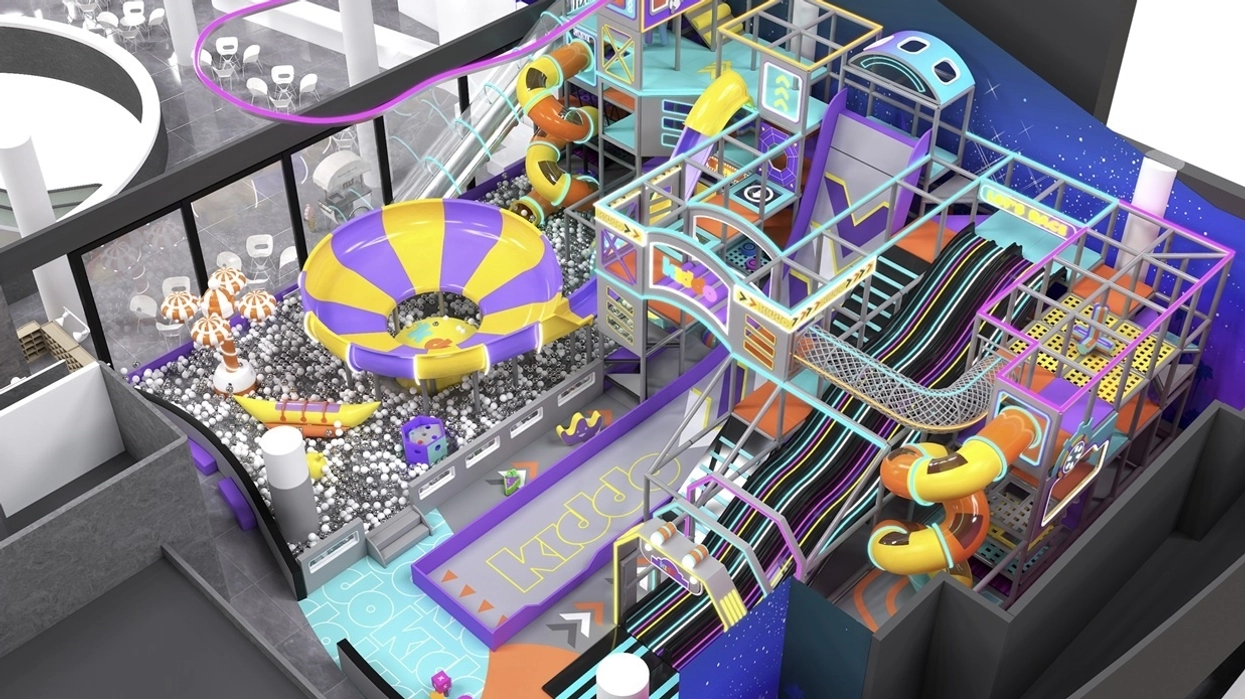
Once the overall concept has been developed, visualization becomes an important part of communicating the proposed experience to the client. At Alturas Mall in Guatemala, Dream Garden used 3D visualization and video presentations for a fully themed children’s playground incorporating multi-level soft play, slides, ball pits, climbing and obstacle activities. For the client, the visual material provided a way to understand how the finished venue would look and operate before manufacturing began. It also gave the operator promotional material that could be used before opening.

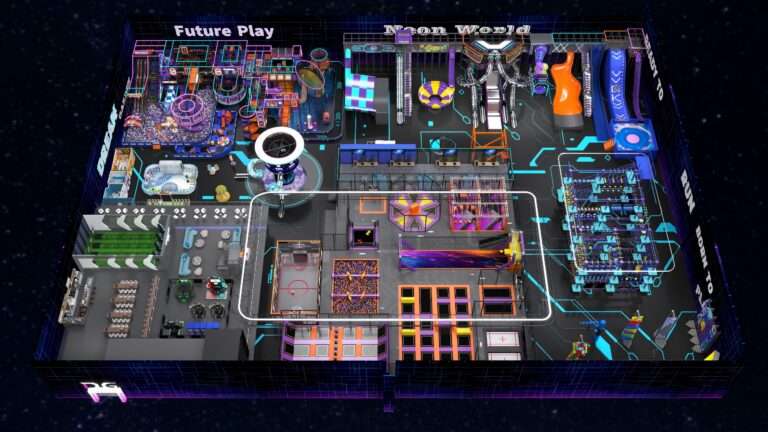
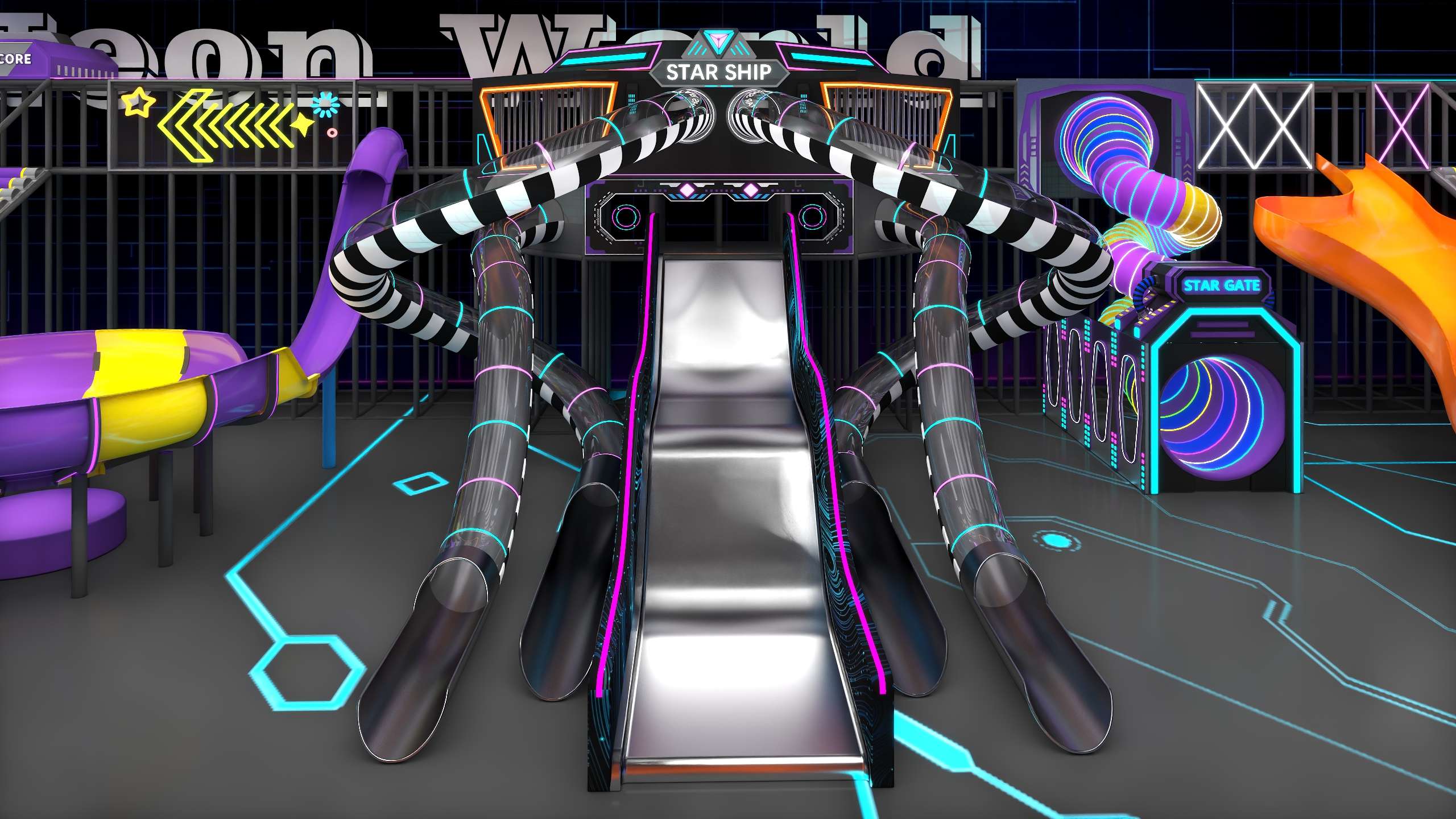
Neon World will combine slides, trampoline and ninja activities, an elevated space capsule route and VR experiences, with play and relaxation areas for different age groups.

Once a concept is approved, a rendering must be translated into something that can actually be manufactured, transported and assembled. Detailed design and engineering plans establish structural dimensions, safety clearances, materials, colors, play elements, technical connections and installation requirements. “We also pay close attention to materials, connection methods, structural stability and the safety standards required for the destination market,” says Zhang. This includes compliance with applicable international and local safety standards.

The engineering team then turns the concept into production drawings and separates the project into manufacturing packages. These can include structural systems, platforms, steel components, slides, netting, soft-play elements, decorative panels and customized components. “A rendering may look simple, but the final product still needs to be manufactured, transported, installed and maintained efficiently,” Zhang says.

That connection between design and production becomes particularly important when projects are highly customized. Because Dream Garden manages design, engineering and manufacturing within the same organization, its teams can communicate directly when adjustments are needed. “Quality control takes place throughout production rather than only at the end,” says Zhang. “For customized FEC projects, one incorrect dimension can create significant problems later during installation, so our objective is to solve as many potential issues as possible inside the factory.”

Test the project before it travels

“Trial assembly is one of the most important steps in our delivery process for larger customised projects,” says Zhang. A 3D model can establish how the project is intended to fit together. Trial assembly provides an opportunity to verify that the physical components actually do so.

At Belamionix Mall in Zenica, Bosnia and Herzegovina, Dream Garden’s nature-inspired playground combines soft play, slides and ball play, giving families another reason to spend time at the shopping center.

“A 3D model can show how a project should work, but physical trial assembly allows us to confirm how the structure actually fits together,” says Zhang. During the process, the team can check connection points, platform heights, safety clearances, slide positions, access routes and the relationship between different attractions. “It also helps us identify practical installation issues that may not be obvious during the design stage,” says Zhang. If an adjustment is necessary, it can be made at the factory rather than after the components have traveled to another country.

The process can also influence what happens after the equipment arrives on site. Components can be labeled and packed according to installation sequence, giving installers and local project teams a clearer roadmap. For international projects, that preparation can be particularly valuable. Site changes, transportation delays and additional travel can quickly add cost and complexity to a project.

Manage the international installation

Installation planning begins well before the first container arrives at its destination. Technical drawings are prepared, components are organized and labeled, and structural and technical sections are identified according to the installation sequence. Depending on the project, Dream Garden may send its own installation team or work with the client’s local installers while providing technical supervision and guidance. The distinction can be important for international projects because local teams may have different construction practices, languages and methods of working. “Communication is critical,” says Zhang. Drawings, labeled components, videos and direct technical communication are used to establish a common understanding of how the project should be assembled.

The site itself introduces another set of variables. Floor levels, ceiling structures, electrical systems, access routes and fire-safety requirements can all affect installation. “The most successful international projects are usually those where the client, local contractor and our technical team communicate early and solve site issues before they become installation problems,” Zhang says. For projects in existing commercial buildings, that early coordination can be particularly important. The attraction must ultimately work with the building rather than being designed as an isolated system. Dream Garden remains involved through installation, adjustment, inspection and final handover.

One process, different markets

The importance of that flexibility becomes apparent across Dream Garden’s international portfolio. In Hetauda, Nepal, the brief called for a broad, multi-attraction FEC intended to serve children, teenagers and families. The venue combines trampoline activities, foam pits and interactive play with soft play, slides, ball pits, climbing, arcade games and VR.

A layout rendering of Cosmic Planet in Indonesia, where Dream Garden combined a space theme with slides, tunnels, ball pits and climbing activities within a 350-square-meter footprint.

Cosmic Planet in Indonesia presented a different challenge. At 350 square meters, the indoor playground uses a space theme, a purple color palette and LED lighting to create an immersive environment within a relatively compact footprint. Slides, tunnels, ball pits and climbing activities provide a mix of imaginative and physical play.

At Belamionix Mall, meanwhile, the focus was on visibility within a shopping center and creating an attraction that would become part of the larger family visit.

The Happy Panda project in Osorno, Chile, demonstrates another variation. The multi-zone indoor entertainment center was designed for both children and adults and combines multi-level soft play, ball pits, slides, obstacle and climbing activities and interactive zones under the Happy Panda brand. Here, the challenge was not simply determining which attractions could fit into the available space. The venue needed to accommodate daily family visits, multiple age groups, birthday parties and group activities while maintaining circulation, capacity, safety and a consistent visual identity. “The challenge was not simply to fit more attractions into the venue,” Zhang says. “The project needed to work as a complete entertainment system serving different visitor groups and different types of use.”

That idea of designing the venue as a system rather than as a collection of individual attractions also influenced the zoning. Active areas, climbing, slides and challenge activities were organized alongside social spaces to help the different functions operate together without unnecessary congestion. “The project demonstrates an important principle for us: a successful FEC should not feel like a collection of individual products,” says Zhang. “It should feel like one coherent entertainment environment.”

Beyond the equipment

For an operator developing an FEC, the equipment is only one component of the project. The finished venue represents the intersection of the operator’s commercial objectives, the characteristics of the building, the expectations of its customers and the practical realities of design, engineering, manufacturing, logistics and installation. That makes coordination particularly important when different companies are responsible for each stage of the process.

A design rendering for KIDDO in Caracas, Venezuela, brings slides, tunnels and ball play together within a colorful, multi-level playground.

An integrated approach can connect concept design with engineering, manufacturing and installation. Trial assembly, coordinated packing and technical support can then extend that connection through the later stages of the project. “The main advantage of Dream Garden’s turnkey approach is that these stages are connected within one workflow,” says Zhang.

For the company, the objective is to take responsibility for the progression from an empty commercial space to an operating attraction rather than simply supplying individual pieces of equipment. “For us, turnkey delivery means taking responsibility for the complete journey from an empty commercial space to a functioning family entertainment venue,” Zhang says.

The projects in Dream Garden’s portfolio vary considerably in size, location, attraction mix and visual treatment. What connects them is the effort to resolve the relationship between the venue, its attractions and the people who will use them before the project reaches the site.

The initial brief informs the concept. Engineering turns that concept into manufacturable components. Factory checks test the physical structure. Coordinated packing and technical communication prepare it for installation.

For an international FEC project, those steps are not simply stages in a manufacturing process. They are the means of making sure the experience envisioned by the operator can survive the journey from a digital rendering to a functioning venue.

The empty box is no longer empty. It has become a place designed around how people move, play, gather and return. Ultimately, that is the challenge of delivering an FEC across international markets: turning the space itself into an experience. •

NFL’s Next Big Play: Location-Based Entertainment

by Judith Rubin

Every September, millions take their seats, breathless, as the National Football League (NFL) season begins and the clock ticks down to the Super Bowl in February. But what began as a game in 1920 has surged into a global force, commanding the hearts, minds, and passions of a worldwide audience. The NFL has broken through traditional boundaries and definitions. The experience is no longer bounded by 60 minutes on a gridiron or by the borders of a stadium. The NFL isn’t just orchestrating sports events – it is mastering the art of high-octane, live guest experiences on an unprecedented scale.

The modern fan doesn’t just watch the game – they hunger to step inside it. Public interest in professional football lives year-round. Fans respond readily to opportunities to connect on a deeper level with everything and anything that brings them closer to the game, and they are willing to travel for those experiences.

With this surging momentum as the backdrop – and driven by growing, global consumer demand – the NFL is launching a coordinated, Location-Based Entertainment (LBE) initiative to place fans directly at the center of the gridiron and has appointed Bay Laurel Unbound (BLU) as its LBE consultant and licensing agency. BLU represents a collaboration between Hong Kong-based Unbound, helmed by Eric Lee, and US-based Bay Laurel Advisors, headed by George Wade. Both companies bring extensive LBE expertise and decades of successful LBE projects around the world showcasing top brands and IPs.

The NFL publicly launched this initiative during IAAPA Expo Europe 2026 in London, allowing George Wade and Ed Kiang, vice president of interactive and experiential licensing at the NFL, to bring the dialogue directly to the industry with “The NFL Playbook for Immersive Experiences.” This fireside chat took delegates into the world of the NFL, outlining the resonance between LBE and the sporting community. The discussion touched on the NFL’s international growth and its many initiatives to continue building generational fandom.

Numbers set the stage
128.2 million halftime viewers took in Bad Bunny’s Super Bowl LX performance, driving billions of social media impressions worldwide. (Tojo Andrianarivo/AP Photo)

The numbers reveal a global cultural phenomenon operating at a staggering scale:

  • Super Bowl LX generated $700+ million in total economic impact for the San Francisco Bay Area region.
  • 800,000+ fans descended on Pittsburgh, PA over three days for the NFL Draft.
  • 14.3 million viewers and 45,000 live attendees were captivated by July’s NFL Flag Championships, paving the way for Flag’s 2028 Olympic Games debut.
  • 128.2 million halftime viewers took in Bad Bunny’s Super Bowl LX performance, driving billions of social media impressions worldwide.

Bringing a brand as powerful as the NFL into Location-Based Entertainment requires much more than simply identifying licensing opportunities. The NFL and BLU undertook an intensive, strategic journey to explore where and how the NFL can most effectively translate into LBE. Together, the teams have examined the marketplace, explored the unique strengths and attributes of the NFL brand, identified the types of experiences that can authentically connect with fans and new audiences, and developed a focused vision and strategy for the NFL’s entry into the sector.

“As we expand the breadth of our experiential offerings on a global scale, the BLU team brings deep brand experience activating iconic franchises with bespoke local strategies,” says Ed Kiang.

Global opportunities
The growth of the NFL International Games initiative has furthered the league’s vision of establishing an enduring global footprint. (Ant Upton/AP Photo)

Over the past few years, the NFL international slate of games and host cities has grown. There were five in 2024, seven in 2025, and the 2026 schedule features nine NFL games taking place over 11 weeks in seven destination cities and countries: Melbourne, Australia; Rio de Janeiro, Brazil; London, England; Paris, France; Madrid, Spain; Munich, Germany; and Mexico City, Mexico. To support this global effort, the NFL has established eight international offices.

The growth of the NFL International Games initiative has furthered the league’s vision of establishing an enduring global footprint. NFL Flag programs are present in 22 countries outside of the U.S. and flag football will be a competitive sport in the 2028 Olympic Games. This underscores the increasing, international appetite for what the NFL has to offer.

“For years, we’ve watched the NFL successfully build its global fan base through international games and strategic market development. The next logical evolution is giving those fans opportunities to engage with the league beyond gameday. Location-based entertainment provides that platform, creating year-round destinations that deepen fan engagement while opening exciting new opportunities for developers and operators worldwide,” says George Wade.

The NFL and BLU have identified four categories as ripe for investment, while leaving the door open for investors to propose other formats as well:

  • Live events – foreseeing a multi-day fan festival combining music, sports and entertainment into a celebration of the sport that would include interactive football skill games and athlete challenges, concerts and player meet-and-greets, and a tailgating atmosphere.
  • Immersive exhibitions – cutting-edge, storytelling journeys and experiences in nontraditional formats that utilize the latest technology and can accommodate multigenerational audiences. They can bring to life historical moments while putting guests “into the game.”
  • Competitive socializing – upscale, high-energy environments, with gamification and challenges, and elevated food and beverage options.
  • Standalone food and beverage – combining premium sports bar features and themed dining with high-end settings, places to see and be seen.
Filling a need
The modern fan doesn’t just watch the game – they hunger to step inside it, as evidenced by this Field Goal Kick activation at the NFL Draft event in Pittsburgh, PA. (Dave Shopland/AP Photo)

The compelling nature of shared, out-of-home experiences is the bedrock on which themed entertainment rests. Industry specialists bring to the mix their expertise in feasibility, operations, merchandising, design and production, all supported by state-of-the-art technologies. Bring in the cultural power of sports, the profound level at which people bond over sports and the tendency for fans to remain fans their entire lives, and you have a potent combination for experience creation on a variety of platforms.

“Few things match the sheer power of a sports brand that is built on a level of fandom and camaraderie that are genuinely unique,” says Lee. “When NFL fans gather at the Super Bowl or the Draft, there is an immediate sense of belonging – a tribal loyalty that is almost impossible to replicate elsewhere. Location-based entertainment allows us to harness that passion and give this community a place to connect with the NFL year-round.”

Sports brings people together in a shared world that takes them through a range of deep emotional experiences – highs, lows, suspense, triumph, conflict, celebration. Being a sports fan provides a meaningful opportunity to feel connected. The game itself, the season and selection process, the players and managers, the rivalries, history and tradition provide structure and a continuously unfolding story.

“Sports is entertainment. It is storytelling. It is identity,” says Wade. “And it is a new experiential frontier for our industry. The NFL lives at the intersection of culture, sports and entertainment. They are already leaders in the experience business, and they will lead in this new direction as well.”

World-class IP, world-class potential
The NFL is launching a coordinated, Location-Based Entertainment (LBE) initiative to place fans directly at the center of the gridiron, and has appointed Bay Laurel Unbound (BLU) as its LBE consultant and licensing agency. (Alison Yin/AP Photo)

The NFL’s decision to explore the LBE sector opens up new platforms, portals and tools to bring fans together around the game on a world-class level. And it signals more than the expansion of another world-class brand – it reflects the continued evolution of experiential entertainment itself.

Operators worldwide can benefit from the vast archives of NFL assets to create new and profitable emotional connections with consumers.

“We are seeking visionary partners who can bring together capital and operational excellence with world-class creative and production talent. With the commitment and support of the NFL, our priority is to collaborate with those ready to define the next generation of sports-themed entertainment and shape the future of the NFL fan experience,” says Lee.

“The experience economy is reshaping the way that the NFL reaches and engages our next generation of fans,” says Kiang. “We’re excited to explore new LBE concepts and collaborations through innovative new partnerships to immerse fans in interactive storytelling and create an emotional connection to their favorite NFL moments.”

For the Location-Based Entertainment industry, the message is clear: one of the world’s most valuable and influential entertainment brands has embraced LBE as a strategic growth platform, creating an extraordinary opportunity for those ready to help shape its future. Developers, operators, investors and creative partners will want to take note.

To learn more about the NFL’s Location-Based Entertainment initiative or explore potential partnership opportunities, contact Eric Lee at [email protected] or George Wade at [email protected].

Minecraft World updates from Chessington World of Adventures, including first Minecraft hotel

Following the announcement of Minecraft World earlier this year, Merlin Entertainments and Mojang Studios have revealed two exciting updates of the Minecraft experience coming to Chessington World of Adventures Resort in 2027; the world’s first Minecraft hotel, and the name of the first-ever Minecraft rollercoaster, Escape the Nether.

With Minecraft World set to bring the game to life through rides, dining and retail experiences, it has been announced that the adventure will also extend beyond the land itself. The Minecraft World Hotel will give families and fans the chance to stay immersed in Minecraft all day and night. Boasting 20 premium and 49 standard rooms across four floors drawing on the game’s iconic biomes, characters, mobs, colors and textures alongside an immersive restaurant and potions bar.

From the moment guests arrive, the hotel will transport them into Minecraft’s most recognizable environments. Blocky trees and animals will bring the Overworld to life at check-in, while Nether Portal inspired lifts and mine tunnel corridors will make every part of an overnight stay feel like another step into the world’s most popular game.

And when it comes to the respawn point – the bedrooms – guests will be able to experience Minecraft’s unmistakable blocks, items, mobs, textures and colors in real life, creating immersive spaces for dedicated fans and newcomers alike. The adventure continues in the underwater-themed restaurant inspired by Minecraft’s ocean biomes, before guests raise a glass of vibrant potions in the bar themed to the Woodland Mansion.

On the site of the theme park land, the crafting adventure continues as the Merlin team mines and builds the first fully immersive Minecraft theme park attraction, coming exclusively to the U.K. in 2027. At the heart of the land will be Escape the Nether, the world’s first Minecraft rollercoaster, where guests will go on a high-speed indoor adventure through dark mines before bursting out of the building through a Nether portal into the Overworld themed area of the land.

Daisy Mercedes, Creative Producer at Merlin Entertainments, said: “We promised something truly special when we announced Minecraft World earlier this year, and with Minecraft World Hotel we are offering even more. Not only will fans be able to experience the game imagined for real life, but they’ll be also able to sleep inside it, ensuring fans respawn exactly where they want to be! Seeing the Minecraft World Hotel take shape alongside the attractions we are building at Chessington World of Adventures theme park is a Minecraft fans biggest dream. Every room, corridor and detail has been crafted with immense love for this game, the stories made within it and its community.”

Filip Keatley Thoms, Creative Lead for Minecraft Parks and Experiences at Mojang Studios, added: “Bringing Minecraft into an entirely new medium has been a fascinating creative challenge. We have thought about everything from the scale of the blocks to how mobs and biomes come to life in the real world. Our goal is to create an experience that feels authentically Minecraft and gives guests the chance to experience the game in an entirely new way.”

Opening in 2027 at Chessington World of Adventures in Greater London, Minecraft World is a £50 million (nearly $67 million) project that represents the next major evolution of the gaming franchise and one of Merlin Entertainments’ most ambitious theme park developments in recent years.

Just a 35-minute direct train from London Waterloo, Minecraft World will open at Chessington World of Adventures in 2027.