Home Blog Page 55

New wavelengths

Visual Terrain debuts Luminous Terrain, making playing with light fun for everyone

by David Green

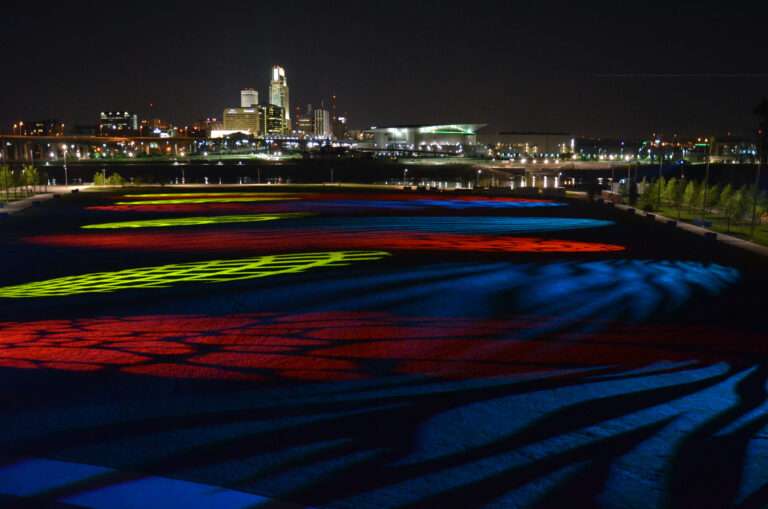
In 2009, Lisa Passamonte Green, CEO and Principal-in-Charge of U.S.-based lighting design firm Visual Terrain, received a call from artist Dan Corson. Since they had attended San Diego State University together, Dan had become a successful artist, using light in many of his installations. He described to Passamonte Green the concept for a new public art project, called “Rays,” that he envisioned to be a canvas for a giant ever-changing light environment that echoes patterns of the past and updates them for the future. Located on the five-acre Great Lawn at Tom Hanafan Rivers Edge Park in Council Bluffs, Iowa, these “living lights” would move, and interact and play games with the guests.

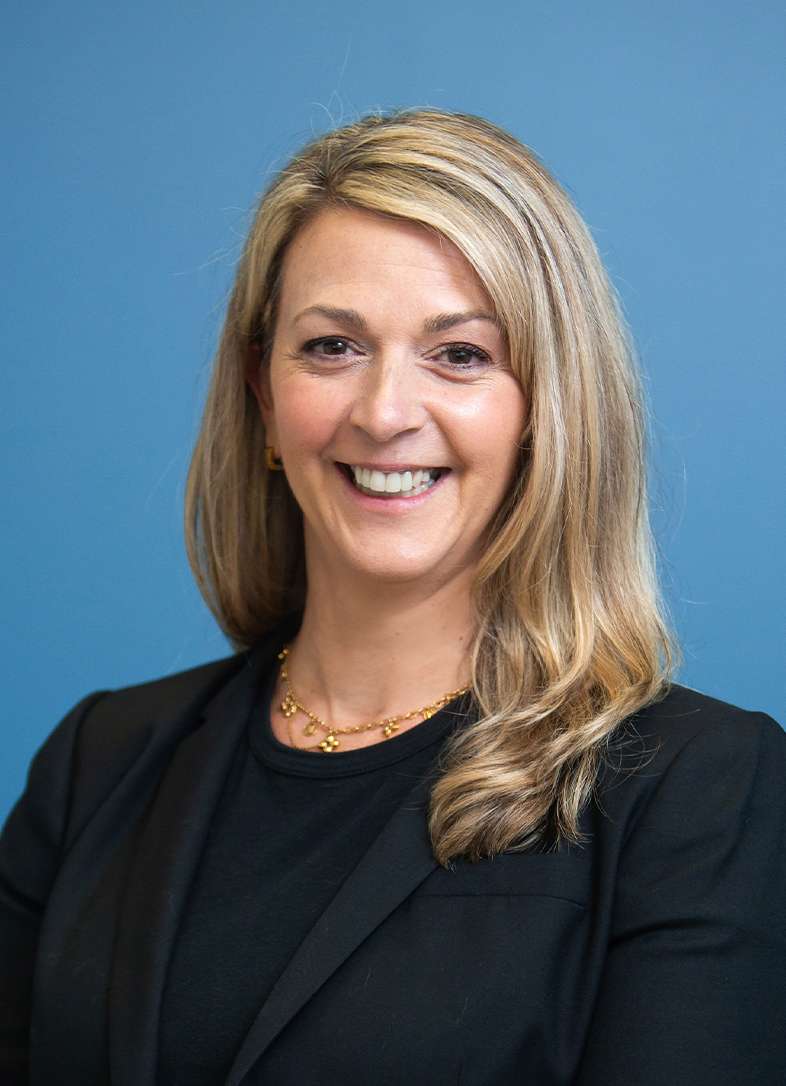
Lisa Passamonte Green

Passamonte Green was immediately drawn to the project. “The guests could play with the lights,” she said, “and even more fun, the lights would play with the guests.” Dan asked Passamonte Green to assemble a team to execute the artwork, so she called Bandit Lites for integration and programming, and Beaudry Interactive to develop the interactive system that made everything possible. (At the grand opening celebration, Yessian Music provided a soundtrack for the installation.)

The team delivered “Rays” to great fanfare in 2013. The installation presented a “show” mode and an “interactive” mode, the latter including a set of eight different games the lights could play with the guests, including:

  • Cat Laser Toy: Guests try to “catch” a spot of light, which continually avoids them.
  • In the Spotlight: Lights randomly select and follow a guest as they walk through the park. However, another guest can steal the spotlight through clever intervention with the light.
  • Stealing Dorothy Hamill’s Spotlight: All the lights in the park randomly select a guest and make them the star of the show (just like the famous figure skater).
  • Flash Mob: If a group in the park acts together, either jumping up and down, or running in the same direction, the lights react in a crazy, celebratory fashion (called a “ballyhoo”), bouncing, whirling, and changing colors all over the park space.

“Rays” opened and ran continuously, without significant maintenance or intervention, until the park and control room were submerged by a 100-year flood in 2019.

Reinventing “Rays”

The loss of the installation was fresh in Passamonte Green’s mind when the Covid-19 pandemic struck in 2020. As many projects went on hold, she looked for a way to keep her team busy during the lull. She thought, “What if we could make a version of ‘Rays’ that could be presented as a standalone product that anyone, anywhere, could install and their guests could experience light in new and playful ways?”

That brainstorm led Passamonte Green to develop Luminous Terrain, an outdoor interactive lighting experience. With Dan Corson’s blessing, she reassembled the teams from Bandit and Beaudry Interactive, two companies with whom Visual Terrain has collaborated frequently. Leveraging advances in lighting and interactive technology since 2012, Luminous Terrain is a self-contained, fully autonomous lighting experience.
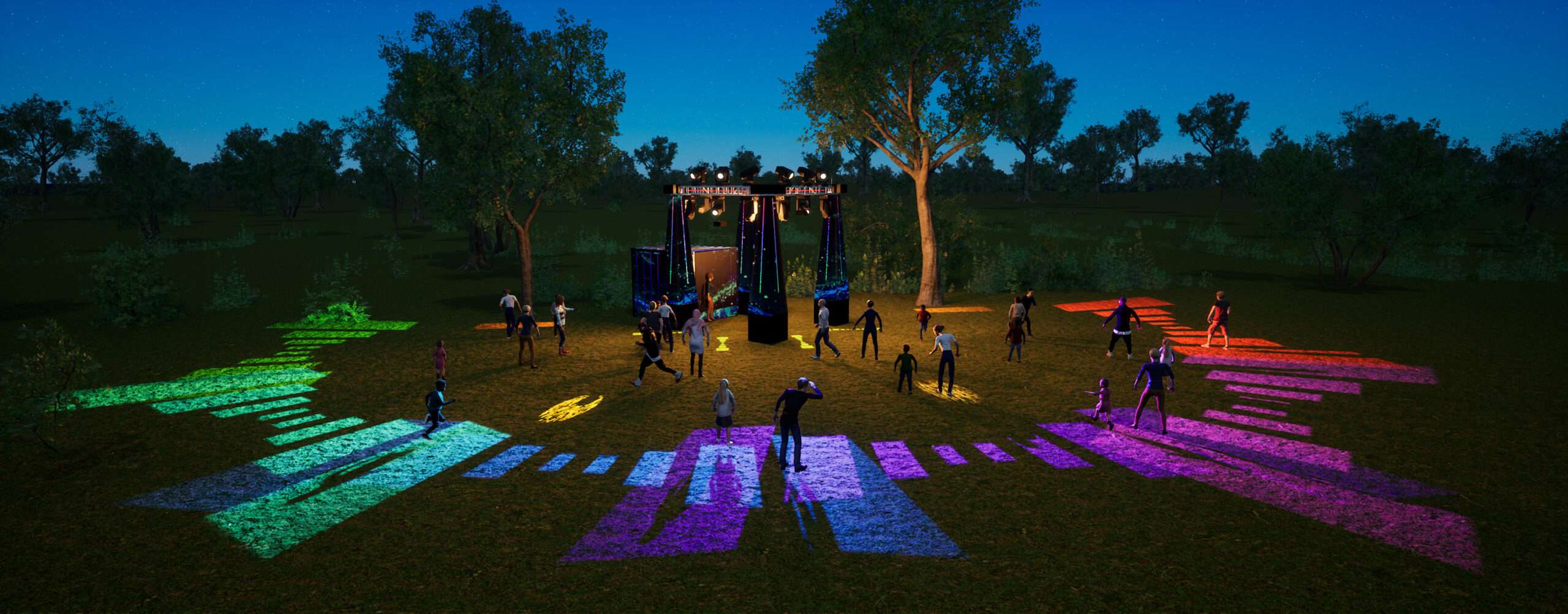
This rendering of Luminous Terrain shows a Light Pinball game in action. Image courtesy of Visual Terrain

Luminous Terrain maintains many of the features of “Rays,” while advancing the level of play thanks to new technology, better lighting fixtures, and reflection on the implementation of the experience over the years it was operating.

“The beauty of Rays and the beauty of Luminous Terrain is that the technology gets out of the way,” said John Jenkinson, Director of Integration for Bandit Lites. “From an integrator’s perspective, the less you read technology and the more you read a game, that was the coolest thing about Rays. If we do our jobs well, as a team, it’s completely transparent.”

Exploring a Luminous Terrain

“What might look like playful, spontaneous illumination is actually a carefully orchestrated blend of sensing technologies, adaptive algorithms, real-time control systems and flexible lighting designs all working together,” said David Beaudry, Principal and Founder of Beaudry Interactive. “Luminous Terrain came about through extraordinary collaborations. Our team’s passion for interactive design and guest empowerment dovetails with Visual Terrain’s gift for storytelling through light. The result is a living canvas of light, a space where invisible technology empowers guests to become artists of light, shaping the story through their very presence.”

During the development of Luminous Terrain, different concepts were considered, but ultimately, the team decided on a four-sided 12’x12’ truss structure with 14 moving lights as the first priority. Equipment support is provided by a secure Mobile Control Center that houses the electronics and provides a place for electrical terminations from the existing infrastructure.

The team designed 12 games to be a part of the Luminous Terrain experience while anticipating that clients might have their own ideas, especially when integrating the system with existing IP. “It was critical to us,” said Passamonte Green, “to be able to support the ideas and branding of any clients. With Beaudry Interactive as a core part of the creative team, we are able to offer any custom and proprietary programming needed. We can really customize any installation to provide support not just for creative concepts and varying game play, but also branding and IP support for wherever the installation might go.”

She continued, “We also have the ability to add sounds or music to the experience, or it can be completely silent. What’s most important is that we’ve designed the play to be intuitive, so that no spoken or text instructions are needed. As soon as someone enters the space, Luminous Terrain becomes aware of them and can begin to interact, ‘suggesting’ the mode of play to engage the guest.”

As the system started coming together, mockups were conducted at Visual Terrain’s facility in Santa Clarita, California and Beaudry Interactive’s headquarters in nearby North Hollywood. The team quickly realized that scalability would allow for more flexibility in the types of places where Luminous Terrain could operate.
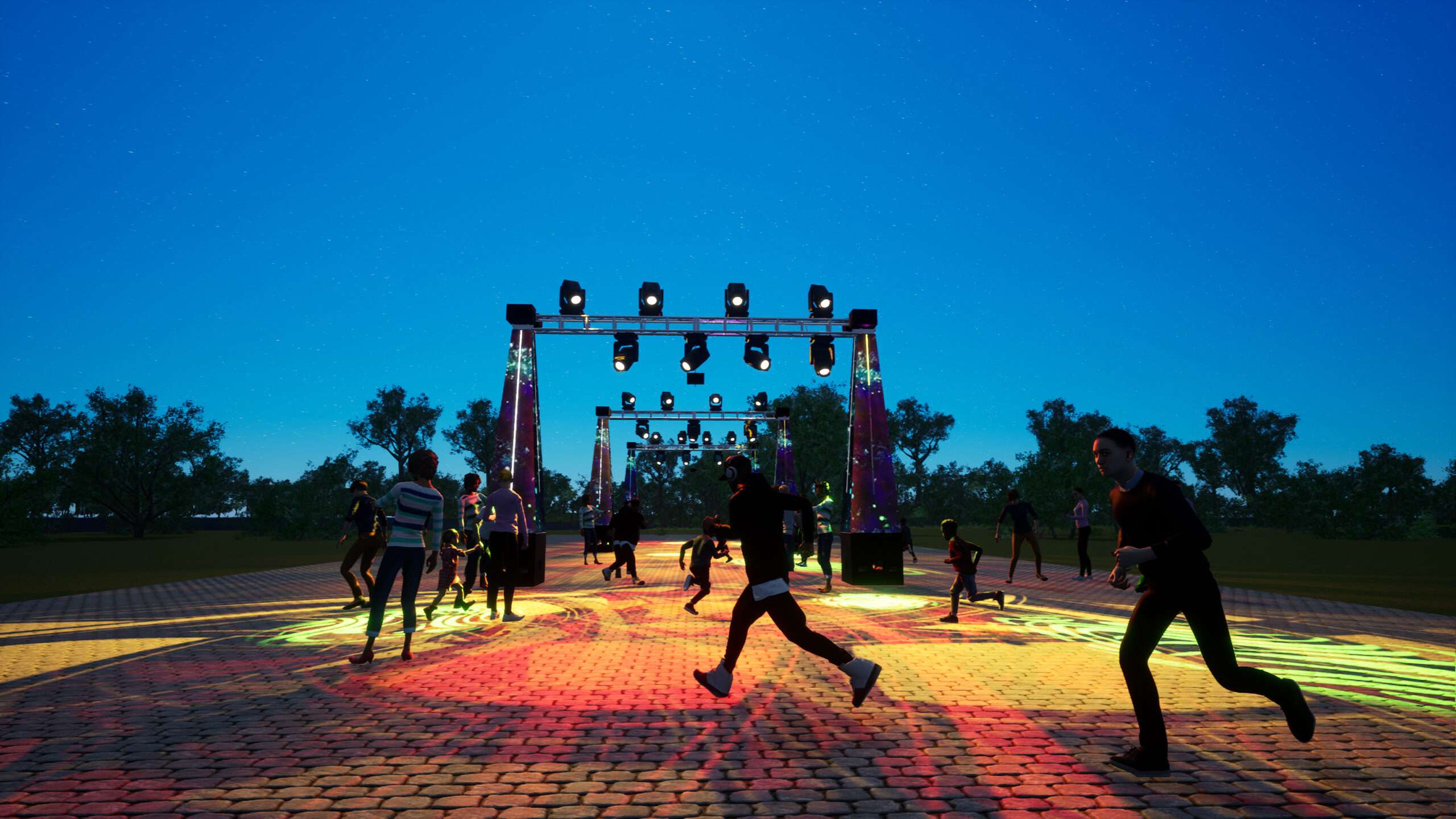
The Linear version of Luminous Terrain uses a set of goalposts, that can be arranged to provide a 20’x50’ area of activation. Image courtesy of Visual Terrain

“Our first impulse was to create something that could more effectively replicate the scope and functionality of ‘Rays,’” said Passamonte Green. “But realizing that not every client has a five-acre space to play with, we considered how the experience could work in smaller areas – and larger ones, too.”

The results of that process were: 1) to design a linear “goalpost” version, to be able to create an experience that follows a set path, rather than the free-form playing-field area supported by the four-sided version; and 2) to design a mini version that had just three moving lights and could be put into areas where less space is available for play. The mini version in particular lowered the barrier to entry for smaller clients, or those who might first want to test the market before committing to a full system.

Thinking inside the box

The team also designed an indoor version. “The format of ‘Rays’ had initially led us to conceive Luminous Terrain as exclusively an outdoor interactive experience,” said Passamonte Green. Although that is the design ideal, we realized that it is also well-suited for certain indoor environments, such as ice rinks, arenas, and pop-up experiences. The types of games and play might have to be adjusted, but being indoors actually frees us up to not have to use weatherproof equipment, and we can also move the control center to an equipment closet on site.”

Now conceptually proven, Luminous Terrain is seeking its first installation. “We can imagine it being installed in theme parks, aquariums, music festivals, city parks, arenas, and even large interior building spaces,” Passamonte Green said. “The interactivity can be dialed up to full-on play mode or dialed down to be more reflective and subtly interactive, for, say, a hotel lobby or airport terminal.”

Valeria Beaudry, Principal of Beaudry Interactive, said, “To me, Luminous Terrain is all about possibility – the way it can turn any space, from theme parks to public plazas, into a living landscape of light, transforming passive presence into playful participation and simple curiosity into moments of genuine connection.” •

Grand and intimate

SimEx-Iwerks’ Vision 360™ wraps guests in immersive storytelling

interview by Martin Palicki

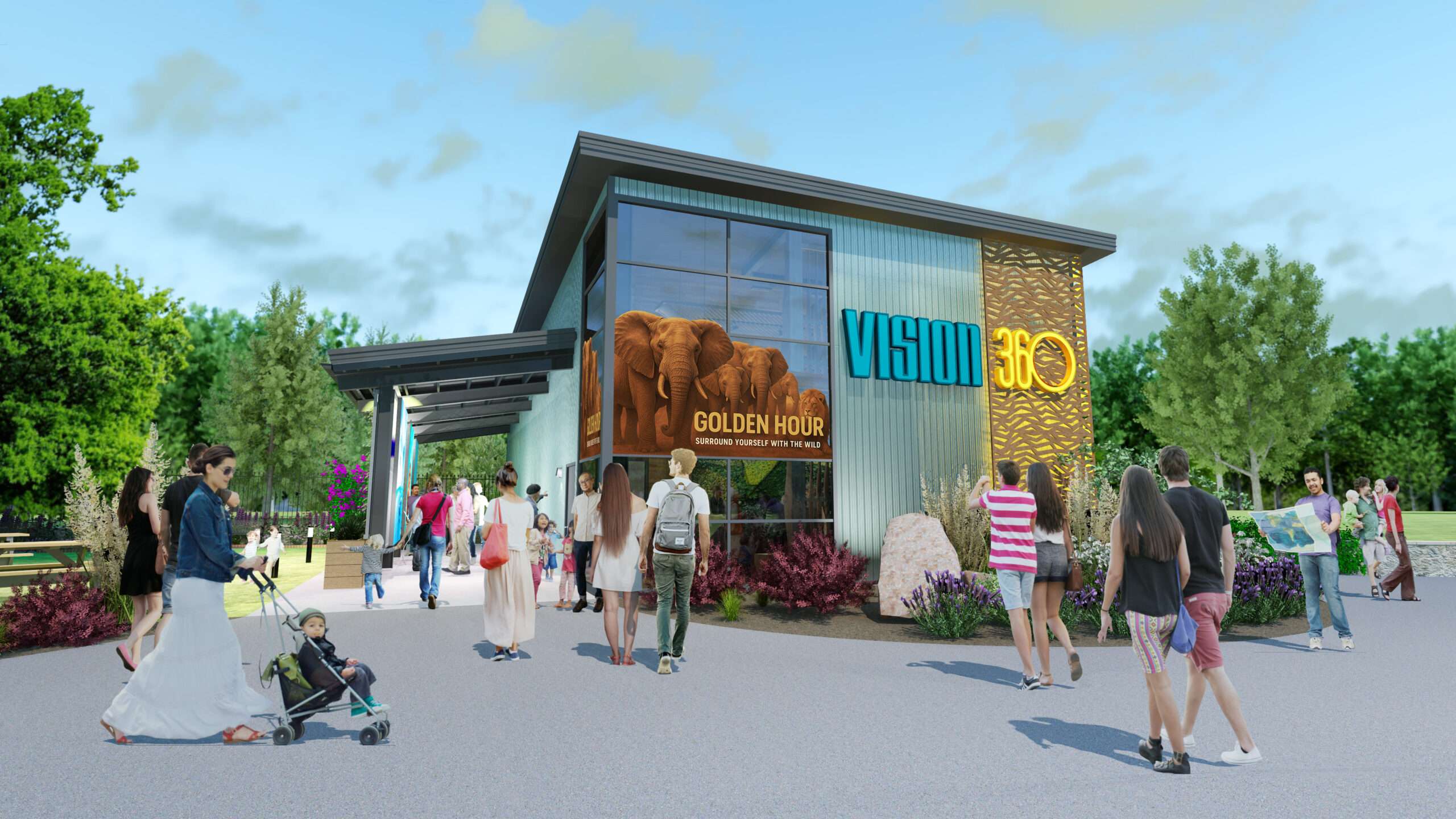
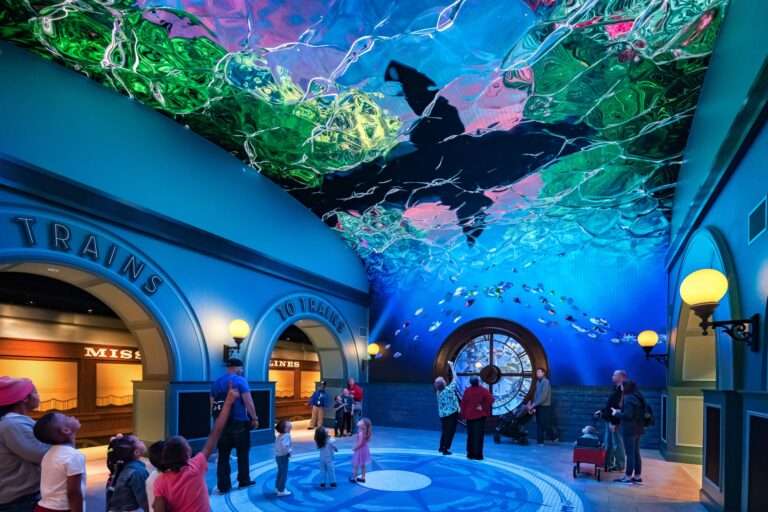
SimEx-Iwerks has spent decades at the forefront of cinematic attractions, creating shared experiences that blend storytelling, technology, and sensory impact. With the debut of Vision 360™, the company is expanding its reach, offering operators a turnkey, flexible, high-impact immersive environment designed to engage guests in a new way. The 360-degree LED room surrounds visitors with vivid imagery, spatial audio, and subtle effects, encouraging movement and exploration.

We spoke with Kate Magnusson, Vice President of Marketing & Partnerships for SimEx-Iwerks about how Vision 360 fits into the company’s portfolio, potential applications and how the company is expanding in other ways.

What is Vision 360 and what makes it unique?

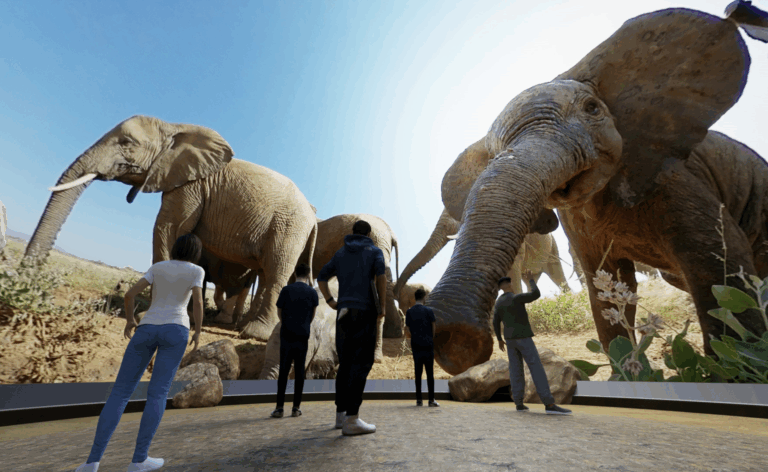
Vision 360 is a full LED room wrapping guests with stunning imagery. There are no seats, so people can move around, look in every direction, and share the experience together. We have incorporated audio cues and subtle effects that add to beautifully choreographed shows that feel both grand and intimate at the same time. For our zoo and aquarium partners, it is a chance to bring guests closer to animals in new ways, capturing moments and behaviors that can deepen their visit. We want guests to feel that they are standing in the Serengeti, as an example, to really experience what is happening all around you.

Can you elaborate more on how it can be simultaneously grand and intimate?

We designed the space to create a very intimate experience while ensuring a solid throughput for venues.

The imagery will be close and impactful. At the same time, the 13-foot-tall LED walls and ceiling create big, cinematic moments. When paired with well-choreographed, life-size or larger-than-life content, it creates a powerful sense of scale and emotional connection.

What inspired the creation of Vision 360?

We wanted to create an immersive experience that delivers a unique and powerful moment, something guests cannot stop talking about afterward. We imagined families and friends experiencing it together, kids tugging on their parents’ sleeves in awe. We also wanted to tell stories in a new way. Our shows will not have narration; they are visually driven experiences that pull you in through the content itself.

How does it differ from other immersive theaters?

Most immersive theaters, including our own Immersion Theater, are seated experiences built around a projected main screen. They are story-driven, adventure-style shows with sensory effects, perfect for broad family audiences. With Vision 360, it is less about watching a show and more about being part of the moment.

What type or size of venues is Vision 360 designed for?

We designed the attraction to be flexible. Many venues will offer Vision 360 as an add-on within their park or museum activating an existing footprint and plugging into current ticketing and operations. That said, it can also be a standalone attraction as a signature draw.

You mention zoo installs, but what other locations do you see it fitting into?

We are launching in the zoo and aquarium market. But Vision 360 is great for a variety of locations using a wide range of content, from space to weather to gaming environments and beyond.

What logistical considerations should operators think about?
Vision 360™ can be delivered as a stand alone building or custom designed into existing spaces.

As with any attraction, location is key. We can design into an existing space or deliver a building. This allows us to customize how the attraction works within a space to maximize visibility. Our delivery is turnkey, with limited site preparation required and with proven durability.

How did you design the experience to appeal across age groups?

We wanted Vision 360 to feel visually impressive for everyone. The pacing is intentional, combining visual and audio cues to keep audiences engaged. The shows balance big, impactful moments with smaller details, so guests can discover something new no matter where they stand.

How does Vision 360 fit into your overall product lineup?

Our focus has always been cinematic attractions, and we have leaned more into creating immersive environments. Vision 360 complements our Immersion Theater and FlyRide. Vision 360 is a flexible, stand-and-move experience; Immersion Theater is a proven performer that delivers seated 3D with effects; FlyRide is our flying theater. Together, they offer a range of guest experiences for different footprints and price points.

Beyond Vision 360, what else is SimEx-Iwerks working on?

We have developed our next generation 4D Theater called Immersion Theater. We’ve included wider screens, side-wall imagery, upgraded projection or LED, in-seat effects, and robust control systems that streamline operations. On the content side, we’re curating and creating titles designed to maximize each technology and provide that experience that guests can’t get at home. We will be announcing two Immersion Theater locations leading up to the IAAPA Expo in Orlando.

How are you making your experiences more accessible?

We look for ways to go beyond what is required. A recent project with Morgan’s Wonderland in San Antonio inspired us to do more. We developed motion platforms for mobility devices. In addition, we are adding language translation to our captioning devices in 2026 and have incorporated inductive loop support for hearing aids. We also offer sensory-friendly versions of shows for special events or scheduled times. Vision 360, in particular, requires no glasses or headsets, and its open floor plan welcomes wheelchairs and mobility devices.

Based on Vision 360 and overall growth, where is SimEx- Iwerks headed?

We will continue to innovate cinematic experiences, add great content, and grow our nature-based experiences that reconnect guests with the outdoors. Our goal is to deliver turnkey, reliable attractions that appeal to broad audiences and inspire repeat visitation.

How can people get more information?

Visit us at IAAPA Expo in Orlando, Booth #1652 or reach out to [email protected]. Let’s talk about bringing a Vision 360 attraction to your venue! •

Engineering meets immersion

Simtec Systems and The VOID collaborate on a new, compact dark ride attraction model

by Martin Palicki and Judith Rubin

Drawing on both companies’ strengths, Simtec Systems and The VOID are working on a new attraction platform that pairs Simtec’s motion-base engineering with The VOID’s immersive premium content and sensory design. The goal is to provide compact, versatile, immersive attractions for operators who want to deliver a layered experience to guests but don’t have the real estate or capital expenditure for a multi-scene, high-capacity ride. This collaboration promises to package high-quality motion and environmental storytelling into a smaller, serviceable footprint.

Simtec Systems is well respected in the industry. The German engineering firm has spent decades building motion bases and simulation systems that power attractions around the world. From 2DOF platforms to large-scale motion theaters, its reputation rests on reliable hardware, safety redundancies, and the kind of service support that operators rely on.

The VOID, meanwhile, built its brand in the mid-2010s pioneering premium immersive, location-based experiences that combined VR visuals with practical sets and tactile environmental effects. While the earlier ventures of this U.S.- based innovator took the form of stand-alone entertainment venues, its core strength has always been in creating multisensory presence – making guests feel like they’ve stepped inside the story, not just observed it on a screen.

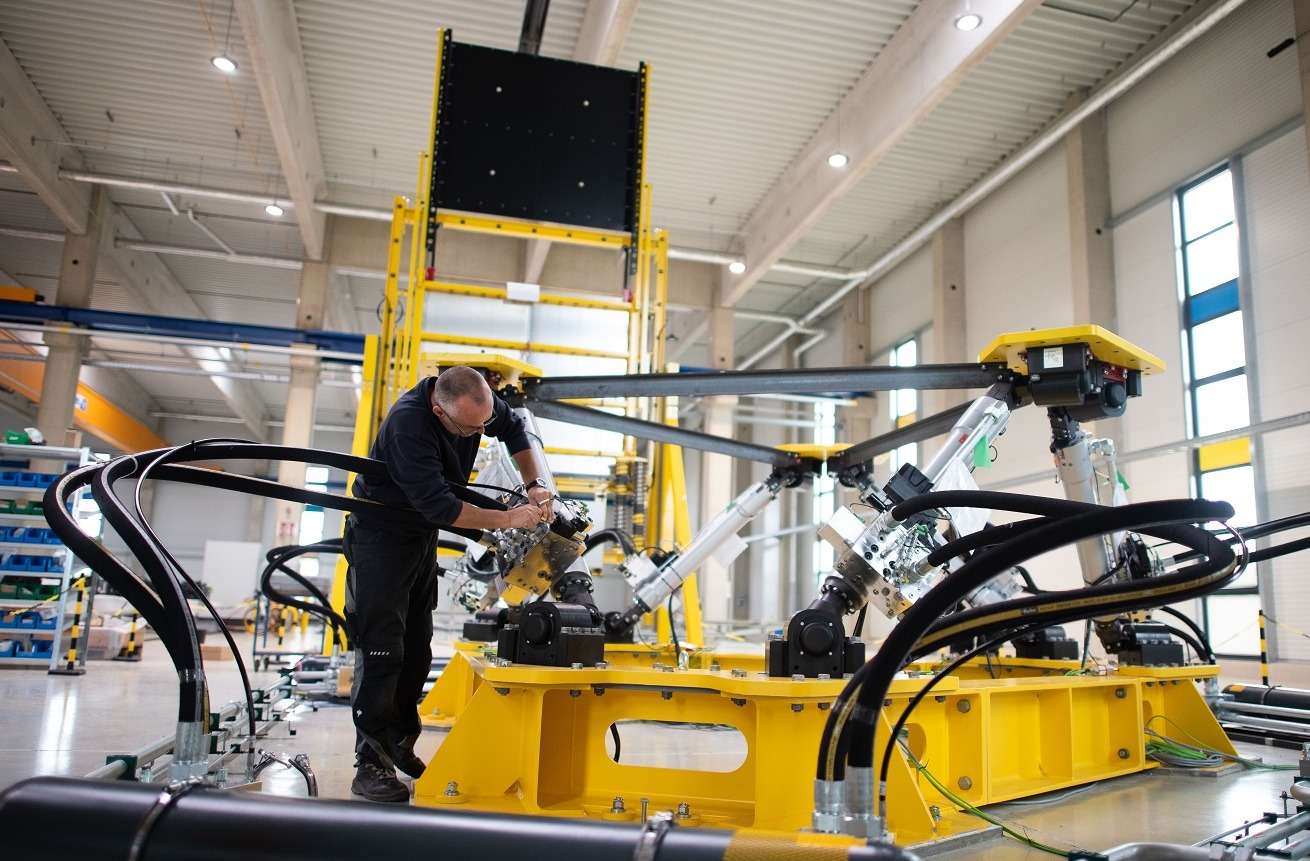
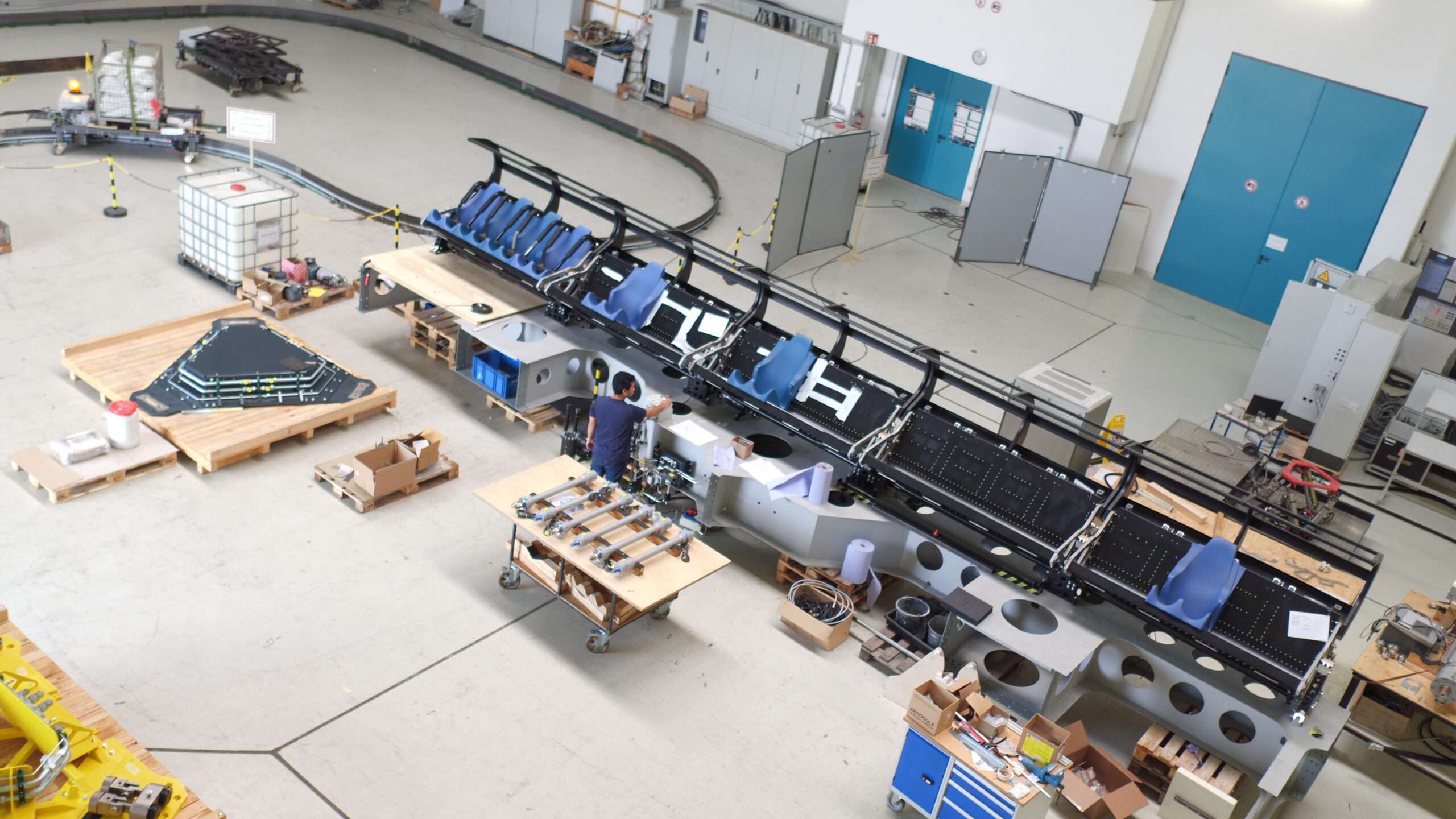
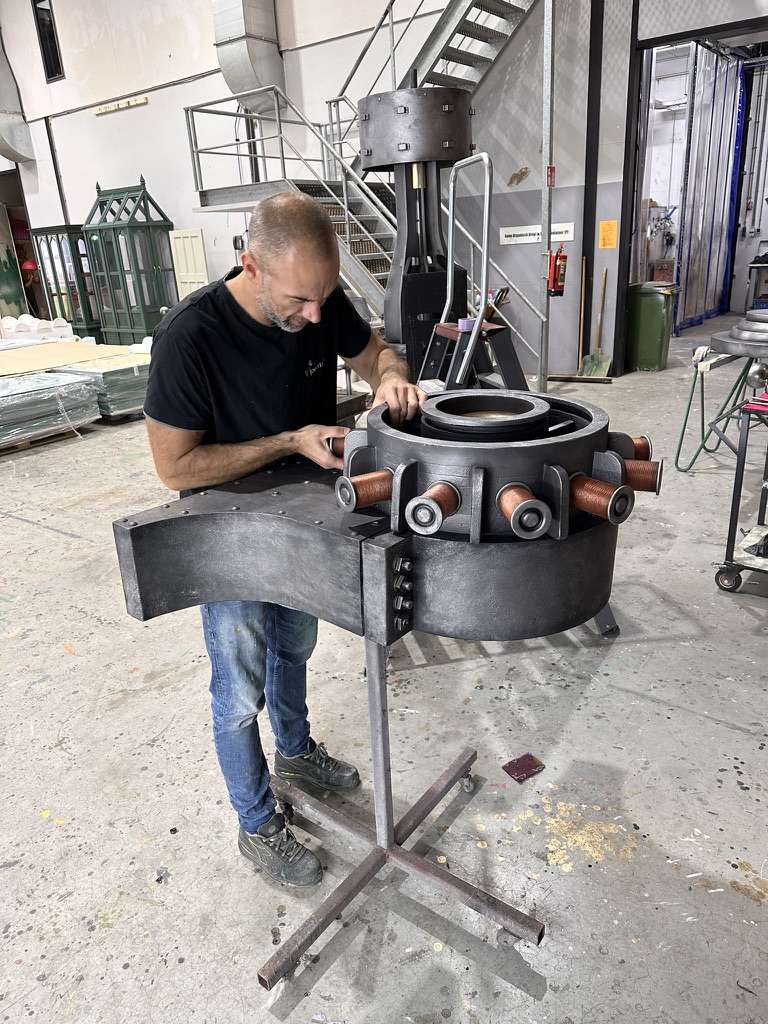
A Simtec Systems technician prepares a large 6DOF motion base for factory testing. Photo courtesy of Simtec Systems

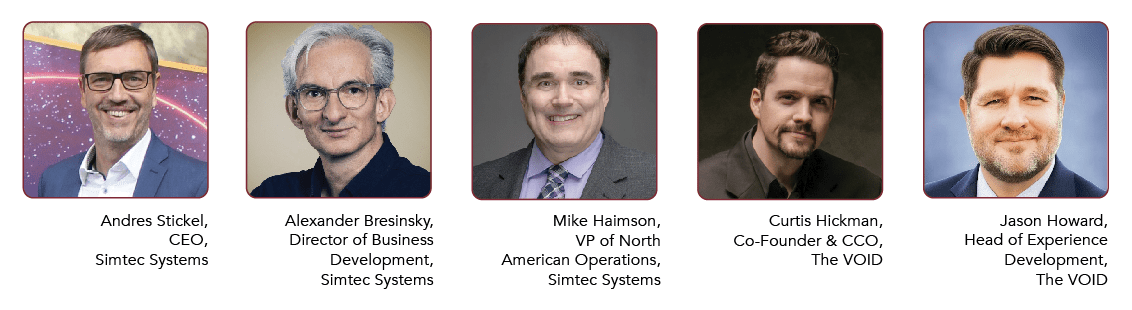
Both companies understand the attraction business, and both bring seasoned leadership to the table. Alexander Bresinsky, Director of Business Development; Andreas Stickel, CEO; and Mike Haimson, VP of North American Operations, anchor the effort on the Simtec side. At The VOID, Co-Founder and Chief Creative Officer Curtis Hickman and Head of Experience Development Jason Howard are shaping how the storytelling, media, and physical environment come together to deliver a constant motion experiences that goes beyond the limitations of a stationary simulator.

A straightforward ride model

The concept is deliberately straightforward: a compact, motion-based experience and platform that can be deployed in spaces smaller than a traditional show building. Guests will board a Simtec vehicle designed to deliver precise, sustained and reliable motion tuned for comfort as well as impact.

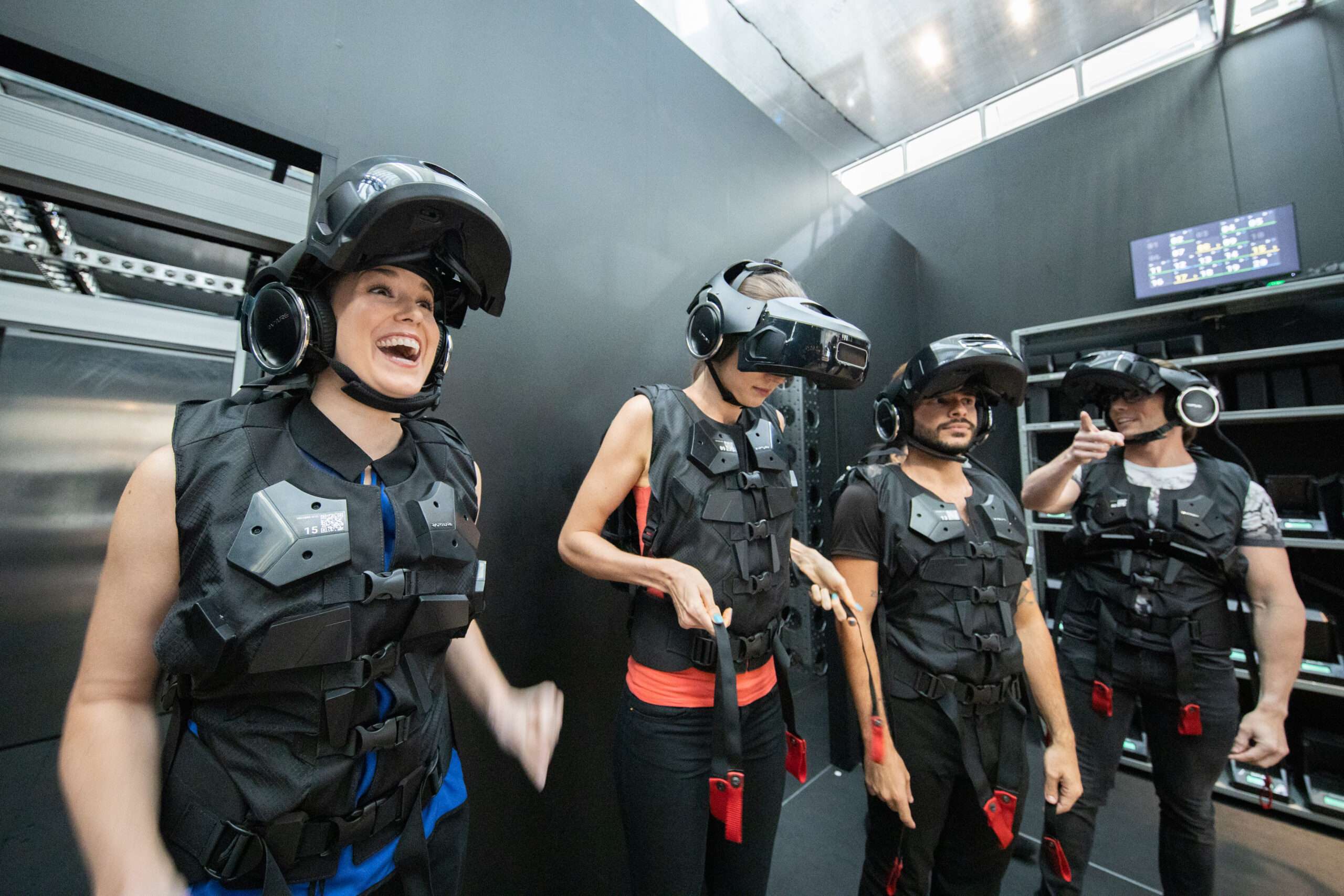
Integral to the story and experience is the VOID’s multimedia content and effects package: headset-based visual media, sound design, targeted haptics, and environmental elements like wind, heat, or scent. Because the show environment is virtual, the ride can be adapted for different stories. The platform is being built with content flexibility in mind. Operators will be able to rotate titles from one ride vehicle to the next without dismantling the infrastructure.

“We designed this to be realistic about what operators need: efficient loading, reliable vehicles, and content that can be constantly reimagined without a construction crew,” said Hickman. “Best of all, it uses state of the art illusion technology to truly immerse guests in seemingly endless worlds.”

A savvy marriage of media and motion

The strength of this collaboration comes not just from the individual capabilities and expertise of each company and how well they align, but also from field experience and understanding of markets, audiences and best practices.

The team is well-positioned to avoid one of the most common pitfalls in ride development: bolting effects and media onto an engineering package after the fact. Instead, motion, sound, story and tactile elements are being designed in tandem.

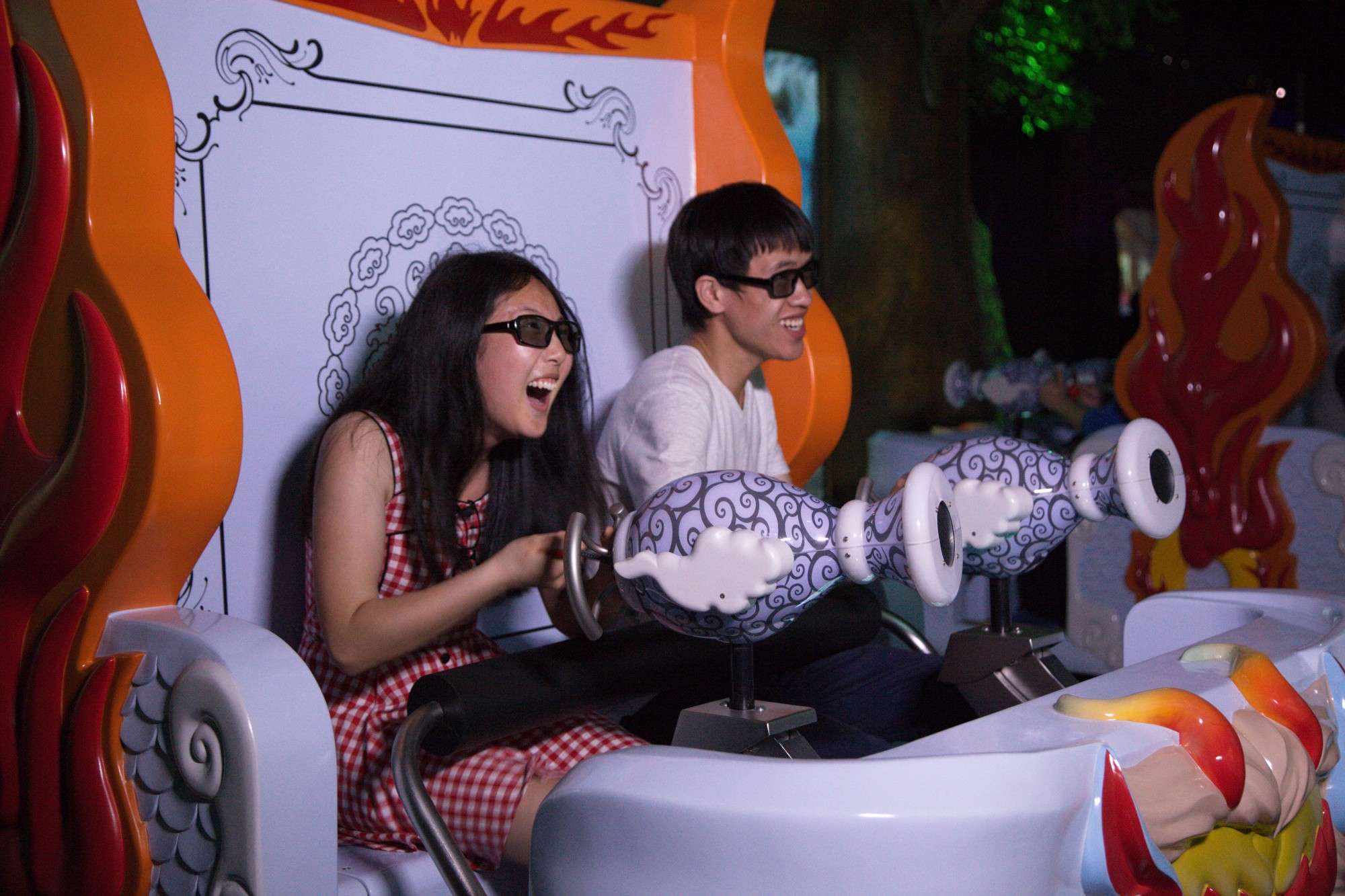
Guests enjoy a Simtec Systems FunRide® Interactive Dark Ride System. Photo courtesy of Simtec Systems

“We’re working toward a system that isn’t just technically sound, but authored from the inside out to make guests feel like they are part of the story” said Howard. “When you design motion and effects as part of the storytelling language, everything feels more natural.”

Space, capacity and refresh

This attraction model is positioned somewhere between a simple simulator and a full-scale themed attraction, aiming for a sweet spot of high impact with moderate build requirements. Cruise lines, regional parks, FECs, urban entertainment centers and mixed-use developments are likely markets; the ride’s footprint is small enough to fit in unconventional spaces, and its refreshable content could align with seasonal itineraries.

“Basically, we expect to serve operators looking to add a premium upcharge attraction with lower operational complexity than a full dark ride,” says Haimson. “Many operators are eager for attractions that can be big enough for strong guest appeal and attendance impact – even a headliner attraction – but not so big that they’re out of reach. Our platform is meant to live in that middle ground. It can transform a previously under-utilized zone, and with modular content it encourages repeat visits.”

The final assembly and dark ride test track at Simtec Systems. Photo courtesy of Simtec Systems

Since the platform is built to support multiple shows over its lifetime. Swapping media packages while retaining the core vehicle and effect infrastructure helps make long-term investment more sustainable. For operators, that means the attraction can change regularly without rebuilding from scratch.

Operational realities and a measured rollout

The companies are also clear about the operational realities. Motion systems require consistent maintenance, spare parts planning, and trained staff. Effects systems need regular calibration and checks to keep the show consistent.

Since headsets are used for visual delivery, operational planning around distribution, sanitization, and turnaround for the devices will be critical. “Operators know there’s no such thing as a maintenance-free ride,” said Bresinsky. “We’re designing for serviceability from the start, but good operations are always going to matter.”

Simtec and The VOID plan to start with pilot installations. These will allow the teams to test comfort profiles, dispatch intervals, show timing, and daily cycle counts in real-world conditions. Early results will guide refinements before broader deployment.

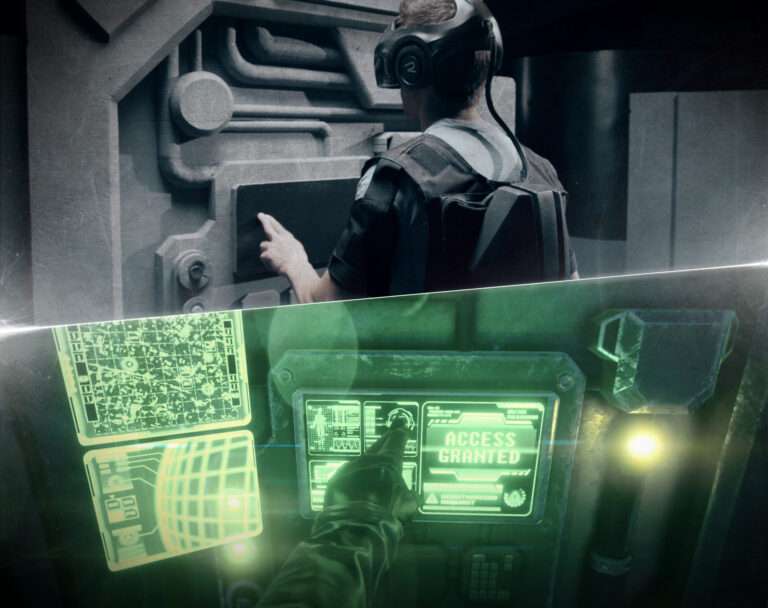
Guests don headsets and haptic vests before their journey into The VOID. Photo courtesy of The VOID

“Our partnership brings together complementary strengths and a pragmatic plan, but success will hinge on the nitty-gritty: things like reliable hardware uptime and speedy guest processing,” said Stickel.

The partnership and concept bring together engineering and experience design with the kind of modular thinking that increasingly defines the modern attractions landscape and benefits operators with more flexible investment strategies.

Instead of locking into a single ride concept for a decade, each ride vehicle can dynamically show a different experience encouraging repeatability or taking advantage of seasonal content refreshes or IP opportunities. Said Stickel, “This will be a stable, repeatable product.” •
To learn more, please visit the Simtec Systems booth at the IAAPA Expo, #1354, or email [email protected].

——

Judith Rubin ([email protected]) is a leading journalist, publicist, strategist, blogger, content marketing specialist and connector in the international attractions industry. She excels at writing about all aspects of design and technical design, production and project management.

Judith has ties to numerous industry organizations. From 2005-2020 she ran communications for the Themed Entertainment Association (TEA). She was honored in 2013 with the TEA Service Award. She served as development director of IMERSA, and publicist for the Large Format Cinema Association, and has contributed to the publications of PLASA, IAAPA and IPS.

The art of creative executive producing

How ImagineLab Studios fills the middleware gap between creative vision and opening day

interview by Martin Palicki

Edward Hodge has spent more than two decades shaping immersive experiences and live events for some of the world’s biggest brands and entertainment companies. His career has included leadership roles at BRC and Disney, among others. After years of leading creative and production efforts, he saw an industry gap widening. The pandemic accelerated reorganization within creative companies, and the professional layer of producers, creative directors, and integrators who ensure strategy and execution are top of mind was shrinking. Hodge saw an opportunity. He founded ImagineLab Studios to bridge creative vision with business reality – creating experiences that thrill guests while meeting client goals.

Hodge and his team are what he calls “creative middleware,” a flexible network of experienced talent focused on story- driven craft, entertainment strategy, and production execution.

What is ImagineLab Studios?

ImagineLab Studios is built on a simple premise: the best projects happen when the right people are in the room at the right time. We’re a group of experienced producers, creative directors, designers, and show directors devoted to helping clients shape and deliver immersive experiences. We work fractionally and collaboratively, advocating for the project and the guest – from that first spark of an idea through to opening day. Most importantly, we bring a strong point of view, protect the creative, and never lose sight of business goals.

What marketplace realities are you addressing?

What our industry has slowly forgotten is, frankly, the art of executive producing.

Themed entertainment’s roots are in theater, but the business was born from a film studio. As projects have scaled to cost potentially billions of dollars, the process has become dominated by design and construction. We’re often missing the strong executive producing team whose job it is to execute the vision, both fiscally and creatively. We should be building business models that match a creative brief before we even think about Blue-Sky or Concept development. A strong EP team can help you strategically plan the project from all sides before too much has been spent.

Beyond that, we’ve seen three shifts. First, there’s the middleware gap. After the pandemic, a lot of the doers who make these projects happen either moved up into leadership roles or left the industry altogether. That expertise is needed from design to opening day. We’re devoted to providing it.

Second, clients need flexible ways of working. Not every project justifies hiring a large studio, but teams still need senior creative leadership. We meet them where they are, whether that’s early concept development, production support, or turning around a project that’s lost its way.

Third, many companies can’t add headcount or a full team, but we can solve that. We’re experienced, story-driven professionals who provide services as needed, without the overhead.

You have said that ImagineLab Studios is focused on “story- driven craft, strategy, and collaboration.” What does that mean?

Story and execution are never separate. Every decision serves both the guest’s emotional journey and the project’s business goals. The best experiences happen when a great story drives every element, from design to operations to the smallest details. When producers, designers, and contractors are all laser-focused on creating memorable emotional moments, that’s when projects succeed.

What does fractional working look like in practice?

It might start with me embedded with a client team a few days a week. It might be a high powered pod – creative, producer, and technical leads – that plugs into an existing organization. We can line produce, show doctor, innovate, or lead creative direction. The throughline is our passionate advocacy for the project and protecting the original creative intent.

Clients appreciate the thought partnership on the front end. In times of economic uncertainty, they can take on leaner, more strategic steps rather than diving all in with one large firm. We cast based on the creative and operational needs, so clients get low overhead tailored specifically for them.

Are you a studio or a network?

We are both! I know it sounds like the easy answer but think of ImagineLab as the front door. Inside is a group of trusted individuals and small companies. We keep agreed rate cards with partners so we can scale quickly. We’re designed to be nimble – we can serve as a single umbrella when that simplifies procurement, but we remain transparent about who’s doing the work.

When one firm tries to do everything in-house, it can drift toward a “house style.” We match the right people to each project and put them directly with the client. That keeps things fresh and innovative. And we’re flexible enough to recommend outside specialists when that’s the right call. It’s all about advocating for the project and the guest experience.

What types of projects does ImagineLab Studios work on?

We’re focused on three core areas: shows and attractions, immersive brand and sports experiences, and immersive destinations. We’re at our best when clients want to do things differently – when they’re ready to innovate, take on unprecedented projects, or enhance existing offerings. If you’re an executive looking for “in-house” style creative firepower without adding full-time staff, that’s what we’re built for.

How do you approach partnerships?

We love partnerships. Maybe we’re leading, maybe we’re supporting, but at our core we love collaborating with architects, feasibility consultants, media producers, technologists, fabricators and operations. Our job is to advocate for the experience and client goals, not dominate the process.

What is your philosophy and where did it come from?

It came from doing the work, period. The people I collaborate with have one thing in common – we are all doers and we all want to create profitable, emotional experiences. Every successful project has clear communication, deep trust between teams, and someone who can translate between creative vision and operational reality.

Story and strategy are inseparable. Creating a memorable guest experience is everything. Protecting a project’s emotional center requires creative conviction, the ability to navigate complex organizations, understanding company culture, speaking their language, and revealing possibilities they didn’t know existed. That’s what we’re good at.

In the dichotomy of left-brain and right-brain thinking, where are you?

I live in the middle. My heroes are people like Steven Spielberg and Kathleen Kennedy, or Bob Iger and Ed Catmull – astonishing creative dynamos and brilliant business people who never lose sight of the “Why.” I believe the ability to toggle between creative and technical is key to successful projects.

Guests want experiences that feel personal, emotional, and shareable. They want the big thrill and the grace notes – the humor, the hidden surprises – that elevate a fun experience to something memorable. Operators want sustainable, smart operations. The best projects balance emotional storytelling with practical execution that leaves room for the little details. I build teams who get both sides. The creative heart and the nuts-and- bolts reality. Those are the people who turn good ideas into something magical.

Look, we’re all kids at heart. We all remember the first time we felt the thrill of a great experience. By age ten, I was already ‘backward engineering’ those moments to figure out how they were done!

Sure, today’s challenges are greater than ever, the stakes are higher and the technology is more advanced. But it’s still simply about that rush of physical and psychological elation, that endorphin surge, that wave of pleasure and exhilaration. That’s the feeling we’re after. That rush of pure joy. And honestly, I can’t think of a better job. •

At the park and on the field

Image Engineering’s acquisition of TASC helps expand the   possibilities of both live and themed entertainment

by Martin Palicki

Towering infernos of fire can regularly be seen inside some of the most intense theme park attractions as well as in pro-sport stadiums as players take to the field. Until recently, though, they’ve been created by very different companies. The Attractions Services Company (TASC), under the leadership of Ron Griffin, has pioneered effects like those for theme parks around the world since 1995. Image Engineering, on the other hand, has been producing live events, pyrotechnics and large-scale sports productions since 1998. Thanks to a recent acquisition, the two experts in their field will bring their combined skills to the field, and to the growing world of themed entertainment.

Image Engineering’s growth and evolution

Founded by brothers John, Joe, and Andy Suehle, Image Engineering specialized in lasers and lighting in its early years, growing steadily through the 2000s. Today, the company sports a team of more than 65 full-time employees and operates from a 60,000 square-foot headquarters in Baltimore with satellite offices in Las Vegas and at the Rock Lititz campus in Pennsylvania. The company’s work can be seen in everything from touring productions and sporting events to architectural lighting installations that blend art and technology.

“Our roots are in live entertainment and sports, and that shaped how we built the company,” says Image Engineering President Joe Suehle. “But over the years we’ve evolved to meet the needs of themed entertainment, and in some ways, themed entertainment has also expanded to need the services we offer.”

That’s what led the company to devote resources to supporting the themed entertainment market, which they internally refer to as permanent installations. While both temporary events and permanent installations run on parallel tracks, utilizing many of the same effects and equipment, there are important distinctions between the two.

Permanent installs typically require a much longer design and build process but also benefit from a workflow that demands continual innovation. Live events stand to benefit from that creative pipeline. Additionally, the real-world limitations of temporary installations can provide information that helps make permanent projects more efficient. It’s a symbiosis that led Image Engineering’s Vice President of Operations Ian Bottiglieri to investigate moving the company in that direction. “I attended the first IAAPA Expo after the pandemic and saw firsthand how well aligned we were to serve this market,” explains Bottiglieri.

One of Image’s first projects in the industry was working on a major theme park operator’s nighttime spectacular. They were brought in for their deep knowledge in specialized flame systems, but because of their relative newness to the market, the operator had them contracted under one of their trusted vendors, TASC. It was a chance connection that would significantly alter the paths of both companies.

TASC’s legacy of engineering and effects

While Image Engineering was busy expanding its presence in live events and sports, TASC was building its reputation in theme parks. Founded and led by Ron Griffin, TASC became known around the globe as a skilled resource for theme park operators needing special effects, motion platforms, ride vehicles, show action equipment, flame and water effects, control systems and more. Since 1995, Griffin and his business partner, Melissa Townsend, have been familiar figures in the industry. TASC’s many projects for Universal Studios parks, starting with work on pioneering attractions such as Jaws and Twister, continued with the company providing many of the major flame effects for Universal Islands of Adventure, Universal Studios Japan and Universal Studios Singapore.

TASC quickly earned a reputation as a trailblazer in the industry, establishing a capable team to serve their formidable list of clients through specialization in nighttime shows, dark rides, and complex multimedia attractions. “We’ve always had a great staff,” says Griffin. “Many people came up through apprenticeships here and went on to leadership roles throughout the industry. That legacy of training and knowledge sharing is something I’ve always valued.”

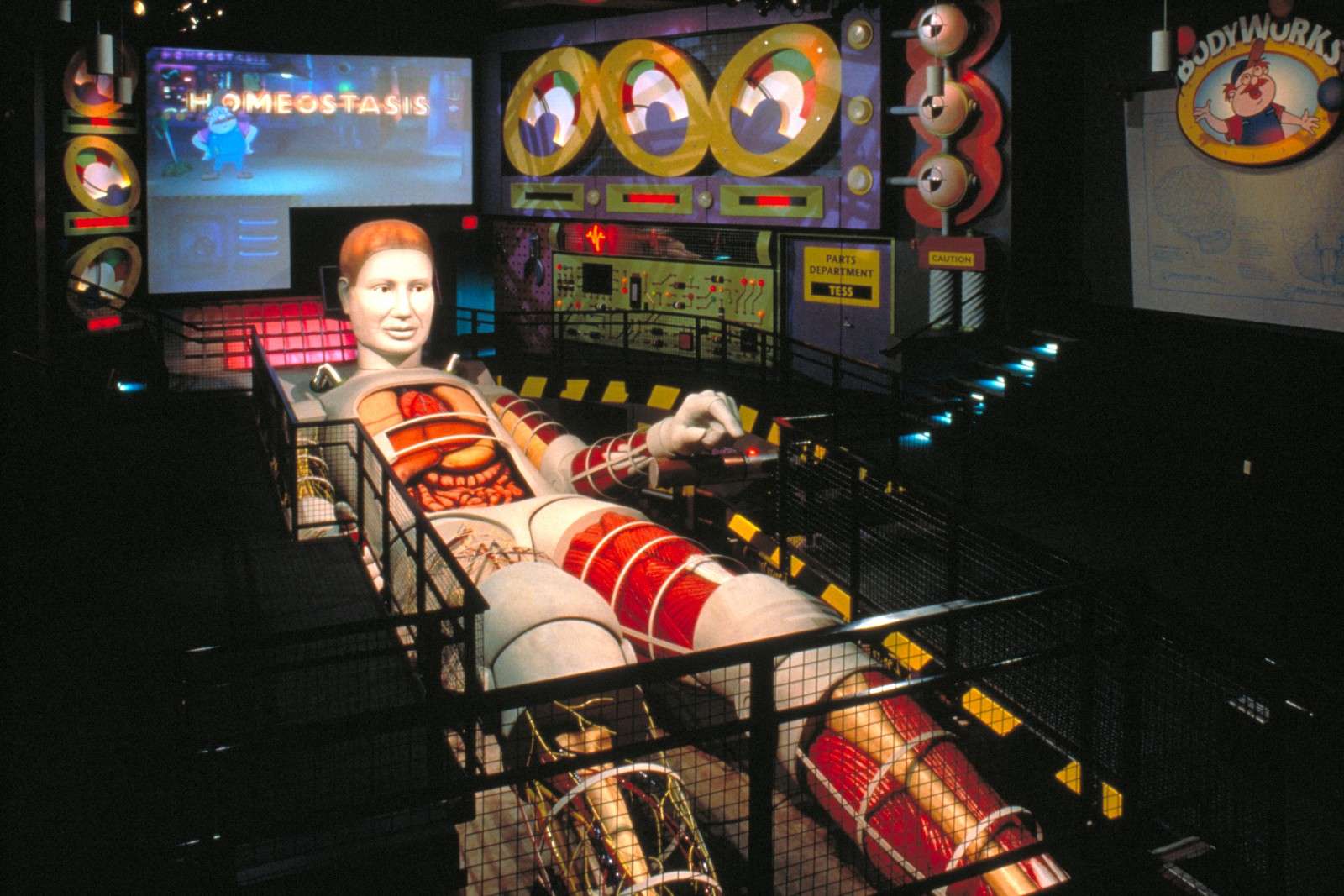
TASC helped create Tess the 50-foot woman for the California Science Center in 1996, a larger-than-life human body simulator designed to demonstrate the inner workings of the human body. TASC developed and engineered the simulator. Photo Credit: TASC

TASC set up a facility in Valencia, California and developed full vertical integration over the years: in-house design, fabrication, and testing. The site includes machining, welding, woodwork, cabinet fabrication, and outdoor areas for testing large flame and water systems.

Finding the right partner

When the two companies met on that joint project in 2023, the timing couldn’t have been more perfect. Griffin had been thinking about succession planning for TASC and Image Engineering was considering ways to quickly scale up their presence in themed entertainment.

“That project was where I got to know Image Engineering, and I really liked how they operated,” says Griffin. A key factor was their innovative approach to flame systems that they had perfected over the years. “Image’s expertise with alcohol-based fire solutions was impressive,” Griffin says. “It offered real advantages that I knew would be a benefit to our existing clients.”

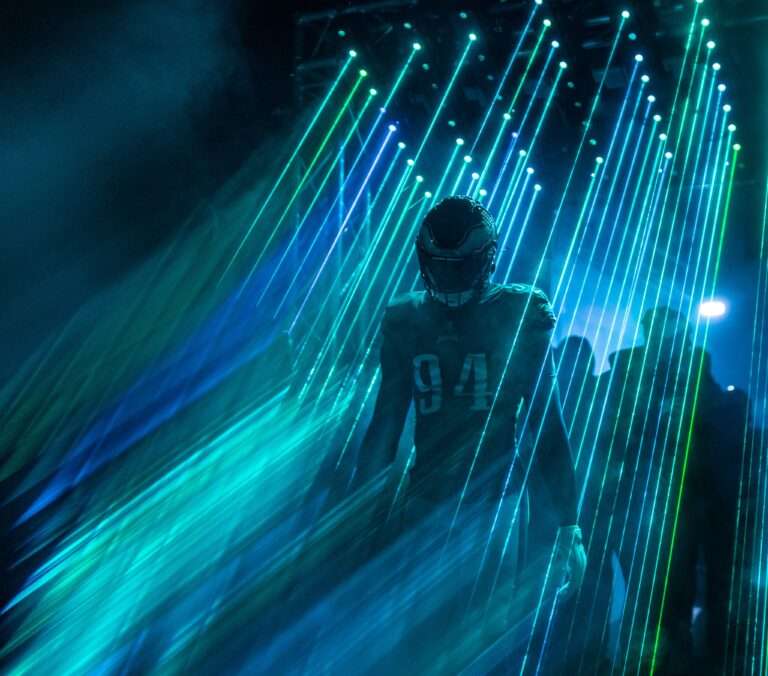
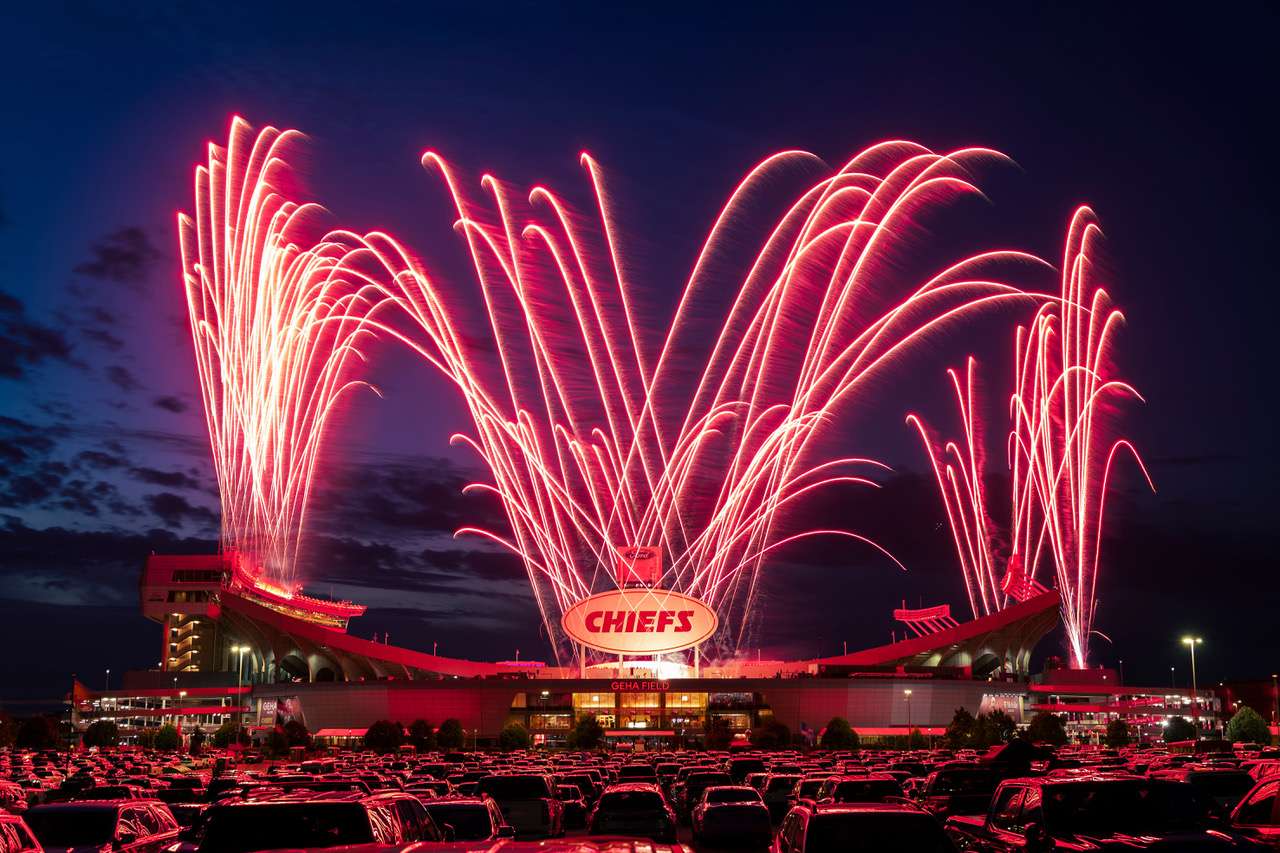
Production of a nighttime game which includes lighting, pyro & lasers to create a dynamic environment. Photo Credit: The Kansas City Chiefs

For Image Engineering, exploring an acquisition also made sense. “TASC was already a trusted partner in permanent installations, with a great reputation and strong client base,” says Suehle. “They were known for innovation, reliability and safety, and that aligned perfectly with how we wanted to grow.”

Bottiglieri adds that there were additional synergies. “Image has deep expertise in permitting, compliance, and large-scale touring systems. TASC brings fabrication, welding, and permanent effects. Together, we cover the spectrum: temporary and permanent, in both live and themed entertainment. That’s powerful for clients.”

Integrating operations and people

Bringing two companies together involves more than adding capabilities, it requires aligning workflows and people. For Bottiglieri, that’s one of the core challenges in a merger. “It’s about ensuring the two companies work together as one, without losing the strengths that made them successful individually,” he says.

Image’s Baltimore headquarters and TASC’s Valencia facility complement one another with their East Coast and West Coast locations. Baltimore provides large- scale engineering and event support, while Valencia adds fabrication strength, including advanced welding programs overseen by certified inspectors. “Our weld shop has been one of the most qualified in the industry,” says Griffin. “That’s something that will now benefit Image as well.”

On the cultural side, both firms share a history of long-tenured staff and career development. “Image, like TASC, has employees who have been with us for decades,” says Suehle. “That continuity and depth of knowledge is part of what is making the integration work so smoothly.”

A Fire Snake flame unit on articulating trusses creates a moving flame stage set in a project for Image SFX that was designed/engineered by Image Engineering. Photo Credit: Image Engineering

While Griffin has plans to retire eventually and Townsend retired in 2025, he’s committed to ensuring the transition is smooth and will remain connected in an advisory capacity as needed. Meanwhile, Griffin’s new title, “Executive Director of Neat Stuff,” is an affectionate nod to legendary Disney Imagineer Roger Broggie, who was known for commenting on how “neat” the things in the TASC shop were. Broggie finished his long and distinguished career working alongside Griffin at TASC building the neat stuff and passing on his wealth of experience and knowledge.

Expanding client offerings and markets

The acquisition broadens the combined company’s capabilities considerably. “Existing TASC clients will now have access to a wider range of products and expertise,” says Griffin. “And Image’s marketing strength will help us reach markets we didn’t pursue aggressively before.”

Casinos, museums, and live venues are prime examples. “Historically, most of TASC’s work came through word of mouth,” Griffin admits. “Now, with Image’s stronger marketing, I think you’ll see us doing more in those sectors.”

Major theme parks remain central, but both companies also see opportunities in regional parks as well. “The opening of Epic Universe has raised the bar in many ways, and that pushes every park to up its game,” Griffin says. “We’re also seeing regional parks invest more in themed experiences, not just rides.”

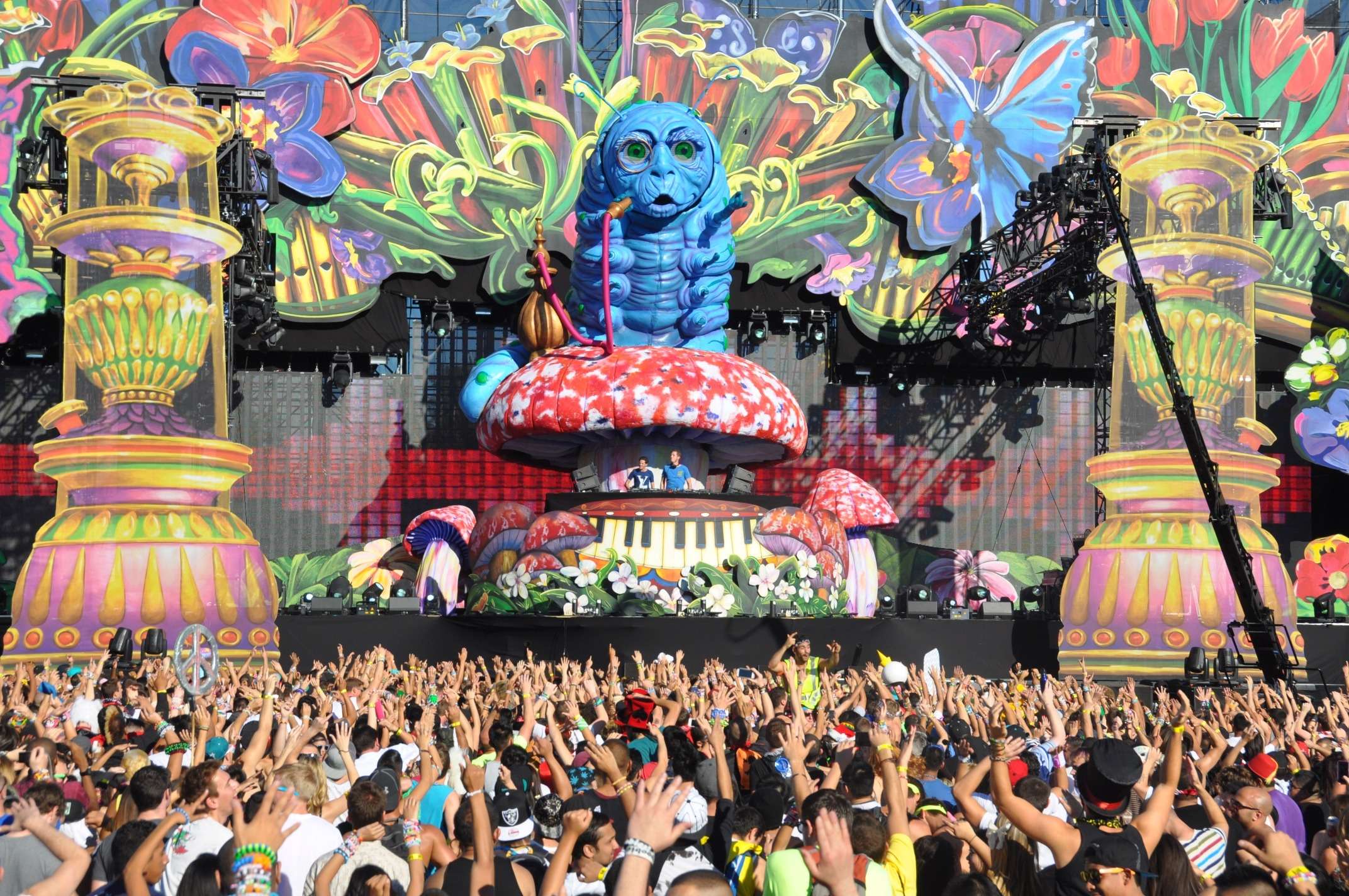
The massive art installation at Beyond Wonderland in San Francisco Bay Area (2013) included a 40-foot animated caterpillar that waved its legs and observed the crowd with LED eyes. The caterpillar even smoked a hookah, referencing its inspiration from Lewis Carroll’s “Alice’s Adventures in Wonderland.” Photo Credit: TASC

Bottiglieri adds that the combined company is already seeing benefits. “There are projects in the pipeline we couldn’t have pursued alone. Together, we’re well positioned to capture that demand.”

For Suehle, the merger is about preparing Image Engineering for the long term. “We want to be seen as a full-spectrum partner,” he says. “Whether it’s a concert tour, a stadium, a theme park, or a casino, we can bring the right people and technology.”

The Image Engineering team also sees opportunity for growth outside of North America, where most of its clients have been based. “There’s clearly growing demand for immersive experiences in places like the Middle East and Asia,” says Bottiglieri. “With TASC on board, we’re better positioned to deliver projects internationally.” •

The dawn of the era of the dark ride

Jora Vision’s Robin van der Want on how technology and a demand for immersive storytelling are creating renewed interest in dark ride attractions

interview by Martin Palicki

In the world of themed entertainment, there’s nothing quite like a dark ride. Over the decades, the format has gone through several revivals, each time propelled by new technologies and creative ambition. Today, a new era is unfolding, one marked by better tools, greater affordability, the increased ability to work within smaller footprints, and strong demand from parks and attractions of all sizes from around the world. To understand what sets this moment apart, we turned to Robin van der Want, Project Director & Creative Producer at Jora Vision. Based in the Netherlands, Jora Vision has delivered attractions around the world for more than three decades and understands firsthand the dynamics and importance of this latest chapter in the evolution of dark rides.

What’s driving the current shift toward dark rides and how are guest expectations changing?
Jora Vision’s Robin van der Want with Snorri at Europa-Park’s Snorri-Tourren dark ride.

Visitors are looking for more than thrills. In particular, families want to share experiences together, and dark rides provide that opportunity. In today’s world, where people value time spent together, these attractions allow guests of all ages to enjoy immersive environments and storytelling. It’s not about moving away from coasters but about filling a gap with experiences that combine story, characters, and atmosphere. Influences from streaming content and gaming also play a role. Younger audiences expect the imaginative, fully realized worlds they know from media – especially gaming – to be brought to life in real environments, which dark rides are perfectly positioned to do.

Why do you think the rise of dark rides is more than just a passing trend?

Dark rides meet multiple long-term needs. Operationally, they are reliable in all weather conditions and not limited by heat, cold or thunderstorms like outdoor rides. From a business perspective, they broaden the audience beyond thrill seekers and attract families, who often spend more time and money in the park. And creatively, dark rides are the ideal vehicle for storytelling, allowing parks to better tell the stories of their brand or mascot. It’s very difficult to tell a complete story on a traditional roller coaster, but dark rides allow worlds and characters to fully unfold.

Dark rides used to be primarily found at major destination parks. Now, regional parks are investing in them as well. What do you think accounts for this shift?
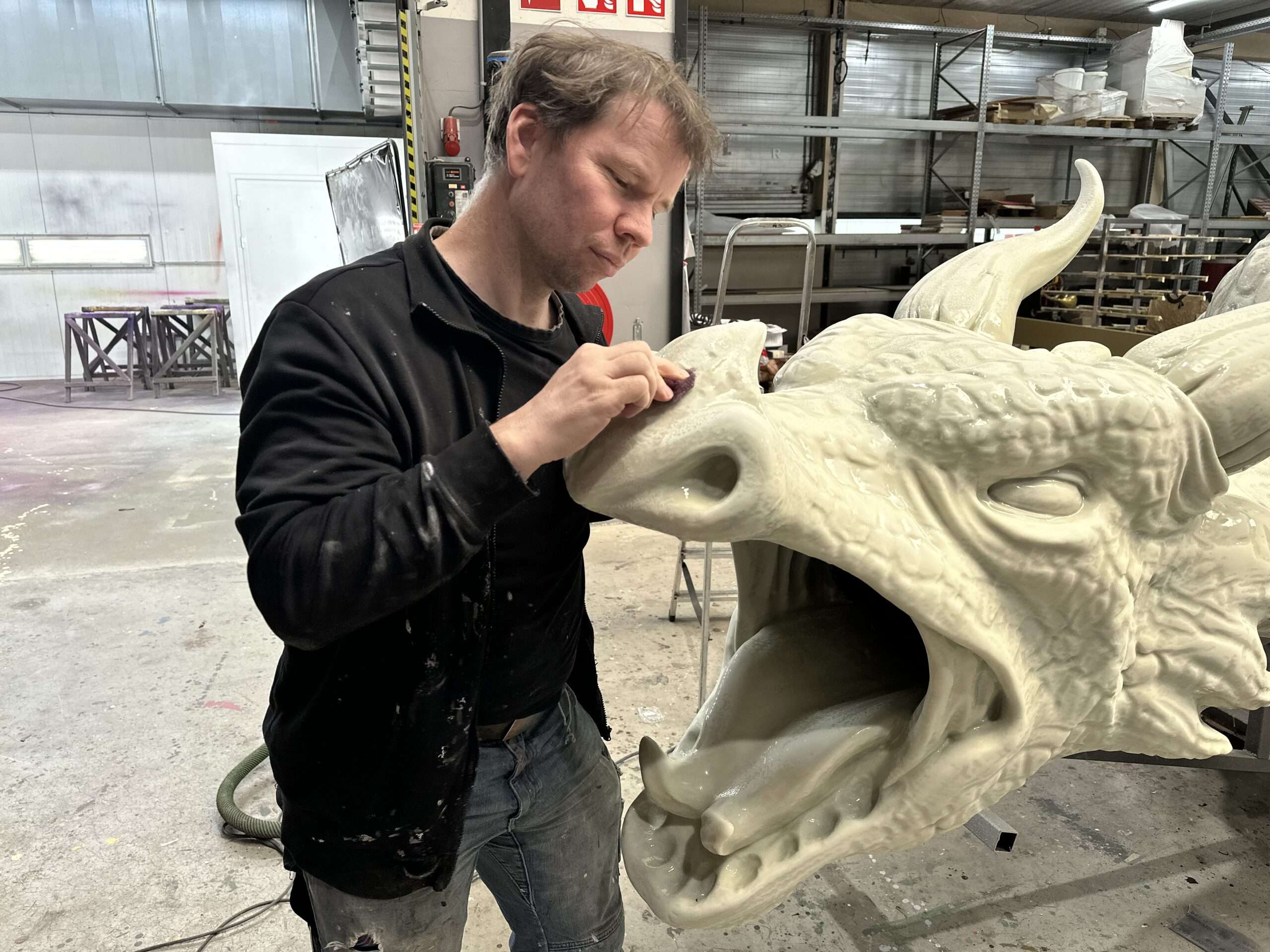
An artist works on fine details for a dragon headed to one of Jora Vision’s installations.

Technology has become more reliable and more affordable. Advances in AV, lighting, and ride systems mean high-quality experiences are no longer limited to the largest budgets. Newer vehicles and tech are allowing dark rides to fit into smaller footprints. This means many regional parks can consider reusing existing buildings for dark rides, which keeps costs manageable. At Jora Vision, we’ve seen strong growth in retrofit projects, where older facilities are repurposed into entirely new attractions.

In what other ways has technology changed the game for dark ride development?

We’re seeing new ride vehicle manufacturers enter the market, which increases competition and innovation. This means more dynamic vehicles at affordable prices. I think we will see opportunities to add thrill elements to dark rides without the scale of a coaster. On the media side, LED screens have become thinner, more versatile, and more cost- effective. They can fit into smaller spaces, be curved or produced in unusual shapes, and last longer with less maintenance than projectors. Projection still has advantages, especially for mapping onto physical sets, but the trend is shifting toward LEDs as they open new creative opportunities.

What role should media play compared to physical sets?

The best dark rides blur the line between the two. The ideal is when guests question whether they are looking at a physical set piece or media. Media should be integrated as an enhancement, not as the sole environment. When done right, media adds movement, transformation, and flexibility, while physical sets ground the story and provide tangible realism. The most powerful experiences are when the two are layered so seamlessly that visitors can’t tell them apart.

What is Jora Vision’s role in dark ride design?

Over the years we’ve built expertise not only in creative development and fabrication, but also in project management and technical integration. A dark ride involves many disciplines (vehicles, media, special effects, audio, lighting, show control) and they all need to come together in one cohesive plan. We often serve as main contractor, managing the entire process from concept to opening. That includes early budgeting, responsibility matrices, and integration of show elements. Clients increasingly recognize that this holistic role is essential for success, and it’s an area where we excel.

How important is interactivity and gamification in today’s dark rides?

Interactivity can be powerful, but it’s not always necessary. The key is determining whether it adds to the experience. Sometimes interactivity is framed as shooting games, but it can also mean achieving collective goals or allowing guests to influence the environment. Gamification adds another layer. It can enhance replayability or create new opportunities such as special event modes allowing for tournament competition during a corporate buy-out, for example. But not every dark ride needs interactivity. Some of the most memorable experiences come simply from immersion and storytelling.

How do you balance guest experience with throughput and operations?
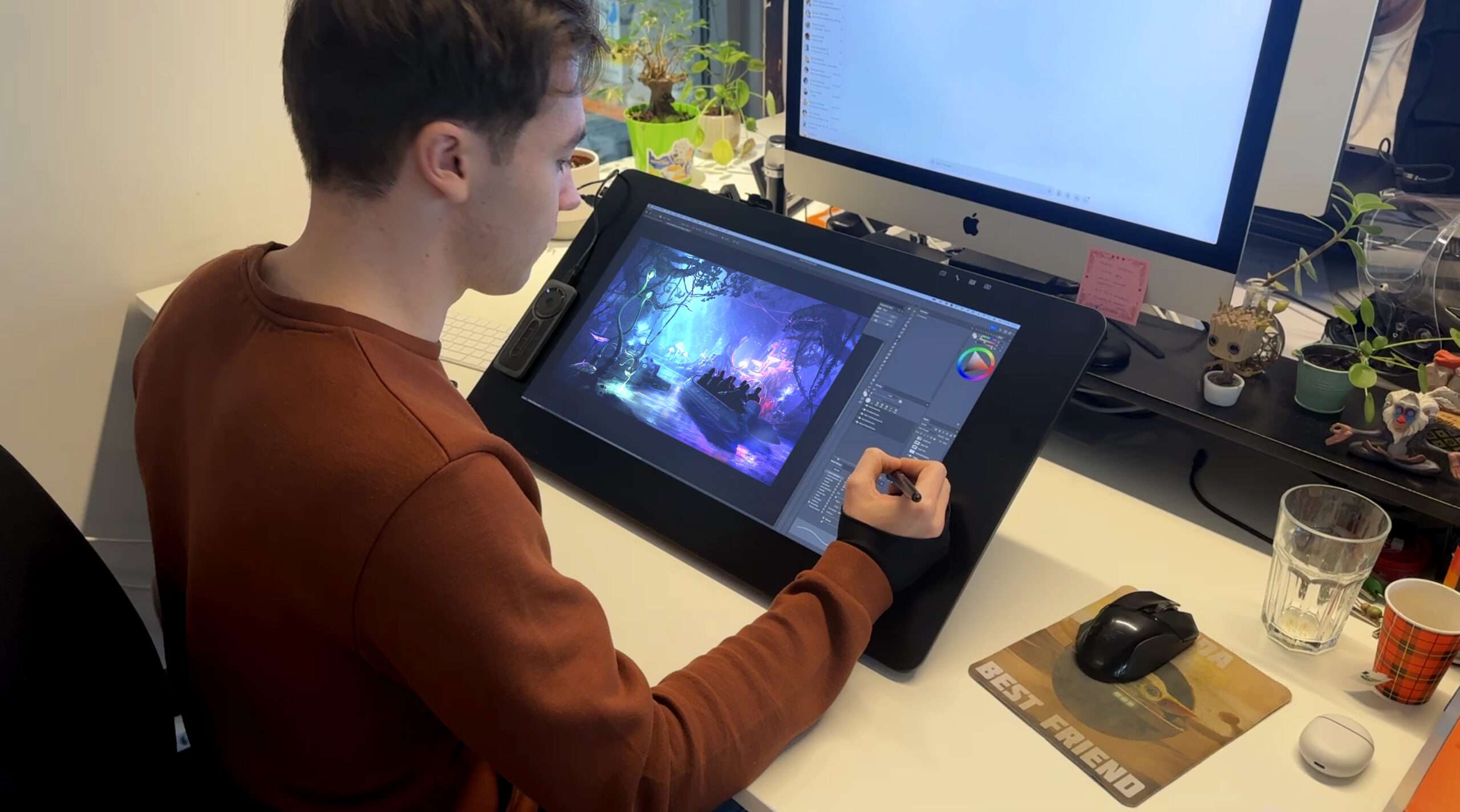
A Jora Vision designer works on a new dark ride attraction.

We begin with the practical foundations: track layout, queuing, loading, safety, and capacity. Those parameters shape the creative work, not the other way around. For example, we design buffer zones into layouts so that dispatch delays don’t disrupt the flow of the ride. Accessibility is also a priority, from ADA-compatible vehicles to clear evacuation routes. By addressing operations from the start, we ensure the creative vision is sustainable and the ride is profitable in practice.

Which regions are driving demand for new dark rides?

The Middle East is a major growth area, with many parks planning dark-ride-heavy portfolios. At the same time, we’re seeing a rise in requests from regional parks across Europe. That’s significant. It shows dark rides are no longer exclusive to the largest players but are becoming part of the standard mix for parks of all sizes.

Where do you see the next creative breakthroughs coming from?
According to Jora Vision’s Robin van der Want, the best dark rides blur the line between physical sets and media.

As I mentioned before, ride vehicles are evolving quickly. More compact, dynamic systems allow thrilling experiences in smaller footprints, opening the door for regional parks to offer attractions once reserved for the biggest operators. Advances in LED integration and track layouts also give designers more tools for variety and surprise. In the long term, we expect to see dark rides that combine family appeal with true thrill elements, competing head-to-head with coasters on guest excitement and ROI.

What excites you most about what’s ahead?

What excites me is how we are helping make this entertainment medium more accessible for operators around the world. As dark rides become more achievable for more parks, creativity will flourish. Designers will experiment with different “recipes” of technology, story, and gameplay. We’re also on the verge of dark rides that challenge coasters not just in storytelling, but in delivering thrills – all while remaining inclusive, reliable, and immersive. That combination has the power to redefine what a park’s signature attraction can be. •
Formula 1 in a Box

F1 Box opens its first venue in London, powered by Disguise

interview by Joe Kleiman

Seventy-five years ago, Formula 1 held its first championship race at the UK’s Silverstone Circuit. As the premier international racing league has grown, F1, as it’s known in shorthand, has sought out new activations to both captivate existing fans and entice those not familiar with the sport. These include a blockbuster feature film starring Brad Pitt, a visitor center in Las Vegas featuring a museum and themed go-cart races on an actual F1 track, a chain of racing simulator arcades, and a brand- new simulator attraction designed for smaller venues.

Continuing the quest for new activations and platforms, F1 partnered with the concept team behind world class competitive socializing concepts including Flight Club, Putt Shack, Bounce and HIJINGO in 2022 to develop F1 Arcade, with locations in London, Birmingham and several U.S. cities (with the latest being Las Vegas). The concept – which combines multiplayer simulator racing with hospitality – builds upon existing game-driven concepts, which combine activities such as table tennis, darts, bingo, and miniature golf, with the latest technology in a festive atmosphere replete with food and drink.

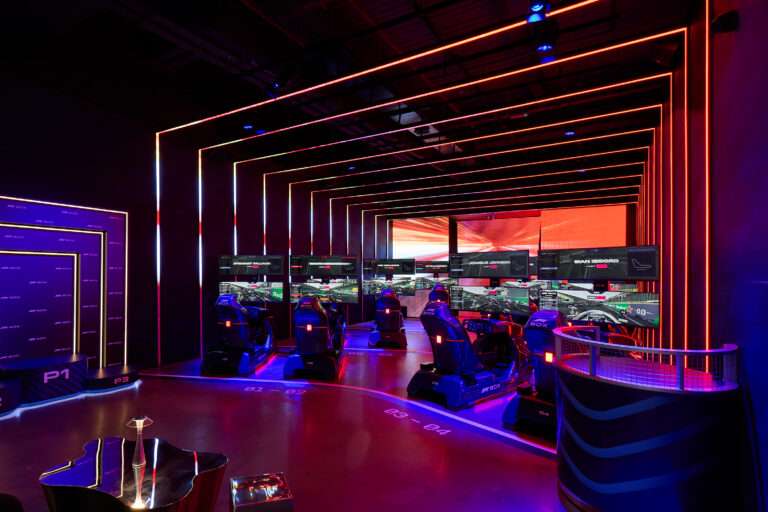
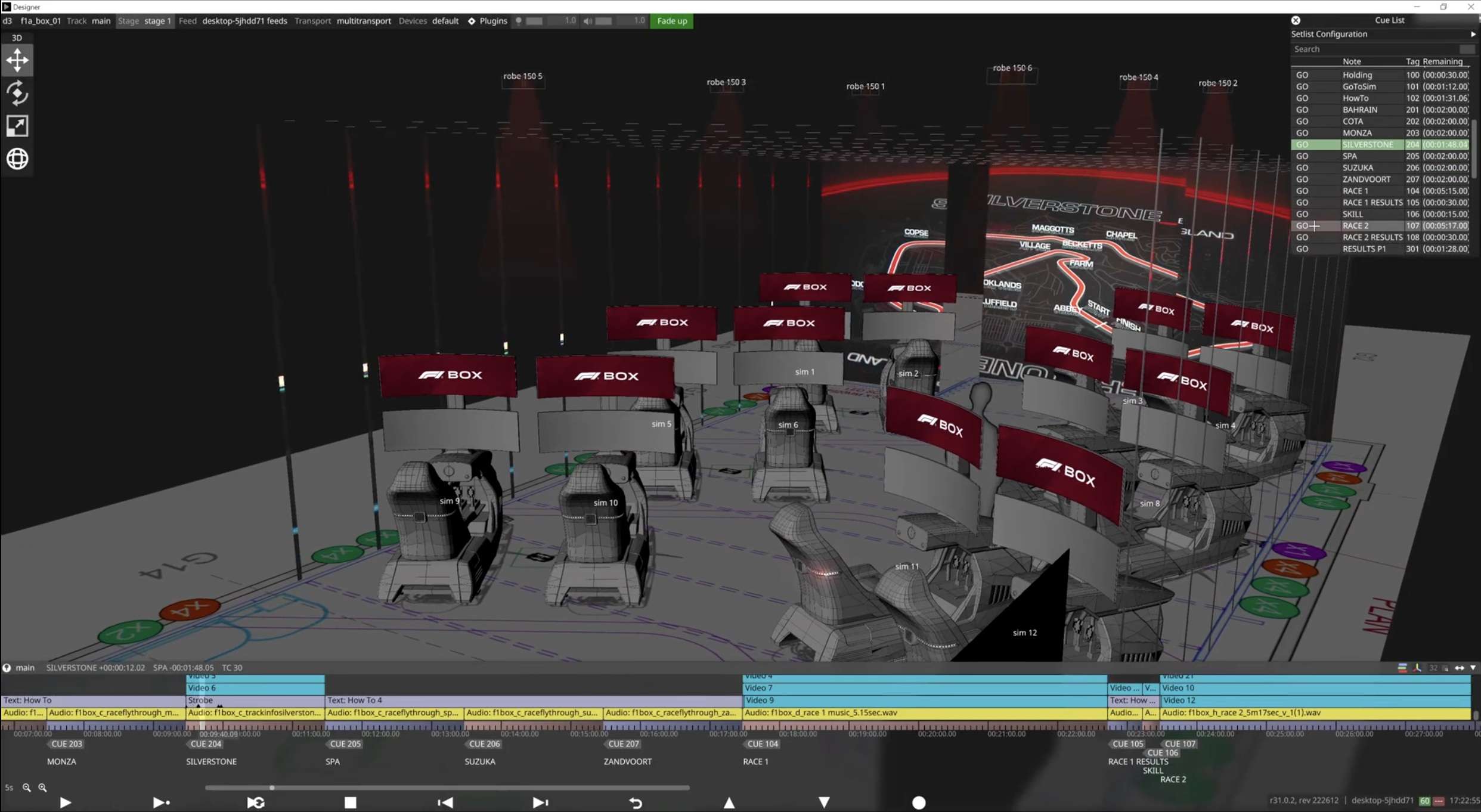
F1 Box explores the F1 Arcade concept in a new format, with sole emphasis on a racing experience involving up to twelve drivers. With its first venue in London, the facility offers a comprehensive race day experience, with individual simulators interacting with a giant LED leaderboard wall, and environmental lighting and sound fully integrated with races in real time throughout the space. Key to this process was global audiovisual technology firm Disguise, which supplied 3D previsualization of the space through its Disguise Designer software and show, lighting, and media control through a Disguise EX 3+ media server.

Gavin Williams

We spoke with Gavin Williams, Chief Technology Officer of F1 Arcade to learn more about the experience and the role of Disguise on the project.

What was behind the creation of F1 Arcade?

Many years ago, F1 approached us to build a racing experience that they could bring to the masses that included an extensive food and beverage component. They wanted to build something accessible and interesting for large groups of people. It needed to be based around racing for all, rather than sim racing for die hard sim racers or elite F1 fans. One way we did this was by giving guests the opportunity to select a skill level and gamify the experience by introducing a bespoke and intuitive points scoring system and custom UI to make this feel like a truly unique experience.

How does F1 Box differ from F1 Arcade?

With F1 Box, we’re trying to build something like F1 Arcade, but something more immersive that attracts a broader audience. You come into F1 Box and race for a shorter period. The F1 Arcade experience takes forty-five minutes to two hours depending on the group size. F1 Box is a roughly thirty-minute experience comprised of three races. It’s designed to accommodate up to twelve racers, and there’s no food and beverage component – it’s all about the competition!

The biggest difference is that F1 Box feels like you really are fully immersed in the racing experience. There’s reactive AV all around. There are three LED panels at the front of the space that show media and also act as a leaderboard during races. There’s also a giant LED embedded on the wall behind the reception desk that shows post-race results. We also email results after each session to our guests.

Is there a minimum number of racers required for F1 Box?

Every spot is available to the public. We either have 10 or 20 cars on the circuit, with a mix of AI and human drivers depending on the number of people who enter a race.

How did Disguise become involved with F1 Box?
Disguise helped create pre-visualization renderings for F1 Box. Image courtesy of F1 Box

We previously worked with Disguise in a different capacity on another project and immediately saw their value in our production workflow. For F1 Box, we wanted to work with Disguise again and through the previsualization capabilities of its Designer software, we were able to make any tweaks and changes before the actual buildout. For example, the original design for the screen at the top of the attraction was floor to ceiling, wall to wall. It was amazing, but the previz process facilitated by Disguise allowed us to explore multiple screen layouts to find the best balance between cost and guest experience. The previz also allowed us to make sure the content was right and allowed us to go through multiple rounds of edits in advance. Our CEO, Adam Breeden, was able to go full throttle on creative design before even getting into the space, so anything we actually did during buildout was simply refinement.

Take us through the F1 Box experience.

Upon approach, guests see a big logo with signage and hear the roar of the attraction. After entering, the giant LED display comes into view along with all the simulators. Guests are welcome to stand in the back and watch people race. Each simulator features two ultrawide screens, one above the other.

After purchasing a ticket or checking in, guests are welcomed by David Croft, Sky Sports’ F1 commentator, inviting them to take their seats. The experience is personalized. Each guest’s name appears on the screen above their simulator. The lights go down, then they come up again with sound. David comes back via vocals to introduce the experience. This is followed by the process of selecting a skill level, and then the first race starts.

There is a customized introduction about each circuit with facts about it. Racers hear loud beeps around them and are immersed in lighting while hearing the roar of the engines of the cars around them. I don’t want to reveal too much – people will just have to come and experience this epic showpiece in person!

All the AV components run through Disguise, so the entire experience is perfectly synced – from the giant LED backwall to the LEDs around the portal and on the simulators themselves. Real- time data from the simulators is sent through the Disguise EX 3+ media servers to generate the final placements for the leaderboard.

You mentioned the ability to modify the gaming experience based on changes in F1 rules. Can the AV experience also be modified as needed?

F1 Arcade and F1 Box are two big concepts that are designed to be expanded. Disguise as a platform allows us to change the show files at F1 Box, and they’ve designed that process to be as flawless as possible. For example, in the case of a sponsor needing visibility, we can inject custom visual elements into the show to tie in with their brand.

We enjoyed working with Disguise on F1 Box; their technical team spent lots of time programming show files for us and their creative team created the leaderboard content, really going above and beyond what we expected.

You’ll see the addition of more significant, dynamic, and reactive elements added over time. We’re barely scratching the surface of what we can do with this space, so keep your eyes out over the next year! •
Dream On!

Elevating human creativity with an AI-infused ecosystem, DreamLab Immersive is a bold new studio for the next era

by Judith Rubin and Martin Palicki

The former DE-ZYN Studios has a new identity as DreamLab Immersive, representing a re-engineered creative vision built for the context engineering era. “Custom generative tools have the power to amplify human imagination and the guest experience,” says founder John Miceli, who has spent decades at the intersection of media creation, technology and storytelling. “The shift is less about adopting new tools and more about redefining how new creative production processes and pipeline design can benefit. These new horizons will connect imagination and innovation with how people learn, explore, react and feel.”

Continuity and collaboration
John Miceli, Founder/ Executive Creative Director

DreamLab Immersive represents continuity as much as transformation. Miceli’s career has been defined by reinvention and leadership, from pioneering sound design work on feature films such as The Crow (1994), and seminal attractions at Universal Studios parks in the 1990s, to large-scale immersive media installations for nearly 20 years with Technomedia, to founding DE-ZYN Studios in 2019, with several projects earning Thea Awards and Brass Ring honors. Some notable recent projects include the St. Louis Aquarium, NFL Superbowl Projection (2024 Las Vegas; 2025 New Orleans), Grand Hall Experience 2.0 (St. Louis), The Tonight Show (flexible configuration digital video building blocks) and Talladega Motor Speedway Big Bill’s Open-Air Social Club.

“Our focus on elevated guest experience carries our legacy forward,” says Miceli. “We have combined artistry and engineering into a unified creative process designed to elevate what’s possible.” Leading that vision is a team of veteran industry innovators who bring more than 75 years of experience spanning design, media and technology integration: Miceli; Nathaniel Ruhlman, formerly of Dorian Orange; and Phil Berard, whom Miceli calls “the undisputed technical genius behind all of Technomedia’s most advanced visual achievements.”

DreamLab’s model is firmly planted in collaboration with some of the industry’s best and brightest. “We are partnering with world class design firms, architects, technical AV integrators, owners and other creative specialists,” says Ruhlman. “Competitors of the past are now partners of today and tomorrow. We all bring unique talents to the table and are having the time of our lives collaborating. Incorporating generative tools like neural networking models, joined with diffusion-based AI provides extreme clarity – fully preserving details when we accelerate rendering and upscaling into our traditional production pipeline. We can leverage its tremendous potential while maintaining control and creativity. The landscape is constantly evolving and staying ahead of it is the only way to not fall behind.”

A human-inspired, AI-first philosophy

Miceli describes DreamLab’s approach as “Human- Centered, AI-Enhanced.” It’s a philosophy rooted in balance: embracing the efficiencies of artificial and synthetic intelligence to evolve both the attraction process and the resulting guest experience. “While keeping creativity, emotion, and storytelling firmly in human hands, we can create scenarios that have the ability to be non-repetitive, informative and artfully unique in real time,” says Miceli. Deeper emotional connection is a significant benefit. “Generative engine-based experiences can communicate and respond to the input or actions of the guests, creating a more personal connection.”

“DreamLab isn’t just about exciting tools that inspire,” says Miceli. “Technology is never an end in itself. It’s about elevating our creative thought process to inspire broader dreaming, and seeing those ideas come to life.”

Creative freedom

Miceli likens DreamLab’s AI leap to the shift from analog to digital, not just in technical terms but in the concerns it has raised. He recalled how early in his career prior to Soundelux in the early 1990s, when producing soundtracks for film, theme parks and LBEs, editing meant physically slicing and splicing magnetic tape. “When sound tools and then Pro Tools came along, a lot of people said the industry was doomed and that anyone could do our jobs at home in their underwear. What in fact happened is that the industry expanded dramatically in the 1990s, and ProTools became a worldwide standard. Similarly, the right application of AI frees the creator. The work will speak for itself.”

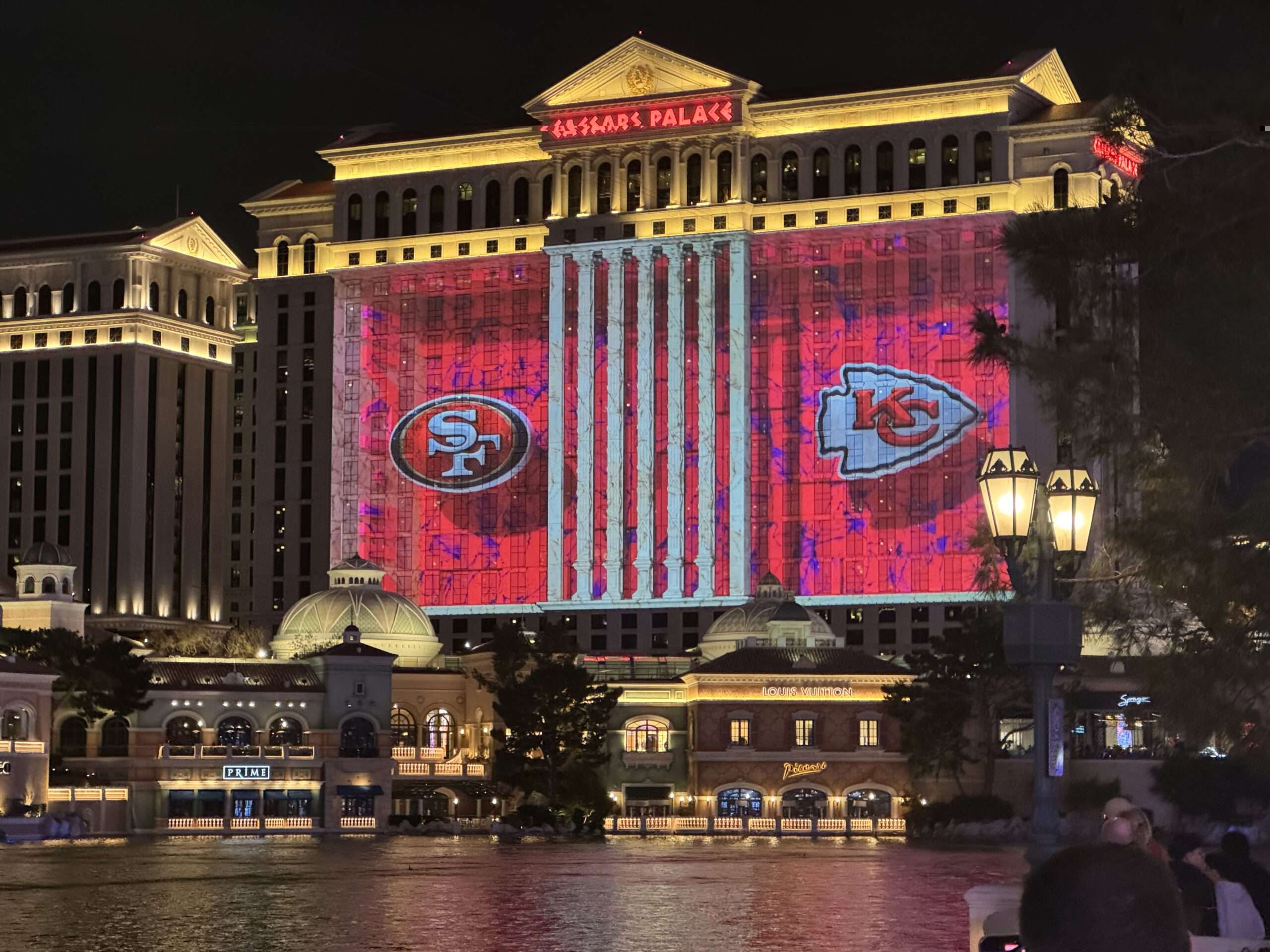
For Super Bowl LVIII in 2024 the exterior of Caesars Palace in Las Vegas was turned into a full projected surface.

That same philosophy drives DreamLab’s new model. “Generative processes are giving people more time to think creatively,” says Berard. The partners cited examples of artificial and synthetic intelligence assisting with tasks that once consumed entire days – such as rendering, upscaling, color correction, data wrangling, and document generation – compressing timelines that previously stretched for weeks. Says Berard, “The company’s proprietary rendering process can output ultra-high- resolution files up to 8K now (16K in 2026) in minutes rather than hours. Ultimately, intelligence-assisted design tools accelerate complex technical setups, freeing artists and programmers to focus on the interactivity and the emotional core of storytelling and art.”

New collaborative opportunities

Perhaps the most profound shift is how DreamLab’s ecosystem is designed to broaden collaboration. “In the past, only trained animators could put their hands on the actual work being created,” says Tracy Balsz, DreamLab’s Marketing Director. “Now, writers, visionaries, and designers who might not have the technical background can contribute to the process by mastering prompt engineering skills. They can be part of the creative process rather than handing things off and hoping the intricate details of the direction are properly embraced.”

This expanded collaboration has already shaped several of DreamLab’s current projects. In Jacksonville, Florida, the company is producing a large-scale projection mapping show that will illuminate the city’s downtown performing arts center and fountain as part of a major riverfront redevelopment. The first show for this nightly experience tells the story of Jacksonville’s rich history and renewal, its culture, art, sports, and expansive music history. To achieve the authentic visual style the client wanted, Dreamlab used its pipeline to fill gaps in historical imagery, generating period-perfect, authentically researched visuals that were then transformed into moving video sequences. “It allowed us to tell a more complete story that represents the storytelling visually and emotionally,” Miceli says. “Without the added hand of these collaborative technologies, that level of curated design would have taken months.”

DreamLab’s ecosystem also makes it possible for remote teams and outside creatives to participate through shared portals and interfaces accessing the creative pipeline. “We are building an environment where anyone on a project, in-house and other partners – from concept artists to clients – can collaborate dynamically within the same digital workspace,” says Miceli.

New tools, familiar values

Despite the advanced technology, DreamLab’s ethos remains deeply rooted in human creativity. “It’s never about sitting by the pool and typing a few words to see what comes back,” Miceli says. “It’s about how far we can push creative thought and emotional storytelling embracing our invisible teammates, our agents to reach further.”

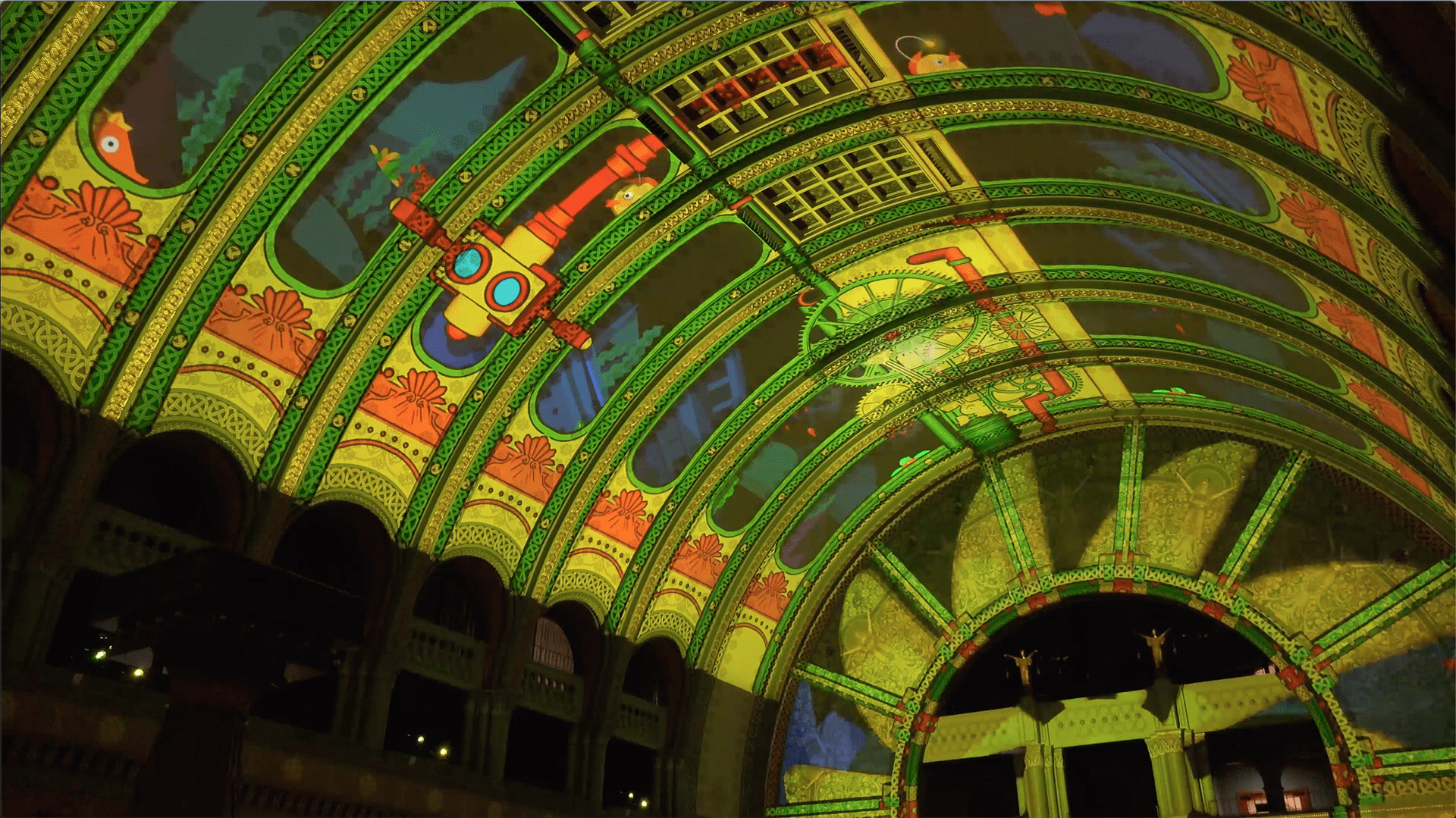
The Grand Hall Experience in St. Louis Union Station is a nightly projection mapping show that DreamLab Immersive is updating for 2025.

He points to another past milestone for comparison – his team’s work on Terminator 2: 3D for Universal Studios in the mid-1990s, where Soundelux integrated the first of its kind DSP audio processing technology to support a thousand-track mix – an achievement that would have been unthinkable just a few years earlier. “We’re similar minds, the same core people with a widely expanded team, but with tools that expand our resources without limit,” he says. “Now we can dream bigger and achieve inspiring results with greater freedom.”

Projects with purpose

DreamLab’s current project slate demonstrates how the company’s culture, philosophy and ecosystem workflow scales across disciplines. In addition to the Jacksonville Riverfront project, the team is developing The Hub in Springfield, Illinois – a transport and community center that will use immersive media and interactivity to transform a civic space into a flexible event and storytelling venue. The design includes a massive, transparent visual ceiling delivering immersive experiential programming. An interactive wall is designed as a central hub for all that visitors can experience in Springfield, a collaborative venture across the city with the intention to expand the stay to multiple days through awareness and connectivity. The Hub connects visitors to local culture, businesses, and attractions in real time using AI to communicate and act as a personal concierge.

The company is also collaborating with the Tennessee Aquarium on new immersive exhibits that complement live animal habitats without overshadowing them. “We’re finding ways to bring digital storytelling and interactivity into the experience in a way that feels natural and fun,” Berard explains. “The goal isn’t to compete with the life around you, it’s to enhance the sense of wonder and engagement.”

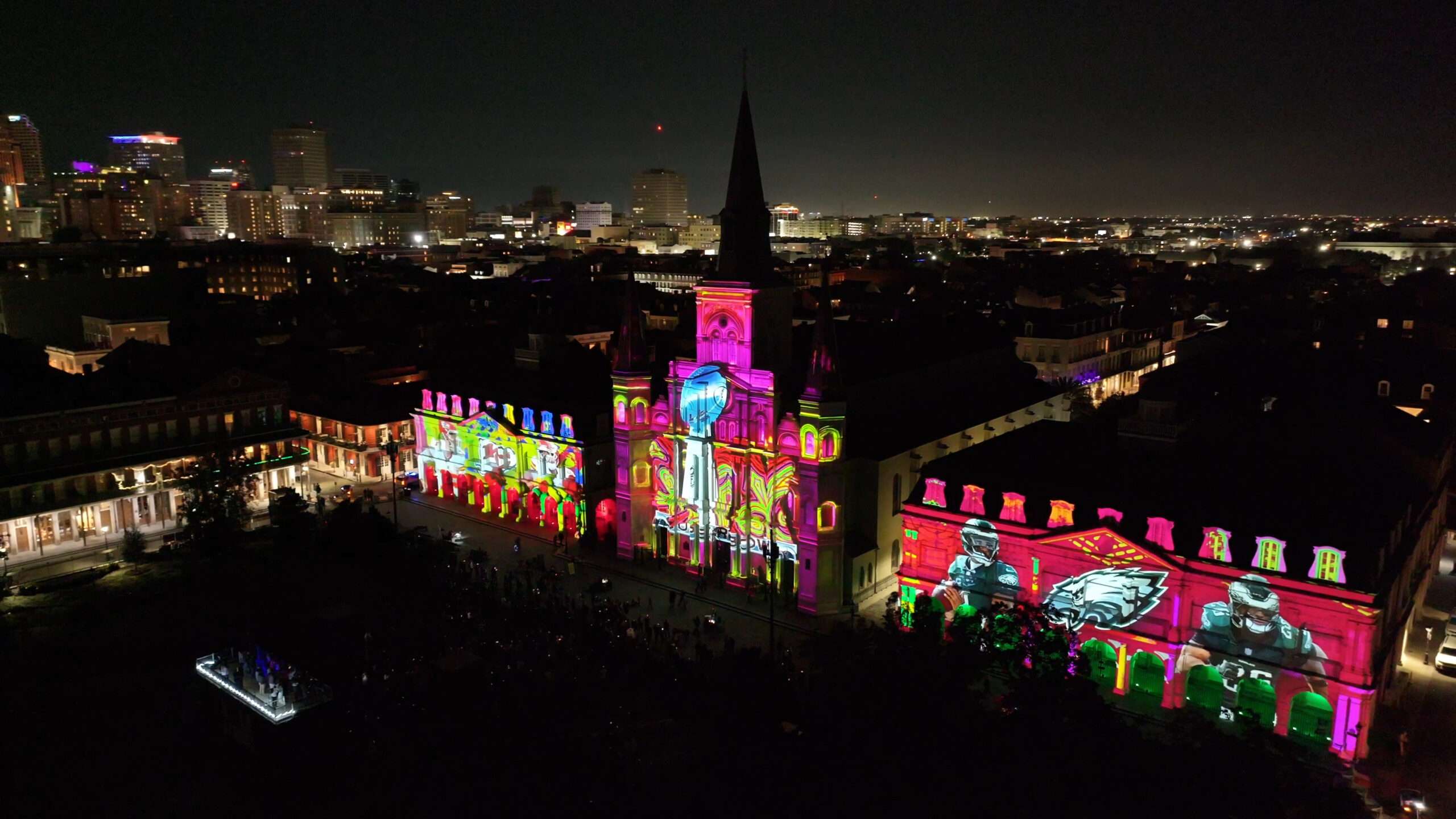
In New Orleans in 2025, Paul Whitney, BlueMedia, the NFL team and DreamLab Immersive transformed buildings in Jackson Square into a projection mapping show for Super Bowl LIX.

DreamLab’s client list continues to grow, with upcoming projects including museum installations, retail experiences, immersive dining, zoos and aquariums, corporate art installations and of course, theme park attractions. “We’ve always looked at technology as a storytelling partner,” Ruhlman says. “Our new generative intelligence-forward experience design just makes that partnership more inspiring, exploratory, timely, alive and expressive for guests.”

Transforming innovation into human connection

DreamLab’s innovations and potential applications go beyond entertainment. Miceli’s team is exploring ways to bring its unique immersive interactive experiences to education, elder-care environments and real time human life interaction – spaces where immersive experiences can have the power to improve emotional engagement and well-being.

Miceli notes that guest expectations are evolving as well. “Most of us now live a good portion of our lives digitally,” he says. “Younger generations expect everything to move, to respond, to know them and to bring immediate gratification. Embracing generative intelligence in our designs allows us to reach for that reality – experiences that are personalized, adaptive, and alive.”

These applications reflect the broader philosophy that AI, when used thoughtfully, expands humanity’s reach rather than replaces it. “The mind is the foundation, the dream is the goal,” says Miceli. “Technology must serve the process, the creator and the soul of the story. That’s what it means to be Human-Inspired, Human-Driven, Human-Centered, AI-Enhanced. Every breakthrough we’ve had – from digital sound to LED media to kinetic interactive systems – has started with a human dream. Our opportunities today allow us to innovate in more collaborative ways to bring those dreams to life, and that’s what Dreamlab Immersive is all about.” •

Martin Palicki ([email protected]) founded InPark Magazine in 2004, combining years of experience working in themed entertainment with a passion for writing and design.

New 24-hour flagship Orlando arcade collaborates with Betson Enterprises for gaming equipment

0

Betson Enterprises shared details on its collaboration with Arcade Time Entertainment on the launch of the company’s newest 32,000-square-foot flagship location on International Drive near Universal Orlando Resort.

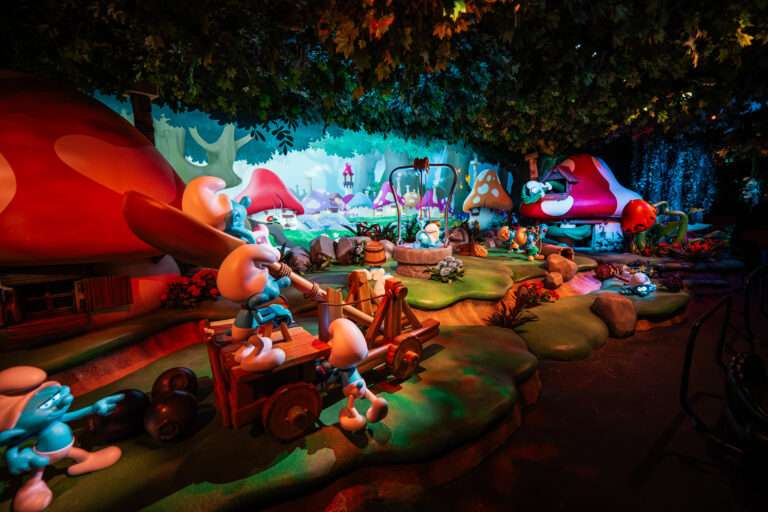
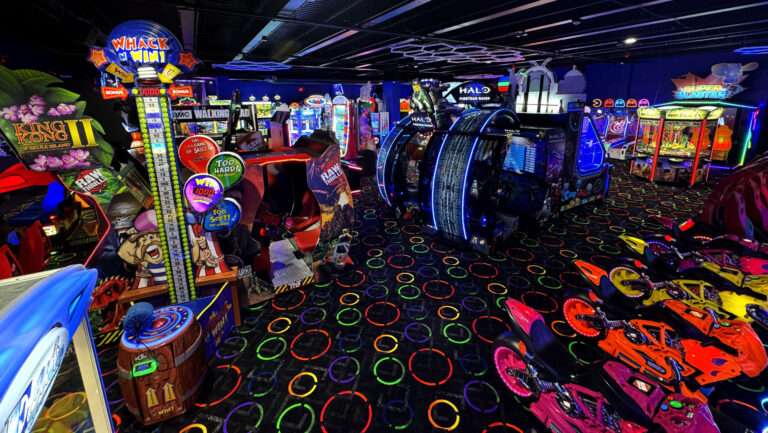
Open 24 hours a day, Arcade Time Orlando features over 300 arcade games, from retro titles to the latest releases, including Top Gun: Maverick, Godzilla Kaiju Wars VR, Fast & Furious Arcade and Wizard of Oz by Raw Thrills, Goldstorm Pirates by Bandai Namco, ICEE Slush Rush from Bay Tek Entertainment, Popeye Boxer from Benchmark Games, and The Smurfs Coin Pusher from Elaut. Beyond gaming, the expansive venue offers Duckpin Bowling, Krazy Darts, and a full-service restaurant and two bars, providing guests with an immersive entertainment experience around the clock.

“Partnering with Betson has been an integral part of the expansion of Arcade Time Entertainment,” said Douglas Mandell, Director of Marketing at Arcade Time Entertainment. “Their expertise in sourcing, financing, and supporting the latest in arcade equipment helped us build a dynamic mix of games and attractions that keep guests engaged and coming back for more.”

The collaboration between Betson Enterprises Regional Sales Manager Joe Herbert and the Arcade Time team ensured a seamless design, setup, and installation process, tailored to meet the high expectations of Orlando’s world-class entertainment market.

“We’re thrilled to partner with Arcade Time on such an exciting project,” said Herbert. “This new location perfectly showcases how a strategic game mix and modern amenities can elevate the guest experience and drive consistent traffic and revenue.”

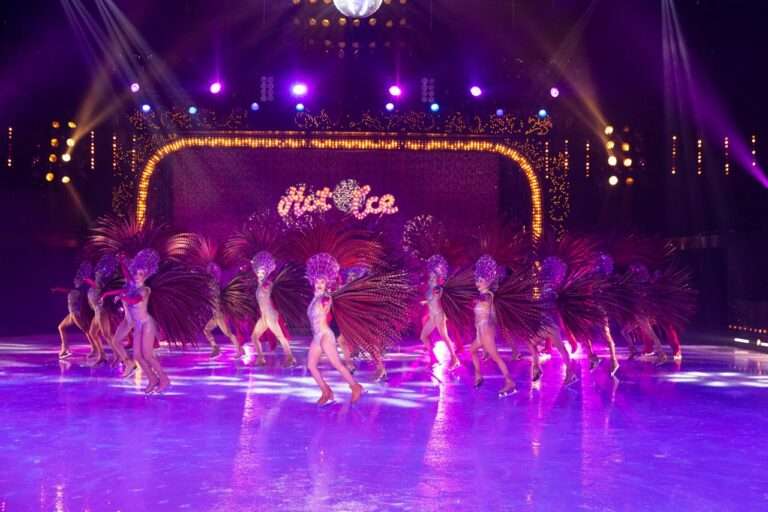
Hot Ice returns to Pleasure Beach Resort in 2026 for its 90th year

Pleasure Beach Resort’s Hot Ice Show is returning for its 90th year with a brand new production: Hot Ice XC.

2026 will mark nine decades of Olympic and world champion skaters traveling to Blackpool, to perform in this signature ice show.

Recognizable performers from previous years include Dancing On Ice stars Dan Whiston, Sylvain Longchambon, Simon Proulx-Sénécal, Stuart Widdall, Natalia Pestova and Katie Stainsby. The cast has also featured multiple Olympians such as Xiaoyu Yu and Shawn Sawyer, who both starred in this year’s show.

Olympic gold medallist for Great Britain, Robin Cousins MBE, starred in Hot Ice in the 1980s and went on to be head judge on Dancing on Ice, while the show is choreographed by Oula Jaaskelainen, another former Olympic athlete.

Like its predecessors, Hot Ice XC promises to be a powerful combination of sport and theater featuring passion, performance and perseverance – qualities that have defined the show since it first graced the ice in 1936.

“Reaching 90 years of Hot Ice is something truly special,” says Amanda Thompson OBE, CEO of Pleasure Beach Resort and director and producer of Hot Ice. “This show is part of Blackpool’s cultural DNA and is a place where exceptional technical skill and theater come together in a way that doesn’t exist anywhere else in the world.

“Hot Ice XC will celebrate our incredible 90 year history while continuing to push the boundaries of what’s possible on the ice. We’ll also be announcing something a little different this year, but you’ll have to wait a little longer until all is revealed.”

Each production features original music, intricate lighting design, and cutting-edge special effects.