Home Blog Page 37

USS Midway Museum: Bringing steel to life

HOW THE USS MIDWAY MUSEUM CREATED ITS MOST AMBITIOUS EXHIBIT TO DATE

by Philip Hernandez

“Hot, Loud & Crowded = Home” states the sign emblazoned on the walls deep below the flight deck of the USS Midway, where the ship’s ultimate problem solvers, its engineers, once lived and worked. When the USS Midway Museum set out to turn the engineering spaces into an exhibit, the goal was not simply to restore machinery or add another technical exhibit. Instead, the team wanted to take visitors on an emotional journey that honors the engineers whose work kept the carrier alive for nearly half a century.

Honorable initiations

Commissioned in 1945, the USS Midway was the longest-serving aircraft carrier in the United States until being decommissioned in 1992. In 2004, it launched into a different kind of service as the USS Midway Museum in San Diego Bay. With roughly 1 million visitors per year, the ship has become a popular attraction, and in the early 2020’s, museum staff began exploring options to revitalize and enhance worn and underutilized sections of the ship.

Their first stop: the ship’s engineering spaces. In December 2023, the unused 4,000-square-foot space looked like a construction zone, filled with debris. Over the next five months, a team of designers, technicians, and volunteers transformed it into an immersive exhibit honoring the USS Midway’s invisible heroes, the engineers who kept the aircraft carrier operational.

Midway’s Engineers: Service, Sacrifice and Everyday Life opened Memorial Day weekend 2024, and redefined the museum’s approach to exhibit creation. “This was our first foray into a new way of storytelling,” said Bill Coleman, Director of Exhibits at the USS Midway Museum. “It was a departure from everything we’d done up to that point.”

Making plans

The exhibit brief focused on people first, work second. “One of our goals was to put more of a human face on this part of the military,” Coleman explained. “Most sailors serving aboard ships are young, 18 to 22 years old, and they’re taking on critical jobs. We didn’t want to inundate guests with technical data that lacks a personal connection. Instead, we took that data and wanted to apply it to actual human experiences.”

To accomplish that meant bringing museum visitors down into spaces not initially designed for high traffic. Passageways and spaces were optimized for equipment needs first and people second. To help overcome those obstacles, the museum partnered with Art Processors to help develop the exhibit. (Since then, the creative leads who led the design and production of the exhibit have formed FELT Design, a boutique experience design studio.)

The concept focused on two interconnected exhibits: the engineering experience (covering steam generation, tools, and living) and a simulated fire experience to address the single most dangerous threat aboard any ship.

Turning a ship into a canvas

In December 2023, the design teams made their first site visits, and it quickly became clear that the engineering deck was in bad shape. “It had been torn apart several times,” Coleman said. “The decks and bulkheads were mostly destroyed.”
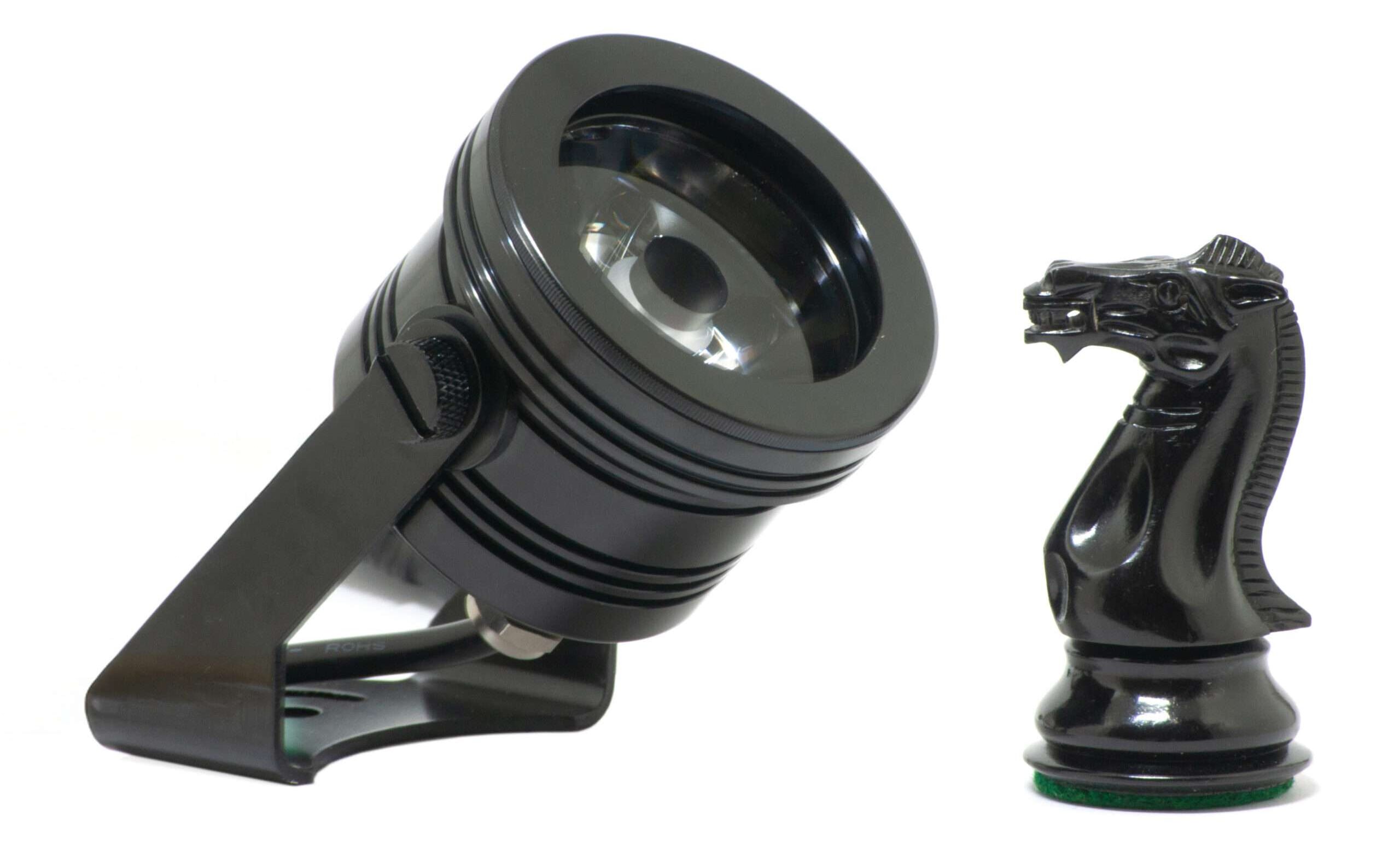
The Gantom One lighting fixture is small (only slightly larger than a chess piece), making it easy to mount in challenging and tight environments. Photo courtesy of Gantom.

“The limitations of the space were obvious,” recalled David Crumley, Technical Director at FELT Design. “I quickly realized how difficult it was to even stand up in the space. How were we going to fit both visitors and AV equipment down there?”

The tightness of space meant the technology had to be carefully selected to sustain the emotional journey, but minimal enough to fit. “The ceilings were only eight feet tall, so I knew fitting theatrical fixtures in the space would be a challenge,” said Harry Foster, lighting designer at Lightswitch.

Not only was the space tight, but the vessel’s immense size also discouraged guests from lingering long. “Midway is massive, and there’s so much to explore,” Crumley noted. “People are constantly moving. We had to design everything to work in a period of 30 to 45 seconds.”

Relying on traditional video screens would take up space and slow down the exhibit. So, the ship itself had to become a canvas. To accomplish that, the experience needed to rely on theatrical lighting, audio design, projection mapping, and interactive elements.

It also meant understanding which natural elements on the ship to highlight. For example, instead of fabricating a prop to illustrate ingenuity at sea, they lit some of the existing pipes.

“The pipes became a sculptural element,” Crumley explained. “It’s one of the strongest areas of the exhibit because we’re highlighting the actual lived experience of engineers on the ship.”

The engineering experience

The interconnected exhibits were designed to guide guests through a classic emotional story arc, conveying the realities of living on the engineering deck and prompting them to care about the individuals.

As visitors near the engineering spaces, they hear the engine below increasing in intensity. “As you descend, you feel the engine room getting closer,” Crumley said. “We used transducers under the stairs for vibration and engine rumble, combined with the 36 audio channels and multiple subwoofers.”

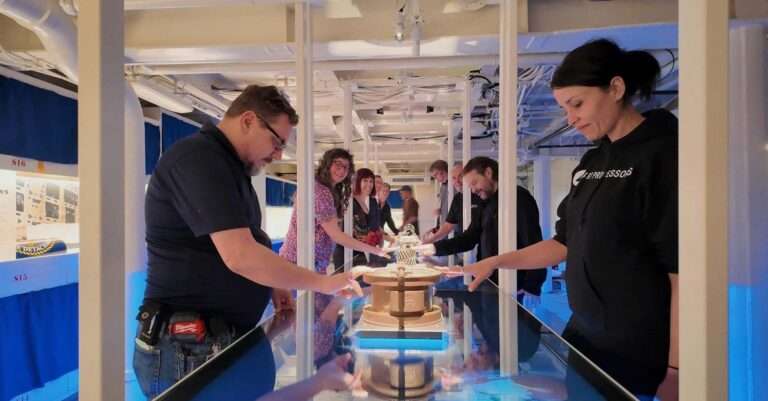
The first gallery builds context by introducing the steam cycle and explaining how steam powered virtually everything aboard the vessel. A table of engineering tools (an engine telegraph, a gas mask, etc.) invites hands-on exploration. As guests touch a tool, a spotlight illuminates it and a short video plays, sharing the story of how the tool is used and why it matters.

The journey continues through the berthing space, where engineers lived and slept. Bunks and lockers have been restored to period condition, filled with clothing, stickers, pictures, and keepsakes. As visitors explore, targeted motion sensors trigger audio from former Midway sailors. For example, when approaching a blank letter on a bed, the letter illuminates, then begins to fill in as the sailor’s voice dictates a letter to his sweetheart. The more guests explore, the more personal stories they encounter.

“We interviewed former shipmates and created compelling stories from those testimonials,” Crumley said. “The interviewees also donated personal items such as jackets and photographs, so we could authentically recreate their actual lockers and bunks.”

Having built an emotional connection to the sailors and set the context, the exhibit moves on to the climax: the fire.

The fire simulation

“Fire, Fire, Fire!” blare the speakers, as guests move through red-washed corridors to see firefighting tools spotlighted in front of them. Alarms, bustling noise, and silhouettes of rushing firefighters projected against the walls create a sense of motion and rising action, carrying guests into the fire simulation.
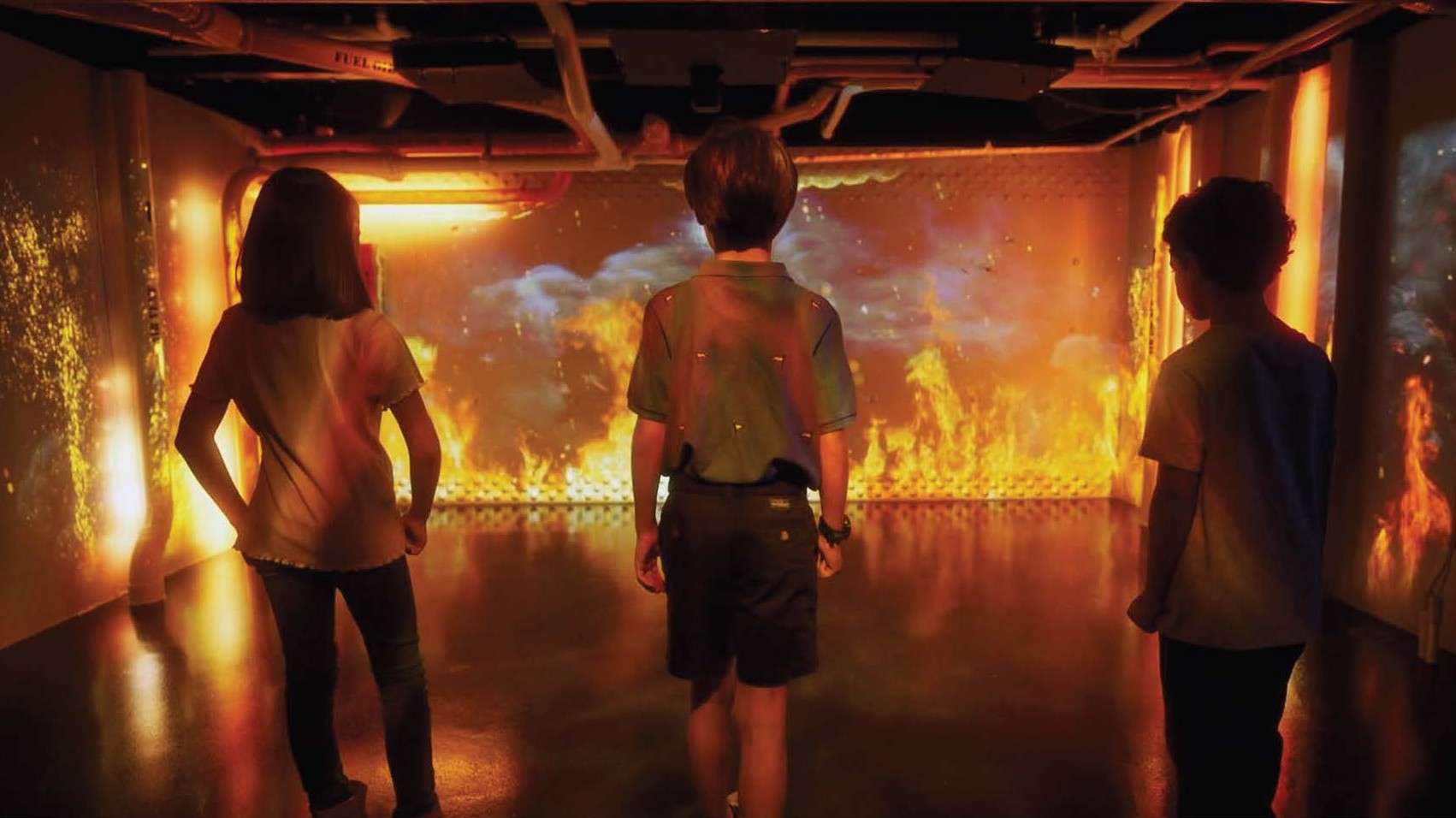
Images of flames dance up the walls in the fire simulation exhibit aboard the USS Midway. Photo courtesy FELT Design.

Guests enter a bare room, facing a clean wall framed by pipes and a breaker box on the left. The two-minute sequence begins with a spark in the breaker box that ignites projected flames, which then lick across the wall, growing in intensity. Voices fill the room as you see water attempting to extinguish the flames. Just as the flames seem controlled, an ember catches, and the second round of fighting begins. With the flames finally extinguished, the voices recede, and guests can move on.

The team spent substantial time tuning color temperatures and media to create something that felt authentic without being overly theatrical. “We never wanted people to feel like they were not on a ship,” Foster added.

“Saving the Ship,” the final gallery, provides guests a moment to reflect and decompress; Somber music, blue tones, and projected water effects set the background. Scrim screens divide the area, honoring sailors who lost their lives in fire-related incidents aboard the Midway and other vessels.

How do you hide the tech?

To create this authentic story experience within the ship’s confines, lighting was essential, yet space was limited. The experience needed theatrical lights with show control, but traditional fixtures were too large for the ceilings. “We selected Gantom fixtures for that reason,” Foster said. The team specified Gantom One UP fixtures, which are compact, low-voltage DMX fixtures roughly the size of a soda can that are easily hidden throughout the exhibit. “In the past, we would have used a track system with traditional mounts,” Foster said. “Here, we used Gantom spots for everything: wall graphics, pattern projection, and focused lighting on objects.”

Theatrical quality lighting highlights the natural architecture and mechanics within the ship. Photo courtesy of Lightswitch.

Even with compact fixtures, mounting them to irregular I-beams presented another challenge. Lightswitch worked with FractaVisual Designs to create bespoke mounting brackets that attached to the ship’s irregular I-beam structure, positioning fixtures precisely where needed. The approach allowed the team to sneak lights into areas that would have been impossible with standard rigging.

Building on success

The resulting exhibit takes guests on an emotional, human-centric journey through the life of an aircraft carrier engineer. It opened to record attendance and maintains strong visitor engagement and satisfaction to this day. Coleman credits both the technology and the volunteers’ commitment for this success.

“The reliability of the tech has been impressive,” Crumley noted. “The ship is open every day, and the equipment has performed well.”

But it is also the dozens of volunteers, including retired machinists, electricians, and general contractors – many of whom are former military – that helped craft the new exhibit. “The volunteers made this possible,” Coleman said. “They brought real skills and were here every day to turn our ideas into reality.”

With Midway’s Engineers: Service, Sacrifice and Everyday Life, the USS Midway Museum has done more than add a new exhibit. It has established a new creative framework for interpreting history by treating the ship itself as both artifact and storyteller, with technology as a quiet partner. The exhibit ensures that visitors leave not just impressed by the engineering but connected to the people who lived it. In doing so, Midway once again proves that even the most imposing machines are ultimately defined by the humans who bring them to life. •

CREDITS

USS Midway Museum

Bill Coleman, Director of Exhibits

Mark Berlin, Director of Operations

Rudy Shappee, Exhibits Content Developer

FELT DESIGN

Christine Murray, Content Lead

Julie Flechoux, Creative Director

David Crumley, Technical Director

Chris Carlson, Creative Technologist

Melanie Malkin, Producer

LIGHTSWITCH

Warren Kong, Principal

Harry Foster, Lighting Designer

Jerreme Aldrich, Project Manager

VENDORS

Electrosonic, AV Integrator

Lightswitch, Lighting Designer

Ironwood, Fabricator

Gantom Lighting, Lighting Manufacturer
Jora Vision/ETF/Alterface: Growing  Together

The Enchanted Greenhouse at Six Flags Qiddiya City

by Becci Knowles

In an emerging destination park trumpeting ambition and scale, one of Six Flags Qiddiya City’s most powerful statements blooms behind the doors of an abandoned greenhouse. The Enchanted Greenhouse is not simply a family dark ride filled with foliage, animatronics and interactive effects – it is a living demonstration of what can happen when creative vision, ride technology and interactivity are conceived as one from day one. Rooted in themes of growth and renewal, the attraction mirrors its own message: when the right partners cultivate trust and shared purpose, story and system can flourish together into something far greater than the sum of their parts.

The Enchanted Greenhouse is a trackless interactive dark ride located in the Twilight Gardens land at Six Flags Qiddiya City, which officially opened to the public in December 2025. Developed by a consortium under the creative leadership of Jora Vision, the team included Alterface and ETF Ride Systems. Together, they positioned The Enchanted Greenhouse as a cornerstone immersive family dark ride within the park’s six themed lands.

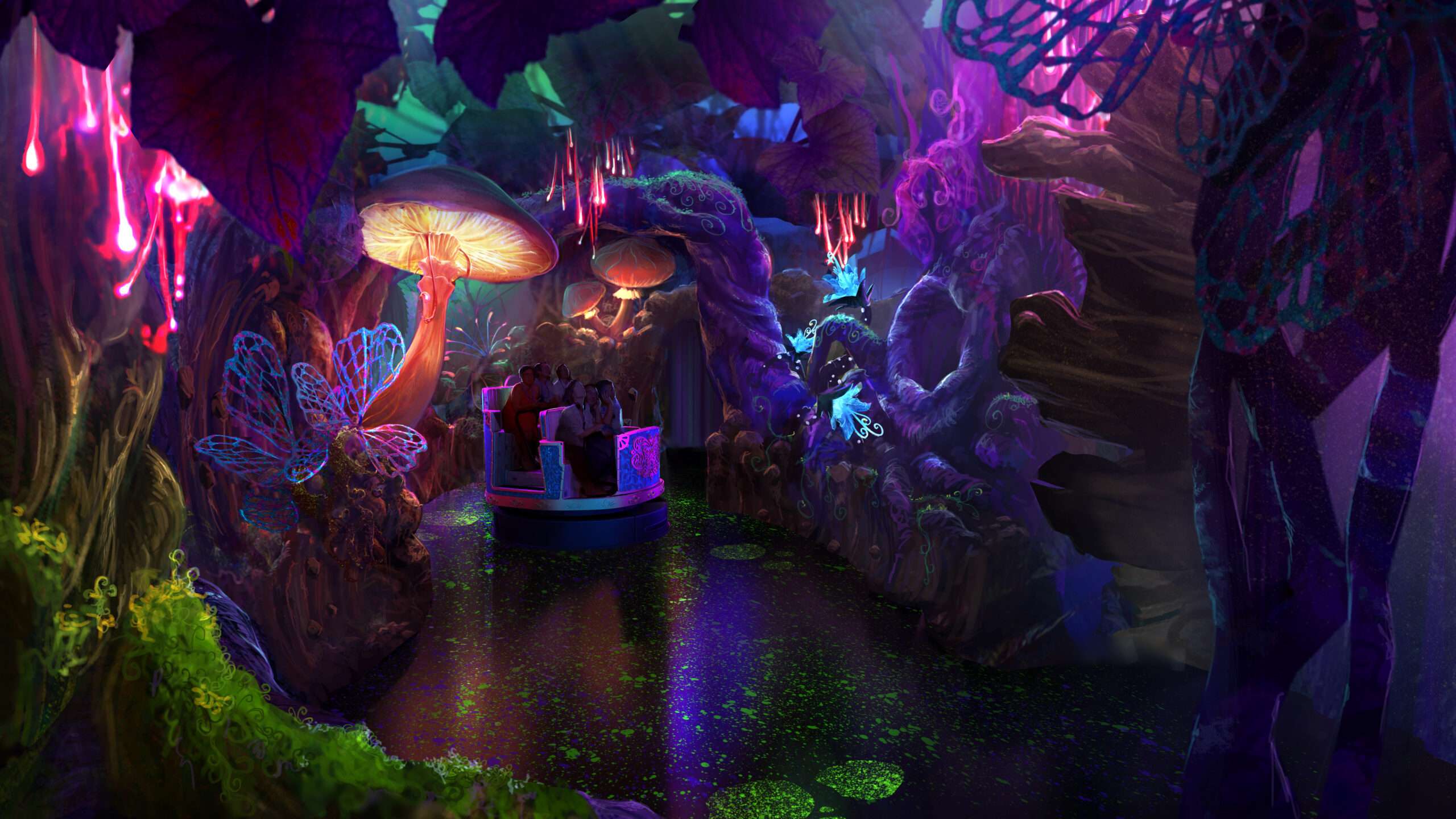
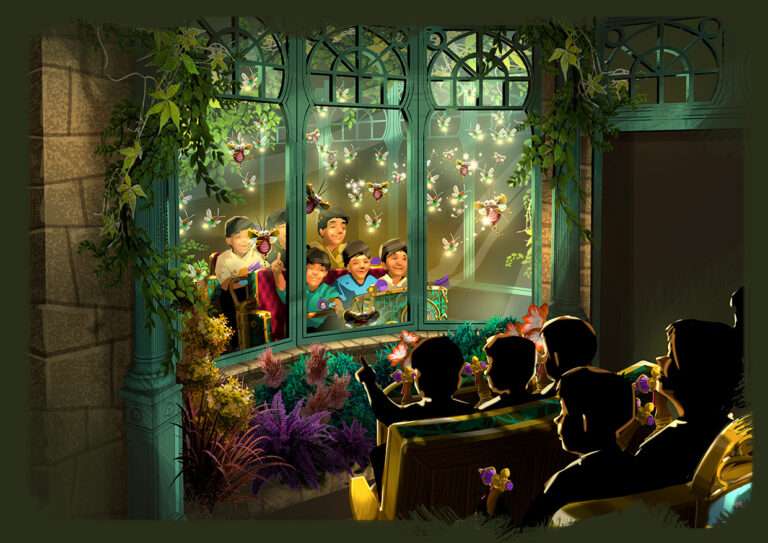
Set inside a long-abandoned greenhouse, the attraction combines dense physical theming, autonomous trackless vehicles and a deliberately non-competitive form of interactivity. Guests travel in one of twelve six-seat vehicles along a 160-meter route using handheld magical dew sprayers to awaken hidden creatures, influence behavior and transform the environment (rather than accumulate points or scores). The whole tale is told by multiple animatronics, 14 multimedia projectors and ground-breaking special effects on the ride vehicle itself, all concealed within immersive decor overgrown with thousands of lifelike otherworldly plants.

The project is significant not because of any single technology, but because story, ride system and interactivity were conceived together from the outset. Rather than a sequential delivery model, The Enchanted Greenhouse was developed as a fully integrated collaboration, allowing narrative intent to be embedded directly into vehicle choreography, timing and guest interaction.

According to the official press release, “The Enchanted Greenhouse is set in an abandoned greenhouse with a symbolic story rooted in growth, love and rediscovery.” For Jora Vision’s Project Director & Creative Producer Robin van der Want and his team, the challenge was translating those abstract themes into physical space, scenes and pacing, particularly for a family audience encountering this type of attraction for the first time.

With a themed surface of 1,300 square meters, the dark ride is relatively compact. Still, through careful scene planning, the experience lasts almost five minutes and includes an extensive preshow. “We really put a lot of effort into building up the story in the queue,” van der Want explains. “The moment people step into the building they are already completely immersed. Throughout the queue they get glimpses of the flora and fauna that await them, and we already introduce interactive effects, so the environment feels alive before the ride even begins.”

The queue incorporates projection mapping, Pepper’s Ghost-style illusions and interactive stations that allow guests to activate hidden creatures and visual moments. An elaborate preshow introduces Farasha, whose name means butterfly in Arabic, guiding visitors into a greenhouse that has been closed for decades and is only now reopening. “We didn’t spare any design effort in the queue,” van der Want says. “From the moment people step inside, they are already part of the environment.”

Once onboard, the experience intensifies. Dense layers of artificial foliage cover ceilings, rockwork and sightlines, creating the impression of a living ecosystem within a compact footprint. “We used many, many square meters of fake foliage,” says van der Want. “Ceilings, rockwork, everything is covered. The scenery changes constantly, so the environment never feels static.”

A key mid-ride transition deliberately alters scale, making guests feel physically smaller as the world around them grows. “That transformation moment is one of my favorite aspects,” he adds. “Suddenly you are under mushrooms, under leaves, everything becomes larger. That is also why the creatures, including the bee, feel so imposing.”

Bespoke vehicles as storytelling devices

The ride vehicles themselves play an active role in reinforcing the attraction’s narrative. Each bespoke vehicle seats six passengers in two rows and features a meticulously crafted body finished in a teal and copper color palette. An elegant butterfly motif is emblazoned across the facade, visually linking the vehicles to Farasha and the ride’s overarching themes of transformation and renewal.

While the narrative is built on universal themes, it was shaped by Saudi cultural context and by the fact that large scale indoor dark rides are still relatively unfamiliar to local audiences. “This is one of the first interactive dark rides of this scale in Saudi Arabia,” van der Want explains. “So, we had to carefully balance local references with something immediately readable for international guests.”

Local influence appears subtly in architectural patterns, materials and detailing rather than overt iconography. “You see Arabian influences in the queue fencing, tiling and motifs,” he says. “They are not pushed forward, but they are there.” The design team worked closely with local curators throughout development. “We asked, ‘Is this appropriate? Will this be understood?’ That dialogue was essential.” The family friendly tone was deliberate. “We designed it as something families experience together,” van der Want notes.

Early guest behavior reflected the novelty of the format. “Some visitors were hesitant to enter,” he recalls. “They would ask, ‘What is in there? Does it go upside down?’ The whole concept of a dark ride inside a building was new.”

From the outset, The Enchanted Greenhouse was conceived as a fully integrated collaboration. From a creative leadership perspective, this allowed Jora Vision to shape story moments that could only exist through synchronized ride systems and interactivity. “As overall art director, we touched everything,” van der Want explains. “Scenery, characters, interactivity, mechanical effects, animatronics. When you separate those disciplines, you lose the intertwined thinking.”

Forming a consortium with Alterface and ETF Ride Systems was therefore a deliberate choice. “It was not just contractual,” he says. “It was a shared creative goal, and that only works when you trust your partners.” That trust also enabled delivery on a compressed schedule. “The sheer planning of this ride would never have worked in the time we had if the partners did not already know each other.”

Trackless navigation as storytelling tool

For ETF Ride Systems, the absence of a physical track was never simply a technical solution. “With trackless technology, you can create unexpected movements,” explains ETF’s Sales Manager, Rob Reijnen. “Splits, merges, roundabouts, dead ends, all of those features are used here.” With the dead end it is possible to increase intimacy, where the ride guests are fully immersed in the scenery. The use of the trackless system also creates more interaction with other vehicles, for example getting chased by the massive animatronic bee on the roundabout. “That would not be possible with a traditional physical track,” he adds. The split and merger in this ride layout create more time for an individual experience for the guests in the vehicles, by means of duplicating scenes.

ETF’s autonomous Multi Mover vehicles also support a nonlinear loading station. “With this feature we create more time for the guests to embark the vehicle, which also allows us to combine operational efficiency with storytelling,” Reijnen explains. Operational moments are folded into the narrative. “At the rear, an illuminated tank houses the vehicle’s dew supply, a functional element that also reinforces the storytelling. As vehicles load and unload, the tank visibly refills, signaling to guests that they are preparing to nurture and awaken the environment ahead. The result is a vehicle design that supports both narrative clarity and operational flow, reinforcing the idea that guests are caretakers rather than competitors.

Designing interactivity without distraction

Alterface’s involvement was guided by a core belief that an interactive dark ride should still be compelling even when guests are not actively triggering effects. “For interactive dark rides, the ultimate goal is engagement,” says Alterface CEO Stéphane Battaille. “Scoring is one way to do that, but it is not the only way. Here, the reward is awakening the environment and making it more beautiful.”

Guests are transported to magical places within The Enchanted Greenhouse. Photo courtesy of Jora Vision.

Guests use specially designed magical dew sprayers to reveal hidden creatures, transform plants and unlock surprising effects throughout their journey. The interaction follows a hide-and-seek logic, encouraging exploration rather than rapid fire action. “We did not want to explain how to play,” Battaille says. “It must be extremely intuitive. You do not collect objects or compete, you just interact and the world responds.”

The ornate dew sprayer itself reinforces that philosophy. Featuring a golden body with a detailed orb at its base, it resembles a horticultural tool rather than a weapon. “It looks like a sprayer, not a gun,” says Battaille. Alterface blended physical interactives, media content and projection mapping so guests can interact with their entire surroundings. “People are encouraged to work together,” he explains. “It becomes a collective experience where you transform the environment as a group.” That design choice fundamentally changes guest behavior. “It becomes a family experience. You share the moment together instead of being in your own bubble chasing points.”

While the attraction integrates physical effects, ghostly illusions, projection mapping, lighting, music and media into a single interactive experience, the challenge, Battaille says, is ensuring that complexity never feels technological. “If people say, ‘nice projection mapping,’ we have failed. Technology is a magic trick; the technique should disappear.” The same principle applies to interactivity. “As soon as people understand the trick, the magic is gone. Story always comes first. Technology should support narrative, not overshadow it,” he adds.

One shared answer

Interestingly, each company converged on the same “bee-spoke” element that represents the attraction’s unique level of integration between creative design, interactivity and ride systems.

“The scene where you are chased by the animatronic bee embodies the full collaboration,” says van der Want. “You have the vehicle movement, the animatronic, the interactive eyes and the show system all working together.”

Alterface integrated the interactive eyes and behavioral responses, ETF supplied the trackless chassis and movement logic, and Jora Vision designed and themed the creature and scene. “It is the first interactive animatronic on a vehicle,” Battaille claims. “We had been thinking about it for a long time, and this project made it possible.” From ETF’s perspective, the scene reflects long standing trust. “That level of detail was only possible because we fully trust each other’s expertise,” says Reijnen.

For the industry, The Enchanted Greenhouse is less of a showcase of individual technologies than a case study in integration. Developed for a new destination park in an emerging market, the attraction demonstrates how aligning creative intent, interactive design and ride systems from the earliest stages can unlock experiences that are efficient, culturally responsive and distinct.

Beyond the attraction itself, The Enchanted Greenhouse also represents a significant milestone for the European themed entertainment industry. All three consortium partners are based in the Benelux region, and the attraction was designed, engineered and largely built there before being shipped to Saudi Arabia for installation. As van der Want says, it is “something we as a Benelux region can be genuinely proud of: a globally scaled, culturally responsive dark ride conceived and delivered by companies working seamlessly together, thousands of kilometers from the park it now anchors.” •

Christie/DreamLab Immersive: All aboard!!

ENHANCED LUMENS, COLOR GAMUT AND RESOLUTION FROM CHRISTIE PROJECTORS COMBINE WITH NEW MEDIA FROM DREAMLAB IMMERSIVE FOR A FIRST-CLASS UPGRADE TO THE HISTORIC UNION STATION IN ST. LOUIS

by Judith Rubin

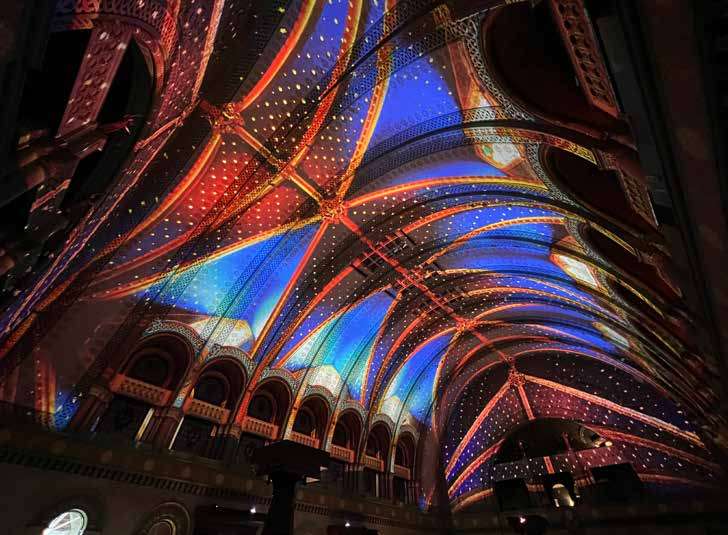
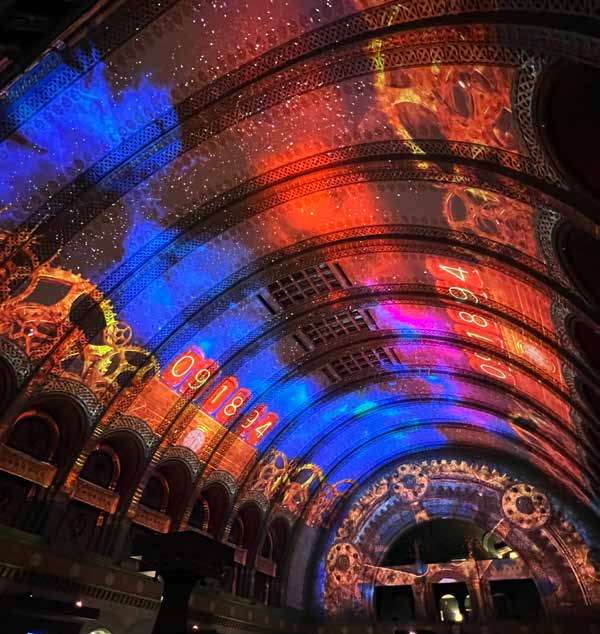
Since opening in 2014, the Grand Hall Experience in downtown St. Louis, Missouri, has helped focus attention on the re-transformation of historic Union Station as a hospitality and entertainment destination under the direction of Lodging Hospitality Management (LHM), which acquired the complex in 2012. The Grand Hall Experience is a free attraction running a nightly series of immersive shows, projection-mapped on the ceiling and walls of the lobby/lounge of St. Louis Union Station Hotel (Curio Collection by Hilton). The shows highlight the period architecture while telling stories that speak to local history and feature local celebrities.

LHM has continued to invest in this successful attraction to keep it at its best over a decade-plus of steady operations including special events. In fall 2025 the projection system received a comprehensive, state-of-the-art upgrade with all projectors provided by Christie®: two Griffyn® 4K50-RGB projectors and 12 projectors from the Jazz Series, model DWU2400A-JS. At this writing, the existing show library was in the process of being re-rendered and two new shows were in production by DreamLab Immersive, which also specified the new Christie projectors.

“We didn’t just patch things up, we rebuilt the system to suit a next-generation immersive show environment,” says John Miceli, DreamLab founder and executive creative director. Miceli has been creatively affiliated with the project since it first opened. “LHM recognized that a refresh would not only delight guests but also reaffirm the Grand Hall’s position as a must-see, immersive destination.”

The team at LHM give positive marks to the new system, and foresee a good run from the Christie projectors with notable improvements in show quality and guest experience, while anticipating improved operations and business benefits. “The system is very heavily used every day, almost like a theme park installation,” says Greg Buerkle, audiovisual director at St. Louis Union Station. “The Grand Hall is our crown jewel. I think people are going to notice the improvements we have made.”

Raising the bar

The Grand Hall began life as the waiting room of the venerable train station that was built in 1894 in the Romanesque Revival style and was, in the 1940s, the nation’s busiest. Preservation dictated that the installation preserve the character of the ornate interior, concealing the technology that would display media on the 65-foot, vaulted barrel ceiling and two curved walls or endcaps.

“The primary goal was to bring the experience up to current technological standards, upgrading to higher resolution, smoother frame rates, richer color, and more dynamic shows, while preserving the architectural integrity and magic of the space,” says Miceli.

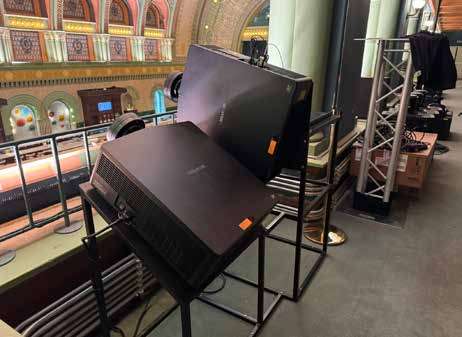
12 Christie Jazz Series projectors (two of which are pictured here) and two Christie Griffyn 4K50-RGB projectors illuminate the Grand Hall for the nightly shows. Photo courtesy of Ken Saba.

The workhorses of the installation are the two Christie Griffyn 4K50-RGB pure laser projectors selected for the endcap projections, ably supported by the Christie Jazz Series projectors covering the barrel-vaulted ceiling. Miceli outlined the projectors’ power to deliver better imagery. “First, brightness: the Griffyn 4K50 is powerful enough to overcome the ambient light in the Grand Hall during the day to expand on the ability to play daytime shows without washing out the projection. Second, color: the RGB pure laser architecture delivers a broader and more saturated color gamut, allowing us to produce vivid, painterly visuals and delicate tones that weren’t as achievable with older lamp-based or single-source projectors. Third, resolution and frame rate: combined with our upgraded server infrastructure, we could push true 16K imagery at 60 frames per second [fps], giving the shows a smoother, more cinematic feel.”

“They are able to get super high contrast and amazing, accurate color reproduction with these new, best-in-class projectors,” says Ernest Bakenie, senior director of sales, themed entertainment, Christie. “Going to 60 fps doubled the frame rate, supporting more fluid images. And this technology delivers true blacks, so the contrast really pops, and you can see more details in the content. It really makes a difference.”

Other Griffyn features include Christie TruLife+™ electronics, proprietary RGB pure laser illumination architecture with a sealed optical path. This model also delivers 50,000 lumens at full brightness, native 4K resolution and includes Christie’s electronic color convergence (ECC), which enables color alignment to be adjusted by remote control.

The Griffyn produces a wide color gamut, approximately 98% of the Rec. 2020 color space. This expansive color palette leaps beyond the earlier benchmark of Rec. 709 associated with HDTV and is a producer’s dream in terms of visual richness and range, and precise color matching. “We’re bringing the content to life like it’s never been seen before,” says Bakenie.

Buerkle praised the projectors’ ability to deliver so much so efficiently. “It was exciting to get them up there and start to see their performance and the immediate increase in brightness. During the daytime, we used to have a noticeable difference in visibility due to ambient light. Now, the new projection punches right through.”

The compact form factor was a boon to installation and promises well for future maintenance. “We had to move the new projectors up to the historical Grand Hall without an elevator,” says Buerkle. “Due to being smaller and lighter, they required less manpower to lift.” [A Christie Griffyn 4K50-RGB weighs in at 197 lbs; a Jazz at 65 lbs.] “Some of the projectors are placed in areas that are not very accessible, and due to taking up less space and being lighter, they’re going to be much easier to clean. We’re expecting to bring maintenance costs down.”

He continued, “Of course we are always concerned about servicing. We were looking at a lot of factors when we purchased the new Christie projectors, such as how long we can expect to keep an installation like this running with the existing equipment. That was a big factor. We’re seeing indications that we’ll get good life performance out of them.”

The new system and higher resolution also provided the capability to enlarge the projection area. “We now have a much wider field,” says Miceli. “The re-rendered library and the new shows will make the most of it, bringing the view farther down the walls while also further enhancing the room’s architecture.”

The overhaul also includes new digital VYV Xenon media servers, selected by DreamLab for performance, reliability, and compatibility with high-frame-rate content.

Reading the room

By any standard the Grand Hall Experience is unique due to its content, setting and presentation. But it is further distinguished by having set a new model for the industry when it first opened – as a permanent, indoor projection mapping installation on a large scale. In 2015, the attraction was recognized with a TEA Thea Award.

LHM has continued to redevelop Union Station into a competitive entertainment and hospitality destination, expanding its leisure offerings with an aquarium, a Ferris wheel and new restaurants, with more on the horizon. Today’s Union Station stands as a leading element within a corridor of downtown St. Louis improvements and attractions serving locals, tourists and business travelers.

Because the Grand Hall Experience takes place in a working hotel lobby and lounge as opposed to a theater or ride, it had to have the right ambience to complement the primary functions of that space and not overwhelm the room or the guests. It had to be respectful to the nature of the space and why guests were there.

“It really is about enhancing the venue,” says Bakenie. “The media has to be purposefully complementing the beauty of the architecture and the history of the venue, not detracting from it. And that’s what a great creative team can do, along with the proper technology and the proper tools. You’re not just sitting there and seeing objects on the ceiling. It’s actually an event that evokes emotions. And in order to get an emotion, you have to have the right tools.”

“This refresh represents not just a technical upgrade, but a reaffirmation of what immersive storytelling can be in an historic space,” says Miceli. “The Grand Hall Experience fuses artistry and technology in ways that deepen emotional connection, celebrate architectural heritage, and create memories in a location that is steeped in history.”

“It was like seeing a whole new show, with the difference in the vibrancy and the lumen level,” says Buerkle. “And now we’re able to get so much more punch out of a smaller body. Instead of a three-foot-long monster sitting on a truss, you have a projector that’s the size of a large shipping box. The advancement of technology is an amazing thing.”

Other areas of St. Louis Union Station have also benefited from updates. “About two years ago we upgraded an installation in our aquarium with Christie projectors, and the performance has been excellent,” says Buerkle. “I look forward to seeing the performance of these newest ones.”

Buerkle continues, “Content-wise, we’re really trying to make this place a destination and that’s a big part of the current upgrade. The Grand Hall Experience is a central facet of St. Louis Union Station. It drives business to our hotel and helps people appreciate our city. I think it’s going to be good for us.”

It is because of the operator’s continual reinvestment in the attraction, and the team’s dedication to high quality and thoughtful choices, that the Grand Hall Experience has retained its wow factor, even as industry standards and public expectations keep rising. The praise given to this attraction when it first earned a Thea Award still rings true: In the words of the Thea Committee, “The project has not only rejuvenated a National Historic Landmark, but it is an engaging, dynamic space that allows the audience to see the architecture in a whole new way with gorgeously rendered, uniquely stylized and fully-developed moments in time or place.” •

Acknowledgment: The writer thanks Ken Saba for providing valuable assistance in gathering information for this article.

Almeria: Installing the thrills

ALMERIA BRINGS ITS RIDE INSTALLATION EXPERTISE TO SEAWORLD AND SIX FLAGS PARKS IN THE UAE AND SAUDI ARABIA

by Joe Kleiman

As the Middle East accelerates its investment in world-class themed entertainment, the scale and complexity of new attractions are reaching unprecedented levels. Delivering those experiences requires more than innovative ride design. It demands installation partners with deep construction expertise, rigorous safety standards, and the ability to operate in extreme environments.

Over the past several years, Almeria has emerged as a key player meeting that challenge. The company has been responsible for installing landmark attractions at SeaWorld Yas Island Abu Dhabi and Six Flags Qiddiya City, working closely with manufacturers, developers, and contractors to bring some of the region’s most ambitious rides to life.

“At the end of the day, the right installation comes down to precision,” says Karim Malaeb, Managing Partner at Almeria. “You have to consider every factor, not just how the ride performs for the guest, but how it will operate and endure over its entire lifespan.”

From construction roots to attractions specialization

Almeria’s story emerges from the construction legacy of International Décor & Contracting (IDC), a UAE-based specialized contracting and fit-out firm founded in 1983 by Karim’s father Majid Malaeb. For over forty years, IDC has delivered complex projects across aviation, healthcare, hospitality, and culture, including Zayed International Airport in Abu Dhabi and the recently opened teamLab Phenomena Abu Dhabi on Saadiyat Island.

“IDC was the foundation of our construction background in the UAE,” Malaeb explains. “My father founded the company and he still plays an active role today as a leader and visionary within the business.”

Karim Malaeb
Almeria

IDC’s entry into themed entertainment came with Warner Bros. World Abu Dhabi, the region’s first indoor Warner Bros.-branded theme park. That project introduced the company to the unique demands of attractions construction, where structural precision, creative intent, and operational performance must align seamlessly.

“Warner Bros. World was really a steppingstone into the attractions industry,” Malaeb says. “Developers were keen to see what further services we could deliver at those same standards.”

Recognizing the opportunity, the team established Almeria as a specialized service focused on ride installation and attractions delivery, leveraging IDC’s construction expertise while building dedicated technical and operational capabilities for the entertainment sector.

“We knew our clients had the same high expectations they were used to with IDC,” Malaeb says. “So we took our extensive construction background, combined it with strong technical expertise, and pushed a specialized new service to the market.”

Managing complexity through collaboration

Large-scale attraction projects involve a wide network of stakeholders, from creative consultants and project management teams to ride manufacturers, main contractors, and client representatives. Almeria operates as a specialist contractor within that ecosystem, coordinating closely with all parties to ensure installations meet both creative and technical requirements.

“It’s always a group effort,” Malaeb says. “We work with the creative consultants to ensure the finished product meets their expectations, with the Project Management Consultant overseeing the work with the main contractor, and with the client’s representatives. There’s a lot of planning and managing involved to achieve what you ultimately see on site.”

That collaborative approach was critical at SeaWorld Yas Island, Abu Dhabi, the world’s largest indoor marine life theme park and adopted on many attractions Almeria was involved in. Over the past few years, Almeria installed a wide range of attractions across the UAE, including several from notable manufacturers Zamperla and Intamin. The company led the installation of a large-scale dome simulation ride, a custom indoor/outdoor triple-launch coaster, and expansive mega soft play structures – along with performing maintenance and refurbishment work on other attractions. 

Precision inside and out at indoor theme parks

Erecting rides indoors presents unique challenges. On of the theme parks, Almeria was involved in, Massive steel structures had to be assembled within confined spaces while coordinating with façade installation, theming, and building systems. Sequencing was essential, particularly when ride components needed to be installed before roof closures limited access.

“You’re dealing with very restricted spaces, but at the same time you’re building massive structures,” Malaeb says. “That required a high level of coordination between many different parties.”

Desert temperatures can significantly affect installation procedures, particularly when it comes to bolting and re-torquing. “There are specific temperature ranges recommended by manufacturers for activities like torquing,” Malaeb explains. “Those conditions have to be respected, especially before final re-torquing after the ride has been running.”

Environmental exposure also demands immediate inspection protocols. To manage these risks, Almeria develops detailed installation methodologies and risk assessments in advance, based on manufacturer recommendations and site conditions. “Our planning allows us to foresee and prepare for every possible installation scenario,” Malaeb says. “That’s how we mitigate risks and avoid delays.”
Pushing limits at Six Flags Qiddiya City

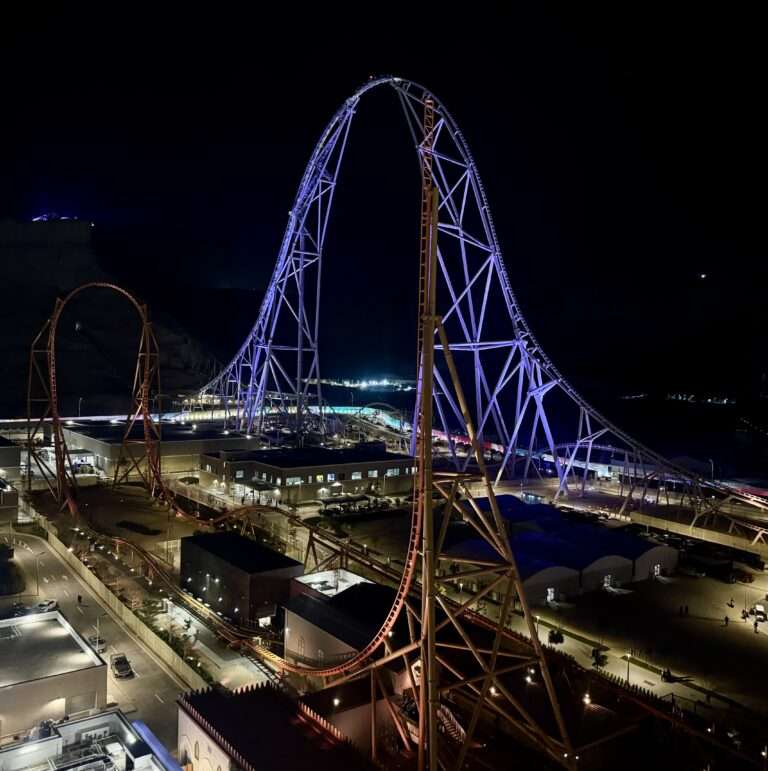
At Six Flags Qiddiya City, Almeria’s work reached new extremes with the installation of two Intamin attractions that opened in December 2025: Falcon’s Flight and the Spitfire triple-launch coaster, which features the world’s tallest inversion.

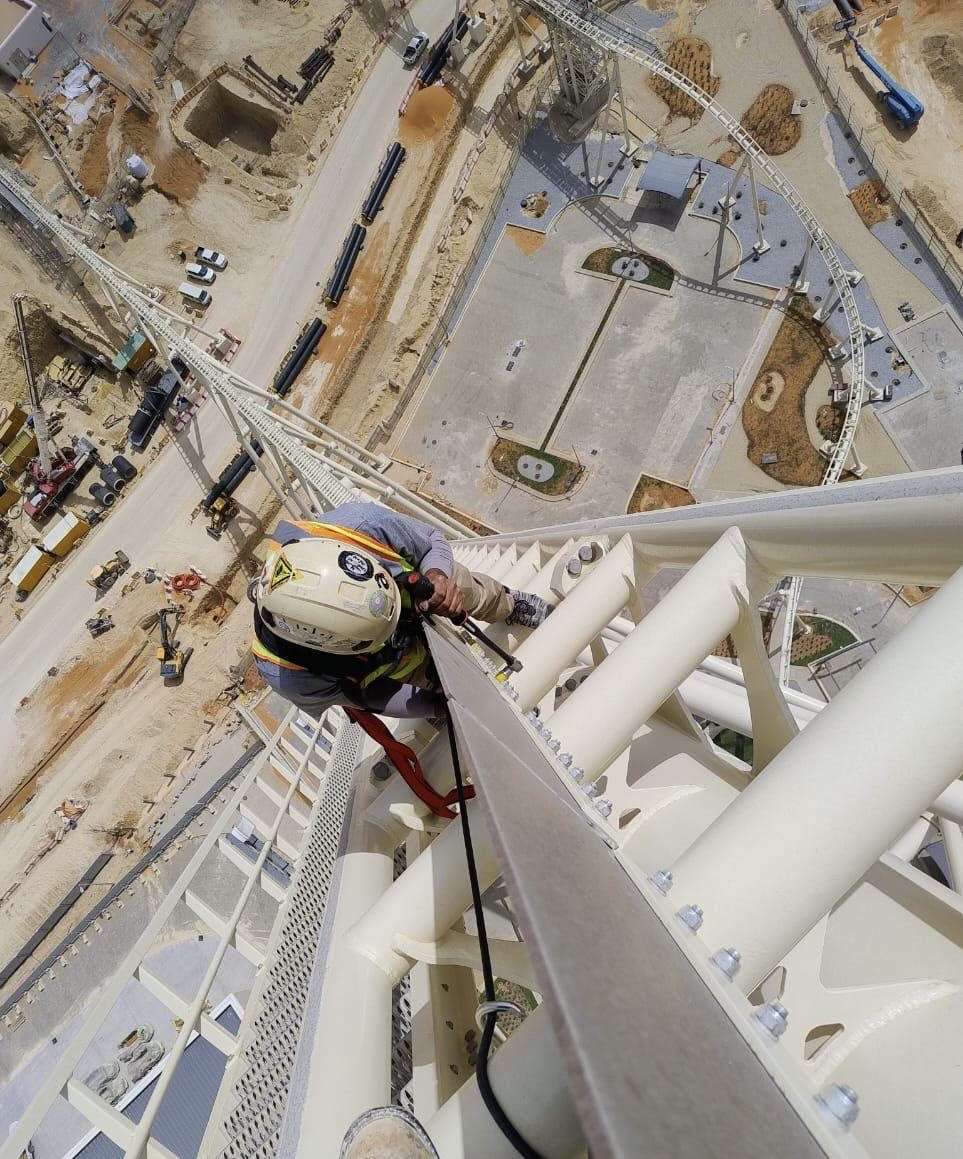
Falcon’s Flight, designed to set new world records, required extensive planning and risk assessment. While the ride design itself did not change during construction, the installation methodology was critical. “You can imagine the challenges of hanging at 170 meters in midair to put a camelback into place,” Malaeb says. “Several sections alone weighed over 20 tons, and were installed in single lifts.”

Every lift was calculated and reviewed by third-party specialists, with wind speed, alignment, and safety continuously monitored by all stakeholders. “Everything was overseen by the client, the contractor, our team, and independent inspectors,” Malaeb says.

Installing thrill rides requires expertise, safety and attention to detail. Photo courtesy of Almeria

Wind conditions in the desert frequently forced schedule changes. “There were many nights when we had to postpone installations because of high wind speeds,” Malaeb says. To reduce time spent working at height, Almeria collaborated with Intamin and the client to preassemble major components on the ground before lifting them into place. “That allowed us to minimize the hanging time,” Malaeb explains. “When that last piece fit in, it was a great feeling. It was a major milestone for everyone involved.”

A turnkey approach to ride installation

Almeria’s value in the region lies in its turnkey approach to ride installation. The company manages logistics, surveying, methodology development, risk assessment, and execution, ensuring manufacturer requirements are met and inspection approvals are achieved efficiently.
“We use our own in-house electrical and mechanical technicians, project managers, and riggers,” Malaeb says. “That’s how we ensure constant quality delivery.”

Decades of construction experience in the UAE further strengthen that capability. “Those 43 years in the construction business add real value for our clients,” Malaeb says.

Feedback from ride manufacturers has reinforced Almeria’s reputation. In a message from Intamin’s roller coaster team, the manufacturer praised the “high work quality” of Almeria’s installation teams and the “constructive communication and cooperation” throughout the project.
Building what comes next

As the Middle East continues its rapid expansion into large-scale, technologically advanced themed entertainment, the expectations placed on ride installation partners are only increasing. Projects are becoming taller, faster, heavier, and more integrated with architecture, media systems, and extreme site conditions, demanding a level of precision that leaves little margin for error. For Almeria, that evolution aligns directly with the company’s DNA.

“Our focus has always been on being prepared before we ever step on site,” says Malaeb. “That means understanding the manufacturer’s requirements, developing the right methodology, and planning every scenario in advance. When you’re working at these scales, preparation is everything.”

The installations at SeaWorld Yas Island and Six Flags Qiddiya City have positioned Almeria at the forefront of the region’s most ambitious attractions, not simply as an installer, but as a trusted technical partner capable of translating bold creative vision into operational reality. “We’re very proud of what we’ve achieved so far,” Malaeb says. “But more importantly, we’re excited about what’s coming next.” •

MEMORIA EXPANDS THE INTEGRATED OFFERING

IDC’s & Almeria’s growth in themed entertainment continues through Memoria, a joint venture with Lagotronics Projects providing professional AV integration for media-based attractions in the UAE. “IDC was our first foray into the entertainment industry, and Almeria followed as a ride installation service,” Malaeb says. “As we became more involved in theme parks, we saw that Lagotronics shared the same belief in quality delivery.”

Today, IDC, Almeria, and Memoria offer complementary capabilities, from specialized contracting and ride installation to advanced audiovisual systems. “Each company offers something different, but together we can bring all these specialized capabilities under one roof,” Malaeb says. “That puts us in a strong position to take on any new and challenging concepts moving forward.”

PGAV Destinations: Designing what’s next

PGAV DESTINATIONS AT 60 AND THE FUTURE OF GUEST EXPERIENCE DESIGN

by Wendy Grant

As PGAV Destinations marks its 60th anniversary, a new generation of leadership is looking forward. The firm currently has more than 80 active projects globally, spanning attractions, cultural destinations, branded experiences, and tourism developments. John Kasman, one of the new Principals with 32 years of experience at PGAV Destinations, says, “Our roots have always been in destination design and guest experience, but the definition of destination is expanding. Brand destinations, cruise developments, cultural attractions are all drawing lessons from themed entertainment. That’s exciting because we’ve always worked across multiple destination types, and now our expertise in these markets is expanding even faster.”

Founded in 1965, PGAV Destinations has evolved alongside the themed entertainment industry itself, beginning with early master planning and design work for Busch Gardens parks, then expanding through the 1980s into collaborations with SeaWorld, Universal Studios, and major zoological institutions. By the 1990s and 2000s, the firm was helping shape a more narrative-driven era of destination design, from international projects like PortAventura in Spain to innovative experiential environments such as SeaWorld Orlando’s Discovery Cove and Georgia Aquarium, then the world’s largest aquarium.

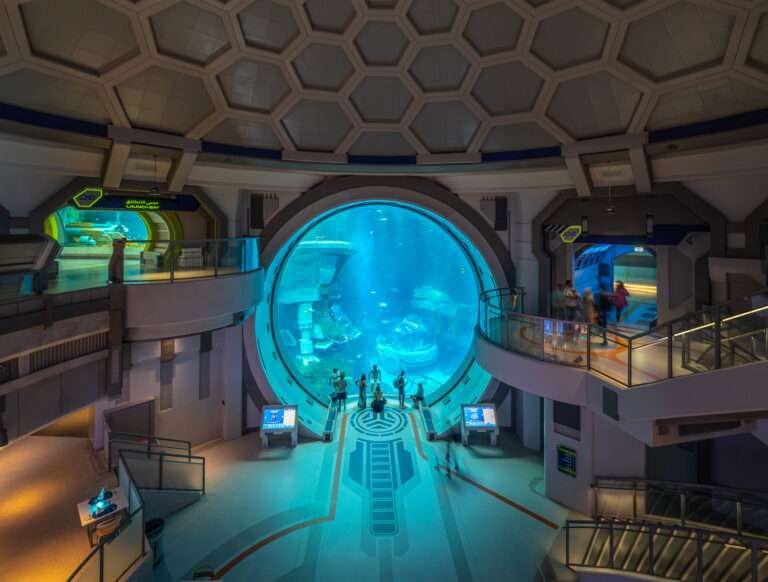
In the 2010s, PGAV broadened its scope further into museums, cultural heritage destinations, and brand-driven experiences, including projects such as the Space Shuttle Atlantis exhibit at Kennedy Space Center Visitor Complex, master planning for The Biltmore Estate, and the design of Chimelong Ocean Kingdom in China. More recent projects, like the world’s largest indoor marine life theme park, SeaWorld Yas Island, Abu Dhabi, reflect the themed entertainment industry’s increasing focus on global tourism and hybrid destination models.

For PGAV Destinations, that history serves as a foundation for what comes next. As the firm looks forward to a future shaped by expanding experiential markets, new technologies that will enhance shared guest experiences, and deeper cultural storytelling, PGAV Destinations’ intentional leadership continuity, deep understanding of their clients and visitors, and passion for the industry positions the firm to help create the next generation of destinations.

Internal succession as strategic strength

Last year, Ashley Edelbrock, Emily Howard, John Kasman, Diane Lochner, and Tom Marschner became Principals with PGAV Destinations. This ownership expansion was intentional. Each Principal is an active practitioner who has contributed to PGAV’s success for years.

“This is really only the third generation of leadership in 60 years,” Kasman says. “All of us have been here a long time, working together across themed entertainment, zoos, aquariums, and other destination types.”

That continuity extends beyond the leadership team. Many of PGAV Destinations’ 140 core team members have been with the organization for decades, reflecting a deliberate emphasis on cultivating talent internally.

Tom Marschner sees that generational depth as one of the firm’s greatest strengths. He says, “It’s incredibly special to have people with 40 years of experience working alongside those with just a couple and seeing how much they learn from each other. It’s exciting to think about the amazing projects this team will continue to create around the world.”

Kasman adds, “We support our team members’ growth through professional development within their disciplines, such as architecture, exhibit design, and graphics. And we also help them gain the leadership skills and expertise they need to serve clients expertly.”

PGAV’s in-house development programs include presentation skills workshops, mentorship initiatives, and the PGAV GO program, which provides funding for employees to seek certifications, attend professional events, and to gain industry insights.

That investment, Kasman notes, directly benefits clients. “Sixty years of cultivating talent adds depth to what we bring to projects. That investment matters.”

Diane Lochner agrees. “Growth at PGAV isn’t only about expanding markets or services – it’s about expanding our people: their confidence, their expertise, and their influence in shaping meaningful guest experiences,” she says.

Designing a strategy

That strong foundation of PGAV Destinations’ work frequently extends from early master planning and design through construction oversight and execution. Kasman says, “That means we’re integrating all the elements that shape the experience, including storytelling, ride design, media, lighting design, and special effects. We’re thinking strategically early on, and we also have boots on the ground during construction.”

In addition to offering a balance of creativity and execution, PGAV applies deep strategic thinking to each project. “Understanding how a project will help a client reach business goals, operational goals, and revenue goals is a key part of the design process, no matter the size of the project,” Kasman notes.

“We focus not only on great creative design but on serving our clients by really learning their business. That strategic level of partnership is one of our differentiators,” Kasman says.

In-depth insights

Equally central to PGAV’s methodology is a deep understanding of the client’s clients. “We work to understand the guest experience at a very deep level,” Kasman says. “It’s a priority for us.”

That’s why PGAV conducts extensive visitor research. For the past 10 years, PGAV’s Voice of the Visitor report has explored visitor motivations and industry trends. Additional reports, like Transformation, have explored visitor avatars, like Zen Chasers and Escape Voyagers. Destinology, a bi-weekly publication that reaches more than 40,000 subscribers, offers articles on topics ranging from complying with accessibility regulations to navigating changes in federal funding for cultural institutions to rebranding for zoos and aquariums.

And rather than holding these insights and reports as proprietary information, PGAV makes them available to everyone. “We absolutely love sharing that knowledge,” Kasman says. “It’s better for the industry, better for our clients, and it helps us do our work more effectively. It’s a big part of who we are.”

Ashley Edelbrock says, “Our promise at PGAV is to be a thoughtful partner who is guest-focused, brand-based, and business-centric. We make it our business to know our clients’ business, while also being out-of-the-box thinkers who know what it takes to get difficult jobs done. We like to take complex challenges and turn them into opportunities uniquely positioned within the market.”

Recent projects reflect industry evolution

Kasman highlights hybrid projects, like cruise-linked destinations, as emblematic of the industry’s increasing convergence across entertainment, tourism, and hospitality sectors.

One example is Celebration Key, Carnival Cruise Line’s new private destination on Grand Bahama, where PGAV led master planning, guest experience strategy, and thematic design. Structured around distinct themed zones serving families, adults, and mixed audiences, Celebration Key combines large-scale water attractions, retail, hospitality, and culturally rooted storytelling into a single cruise-linked destination designed to accommodate multiple ships simultaneously.

Celebration Key, Carnival Cruise Line’s private island in the Caribbean, combines luxury, play and relaxation in a fun destination. Photo courtesy of PGAV Destinations.

The project opened in July 2025 and won the World Waterpark Association’s Leading Edge Award. Kasman notes, “It’s a mix of waterpark, themed entertainment, and tourism infrastructure. That blending of sectors is happening everywhere, and we helped lead the effort.”

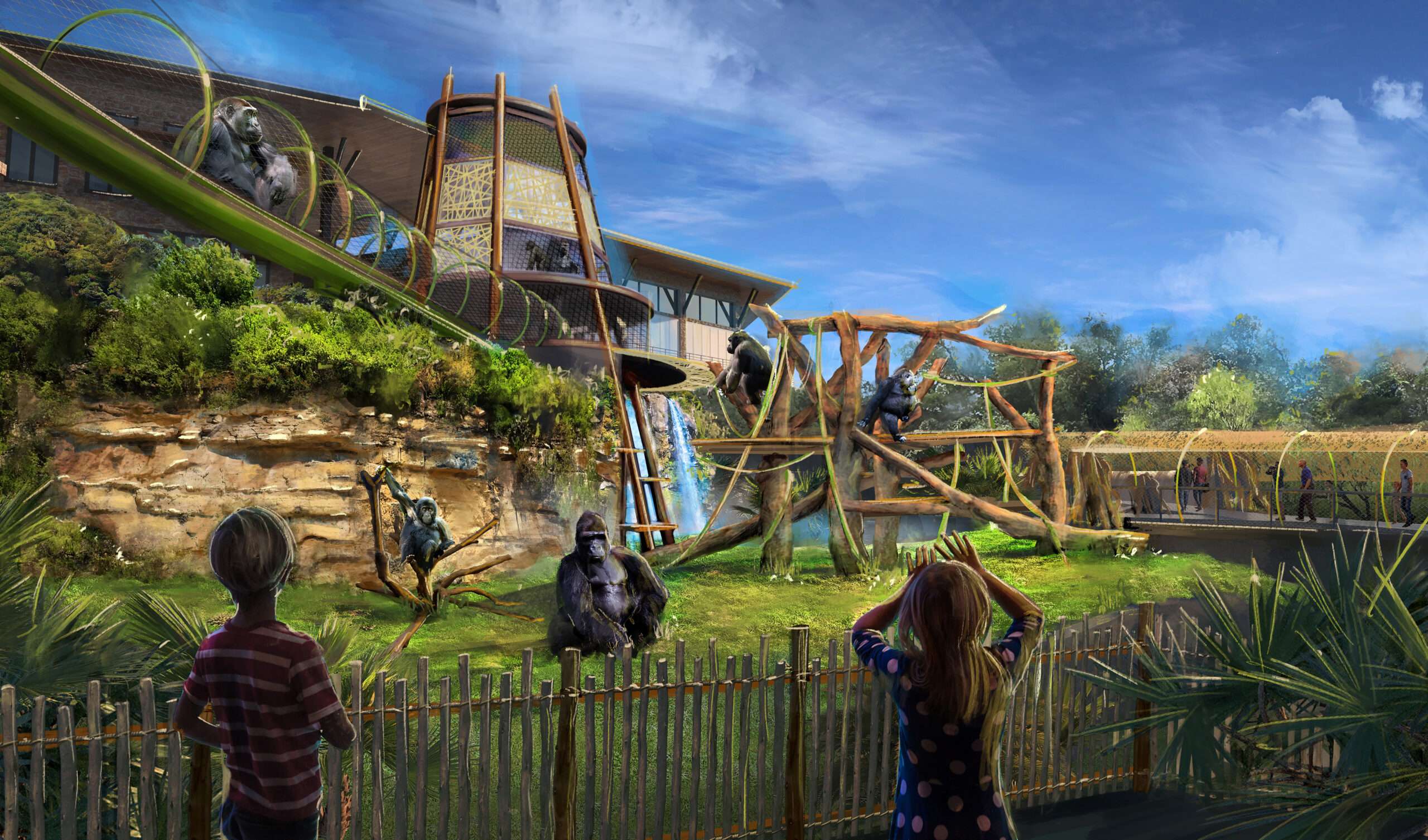
A fusion of innovative habitat design, guest experience strategy, storytelling, and operational thinking can be seen at Congo Falls at the San Antonio Zoo, which was developed as part of a broader campus master plan with PGAV and opened in December 2025. “Attractions are linking more directly to events, programming, and revenue opportunities. That melding is part of where the industry is headed,” Kasman says.

Built within a former quarry, the new gorilla habitat integrates animal wellbeing, immersive guest viewing, and event programming anchored by The Ralston event center that overlooks the habitat. Visitors encounter Congo Falls through layered vantage points, from below-grade views through vegetation to elevated trails mimicking gorilla pathways. The design prioritizes environmental complexity for the animals while simultaneously creating a dynamic guest journey, illustrating how modern zoological destinations increasingly balance conservation, entertainment, and revenue-generating uses such as events and hospitality.

When designing Congo Falls at the San Antonio Zoo, PGAV applied their expertise in animal wellbeing and visitor experience to create an innovative new habitat for gorillas. Photo courtesy of PGAV Destinations.

Emily Howard sees their work on Celebration Key and the San Antonio Zoo as representing two particular strengths of PGAV: experiential tourism and natural environments. She notes, “We have been building on the momentum of experiential tourism by immersing people into destinations through media, themed environments, interactions, and the like. Additionally, appreciating and being part of nature in a meaningful way will never go away.

“We design natural environments for all species, thinking deeply about how to provide spaces to disconnect from busy lives, connect with the world around us, and just take a breath. We create opportunities to help people make lasting memories,” says Howard.

Technology, culture, and shared experiences

Continuing to look ahead, Kasman sees technology uniting rather than isolating visitors. “We’re just at the beginning of how tech can allow guests to impact their environment,” he says. “What excites me is how it can encourage shared experiences.”

For instance, advances in AI-driven language translation, real-time interaction, and adaptive storytelling may help visitors from different cultures experience destinations together seamlessly. Kasman says, “It’s wonderful to imagine people sharing experiences even when they don’t speak the same language, and technology making that effortless rather than operationally complicated.”

PGAV’s work increasingly spans North America, Europe, the Middle East, and Asia, and Kasman is seeing cultural storytelling as a growing industry trend. “We’re seeing destinations celebrate the culture they’re in more intentionally,” Kasman says. “Intellectual property [IP] will always matter, but cultural expression is becoming a bigger part of destination design.

“I don’t think the world is getting smaller – I think it’s getting more connected,” he continues. “I love seeing regions invest in celebrating their culture and sharing that through tourism.”

Curiosity, collaboration, and passion

This global connectivity reinforces Kasman’s positive outlook. “There’s definitely optimism – for the industry and for PGAV’s future,” he says.

Kasman says that the words that characterize PGAV’s culture are curiosity, collaboration, and passion. Those qualities, he believes, translate directly into stronger projects.

“When you have curiosity and you keep pushing yourself to learn more, it helps in strategy, it helps in design, it helps in everything,” he says. That means staying curious about clients’ businesses, emerging technologies, cultural contexts, and the evolving expectations of guests.

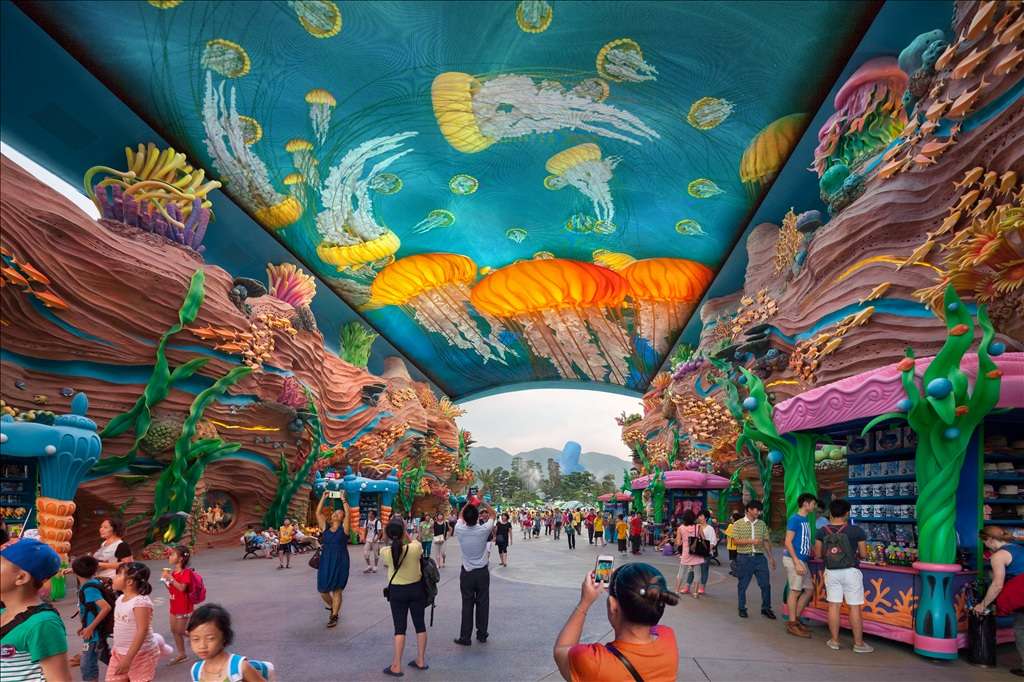
The entrance to Chimelong Ocean Kingdom, designed by PGAV, immediately immerses guests in the park’s aquatic theme. PGAV continues to have a client relationship with Chimelong. Photo courtesy of PGAV Destinations.

Collaboration, he says, is equally foundational. PGAV intentionally fosters a highly collaborative environment, because complex destination projects demand integrated thinking. “We’ve always encouraged teams to work closely together, not just with each other but with our consultants and clients. That collaboration improves how we execute projects,” explains Kasman.

Passion is tied closely to storytelling. Kasman says the firm’s work, whether rooted in IP, culture, conservation, or place-based narrative, naturally invites deeper engagement. He shares, “When you dive into the story behind a project and you’re passionate about it, when you fall in love with what you’re doing, the project only gets better.” That passion, he believes, ultimately shapes the guest experience as much as design does.

Sixty years forward

As experiential destinations evolve, becoming more multidisciplinary, culturally rooted, technologically connected, and strategically driven, firms that are able to combine creative design, research, operational insight, and execution expertise could shape the next chapter of themed entertainment on a global scale.

For PGAV Destinations, its 60th anniversary marks continuity more than change, with internally cultivated leadership, deep institutional knowledge, a sustained focus on understanding both guests and clients, and passion for the projects they take on. And at PGAV, that legacy serves as a springboard for what’s next: PGAV is expanding its international practice with a physical presence in Abu Dhabi to better serve clients, responding to accelerating investment in themed entertainment, cultural institutions, and experience-led tourism in markets such as the Middle East and Asia.

“We’re proud of where we’ve been,” Kasman says, “but even more excited about where the industry – and our work – are heading.” •

Why experience design is replacing the attention economy

by Dominic Audet, Co-Founder & Chief of Innovation, Moment Factory

The evolution from attention to connection
Dominic Audet,
Moment Factory

For decades, brands, urban destinations, and theme parks have competed for visibility, measuring success through reach and digital KPIs. This attention economy has shifted the discourse on the value of these metrics. The infinite content, game mechanics and ubiquitous screens of the digital age have fundamentally reshaped how we experience and interact with each other. Destinations do not compete on impressions and clicks, or the behavioral constraints of attention. They aim to generate persistent and cumulative relationships with people, real-world conditions for emotional connection and cultivating a sense of belonging.

After designing more than 600 large-scale public and cultural experiences around the world over 25 years, we’ve seen this shift take place. The places people return to and talk about are no longer the loudest or most visible. They are the ones that create remarkable shared moments, spark emotion, and guarantee to leave a lasting memory. Attention may get people through the door, but forging connections through authentic shared experience is what makes destinations stand out, making people stay longer and return again.

Multi-layered experience design

Some of the world’s most digitally native companies are now investing heavily in physical, real-world experiences to extend their impact. Urban developers and themed destinations are recognizing this change as well. Around the world, we’re moving away from single-purpose destinations toward living models where different generations, interests, and activities coexist. Entertainment and culture are no longer programs considered at the end of a project; they have become anchors. Mixed-use development is creating innovative hybrids, with emotional gravity becoming the driving purpose of destinations that succeed in bringing people together. Happiness, belonging, and community are no longer abstract outcomes; they are central design principles shaping how places are imagined and built.

Working across verticals – from concerts, festivals, public space activations and hospitality programmed in theme parks like in urban development and sports venues – we see a future of experience design in placemaking where these layers coexist in an annual schedule. By programming them with local and authentic flavor, destinations can integrate this thinking from the earliest stages of master planning, deepening engagement and reclaiming the appeal and cultural resonance that truly draw local audiences with repeat visits and give tourists a remarkable authentic experience to remember.

A themed entertainment mindset

For example, applying a themed entertainment mindset to a sports venue enables operators to blend storytelling tied to the venue’s identity and IP with creative, immersive design, bringing the space to life year-round while preserving its integrity and core function.

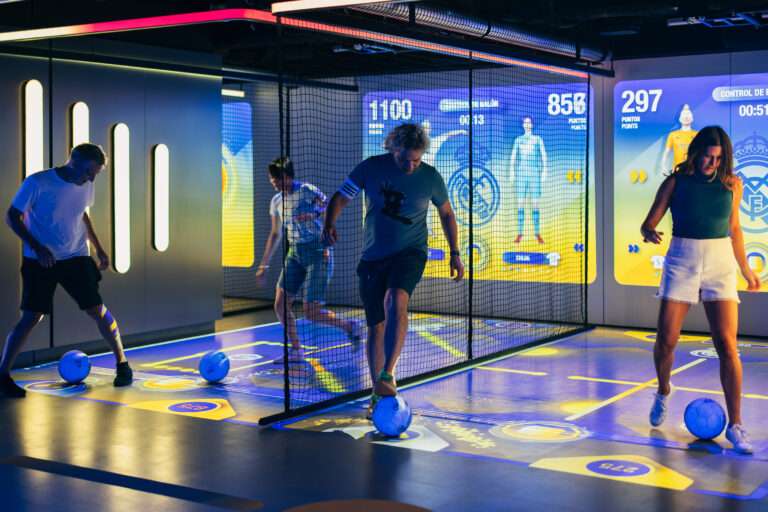
Realmadrid Games, a permanent addition to the newly renovated Bernabéu Stadium in Madrid exemplifies this approach in action. The objectives of Real Madrid were to strengthen the connection between fans, the team, the stadium, and the city of Madrid, while generating new revenue streams on non-match days and optimizing underused infrastructure.

While Real Madrid is one of the world’s most powerful sports clubs, Bernabéu, like many stadiums worldwide, faces the challenge of maintaining engagement with the public on non-match days. In close collaboration with the club, we developed an innovative experience that transforms the stadium corridors into a multi-level, Real Madrid-themed gamified journey. This modular attraction, which does not obstruct high traffic on game days, combines interactive technology and immersive media, allowing players to progress from “rookie” to “elite” status via connected devices and custom avatars wearing the club’s colors.

Emotional bonds through shared collective experiences

Why does it work? Everything we do is guided by a simple belief: people form strong emotional bonds through shared collective experiences. Human connection always comes first in the design. From there, we craft narratives rooted in place, purpose, and audience, using creative and multimedia tools to transform spectators into participants. When people actively engage with each other – not just coexist – emotional impact becomes deeper and more enduring.

Immersion and interactivity play a central role in this, allowing people to connect directly and emotionally with their surroundings, moving from passive observation to active participation. Sound and music are particularly essential; with our roots in the music world, we know they create the heartbeat of an experience, synchronizing emotions and generating collective energy that transcends language and culture.

Hidden technology at the service of human connection

Technology, when used well, supports the goal of immersion and enhances participation with interactivity. The most powerful technologies are often the least visible, seamlessly integrated into the environment. Storytelling, scenography, and sensory design are just as vital as digital systems. It is the creative integration of technology that amplifies wonder and magic in an experience, giving people the feeling of living something truly remarkable.

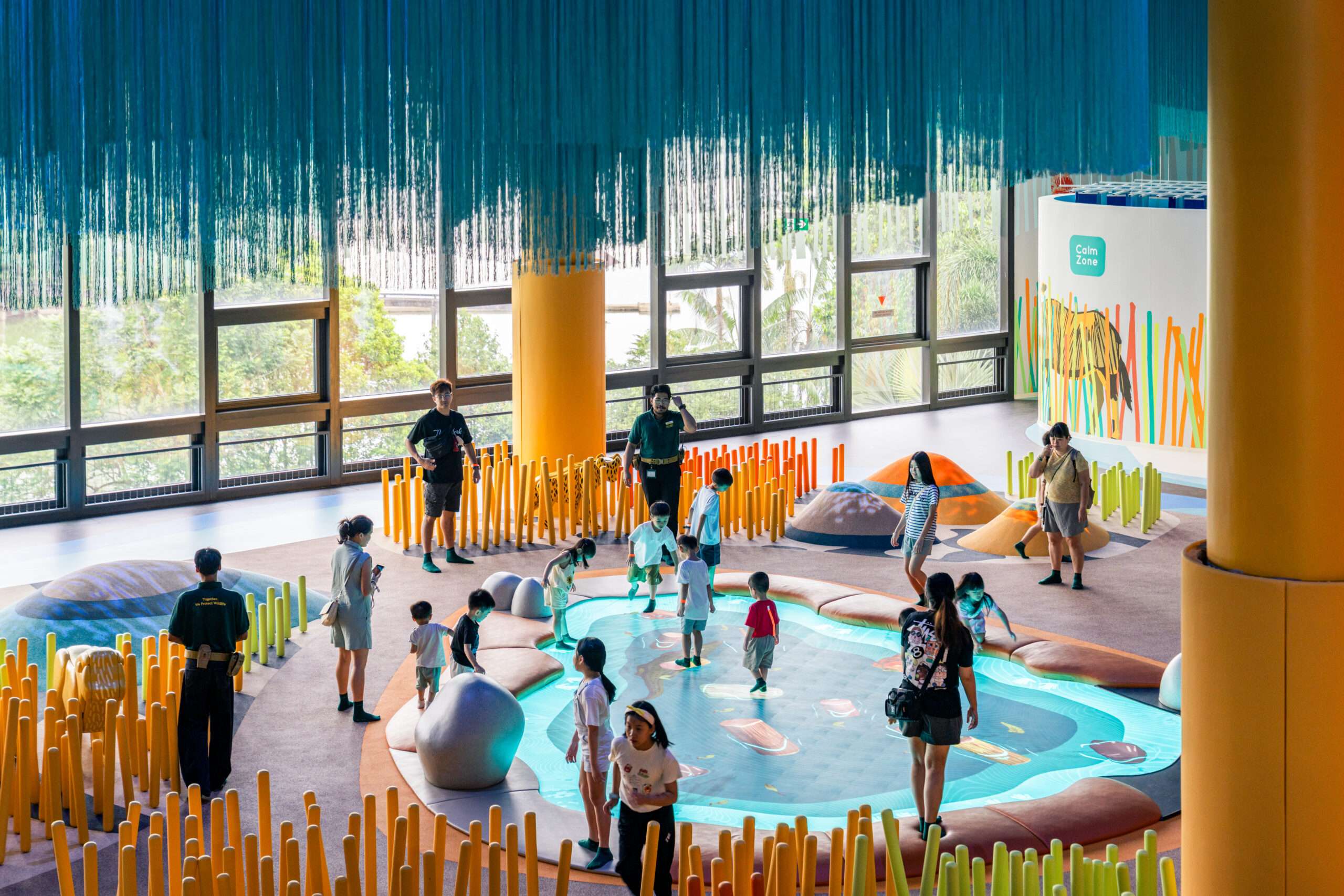
Curiosity Cove at Mandai Wildlife Reserve. Photo courtesy of Moment Factory

At Curiosity Cove at Mandai Wildlife Reserve in Singapore, we were commissioned as lead experience designers to create a permanent attraction that sparks children’s curiosity for the natural world. The 4,600-square-meter space features more than 30 tactile and interactive elements where technology – from sensors, projectors, and lighting to spatialized sound – is thoughtfully embedded directly into the architectural elements, creating a unified physical and digital environment where movement awakens hidden life or alters light and sound.

Building bridges for the future

Looking ahead, destinations will be judged by how they make people feel. Engagement through participation and emotional resonance will become key indicators of success. Entertainment and play are powerful enablers, lowering barriers, encouraging connections and building bridges across cultures and generations to create thriving communities.

As we approach 2026, this shift is accelerating. Moment Factory is committed to being part of this movement, continuing our international expansion with new offices in Abu Dhabi and Riyadh, supporting the growing demand for transformative experiences in the Middle East.

The opportunity within theme park destinations lies in their ability to experiment with new forms of social experience. Entertainment creates a unique mindset – one where visitors momentarily leave behind the complexity and seriousness of everyday life to reconnect with joy and shared human emotion. These environments can become modern sanctuaries: living testbeds for how future cities might feel – contemporary utopias where people genuinely see and connect with one another. In celebrating life together, they remind us that we belong to something larger than ourselves. •

Dominic Audet is Co-Founder and Chief Innovation Officer of Moment Factory. From Montreal’s rave scene roots to building a global immersive entertainment company, he now drives innovation for world-class destinations, blending architecture, technology, and storytelling to create remarkable experiences that connect people in the real world.

JOHN WICK EXPERIENCE: A Continental journey

EGAN PRODUCTIONS , LIONSGATE AND AREA15 COLLABORATE TO CREATE THE JOHN WICK EXPERIENCE IN LAS VEGAS

by Philip Hernandez

In a city built on spectacle, it’s often difficult to rise above the noise. But Las Vegas transplant Jason Egan, founder of Egan Productions, has made a career out of doing just that. The JOHN WICK EXPERIENCE, a collaboration between Lionsgate, AREA15 and Egan Productions, brings together all he has learned through years of crafting immersive and interactive experiences in Sin City.

The JOHN WICK EXPERIENCE combines popular IP, themed beverages, interactive group experiences, and “interactors” under one roof to create a compelling 90-minute experience that blurs the lines between escape room and themed entertainment.

Seeing opportunity on The Strip
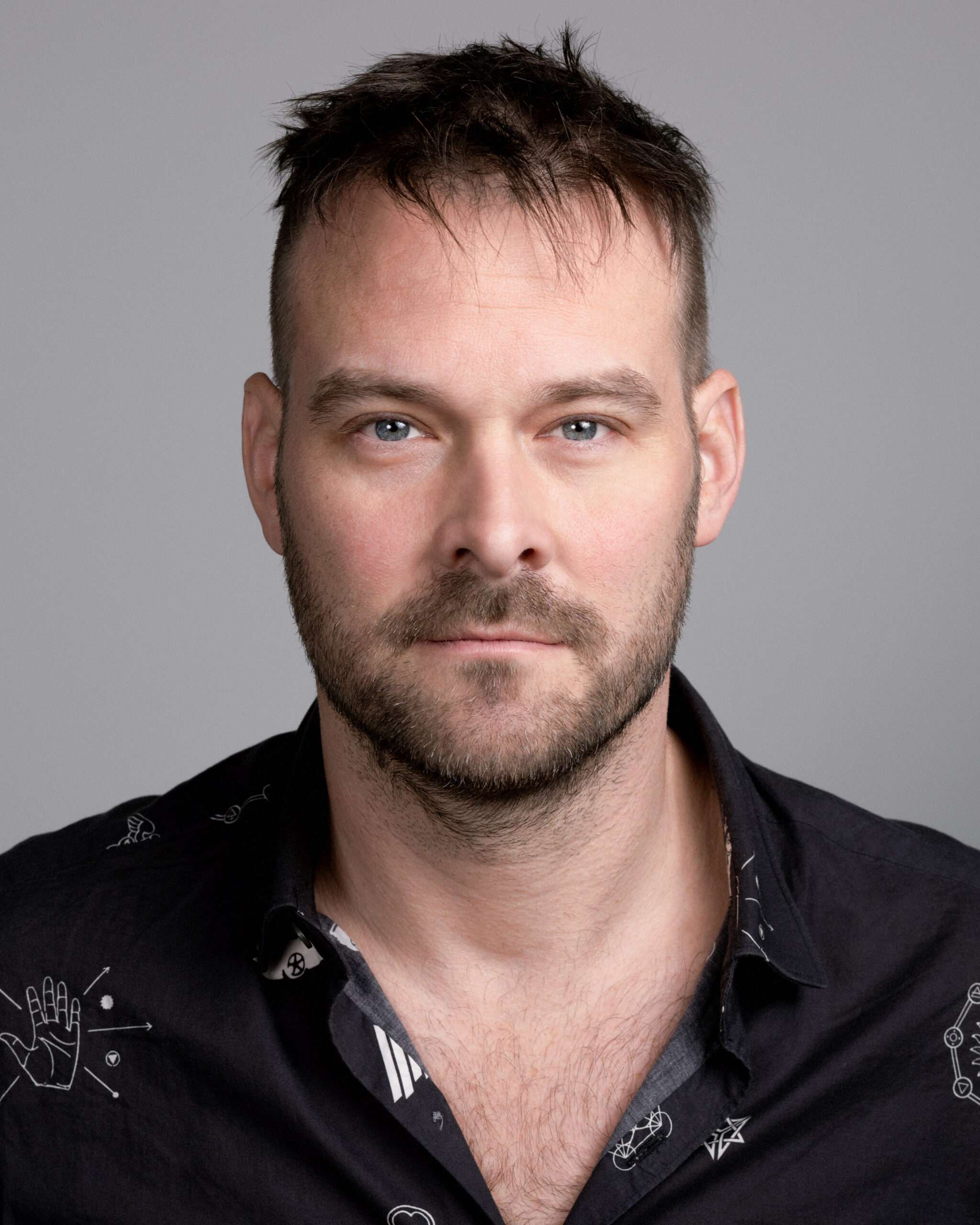
Jason Egan
Egan Productions

Jason Egan moved to Las Vegas at age 22, identifying an opportunity in the city’s lack of quality haunted attractions. “The entertainment capital of the world was being served by temporary haunts in grocery store parking lots,” he says. “No one was investing in permanent infrastructure or high-quality scenic.”

After raising capital working at MGM Grand, he launched his first haunted house in a 10,000-square-foot abandoned ballroom near The Strip. The permanent location allowed him to build higher-quality sets than the competition. The work soon caught the attention of Circus Circus, which was looking to add a similar experience to its property.

At age 23, Egan contracted with Circus Circus to build and operate a professional seasonal haunted house on their property. The result was Fright Dome, which would run for 15 years and rank among the top five haunted attractions in the nation by USA Today. Fright Dome became a Vegas institution, and it’s where Egan first learned about the power of IP, finding underserved demand, and building partnerships that transform cult fandom into scalable business.

Learning the power of IP

During the Fright Dome years, Egan experimented with licensed collaborations. He worked with Lionsgate on SAW-themed mazes, brought in Halloween and Friday the 13th IP, and partnered with filmmaker George Romero. The relationship with Lionsgate began here, in the seasonal haunt context, years before it would evolve into permanent installations.

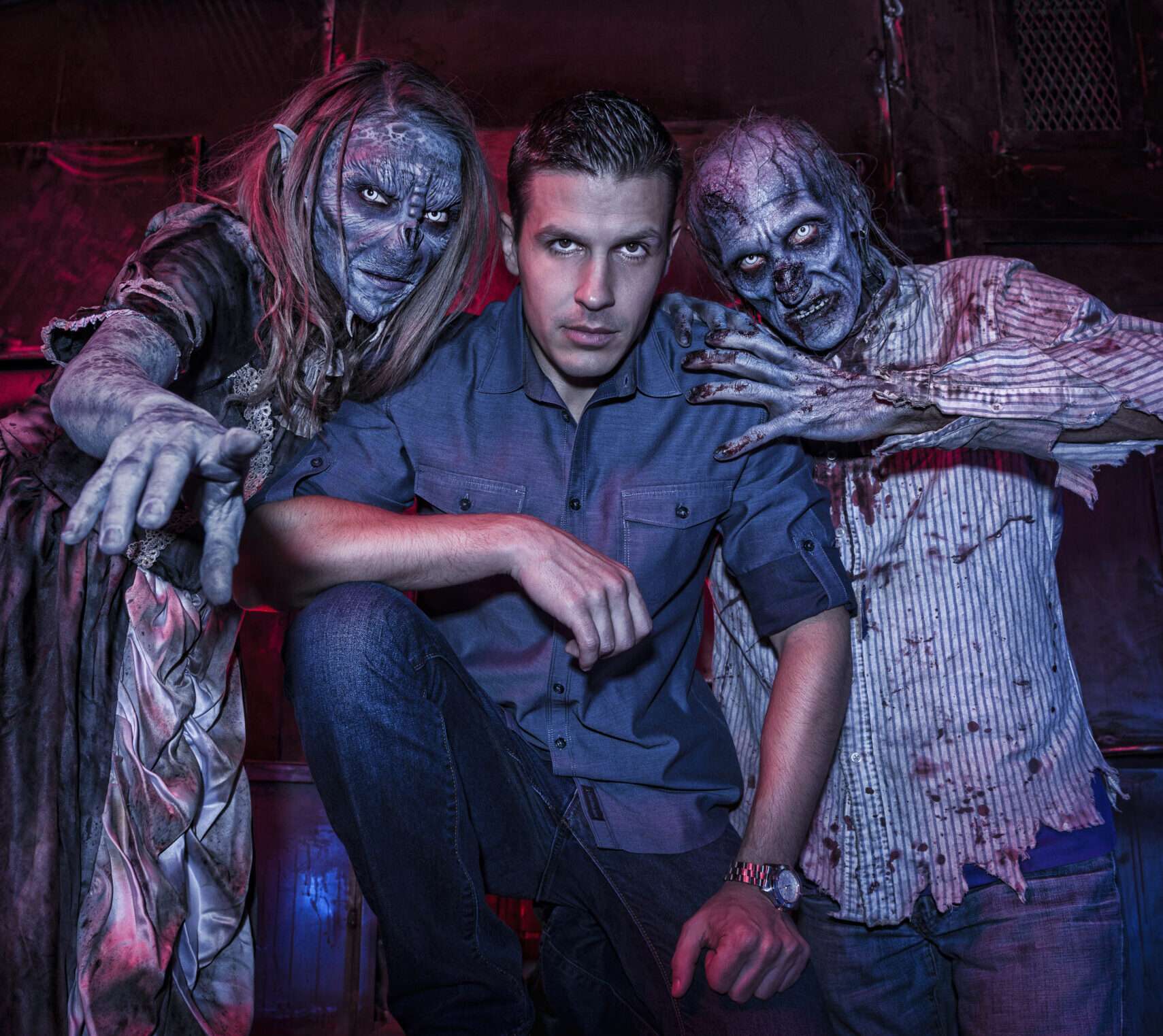
Jason poses with some undead friends, highlighting his background in haunted attractions. Photo courtesy of Egan Productions

In 2016, he created a haunted house based on Five Nights at Freddy’s. The response was immediate and visceral. “Fans were literally breaking into the attraction just to capture footage,” he says. “Their videos generated millions of views online.”

While witnessing how excited fans were to see their beloved stories brought to life was inspiring for Egan, the business model was brutal. Seasonal haunted attractions face cash flow constraints because they must generate a year’s worth of revenue in a single month. “It’s like having a year-round business, but you only have 23 working days to make your money,” Egan explains. “That is a real tall order.”

Another issue is scale. Operating for one-month caps overall capacity because haunted attractions can only put through so many guests per night. “You can’t add more hours to the night or more days to October,” he jokes.

The escape experience innovation

By 2017, Egan began to take notice of another market gap and opportunity. Local escape rooms lacked the production values and storytelling depth he’d developed in haunted attractions, but there was clearly an opening in the marketplace for that level of quality. “At that time, the market standard didn’t prioritize compelling narratives and high-quality scenic,” he says. As he did fifteen years prior with haunted attractions, Egan would redefine the local escape room experience.

This new genre of escape experience combined multiple rooms of quality scenery with theatrical elements, while leveraging IP relationships. Additionally, the year-round business model addressed both the cash flow and capacity issues he faced with haunts. Rather than having a single group solve puzzles in a single room for 45 minutes, he built linear, multi-room attractions where groups moved through elaborately themed environments roughly every 10 minutes, allowing for steady throughput throughout the day.

In collaboration with Lionsgate, Egan opened The Official SAW Escape in 2018 (later named Best Escape Room by USA Today). Escape Blair Witch followed in 2021, continuing his collaboration with Lionsgate. With each project, Egan refined the format, culminating in 2023 with his largest installation: Escape IT, produced in collaboration with Warner Bros.

Escape IT is divided into two experiences, chapters One and Two, corresponding to the movies. Each experience lasts 90 minutes, and guests travel through 16 rooms featuring live actors and show sequences that follow each movie’s plot. Guests work together to solve puzzles in each room, walking through iconic scenes from the movies while trying to escape before Pennywise catches them. “When guests first approach the Neibolt House, you can see the reaction on their faces,” Jason says. “We’ve had many sold-out months, and demand remains strong.”

Crossing genres

As Escape IT was growing in popularity, Universal Destinations & Experiences announced Universal Horror Unleashed for AREA15 in Las Vegas. Egan’s escape experiences were already differentiated from Universal’s walkthrough model as they relied on people actively solving puzzles together and participating in the story, which was fundamentally different from being scared by actors in a linear haunted house. Still, as he considered expansion, diversification beyond horror made strategic sense. “I thought this was probably a good time to look beyond my go-to genre of horror,” he says. “I knew we had to diversify and would be better off if we didn’t put all our eggs in the horror basket.”

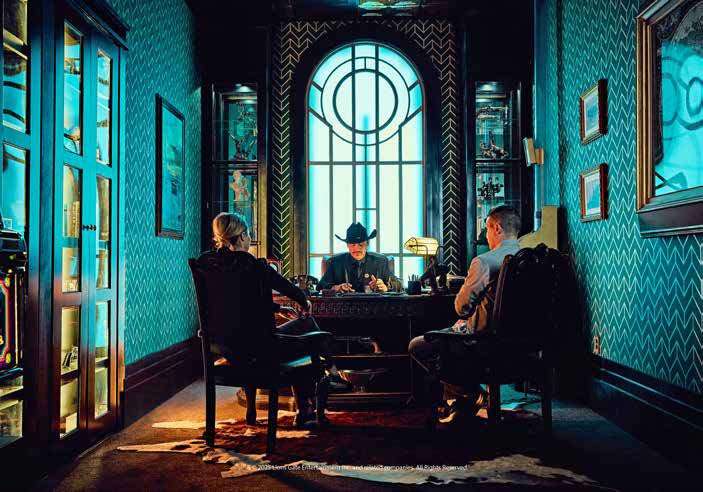
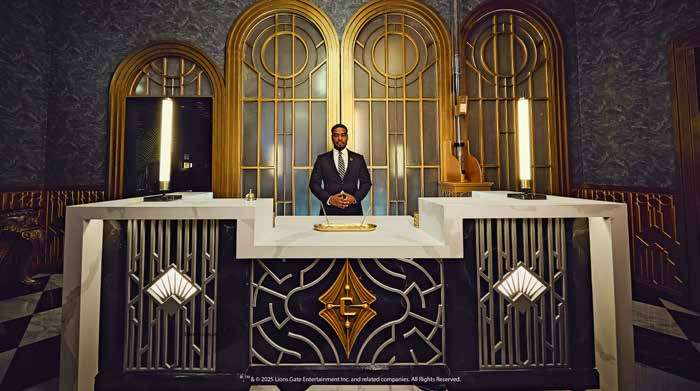
The Continental lobby reflects the style and aesthetics featured in the John Wick movies. Photo courtesy of Lionsgate

Around the same time, Lionsgate began developing an experience at AREA15 based on the John Wick franchise. With Egan’s relationship with Lionsgate stretching back to the early Fright Dome days, continuing with SAW Escape in 2018, and followed by Blair Witch, he was a natural choice for the project’s producer role.

The project marked Egan’s first major installation in the action genre. The creative process was also different, featuring a three-way collaboration with Lionsgate and AREA15. It wasn’t a standard licensing deal, with the collaboration involving everyone from early concept through execution. “We knew the standards would be incredibly high, but we were ready for the challenge,” Egan said.

Concepting the John Wick Las Vegas Continental

In the world of John Wick, The Continental is a neutral-ground hotel that serves the criminal underworld, operating under strict rules that prohibit violence on the premises. The New York location, managed by Winston Scott and concierge Charon in the films, provides specialized services to its exclusive clientele through a gold-coin currency system.

“Interactors” play a critical role in bringing the JOHN WICK EXPERIENCE to life. Photo courtesy of Lionsgate.

Lionsgate wanted to create a Las Vegas branch of The Continental with its own identity – distinct from the New York location – while remaining authentic to the brand. “To bear the John Wick name, it was necessary for the attraction to be an authentic and compelling action-packed experience,” a Lionsgate spokesperson explains. “Everything from the world needed to come to life in a credible and captivating way.”

As with his previous work redefining local haunted attractions and escape rooms, Egan saw an opportunity with the JOHN WICK EXPERIENCE to incorporate trends from the themed entertainment industry and build on the format of his previous experiences. For example, Escape IT lacks a space that offered drinks, food, and VIP experiences along with a place where guests could reflect on the experience.

The solution centered on one of The Continental’s defining features: its hotel bar, which operates as a public space where anyone can visit without purchasing the experience ticket. There is also a second bar, the Unseen Bar, a hidden speakeasy that serves as the exit point for guests completing the experience. The bars contribute to the themed environment, increase dwell time before and after the core attraction, create additional revenue sources through beverage sales, and give guests space to linger in the themed environment.

The John Wick Las Vegas Continental’s design offers several strategic benefits:

  • Extended dwell time: The two-bar structure encourages guests to extend their stay well beyond the core attraction, which takes 45-60 minutes.
  • Integrated amenities: Both bars and retail spaces are tied directly to the narrative rather than functioning as separate add-ons, maintaining immersion throughout the visit.
  • High-quality live performances: Bar staff are interactors who maintain character while also serving drinks.
  • Tiered packages: While the core attraction experience remains the same, the additional bars create the opportunity for customized packages, offering guests various bonus experiences that also increase per capita revenue potential.
The guest experience

Upon arrival, guests check in at the concierge desk and, depending on the package they purchased, may receive a gold coin. Guests can redeem their coin for a drink, enjoy the John Wick Las Vegas Continental Bar’s atmosphere, and interact with staff. The concierge, bartenders, and other staff provide background on the John Wick Las Vegas Continental’s rules, The High Table’s authority, and the world guests are about to enter. This pre-experience time allows guests unfamiliar with the films to understand the stakes before the action begins.

JOHN WICK EXPERIENCE provides high levels of interactivity in a roughly one-hour experience. Photo courtesy of Lionsgate

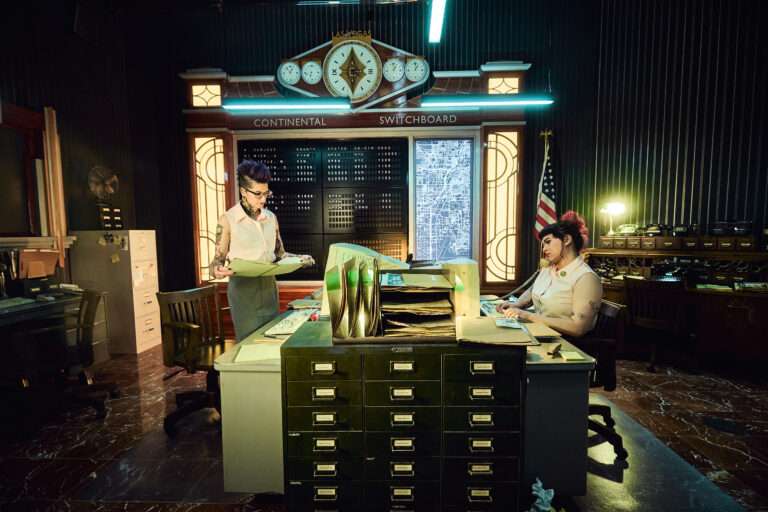
When called, guests board an elevator simulator that transports them inside the world of John Wick. They then find themselves in the Switchboard room where contracts and bounties are posted. Guests speak to interactors assuming the role of accountants about current bounties when suddenly the switchboard comes to life.

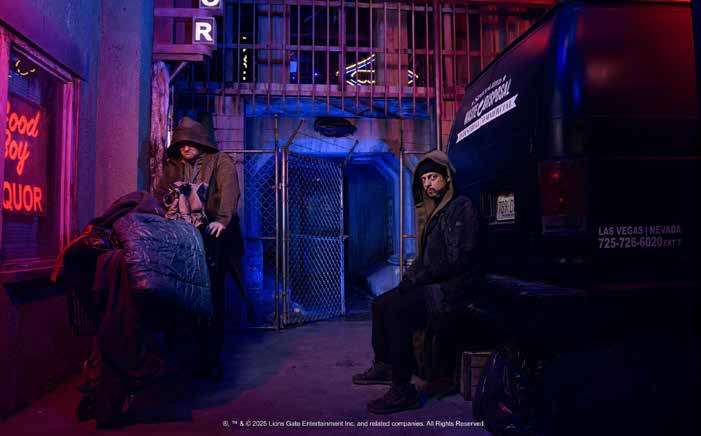
The experience guides guests through themed environments inspired by the world of John Wick, where they collect items and complete tasks to aid their escape. For example, guests engage in training and meet with a tailor to inquire about bulletproof garments. Each space incorporates interactive elements and show sequences that advance the escape narrative.

The journey concludes in the Unseen Bar, a speakeasy-style space hidden from public view. The bar maintains the John Wick aesthetic and offers specialty cocktails, temporary tattoos mimicking the films’ iconography, and occasional live performances. Guests can remain in the space as long as they wish.

To maintain the high level of interactivity, the experience uses a controlled entry system. Groups of twelve enter every ten minutes, with VIP options available for private group experiences. “Smaller groups allow us to maintain intimacy and ensure every guest can actively participate,” Egan explains. This approach prioritizes engagement over throughput, allowing guests to meaningfully interact with the environment rather than moving through as passive observers.

Recognition and what’s next

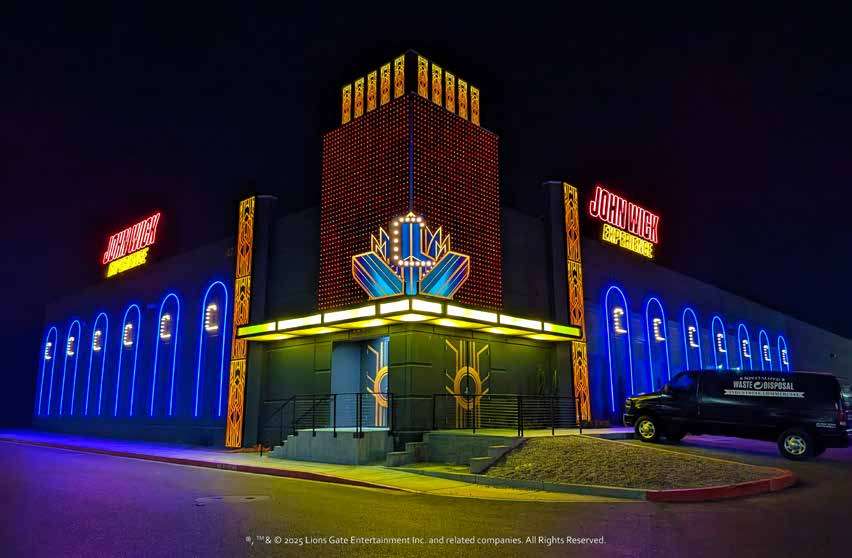
The JOHN WICK EXPERIENCE opened in March 2025 and currently maintains a 4.9 rating on Google with over 2,600 reviews. According to a Lionsgate spokesperson, “Fan love and guest reviews are our greatest success metrics.” Industry insiders have noticed as well. Recently, the attraction was honored with a TEA Thea Award.

The Thea Award validates more than the commercial success of the attraction. For Lionsgate, it recognizes the further expansion of a billion-dollar film franchise into location-based entertainment. For AREA15, it confirms their model of drawing guests off-strip for high-quality immersive experiences.

For Egan, the award represents the culmination of a strategic approach developed over two decades. Each time, he developed solutions that raised industry standards while building sustainable business models.

His portfolio now spans horror (Escape IT), action (JOHN WICK EXPERIENCE), and hospitality-entertainment hybrids (Odyssey Manor at AREA15). He operates six attractions, with more in development, including family entertainment ventures soon to be announced.

The formula is tried and true: identify gaps in growing markets, execute experiences that address those shortfalls, and build collaborations with studios seeking to extend their IP into physical spaces. As the location-based entertainment industry continues to evolve, Jason Egan remains at the intersection of market demand and untapped opportunity. •

Enjoying Xcaret

by Martin Palicki

Xcaret is being honored by the Themed Entertainment Association with the Thea Classic Award. InPark Magazine has been writing about the park (and Groupo Xcaret’s other properties) since 2014. We’ve assembled an “Xcerpt” on Xcaret based on IPM’s coverage over the past 12y ears.

If you haven’t had the opportunity to explore these parks, it’s well worth it. Perhaps the perfect time will be during the IAAPA Honors event being held there this May, 2026.

–M.P.

In 1986, when Mexican architect Miguel Quintana Pali purchased 12 acres of property south of Playa del Carmen in Quintana Roo, Mexico, his initial plan was to create an oceanside retreat for his family. While clearing the land, however, he discovered the site was full of cenotes (large sinkholes) and underground rivers, and the land was likely once inhabited by Mayans, the region’s native population from over 2,000 years ago.

He felt the location was special enough to be turned into a destination attraction and partnered with the Constandse brothers (Oscar, Marcos and Carlos) to help develop the property into a public attraction.

In December of 1990 the group opened Xcaret park (pronounced ESH-car-ett, meaning “little inlet”). The park combines natural landscapes with local customs and art influenced by both Mayan and modern Mexican traditions.

Xcaret is somewhat difficult to define. It’s not quite a traditional theme park, nor is it a zoo. It’s exploration-based and highly connected with the natural environment. The core experience centers around the park’s three underground rivers. Armed with snorkel gear and life vests, guests float or swim down the winding rivers, which oftentimes lead to dark caverns and seemingly endless pits. The rivers are a common feature of the peninsula and remain unenhanced, allowing their natural beauty to shine.

Scattered around the park are ancient ruins, natural animal habitats, and a variety of man-made attractions. The pinnacle of the park’s entertainment offering comes in the form of the nightly show “Xcaret México Espectacular.” Housed in a giant theatrical arena, the two-hour production features over 300 performers guiding guests through Mexican history and folklore. The production feels akin to an Olympics opening ceremony, conveying a sense of pride in and admiration for the country of Mexico. •

Since its founding, Grupo Xcaret has become a major force in the Riviera Maya tourism market. The company now operates a variety of parks and experiences. Here are some highlights:

Xel ha – The company acquired this natural park in 1995. It features all-inclusive service, snorkeling and water activities. In 2017, the park added a lighthouse-themed waterslide tower.

Xplor – Opened in 2009, this adventure park features zip lines, amphibious vehicles, swimming and rowing in underground rivers. The park also operates an evening version of the activities called “Xplor Fuego.”

Xichen – Starting in 2010, the group started offering tours to archeological and cultural sites in the Yucatan. In 2013, they added a tour devoted to visiting regional cenotes.

Xoximilco – In 2013, Xoximilco opened as a tribute to the traditional Xochimilco of Mexico City. Guests board colorful themed boats and cruise through canals while enjoying Mexican cuisine, drinks and live music.

Xenses – Xenses opened in 2016, offering more than 17 different activities that challenge the power of the senses and the mind.

Xavage – In 2019, the company debuted Xavage, an extreme thrill park whose activities amp up the adventure level offered to guests with whitewater rafting, off-road vehicle courses, a ropes course, and more. The park is currently closed for remodeling.

Dronisos appoints Jeremy Pancoast as VP, U.S. Business Development

Dronisos, provider of large-scale aerial drone storytelling, announced the appointment of Jeremy Pancoast as Vice President, U.S. Business Development. 

Pancoast brings more than two decades of executive leadership across the themed entertainment and live experience industries, having held senior roles with organizations including Merlin Entertainments Group (LEGOLAND Resorts North America) and United Parks & Resorts (SeaWorld & Busch Gardens). 

Throughout his career, he has led complex, multi-disciplinary entertainment divisions across major destination brands and IP-driven experiences, consistently bridging creative vision, operational excellence, and commercial performance. 

In his new role, Pancoast will lead Dronisos’ U.S. growth strategy, focusing on client partnerships, strategic market development, and the integration of motion-controlled entertainment technologies across destination-based and live environments. His background as both executive producer and operator positions him uniquely to support partners in identifying where technology can elevate storytelling while remaining scalable, safe, and operationally sound.

“Jeremy’s experience sits at the intersection of creativity, technology, and disciplined execution,” said Laurent Perchais, CEO Dronisos. “Dronisos has earned its reputation through the precision and reliability of its aerial drone productions, powered by our proprietary ORUS platform. As we extend this orchestrated motion control architecture across complementary storytelling systems, Jeremy strengthens our ability to build long-term partnerships and support ambitious, large-scale projects.”

Pancoast added, “I’m honored to join Dronisos at such a dynamic moment of innovative growth and business expansion. What excites me most is the company’s ability to combine high-quality, reliable aerial drone productions with a scalable technology ecosystem that can adapt to each partner’s vision. Whether supporting a single signature show or orchestrating multi-platform motion systems across air, water, and kinetic environments, Dronisos provides solutions that allow clients to grow at the pace that best serve their creative and operational objectives.”

Gateway Ticketing adds Eric Fluet and Chad Wallace

0

Gateway Ticketing Systems, a global provider of ticketing, admission control, and revenue management solutions for the attractions industry for more than 35 years, announced the appointments of Eric Fluet as Vice President of Marketing and Chad Wallace as Director of Sales, effective February 23 and March 2, respectively.

Fluet brings more than 30 years of experience in the amusement and attractions industry, including senior marketing roles with Six Flags and Madame Tussauds. Throughout his career, he has led initiatives focused on attendance growth, brand strategy, and revenue performance across destination-driven entertainment organizations. 

In 2017, Fluet founded Get It Done Marketing, a strategic consulting firm serving the greater amusement industry, specifically amusement parks, waterparks, family entertainment centers, hotels, campgrounds, and industry suppliers. He partnered with more than 50 organizations to develop short- and long-term marketing strategies, strengthen team performance, and implement disciplined, data-informed marketing programs designed to drive measurable growth.

Fluet is known for combining strategic planning with hands-on execution. His experience at both the corporate and property levels gives him a clear understanding of the operational and competitive demands facing destination attractions.

As Vice President of Marketing, Fluet will lead Gateway’s global marketing strategy, overseeing brand development, communications, and demand generation as the company continues to expand its footprint in the attractions technology sector.

Wallace brings more than 30 years of sales experience in the attractions industry, including roles at Nutmeg and, most recently, at Digonex. He has partnered with attractions across North America and internationally to implement ticketing, pricing, and guest-engagement solutions, focusing on practical, revenue-driven strategies that drive attendance, optimize yield, and enhance the visitor experience.

As Director of Sales, Wallace will lead Gateway’s sales initiatives, focusing on strengthening customer relationships, expanding market presence, and delivering measurable value to attractions worldwide.

“Eric and Chad bring complementary strengths that will help us better serve attractions around the world and continue delivering long-term value to our clients,” said Michael Andre, President and CEO of Gateway Ticketing Systems. “Eric understands the pressures our customers face because he’s lived them, and Chad has a rare ability to connect strategy to real operational results. Beyond their experience, they share our commitment to partnership and long-term success. I’m genuinely excited to welcome them to the Gateway leadership team and confident they will make an immediate impact for our customers around the world.”

Gateway employs more than 150 professionals across the United States, the United Kingdom, and Canada, including software developers, technical experts, IT resources, project managers, customer service representatives, and other professionals.